With Ultralytics YOLO models, MarineSitu automated wildlife detection around marine energy systems, achieved more than 96% uptime, and reduced daily footage reviews to just an hour or two.
Monitoring underwater environments and marine energy systems isn’t easy, but it’s essential for understanding how this infrastructure interacts with the surrounding ecosystem and ensuring it operates safely without harming wildlife. Traditionally, researchers have had to manually sift through hours of underwater footage, a task made even harder by murky conditions, strong currents, and inconsistent visibility.
MarineSitu helps researchers and organizations monitor and understand underwater environments using high-resolution cameras, computer vision, imaging sonars, environmental sensors, and machine-learning models. For instance, using Ultralytics YOLO models, their systems can identify and track wildlife as it moves around tidal turbines and other marine energy infrastructure.
Smarter marine monitoring through AI innovation#
Founded in 2016, MarineSitu originated from research at the Pacific Marine Energy Center (PMEC) and the University of Washington’s Applied Physics Lab (APL). Today, they work with organizations such as the U.S. Department of Energy and the U.S. National Oceanic and Atmospheric Administration.
Through platforms like SaltySuite™, MarineSitu integrates its purpose-built hardware systems, including cameras, sonars, and hydrophones, with AI-powered detection models to monitor and analyze complex underwater environments. In particular, by applying computer vision tasks such as object detection (locating and identifying individual animals or objects within an image), image classification (assigning a label to an entire image based on its contents), and object tracking (following detected objects across consecutive frames to analyze their movement), MarineSitu provides real-time insights that support marine energy, fisheries, and environmental research.
Why underwater monitoring is harder than it looks#
Monitoring marine environments is far more challenging than observing conditions on land. Visibility can drop without warning, strong currents shift equipment, and marine growth can quickly obscure cameras and sensors. Conditions can change from hour to hour, making consistent data collection difficult.
For researchers and energy operators, this creates a major bottleneck. Projects can generate hundreds of terabytes of video, sonar, and acoustic data, which makes manual review slow and impractical.
Remote ocean sites face additional hurdles, such as limited bandwidth, making it difficult to send large video files to the cloud. This increases operational costs and introduces data security concerns.
To solve these challenges, MarineSitu uses an edge AI approach that processes data directly on underwater hardware rather than relying on cloud transfers. This enables real-time detection of wildlife and environmental events, reduces the amount of data researchers need to review, and keeps monitoring reliable even in low-bandwidth, unpredictable ocean conditions.
Real-time underwater detection using Ultralytics YOLO models#
MarineSitu deploys its monitoring systems around demanding underwater infrastructure, including tidal turbines, ports, research installations, and long-term environmental observatories, to capture how marine life interacts with these structures. Their Adaptable Monitoring Package (AMP) integrates high-resolution optical cameras, imaging sonars, hydrophones, LED lighting, and antifouling systems that keep lenses and sensors clear for months at a time.
To interpret the continuous stream of multimodal data, MarineSitu uses custom-trained Ultralytics YOLO models to analyze video footage in real time. These models detect and track marine species as they move through areas such as a turbine’s field of influence, automatically flagging important events and aligning them with the associated sonar and acoustic recordings.
For instance, when a jellyfish drifts near the turbine, instance segmentation supported by Ultralytics YOLO models like Ultralytics YOLOv8 and Ultralytics YOLO11 can capture its full outline in the image. This ensures that wildlife interactions are captured with full contextual detail instead of being buried within hours of uneventful footage.
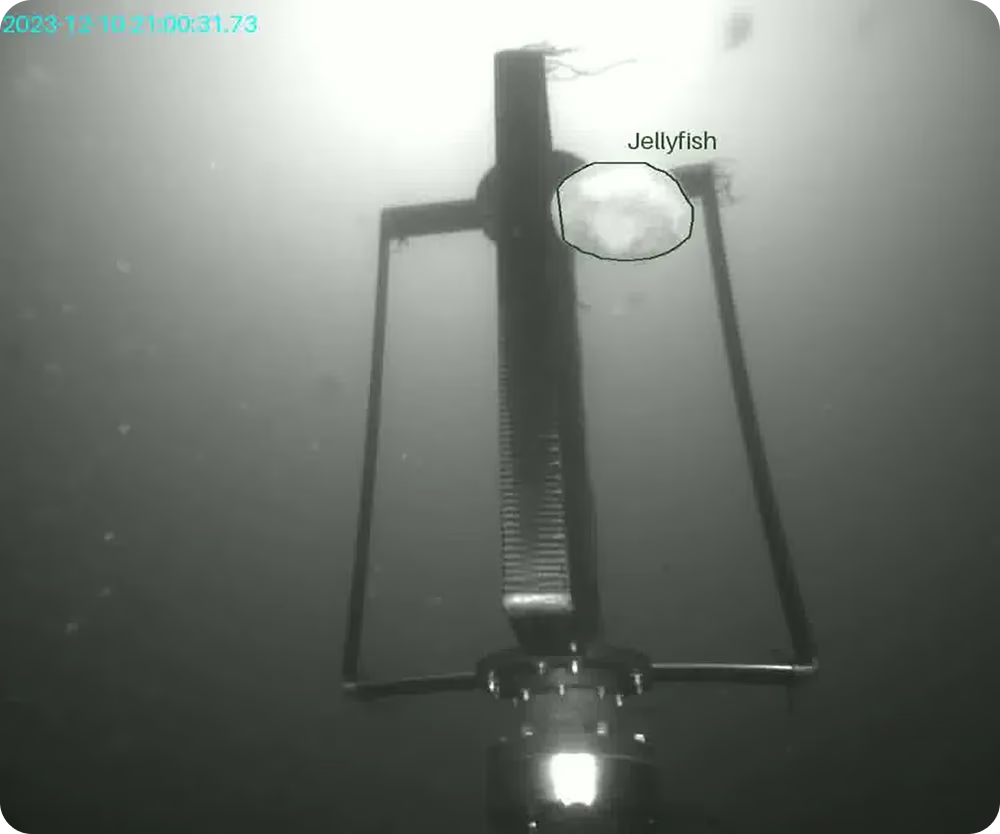
Fig 1. An example of using Ultralytics YOLO models to detect and segment jellyfish.
Why choose Ultralytics YOLO models?#
Ultralytics YOLO models give MarineSitu the speed and accuracy required for real-time detection in complex underwater environments. Models such as YOLOv8 and YOLO11 run efficiently on their edge systems and can be exported to formats like TensorRT.
MarineSitu and Ultralytics YOLO monitoring achieves 96% uptime#
MarineSitu’s use of Ultralytics YOLO models has enabled reliable, real-time wildlife monitoring during long-term deployments in tricky ocean conditions.
In one 141-day deployment in the Pacific Northwest, the MarineSitu Adaptable Monitoring Package, or AMP, maintained over 96% uptime despite strong currents, low visibility, and constant biofouling pressure. Antifouling systems kept camera ports, lights, and imaging sonars clear the entire time, ensuring consistent high-quality data.
With YOLO running continuously on the system, researchers could follow seals, fish, and other species as they moved around the turbine. Automated object detection and event filtering drastically reduced manual review time. According to PNNL and UW-APL researchers, reviewing YOLO-flagged events often took only an hour or two each day, compared to the time-consuming process of scanning through unfiltered footage.
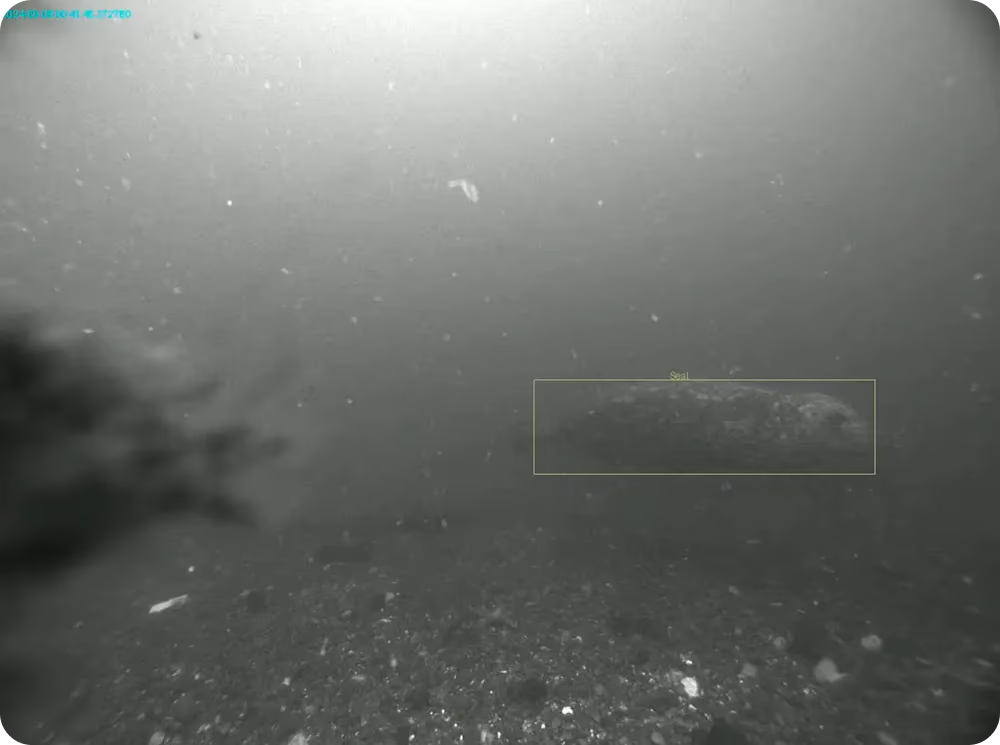
Fig 2. Detecting a seal using an Ultralytics YOLO model.
By pairing durable hardware with multimodal sensing and real-time computer vision, MarineSitu delivered a complete and contextual view of wildlife interactions, something that would have been extremely difficult to achieve through manual review alone. This level of reliability and efficiency is helping accelerate environmental assessments for tidal energy projects and raising the standard for marine monitoring systems.
Scaling real-time marine intelligence#
MarineSitu is continuing to extend its real-time computer vision capabilities across a wide range of underwater settings. Beyond tidal turbines, their Ultralytics YOLO–powered systems are being used to monitor wildlife in ports, support coral reef research, observe fish behavior around scientific installations, and collect long-term environmental data at remote ocean sites.
With YOLO models at the core of their detection pipeline, MarineSitu is focusing on improving species recognition, strengthening edge-based AI processing, and bringing automated monitoring to more locations where conventional methods are difficult or costly. They aim to make underwater monitoring more efficient and accessible while giving researchers clearer, faster insights into how marine ecosystems interact with human activity.
Curious about AI? Check out our licensing options to bring Vision AI to your projects. Visit our GitHub repository to learn more. Explore computer vision in robotics and AI in the automotive industry on our solution pages.








