Tracking golf balls using Ultralytics YOLO models
Discover how Ultralytics YOLO models and computer vision can be used to track golf balls in real time, supporting instant feedback, key stats, and better training.

Golf is reaching more people than ever. In 2024, an estimated 138 million people in the U.S. engaged with the sport in some way, and 47.2 million actually played golf, either on a course or through off-course options like driving ranges and simulators.
As participation and interest continue to climb, golfers are increasingly expecting better tools for practice, feedback, and performance tracking. This is because golfing is often more entertaining when there are clear game insights.

Fig 1. Millions of people play golf worldwide.
Let’s say you hit a drive, a long shot from the tee, and you want to know exactly how the ball flew, where it landed, and whether it curved left or right. That’s where cutting-edge ball tracking and analytics can make a difference.
At the core of these ball tracking systems is computer vision, a branch of artificial intelligence (AI) that processes visual data. Computer vision systems use high-speed cameras and deep learning models, such as Ultralytics YOLO11 and the upcoming Ultralytics YOLO26, to detect and track ball movement in real time.
Once the ball is detected and tracked frame by frame, its positions can be used to map flight, predict landing, and estimate details like speed, launch angle, and spin. The result is instant feedback for better practice, coaching, and viewing.
In this article, we’ll explore how computer vision and Ultralytics YOLO models can be used for golf ball tracking. Let’s get started!
Types of golf ball tracking technologies#
Before we dive into computer vision for golf ball tracking, let’s quickly look at a few other ways golf balls are tracked.
One method is by using smart golf balls. Smart golf balls are hardware devices equipped with internal sensors, Bluetooth connectivity, RFID tags, and even GPS-based location systems.
These features allow precise tracking and performance monitoring. But they also come with trade-offs, including limited battery life, durability challenges, and concerns about whether smart golf balls feel like standard golf balls.
Beyond smart balls, external tracking systems are also becoming popular. For instance, radar-based launch monitors and high-speed optical camera setups can capture detailed data on ball flight, trajectory, and spin with high accuracy, providing key insights for golfers at all levels.
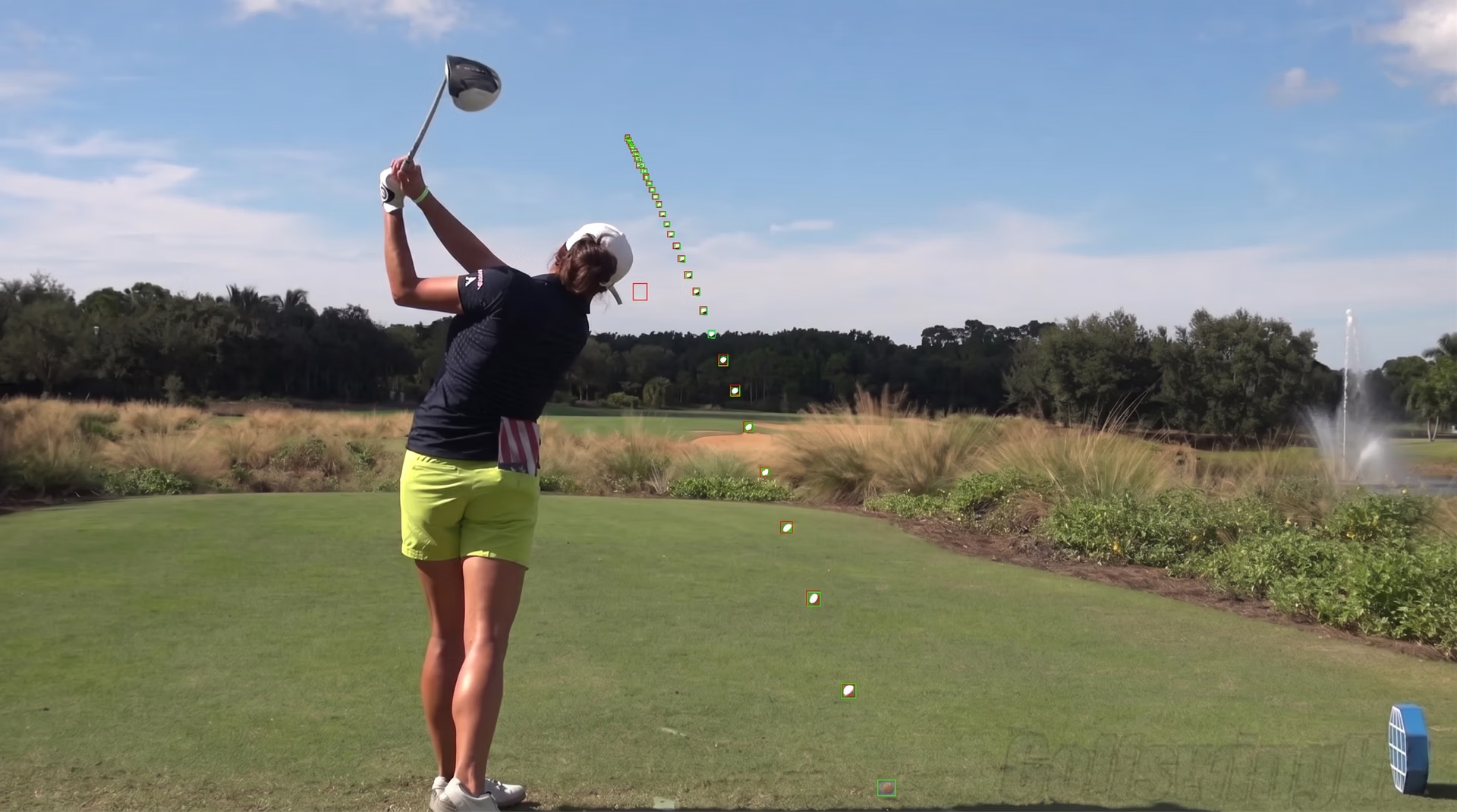
Fig 2. An example of tracking a golf ball. (Source)
Integrating Vision AI into golf analytics#
Computer vision is another great example of external tracking. In particular, models like YOLO11 and the upcoming YOLO26 support computer vision tasks such as object detection, pose estimation, instance segmentation, and object tracking. Together, these capabilities make it easier to spot the ball, follow it frame by frame, trace shots automatically, and generate useful performance insights from standard camera footage.
Such insights can also plug into larger connected ecosystems, including mobile apps, Garmin wearables (like GPS watches that track rounds and shots), and golf simulator platforms. This makes it simple for golfers to save data, review performance over time, and access insights across multiple devices.
Another reason these methods are popular is that they work with the balls golfers already trust. Many systems are compatible with premium golf brands like Titleist Pro V1, Callaway, TaylorMade, and Srixon, and they work well with standard high-performance urethane balls. That way, players can get advanced tracking without switching equipment.
How to use Ultralytics YOLO models for golf ball tracking#
Ultralytics YOLO models are available as pre-trained computer vision models, trained on popular datasets like COCO, so that they can detect various everyday objects, such as people, cars, bicycles, and animals, out of the box. This makes them a good starting point for a wide range of real-world applications.
However, they can also be custom-trained on your own data, which is especially important for golf ball tracking, where the target is small, fast, and easy to miss. If you want to train an Ultralytics YOLO model to detect and track golf balls, the first step is to collect or find a relevant dataset.
This usually involves videos or images of golf shots where the ball is labeled in each frame. The model can then be fine-tuned to learn to detect the ball reliably across different lighting conditions, backgrounds, and camera angles.
The training process is streamlined by the Ultralytics Python package, which provides simple tools for data loading, model training, validation, and deployment. Once trained, the model can detect golf balls frame by frame in new videos.
It’s important to keep in mind that the YOLO model itself doesn't track objects over time. Instead, tracking is enabled by the Ultralytics Python package, which combines YOLO’s detections with multi-object tracking algorithms such as BoT-SORT and ByteTrack.
These trackers use motion prediction, often based on Kalman filters (a mathematical model that predicts an object’s next position using past motion and noisy measurements), to estimate where the ball should appear next and maintain a consistent ID across frames. With this setup, the system can follow the ball as it moves, briefly overlaps with other objects, leaves the frame, and reappears later.
Turning detections into stable trajectories#
You might be wondering how detecting and tracking a golf ball helps drive more accurate analytics. Simply put, it’s like connecting the dots.
Each detection is one dot, and tracking links them into a smooth path that shows how the ball moved through the air. Once you have that ball trajectory, you can estimate key shot details like speed, launch angle, shot shape, and where the ball is likely to land.
For instance, in a recent study on physics-guided 3D tracking of fast-moving small objects, researchers paired an Ultralytics YOLOv8 detector with a physics-based tracking model. Ultralytics YOLOv8 was used for object detection to locate the ball in each frame, while the motion model predicted where it would appear next. This helped the system stay on track through motion blur, brief occlusions, and missed detections.
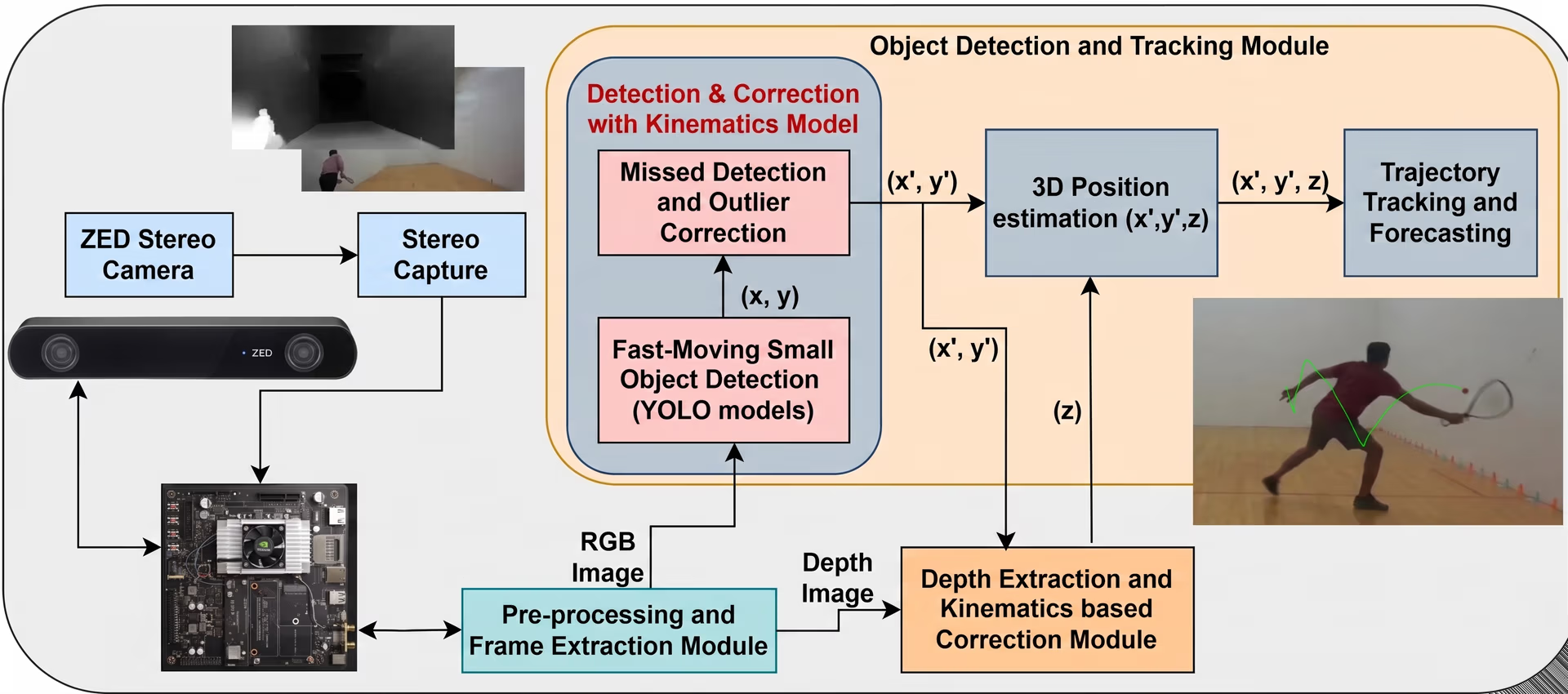
Fig 3. A system that uses YOLO models and 3D tracking to track small objects. (Source)
A key advantage of such systems is that what once required professional gear is now available to everyday golfers, with shots visualized in real time on smartphones, wearables, and simulator screens for instant feedback. These insights apply to every shot, from drives to putts, helping golfers spot patterns, compare golf clubs, and improve faster.
Pros and cons of using computer vision-enabled golf ball trackers#
Now that we have a better understanding of how computer vision enables golf ball tracking, here’s a closer look at some of its advantages:
- Real-time feedback: These systems provide instant data on ball flight, trajectory, and landing location, allowing golfers to make immediate adjustments to their swing and shot strategy.
- Fewer lost balls: By tracking the ball continuously, golfers spend less time searching for lost balls, which improves the overall pace of play on the golf course, practice range, or fairway.
- Universal compatibility: Since vision AI systems track the ball using cameras rather than sensors inside it, they typically work with standard golf balls, including premium models like Titleist Pro V1, Callaway, TaylorMade, and Srixon.
Even with these benefits, computer vision–based golf ball tracking has a few limitations to keep in mind. Here are a couple of factors to consider:
- Dependence on clear visibility: These systems require unobstructed camera views and stable lighting; shadows, glare, or obstructions can reduce detection accuracy.
- Challenges with long or fast shots: Extremely long drives or very high ball speeds can sometimes exit the camera frame, making tracking less reliable.
- Regulatory restrictions: Certain computer-vision tracking systems may be restricted under USGA and PGA Tour competition rules, limiting their use in official tournaments.
The future of smart golf ball tracking#
Golf ball tracking is moving fast, driven by better models, better sensors, and faster on-device processing. Newer architectures, such as the upcoming Ultralytics YOLO26, build on earlier models with accuracy improvements and more efficient inference, which can make real-time detection more practical on edge devices used at ranges, simulators, and training setups.
At the same time, tracking systems are becoming more complete by combining computer vision with radar-based launch monitors, pairing camera-based ball flight with richer club and impact data. As these tools spread into driving ranges and mobile apps, more golfers can access instant feedback without changing the ball they play.
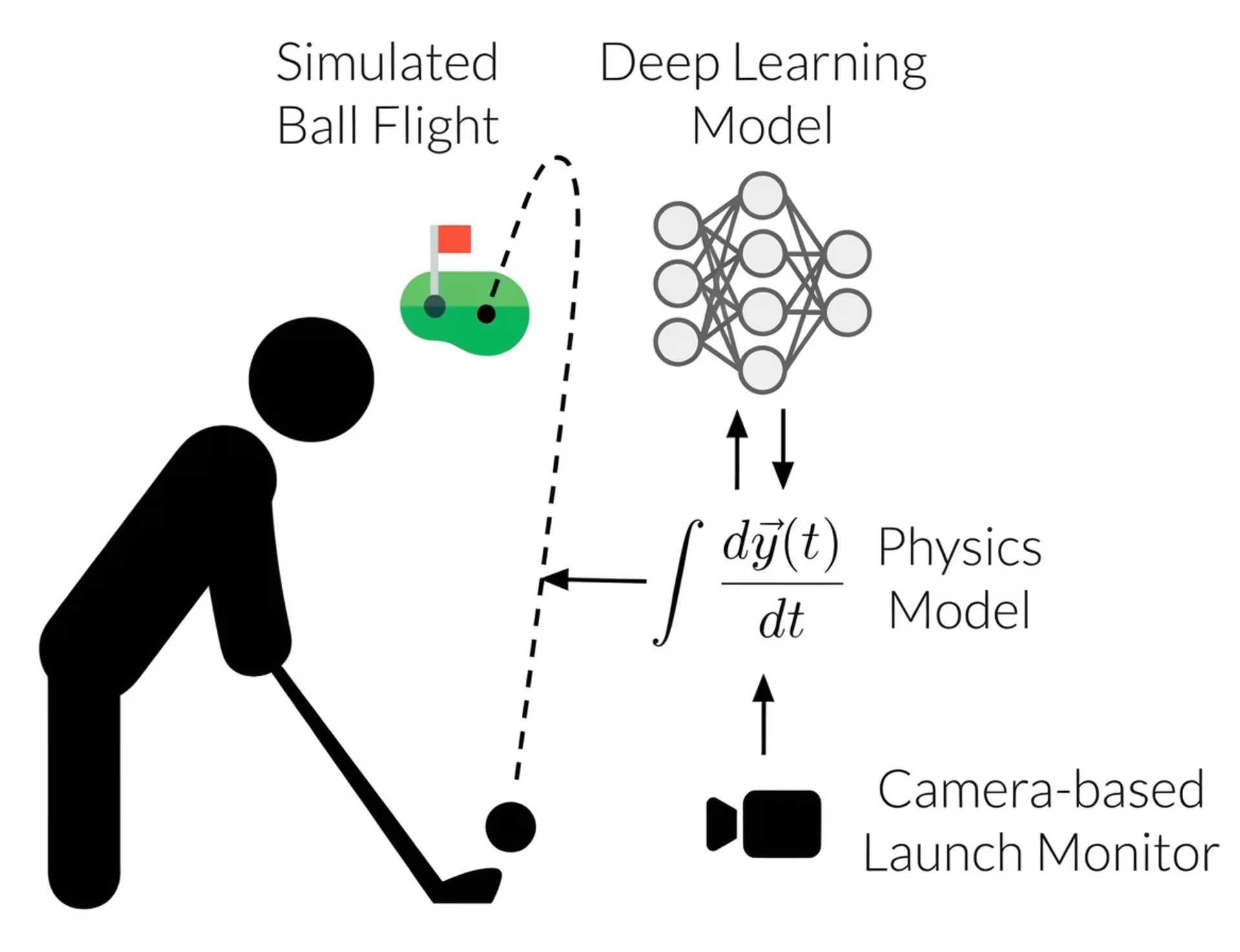
Fig 4. A look at a deep-learning golf ball flight model using launch monitor data. (Source)
It’s likely that AI-enabled insights will continue to support more parts of golf, from training and coaching to on-course decision-making. As tracking and shot tracer systems get smarter, golfers can expect more automated analysis, more personalized recommendations, and practice tools enhanced with augmented reality (AR) overlays.
Key takeaways#
Ultralytics YOLO models and computer vision are changing how golf balls are tracked. They can produce accurate trajectories and deliver real-time feedback with useful performance insights. As these tools connect with radar systems and cell phones, advanced shot analysis is becoming easier for more golfers to use.
Curious about AI? Check out our active community and discover innovations like AI in manufacturing and Vision AI in retail. Visit our GitHub repository and get started with computer vision today by checking out our licensing options.








