
Glacier integrated Ultralytics YOLO11 into both its robotic sorting systems and facility analytics platform, achieving significant improvements in classification accuracy and reducing the data correction overhead that had slowed model iteration.
Recycling waste is more complicated than it looks. In a materials recovery facility (MRF), single-stream waste arrives unsorted, and the job of separating it into usable commodity streams falls to a combination of automated equipment, optical sorters, and human sorters working in fast-moving, often chaotic conditions. The margins for error are narrow: a bale of aluminum contaminated with the wrong materials loses value, and valuable commodities that slip through unrecovered go to landfill.
Glacier was founded to make this process more reliable and more efficient. Based in San Francisco and recognized by Fast Company as the number one most innovative company in robotics and engineering, Glacier builds AI-powered robotic sorting systems and facility analytics tools for Material Recycling Facilities (MRFs). Its robots are installed directly on conveyor belts, using computer vision to identify and sort materials in real time. Its analytics platform gives facility operators visibility into what is moving through their lines and where problems are occurring.
Ultralytics YOLO11 sits at the core of both products, handling the detection and classification that makes real-time sorting and continuous monitoring possible.
Bringing computer vision to the recycling floor#
Glacier's robotic sorting system is built around a top-down camera mounted directly over the conveyor belt on a scaffold, positioned to capture every object passing beneath it. As materials move along the belt, the camera captures each object from above, giving the system a consistent, unobstructed view regardless of object shape or orientation.
Ultralytics YOLO11 processes this feed in real time, detecting and classifying each object as it passes. The model outputs a bounding box and a class label for every detected item, identifying whether it is, for example, an aluminum can, a milk jug, a cardboard box, or a plastic film. That classification, combined with a velocity estimate based on the belt speed, allows Glacier's system to calculate where each object will be when the robot arm reaches it, typically under one second after detection.
The robot arm, equipped with suction cups, then picks the object from the belt and deposits it into the appropriate receptacle based on its class. The entire loop (detect, classify, predict position, pick) runs continuously as material flows through the facility, with the camera giving the system two to three frames per object before it moves out of range.
In parallel, the same camera data can feed Glacier's analytics platform. Images are uploaded to the cloud, where YOLO11 runs inference to count objects by type over time. Facility operators can also install analytics cameras independently, without a robot, if they want visibility into a line without automated sorting. Either way, the output is a continuous stream of structured data about what is moving through the facility.
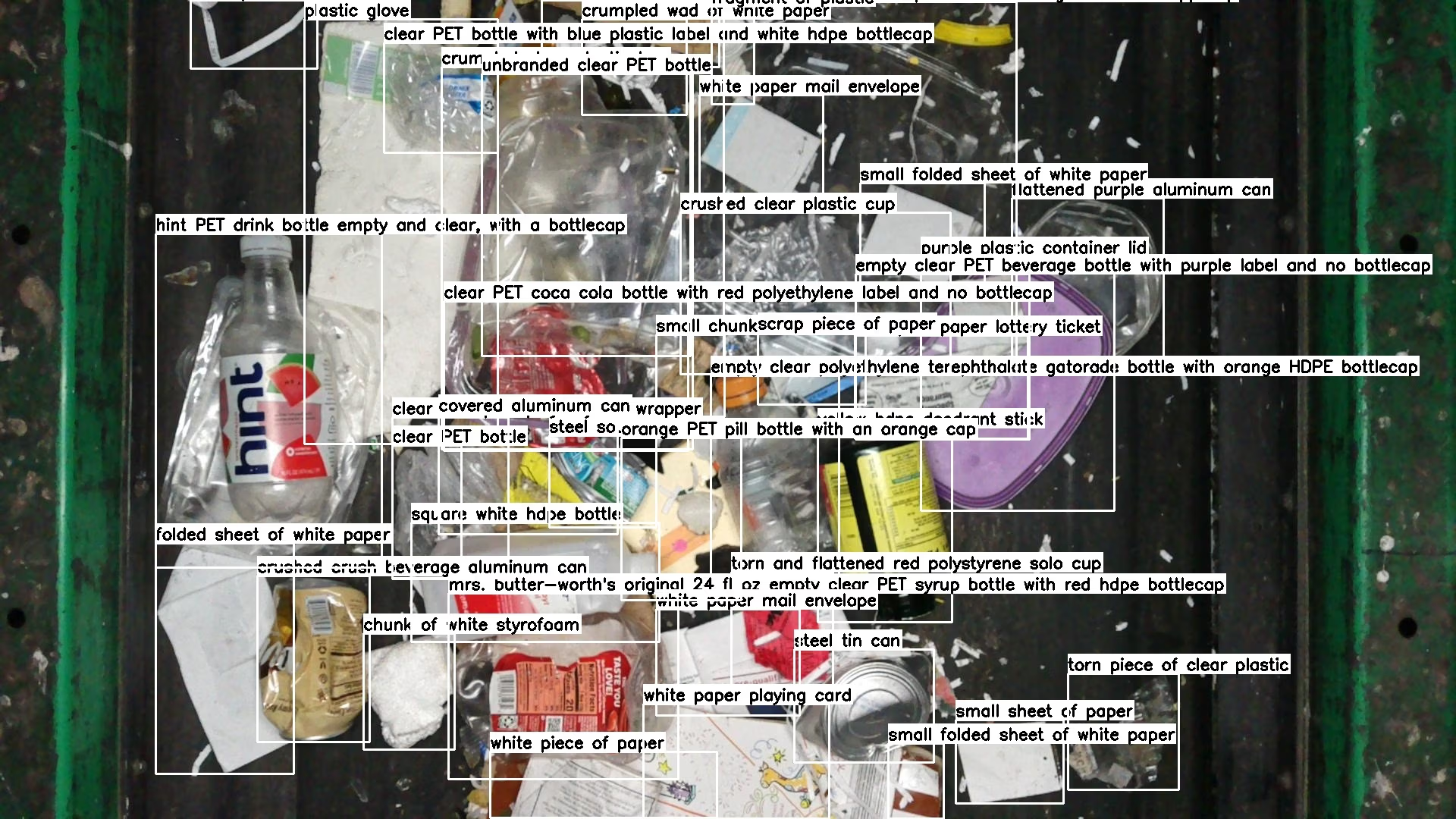
Fig. 1. Ultralytics YOLO11 in action at a recycling facility, enabling real-time waste detection and streamlining material sorting for improved recycling efficiency.
The challenge of classifying heterogeneous materials#
Object detection on a recycling conveyor belt is a harder challenge than it might appear. Often, belts are running at speeds that reach more than 200 feet per minute, where materials are often overlapping, partially obscured, wet, dirty, or deformed. Lighting conditions vary. Objects within the same material category can look radically different from one another, such as a laundry detergent bottle, a soap dispenser, and a milk jug, which are all number two plastic, but they share very little visual similarity.
As Glacier deployed their technology across dozens of MRFs nationally, they required a more rigorous level of accuracy to improve performance on complex, visually heterogeneous material categories, allowing them to scale more efficiently. The heterogeneity, coupled with the speed and the scope, ultimately led Glacier to outgrow the previous open-source detector model as improving model generalization across sites became increasingly important for Glacier’s growing deployment footprint.
Ultralytics YOLO as the solution#
As Glacier scales, deploying Ultralytics YOLO11 has played a significant role in their mission to improve and optimize their solutions across the board. YOLO11 is used across two distinct deployment environments, each with different performance requirements.
- On the edge: Each Glacier robot runs YOLO11 locally for real-time robotic sorting on a dedicated GPU, processing the camera feed in real time. Inference latency is low enough to support the pick timing calculation, allowing the system to know where an object will be in under a second, which means detection and classification are completed well within that window.
- In the cloud: For the analytics platform, images captured at the facility are uploaded to AWS, where YOLO11 runs inference to generate object counts over time. Because this pipeline is not time-critical in the same way as robotic sorting, it runs in the cloud rather than on edge hardware, allowing Glacier to process historical data and surface insights to facility operators through dashboards and reports.
Switching to YOLO11 produced clear improvements in areas where the previous model had struggled most. Classification accuracy improved across heterogeneous categories, particularly number two plastics, giving Glacier a more reliable foundation for deploying a shared model across multiple customer sites without per-site fine-tuning. Bounding box precision also improved, which changed how Glacier's team used model outputs during data review: rather than flagging things the model had misunderstood, the model's disagreements with training labels more consistently pointed to genuine annotation errors that needed fixing. That shift made the data improvement process faster and more targeted.
Why choose Ultralytics YOLO models?#
For Glacier, the decision to move from DETR to Ultralytics YOLO came down to classification performance on the specific material classes like number 2 plastics that MRF operators need to track and recover reliably. YOLO11 handled those categories more consistently, which was the critical factor.
The improvement in bounding box quality was a secondary but meaningful benefit. Precise bounding boxes make the data review and annotation process more efficient, allowing the team to trust that when the model disagrees with a label, it is more likely pointing to a real error in the data than to a model failure. The Ultralytics Python package also gave Glacier's engineers a straightforward way to train, fine-tune, deploy, and maintain models across both their edge and cloud environments. The flexibility to run the same model family across GPU-equipped edge hardware and AWS inference pipelines, without rebuilding the underlying detection code, was a practical advantage as Glacier's deployment footprint has grown.
Giving MRF operators visibility into their facilities#
Beyond sorting, Glacier's analytics platform addresses a problem that is fundamental to how recycling facilities operate: In a large MRF with multiple conveyor lines running simultaneously, it may be challenging for operators to know what is happening across the whole facility at any given time. Problems on one line may not be visible from another, and by the time an issue becomes obvious, it may have already affected hours of throughput.
Glacier's analytics give operators a continuous, structured view of object flow at the line level. Some of the insights this enables:
- Burden depth monitoring. Tracking how many objects are passing through a section of line at a given time, and flagging when depth is unusually high or low.
- Contaminant detection. Alerting operators when the proportion of unwanted materials on a line rises above normal - often a signal that something has gone wrong upstream.
- Equipment failure signals. A sudden increase in a specific material type - aluminum cans, for example - can indicate that an optical sorter has stopped working and is no longer diverting those items as expected.
- Operational pattern analysis. Understanding how material composition changes across shifts, days of the week, or seasons - and how events like public holidays affect what arrives at the facility.
The analytics are more powerful when cameras are installed at multiple points in the facility, because the ability to correlate counts from different locations makes it possible to trace where specific materials are being lost or recovered across the full sorting process.
Real-world results across US recycling facilities#
Glacier's deployments across materials recovery facilities in the United States have produced measurable results across both robotic sorting and analytics use cases.
- Michigan MRF (Residue Line): 15M PET bottles recovered, $138K in new revenue. Glacier's AI dashboard identified PET leakage on the residue line. The MRF used that visibility to justify installing an upstream PET sorter, which delivered a 70% reduction in PET leakage and a 10-month payback period, recovering 15 million PET bottles and generating $138,000 in new commodity revenue.
- California MRF (Fiber Line): +17% paper purity. A three-robot deployment on the fiber line improved sort quality and paper purity downstream of an optical sorter, with robots achieving 95% uptime across the deployment.
- Indiana MRF (Residue Line): 500,000+ lbs of PET recovered. Glacier's AI flagged recyclables leaking into the residue stream. Operators used the insights to redirect material and justify upstream equipment investments, with PET and HDPE identified in real time and additional commodity revenue unlocked.
Making recycling more reliable with computer vision#
Glacier is building the tools that make recycling a more predictable, measurable, and efficient process. By combining robotic sorting with facility-wide analytics, it gives MRF operators both the automation to recover more material and the visibility to understand what is happening across their lines.
Ultralytics YOLO11 provides the detection and classification foundation that both products depend on - accurate enough to handle the visual complexity of real recycling streams, fast enough to support real-time robotic picking, and flexible enough to run across both edge hardware and cloud inference pipelines. As Glacier continues to expand across facilities in the United States, Ultralytics YOLO remains at the core of its computer vision stack.
Curious about vision AI? Discover our licensing options to build your computer vision solutions today. Visit our GitHub repository and join our community.








