Meet YOLO26: next-gen vision AI.
Ultralytics
Back to customer stories
Food & BeverageIndustrial quality control

RapiD Engineering deploys seafood quality control 1 week faster with Ultralytics YOLO

RapiD Engineering deploys seafood quality control 1 week faster with Ultralytics YOLO logo

See how RapiD Engineering uses Ultralytics YOLO to automate salmon inspection, detect defects in real time, and save a week of engineering work.

RapiD Engineering deploys seafood quality control 1 week faster with Ultralytics YOLO

Problem

Quality control in salmon processing has traditionally relied on manual visual inspection, making it slow, inconsistent, and difficult to standardize across suppliers, farms, and batches.

Solution

RapiD Vision, a plug-and-play vision system powered by Ultralytics YOLO models, detects defect and deformities in real-time, feeding insights directly into customer's ERP systems and reducing engineering time by 1 week.

As food processing companies face increasing pressure to deliver consistent quality at scale, computer vision is reshaping how the industry operates. RapiD Engineering, a Netherlands-based engineering company headquartered in the fishing village of Urk, is at the forefront of this shift, building RapiD Vision, a plug-and-play vision platform designed for the seafood industry and beyond.

By integrating Ultralytics YOLO models into its quality control systems, RapiD Engineering helps automate quality control with salmon processors, automating defect and deformity detection (one of the most labor-intensive and subjective steps in their workflow), with full traceability from farm to customer.

Link to this sectionBringing plug-and-play vision AI to industrial production#

RapiD Engineering develops engineering simulations, software applications, and computer vision solutions for industrial environments. Through its RapiD Vision platform, the company designs end-to-end systems built around three core capabilities: Pick & Place applications for robot-controlled product handling, Quality Control for real-time defect detection, and RapiD Vision Explorer, a cloud-based reporting and analytics layer that integrates directly with ERP systems.

The platform is designed for complex, real-world conditions, capable of handling overlapping products using 3D vision/cameras, distinguishing between product types, and orchestrating multiple robots or machines from a single vision system. Among its product lines, Quality Control has become the company's fastest-growing offering, attracting strong demand from salmon processors across Europe.
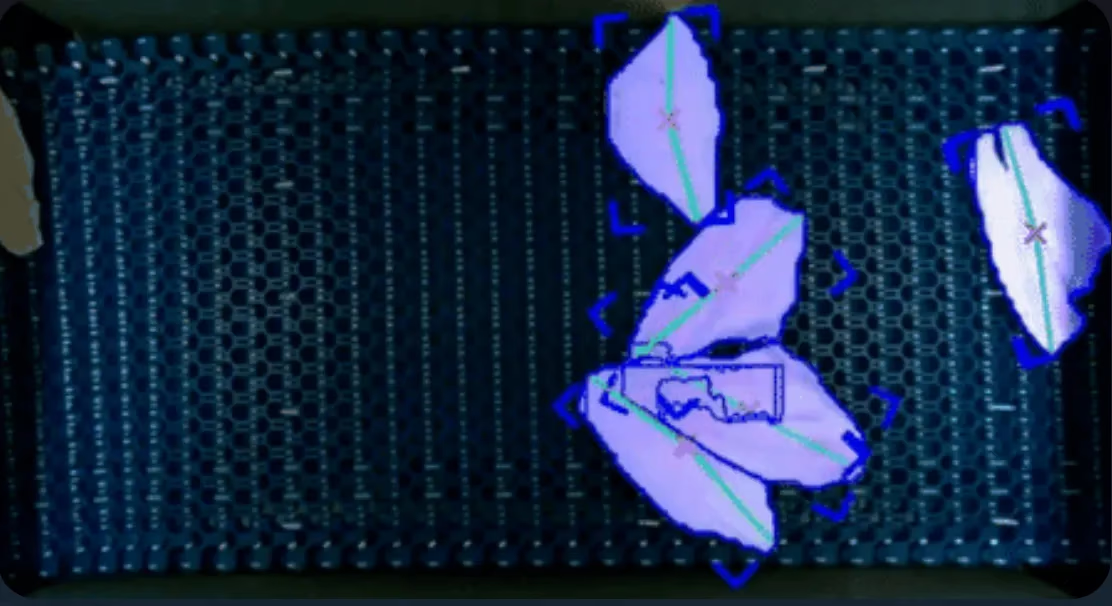
Fig 1. Overlapping fish being detected precisely by Ultralytics YOLO Fig 1. Example of overlapping fish being detected precisely by Ultralytics YOLO.

Link to this sectionThe challenges of quality control in salmon processing#

Salmon processing is a high-volume, high-precision industry where quality issues can have a significant impact on customer satisfaction and pricing. Defects like blood spots, melanin marks, and other deformities are subtle and visually similar to the natural color of salmon flesh, making them difficult to spot consistently with the human eye.

Traditional manual inspection is slow, fatiguing, and inconsistent across operators and shifts. Even when computer vision became more accessible, deploying it in food processing environments brought its own challenges. Models needed to be small enough to run in real-time on edge hardware, accurate enough to detect subtle defects, and flexible enough to be retrained quickly when new cameras, lighting conditions, or environments were introduced.

Before adopting Ultralytics, RapiD Engineering relied on Detectron, an open-source library from Meta. While powerful, it was difficult to set up, hard to export models from, and was no longer actively maintained, making it unsuitable for long-term production use.

Link to this sectionReal-time defect detection with Ultralytics YOLO#

After moving to Ultralytics, RapiD Engineering rebuilt its quality control pipeline around YOLO models running on NVIDIA Jetson edge hardware. Each salmon processing system runs four Ultralytics YOLO models simultaneously, with one top-mounted and one bottom-mounted camera capturing both sides of every fish as it passes through the line.

For each side, the system runs two models in sequence: An Ultralytics YOLO11 nano model to segment the salmon from the conveyor, followed by a large YOLO11 model to detect fine-grained deformities like blood spots and melanin marks, where color differences from the surrounding flesh can be extremely subtle. By using a smaller model for high-throughput segmentation and a larger model for high-precision detection, RapiD Engineering achieves the right balance of speed and accuracy on Jetson hardware.

To train its models, RapiD Engineering manually annotated more than 20,000 images of salmon, building a high-quality dataset that handles the visual nuances of real-world processing conditions. The team re-trains models when deploying new systems or when environmental factors like cameras or backgrounds change.

Link to this sectionWhy choose Ultralytics YOLO models?#

For RapiD Engineering, Ultralytics YOLO offered the ideal combination of simplicity, performance, and flexibility to support a production system running across multiple deployments.

Compared to its previous framework, the team was able to dramatically reduce time spent on training, exporting, and maintaining models, saving around a week of engineering time per year just on the export workflow. With every new Ultralytics release, models can be retrained, exported to TensorRT for Jetson deployment, and pushed back into production with minimal friction.
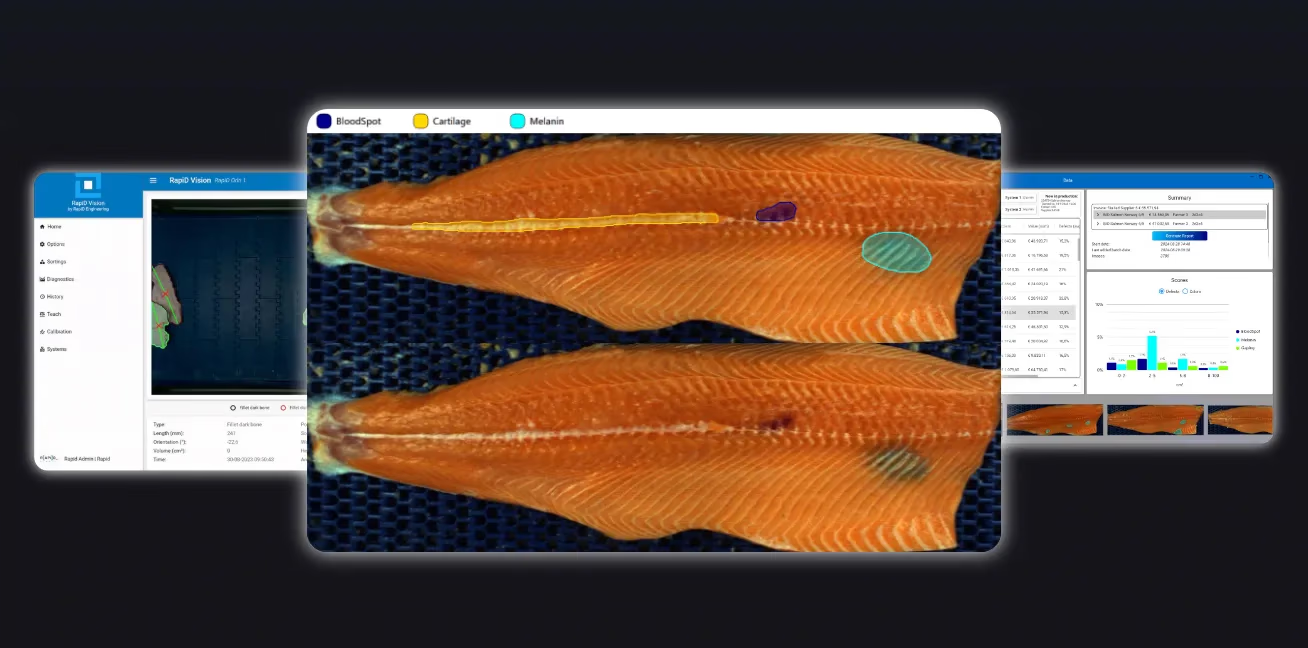
Fig 2.Defects on salmon fillet being detected with Ultralytics YOLO Fig 2. Example of defects on salmon fillet being detected with Ultralytics YOLO.

Ultralytics YOLO also gave RapiD Engineering the flexibility to use multiple task types, including instance segmentation, object detection, and pose estimation, all from the same unified framework, supporting current and future product features as the company expands its vision AI portfolio.

Link to this sectionFrom raw detection to actionable insights#

Beyond detection, RapiD Engineering's quality control system is fully integrated with its customers' ERP systems through RapiD Vision Explorer, the platform's cloud-based reporting and analytics layer. Every salmon analyzed is logged in the cloud alongside its supplier, farm, location, and order data, giving customers a detailed view of quality performance by source.

This data is used to generate per-batch quality reports, helping processors track which farmers and suppliers consistently deliver the highest-quality fish, and to make informed sourcing decisions over time. Through advanced analytics, RapiD Vision Explorer can even predict the best current sources for high-quality products. The system also controls downstream conveyor belts, automatically routing lower-quality salmon to alternative processing paths so that customers always receive fish that match their quality specifications.

Front-end software allows operators to fine-tune detection thresholds, including minimum spot size, confidence scores, and total affected area, ensuring the system can be adapted to each processor's specific quality criteria.

Link to this sectionScaling vision AI across the seafood industry#

With strong demand for its quality control systems and a growing customer base across Europe, RapiD Engineering is well-positioned to keep expanding the role of vision AI in seafood processing and beyond. The company is also planning to migrate its training and annotation workflows to Ultralytics Platform, further streamlining its pipeline as it scales across new deployments.

By combining decades of engineering expertise with cutting-edge computer vision, RapiD Engineering is helping salmon processors build a more transparent, data-driven, and efficient supply chain, one batch at a time.

Interested in building Vision AI solutions of your own? Explore Ultralytics YOLO models, learn how YOLO is driving innovations across industries, and check out our licensing options to get started.

Our solution to your industry

Real-time AI that works with your team

AI in Robotics

Power smarter machines with Ultralytics YOLO models. Vision AI in robotics drives autonomous navigation, perception, object tracking, and real-time control.

Learn more
Real-time AI that works with your team

AI in Logistics

Streamline logistics with Ultralytics YOLO models. Vision AI enables package inspection, sorting, vehicle tracking, and real-time warehouse safety monitoring.

Learn more
Real-time AI that works with your team

AI in Retail

Reimagine retail with Ultralytics YOLO models. Vision AI powers inventory tracking, shelf monitoring, queue management, and smarter customer insights.

Learn more
Real-time AI that works with your team

AI in Healthcare

Build healthcare solutions with Ultralytics YOLO models. Vision AI in healthcare powers faster medical imaging, smarter diagnostics, and patient monitoring.

Learn more
Real-time AI that works with your team

AI in Manufacturing

Optimize manufacturing with Ultralytics YOLO models. Vision AI drives quality control, defect detection, PPE compliance, and assembly line automation.

Learn more
Real-time AI that works with your operation

AI in Automotive

Apply computer vision in automotive with Ultralytics YOLO models. Vision AI elevates road safety, driver assistance, and vehicle automation for smarter roads.

Learn more
Real-time AI tailored to your operation

AI in Agriculture

Bring vision AI to smart agriculture with Ultralytics YOLO models. Power crop monitoring, livestock tracking, and precision farming for higher, smarter yields.

Learn more
Real-time AI that works with your team

AI in Robotics

Power smarter machines with Ultralytics YOLO models. Vision AI in robotics drives autonomous navigation, perception, object tracking, and real-time control.

Learn more
Real-time AI that works with your team

AI in Logistics

Streamline logistics with Ultralytics YOLO models. Vision AI enables package inspection, sorting, vehicle tracking, and real-time warehouse safety monitoring.

Learn more
Real-time AI that works with your team

AI in Retail

Reimagine retail with Ultralytics YOLO models. Vision AI powers inventory tracking, shelf monitoring, queue management, and smarter customer insights.

Learn more
Real-time AI that works with your team

AI in Healthcare

Build healthcare solutions with Ultralytics YOLO models. Vision AI in healthcare powers faster medical imaging, smarter diagnostics, and patient monitoring.

Learn more
Real-time AI that works with your team

AI in Manufacturing

Optimize manufacturing with Ultralytics YOLO models. Vision AI drives quality control, defect detection, PPE compliance, and assembly line automation.

Learn more
Real-time AI that works with your operation

AI in Automotive

Apply computer vision in automotive with Ultralytics YOLO models. Vision AI elevates road safety, driver assistance, and vehicle automation for smarter roads.

Learn more
Real-time AI tailored to your operation

AI in Agriculture

Bring vision AI to smart agriculture with Ultralytics YOLO models. Power crop monitoring, livestock tracking, and precision farming for higher, smarter yields.

Learn more
Real-time AI that works with your team

AI in Robotics

Power smarter machines with Ultralytics YOLO models. Vision AI in robotics drives autonomous navigation, perception, object tracking, and real-time control.

Learn more
Real-time AI that works with your team

AI in Logistics

Streamline logistics with Ultralytics YOLO models. Vision AI enables package inspection, sorting, vehicle tracking, and real-time warehouse safety monitoring.

Learn more
Real-time AI that works with your team

AI in Retail

Reimagine retail with Ultralytics YOLO models. Vision AI powers inventory tracking, shelf monitoring, queue management, and smarter customer insights.

Learn more
Real-time AI that works with your team

AI in Healthcare

Build healthcare solutions with Ultralytics YOLO models. Vision AI in healthcare powers faster medical imaging, smarter diagnostics, and patient monitoring.

Learn more
Real-time AI that works with your team

AI in Manufacturing

Optimize manufacturing with Ultralytics YOLO models. Vision AI drives quality control, defect detection, PPE compliance, and assembly line automation.

Learn more
Real-time AI that works with your operation

AI in Automotive

Apply computer vision in automotive with Ultralytics YOLO models. Vision AI elevates road safety, driver assistance, and vehicle automation for smarter roads.

Learn more
Real-time AI tailored to your operation

AI in Agriculture

Bring vision AI to smart agriculture with Ultralytics YOLO models. Power crop monitoring, livestock tracking, and precision farming for higher, smarter yields.

Learn more

Frequently asked questions

  • Ultralytics YOLO repositories are distributed under the AGPL-3.0 License by default. This OSI-approved license is designed for students, researchers, and enthusiasts, promoting open collaboration and requiring that any software using AGPL-3.0 components also be open-sourced. While this ensures transparency and fosters innovation, it may not align with commercial use cases.

    If your project involves embedding Ultralytics software and AI models into commercial products or services and you wish to bypass the open-source requirements of AGPL-3.0, an Enterprise License is ideal.

    Benefits of the Enterprise License include:

    • Commercial flexibility: Modify and embed Ultralytics YOLO source code and models into proprietary products without adhering to the AGPL-3.0 requirement to open-source your project.
    • Proprietary development: Gain full freedom to develop and distribute commercial applications that include Ultralytics YOLO code and models.

    To ensure seamless integration and avoid AGPL-3.0 constraints, request an Ultralytics Enterprise License using the form provided. Our team will assist you in tailoring the license to your specific needs.

  • The model you choose depends on your project requirements, including performance, accuracy, deployment target, and hardware constraints. For most new projects, Ultralytics YOLO26 is the recommended starting point because it offers the latest improvements in speed, accuracy, exportability, and multi-task support.

    Earlier YOLO model families remain available for teams with existing workflows or compatibility requirements.

    If you are starting fresh, choose YOLO26 first, then benchmark smaller or larger variants to find the right balance of speed and accuracy for your deployment environment.

  • Ultralytics YOLO models are a family of computer vision models for tasks such as object detection, segmentation, classification, pose estimation, and oriented object detection. YOLO26 is the latest stable version and is recommended for most new projects. Earlier YOLO versions remain available for teams with existing workflows or compatibility requirements.

  • Ultralytics YOLO models are computer vision architectures developed to analyze visual data from images and video. These models can be trained for tasks including object detection, classification, pose estimation, tracking, instance segmentation, and oriented object detection.

    The latest Ultralytics YOLO model family is YOLO26, with earlier YOLO versions available for existing workflows.

Let's build the future of AI together!

Begin your journey with the future of machine learning






