Top 8 open source object tracking tools and algorithms
Explore 8 top open-source object tracking tools for real-time video analysis. See how each one works and how to choose the right fit for your project.
When a car runs a red light and an automated ticket is sent to the driver, or a soccer player dribbles down the field and the camera smoothly follows the play, AI is quietly working in the background. In particular, these systems rely on computer vision, a subfield of AI that enables machines to see, interpret, and understand visual information from the world.
Within computer vision, one of the key tasks behind these applications is object tracking. It is used to identify objects in each frame of a video and then follow those objects as they move, overlap with others, or change direction.
There are many object tracking tools and algorithms available today, each designed for different use cases, performance needs, and levels of complexity. Some focus on speed and can track dozens of objects in real time, while others prioritize accuracy or long-term stability in challenging conditions like occlusion, fast motion, or low lighting.
Specifically, open-source projects have played a major role in advancing this field. Because their code is openly accessible, developers and researchers can study how they work, improve upon existing methods, and adapt them to new applications. This openness has helped object tracking evolve quickly and become easier to integrate into real-world systems.
In this article, we’ll explore eight popular open-source object tracking tools and algorithms. Let’s get started!
What is object tracking?#
Consider a scenario where a security guard is watching CCTV footage of a parking lot. He decides to keep an eye on one red car. As the video plays, he mentally tags that car and keeps tracking it wherever it goes, even when other cars pass by or people walk in front of it.
AI-powered object tracking is similar, but it operates automatically and at scale. In other words, object tracking is the process of following an object as it moves through the frames of a video and keeping its identity consistent from one frame to the next.
In many systems, this starts with object detection, which finds and labels objects like people, vehicles, or road signs in each frame. Then, as these objects move, appear, disappear, or overlap, the tracking system links the detections across frames so it knows which object is which and where each one goes over time.
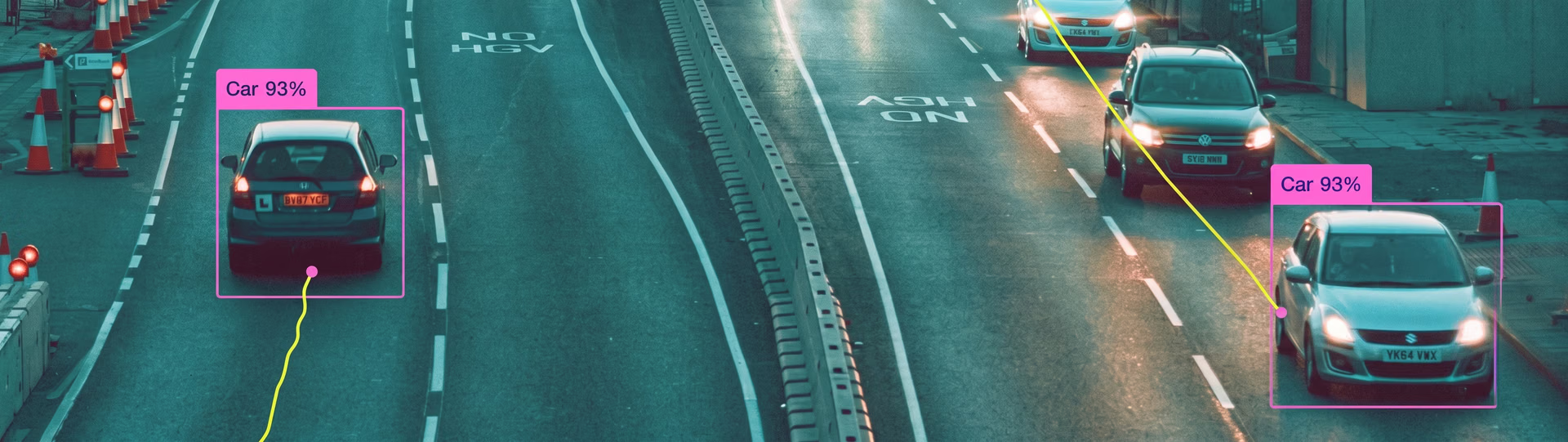
Fig 1. A look at object tracking (Source)
There are two common types of tracking: single object tracking (SOT), which focuses on one main object (like tracking just the ball in a sports video), and multi-object tracking (MOT), which follows many objects at once and assigns each one a unique ID (like tracking all the cars at a busy junction).
Regardless of the type of tracking, most systems rely on three core components: a detector to find objects in each frame, a motion model to predict how those objects are likely to move, and a matching step to connect new detections with previously tracked objects. These parts turn raw video into meaningful information about how objects move and interact over time.
The need for open-source object tracking tools#
Before we dive into the details, you might be wondering: what makes open-source object tracking tools and algorithms so special?
Open-source tools have played a big role in making object tracking easier to use and more widely available. Because the code is open, developers and researchers can see exactly how a tracker works, learn from it, and adapt it to their own projects instead of treating it like a black box.
They also benefit from strong communities. Many open-source tracking tools are maintained by active contributors who add new features, improve speed and accuracy, fix bugs, and keep the tools aligned with the latest research. This ongoing collaboration helps them stay reliable and useful across different applications.
Cost is another big reason they matter. Since open-source tools are free, students, startups, and small teams can experiment, prototype, and build real systems without worrying about license fees or subscription costs.
Top 8 open source object tracking tools and algorithms#
A wide variety of open-source options are available today for building tracking systems. Some are tracking algorithms or models you can plug directly into your pipeline, while others are libraries and frameworks that make it easier to run, manage, and integrate those models. Together, they cover everything from the core tracking logic to the surrounding tools you need in a real project.
Next, let’s take a look at eight popular open source object tracking tools and algorithms.
1. Ultralytics YOLO models and the Ultralytics Python package#
One of the easiest and most practical options for object tracking is using the Ultralytics YOLO models in combination with the Ultralytics Python package. Ultralytics YOLO models like Ultralytics YOLO11 and the upcoming Ultralytics YOLO26 are computer vision models that support a range of vision tasks, including object detection, instance segmentation, pose estimation, and object tracking.
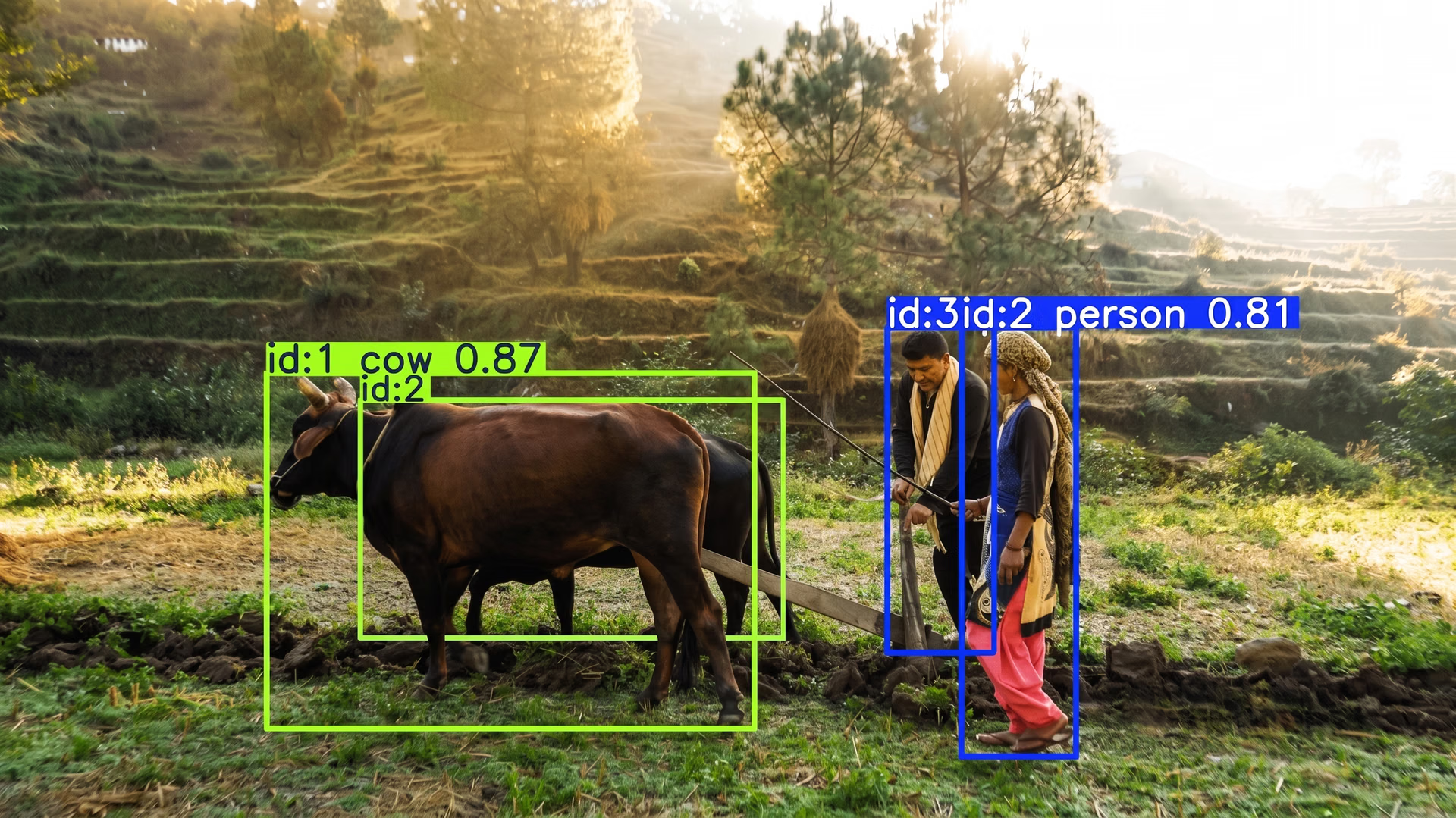
Fig 2. An example of using YOLO11 to detect and track objects. (Source)
Interestingly, the models themselves do not track objects across frames. Instead, the Ultralytics Python package, a library that simplifies running and deploying Ultralytics YOLO models, makes tracking possible by combining YOLO’s frame-by-frame detections with dedicated multi-object tracking algorithms such as BoT-SORT and ByteTrack.
With its built-in tracking capability, the Ultralytics package and Ultralytics YOLO models can be used to detect objects in each frame and then assign consistent IDs so they can be followed as they move, overlap, leave the frame, and re-enter later. This approach is increasingly being adopted in sectors like manufacturing and retail, enabling applications such as defect inspection workflows, inventory flow tracking, and in-store customer tracking.
2. OpenCV trackers#
OpenCV is a vast computer vision library that includes a collection of object tracking algorithms. This library has been developed and maintained by the OpenCV community since 1999.
Instead of relying on deep learning, most of these trackers use traditional computer vision methods such as correlation filters and kernel-based techniques (which follow an object by matching its visual appearance, like color and texture, from one frame to the next, rather than learning features using neural networks).
When using these algorithms, you can typically first select the object you want to track, and the tracker continuously searches for the most similar visual region in subsequent frames as the object moves.
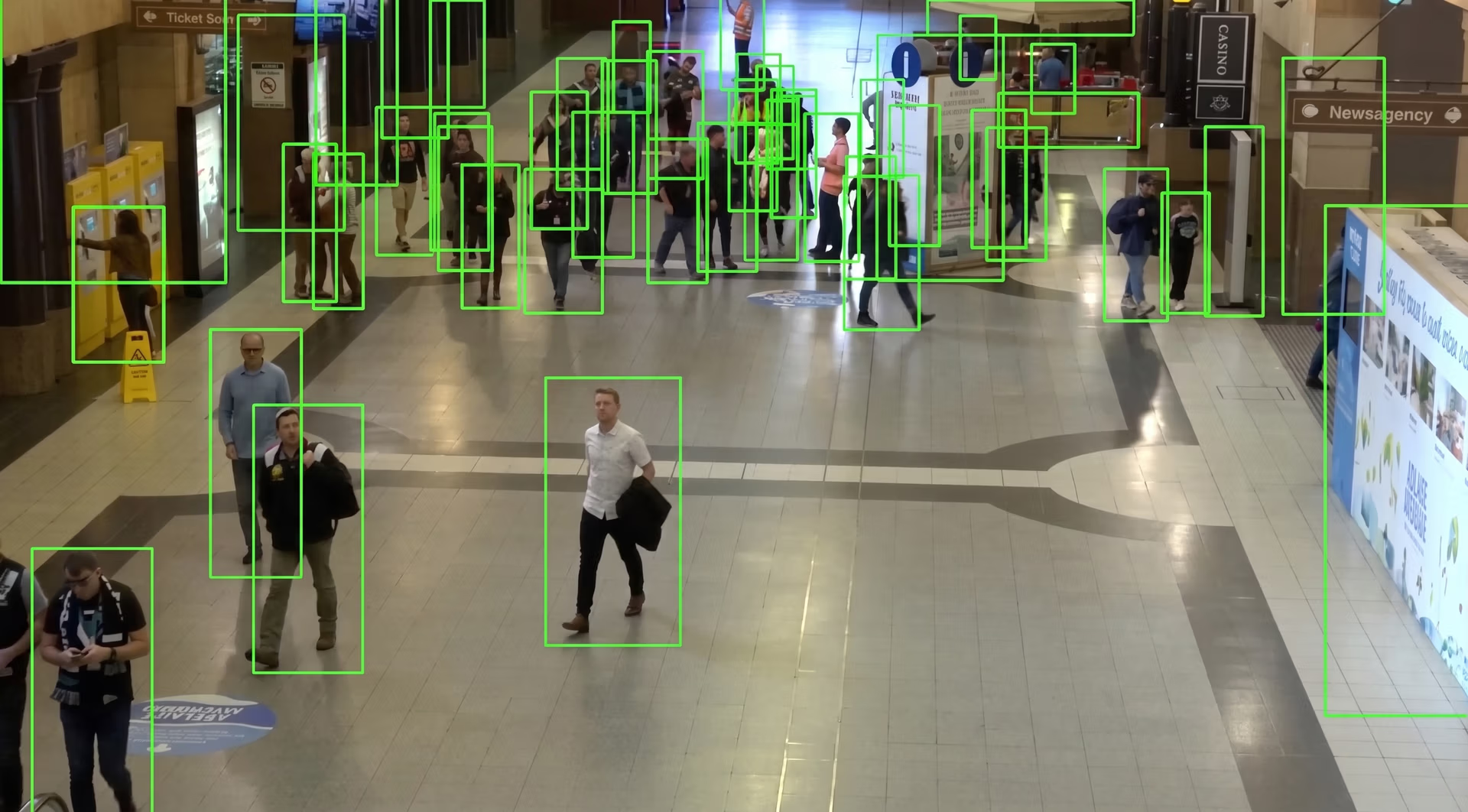
Fig 3. Tracking objects using OpenCV (Source)
While these methods may not be as robust as modern deep-learning-based tracking systems in complex or crowded scenes, they are still widely used because they are lightweight, fast, and easy to run. Also, because these trackers run efficiently on CPUs and usually don’t require a GPU, they work well for quick experiments, classroom learning, and hobby projects.
3. ByteTrack#
ByteTrack is one of the most popular open-source algorithms for multi-object tracking. Instead of matching only the detections the model is very sure about, it also makes use of lower-confidence detections that many systems normally ignore.
This helps it keep track of objects that are briefly hard to see, such as when they are partially blocked, far away, or moving quickly. Because it is fast and reliable, ByteTrack is commonly used in applications like traffic analysis, pedestrian tracking, and retail monitoring, where real-time performance and consistent IDs matter.
As mentioned earlier, if you are using Ultralytics YOLO models for detection, it is easy to enable ByteTrack through the Ultralytics Python package. But it can also be used independently in custom pipelines, making it suitable for everything from research prototypes to production systems written in C++.
4. DeepSORT#
Another widely used algorithm for multi-object tracking is DeepSORT, short for Deep Simple Online and Real-Time Tracking. It is an advanced version of SORT, which stands for Simple Online and Real-Time Tracking.
Similar to ByteTrack, SORT follows a tracking-by-detection approach. However, SORT relies on a Kalman filter, a mathematical model that estimates an object’s future position based on its past movement, to predict where each object is likely to move next.
It then matches new detections to existing tracks, mainly based on position and bounding-box overlap. This makes SORT fast and lightweight, but it can struggle when objects overlap, cross paths, or briefly disappear from view.
DeepSORT improves on SORT by adding appearance information to the tracking process. In addition to motion and position, it uses a deep learning–based re-identification or re-id model that learns how objects look. This allows the tracker to recognize the same object across frames, even when motion isn’t enough to distinguish it from others.
Because of this, DeepSORT is commonly used in applications like surveillance and crowd monitoring, where people frequently overlap or get briefly occluded. However, it is considered a classic baseline today, and newer tracking methods often achieve better performance in more challenging scenes.
5. Norfair#
Norfair is a lightweight tracking library designed to be flexible, rather than forcing you into a fixed tracking pipeline. It can add tracking on top of almost any detector, as long as the detector outputs can be represented as a set of points, such as bounding-box centers, keypoints, or custom coordinate data.
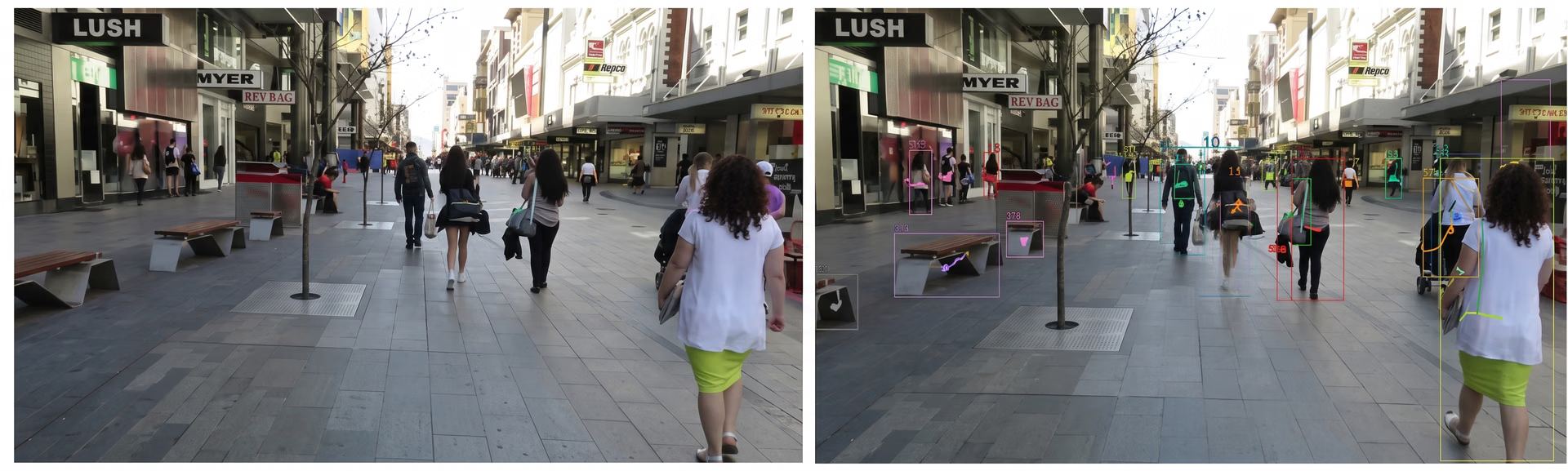
Fig 4. Real-world object tracking using Norfair (Source)
This flexibility makes it especially impactful for projects involving unusual inputs or dynamic movement patterns where standard multi-object tracking tools may fall short. The library also provides built-in distance functions to control how detections are matched across frames.
These distance functions measure how similar two points or objects are, giving users full control over the tracking logic. Norfair is often used in robotics, sports motion analysis, drone navigation, and applications that rely heavily on tracking pose landmarks or keypoints.
6. MMTracking#
MMTracking is an open-source tracking toolbox from the OpenMMLab team, which is also behind widely used computer vision libraries like MMDetection. Built on top of MMDetection, it provides a flexible framework for developing and experimenting with tracking systems.
One of its biggest strengths is its modular design. Instead of locking you into a single pipeline, MMTracking lets you configure and swap different components, such as detectors, tracking modules, and in some setups re-identification models. Because of this flexibility, it is especially popular in research and advanced projects where teams want to benchmark methods, test new ideas, or fine-tune tracking pipelines.
7. FairMOT#
FairMOT is a multiple-object tracking framework designed to track many objects at the same time. Unlike traditional tracking-by-detection pipelines that run detection first and then link objects across frames as a separate step, FairMOT learns detection and re-identification together in a single network.
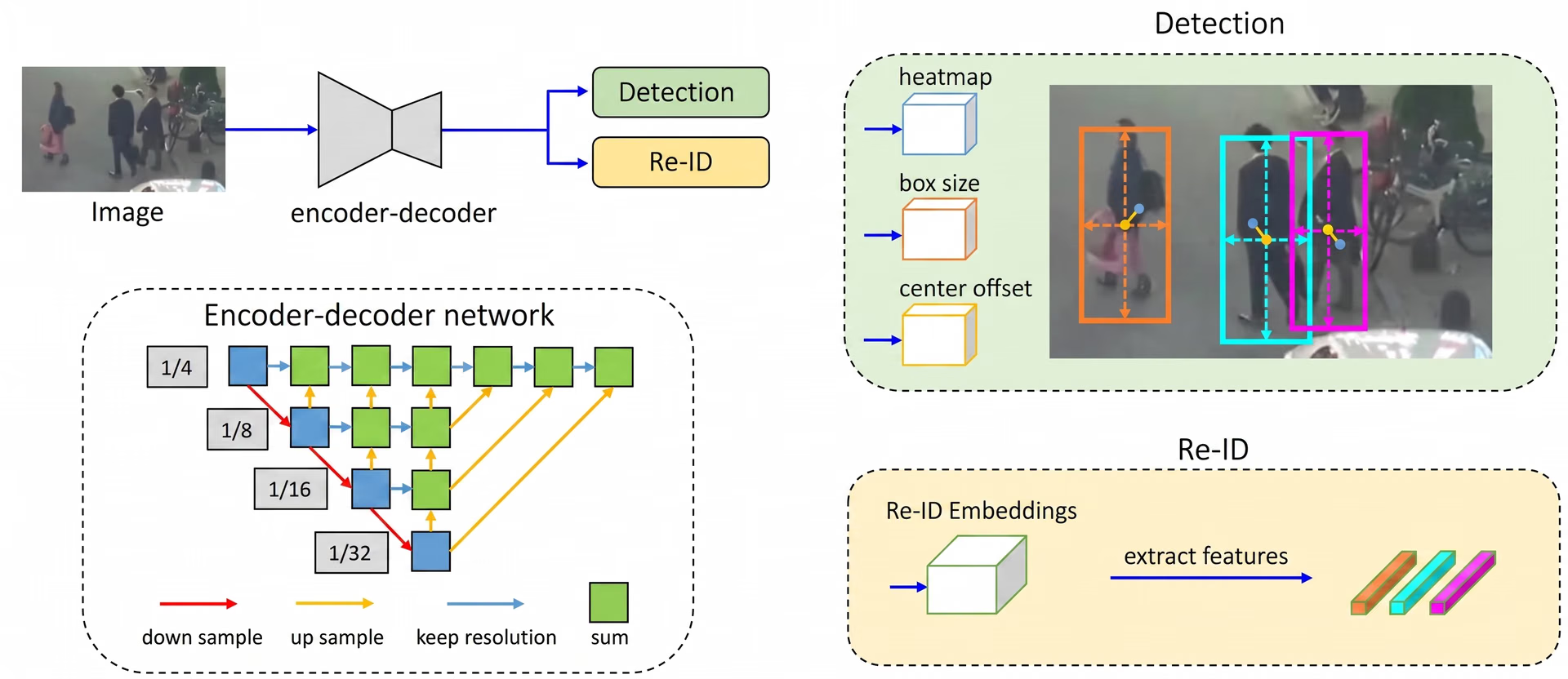
Fig 5. How the FairMOT framework works (Source)
This joint setup helps it maintain more consistent identities, especially in crowded scenes where people often overlap or move quickly. FairMOT is commonly used in scenarios like pedestrian tracking and crowd monitoring, and it is also applied in settings such as retail analytics and traffic monitoring, where tracking many targets in real time is important.
8. SiamMask#
SiamMask is a single-object tracking method that goes a step further than many trackers by producing a segmentation mask along with a bounding box. Simply put, it doesn't just draw a rectangle around the target. It also outlines the object’s shape at the pixel level, which can be helpful when the target changes shape, rotates, or becomes partly hidden.
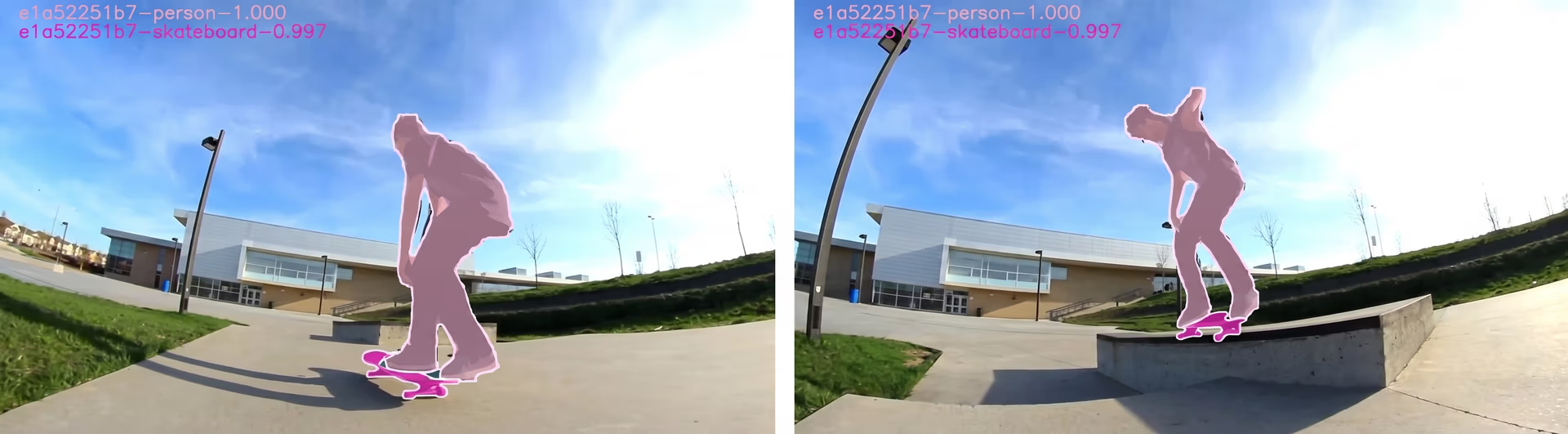
Fig 6. Tracking and segmenting an object using SiamMask (Source)
This approach uses a Siamese tracking design, which involves the tracker first taking a small reference view of the target from the first frame, often called a template. Then, in each new frame, it searches a larger region and finds the spot with the highest similarity to that template.
SiamMask builds on this matching-based idea. It also predicts a pixel-level mask for the target, so you get both the object’s location and a more precise outline as the video plays.
Key factors in choosing an object tracking tool#
With various options for open-source object tracking tools available in the AI space today, the best option for your computer vision project depends on what your specific use case requires. Here are some factors to consider:
- Accuracy: This is most significant in crowded or visually complex scenes, where the vision system needs to maintain stable IDs even during overlap, occlusion, or fast motion.
- Speed: For real-time applications like robotics, traffic monitoring, and sports analytics, responsiveness can matter more than perfect precision.
- Ease of integration: Some object tracking tools are easy to plug-and-play and work with just a few lines of code, while others require more setup, configuration, or custom pipeline work.
- Deployment constraints: The target environment, such as GPU servers, edge devices, or mobile hardware, can determine which tracking approach is practical.
- Scalability: If your system needs to track many objects at once or process multiple video streams, the tracker should scale efficiently without a large drop in performance.
Each object tracking tool or algorithm serves a different purpose. Ultimately, the right choice depends on your specific requirements, runtime constraints, performance metrics, and how customizable your project requires the tracking approach to be.
Key takeaways#
Object tracking has evolved from early handcrafted techniques to today’s state-of-the-art deep learning systems that interpret movement, identity, and behavior with impressive accuracy. Open-source tools have been a driving force behind this progress. They democratize access to powerful algorithms, encourage experimentation, and enable researchers to build sophisticated tracking pipelines without restrictive licensing or heavy infrastructure.
Check out our community and GitHub repository to learn more about AI. Explore our solutions pages on AI in agriculture and computer vision in manufacturing. Discover our licensing options and get started with building your own vision model.








