Exploring vision AI frameworks: TensorFlow, PyTorch, and OpenCV
Discover the role of AI frameworks in the development of a computer vision application. Learn about vision AI frameworks like TensorFlow, PyTorch, and OpenCV.
Artificial intelligence (AI) and computer vision are quickly reshaping our daily lives in remarkable ways. From personalized recommendations to self-driving cars, vision AI applications are becoming a vital part of every industry. At the heart of these innovations are AI frameworks, essential tools that make creating, optimizing, and deploying AI models possible.
TensorFlow, PyTorch, and OpenCV are popular AI frameworks for developing computer vision applications, each tailored to address specific challenges and use cases.
For example, TensorFlow is known for its scalability and production-ready features, making it a great choice for large-scale AI projects. Similarly, PyTorch, with its intuitive and flexible design, is popular among researchers and developers working on innovative technologies. On the other hand, OpenCV is well-suited for lightweight, real-time tasks such as image preprocessing, feature detection, and object tracking, making it a good option for prototyping and smaller-scale applications.
In this article, we will explore these three vision AI frameworks, their key features, differences, and common use cases. Let’s get started!
What are AI frameworks?#
AI frameworks are the backbone of cutting-edge AI and computer vision development. These structured environments come equipped with comprehensive tools and libraries. They streamline the creation, training, and deployment of AI models. By offering pre-built functions and optimized algorithms, AI frameworks significantly reduce development time and effort.
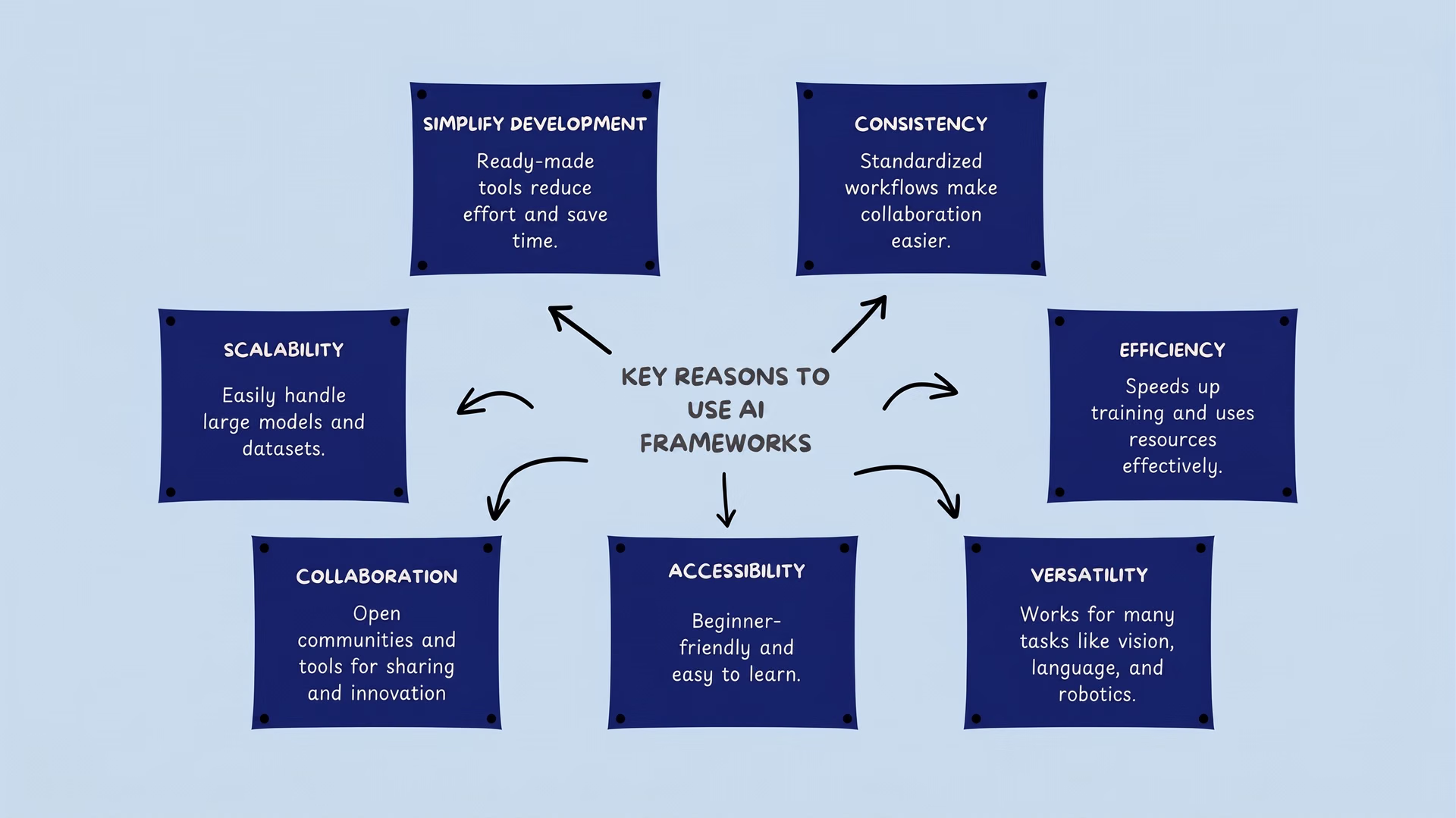
Fig 1. Reasons to Use AI Frameworks. (Image by Author).
Here are some of the most widely used AI frameworks:
- TensorFlow: Developed by Google, TensorFlow is a platform for building and training deep learning models. It supports various architectures, including neural networks, convolutional neural networks (CNNs), and recurrent neural networks (RNNs).
- PyTorch: Created by Meta, PyTorch is commonly used for research and prototyping. It’s flexible and easy to use, making it ideal for experimenting with new ideas.
- OpenCV: It is a library for computer vision and image processing tasks. OpenCV is known for its real-time capabilities and extensive algorithms and is used in both research and practical applications.
Using TensorFlow for AI projects#
TensorFlow is an open-source library for building and deploying deep learning models. It offers powerful tools for numerical computations on CPUs (Central Processing Units) and GPUs (Graphics Processing Units). It can be used for tasks like developing neural networks, processing data, and solving various AI and machine learning challenges.
TensorFlow was first released in 2015 and quickly became a major player in AI development. It evolved from Google’s earlier closed-source framework, DistBelief. Since then, it has been used in major Google projects like the RankBrain Search algorithm, which helps make search results more accurate and relevant, and Street View mapping, which processes and analyzes images to improve navigation and mapping services.
In 2019, TensorFlow 2.0 introduced key updates, including easier execution, improved GPU performance, and compatibility across platforms.
How does TensorFlow work?#
The name "TensorFlow" comes from its key concept: "Tensor" represents multidimensional arrays of data, and "Flow" describes how data moves through a computational graph.
TensorFlow uses dataflow graphs, where nodes represent mathematical operations, and the connections between them represent tensors or multidimensional data arrays. Complex computations are handled efficiently in the background by C++, while Python provides an easy-to-use interface for developers.
It offers high-level APIs for simplifying development and low-level APIs for advanced debugging and experimentation. TensorFlow can run seamlessly across devices, from smartphones to cloud systems, making it a dependable choice for machine learning and deep learning projects.
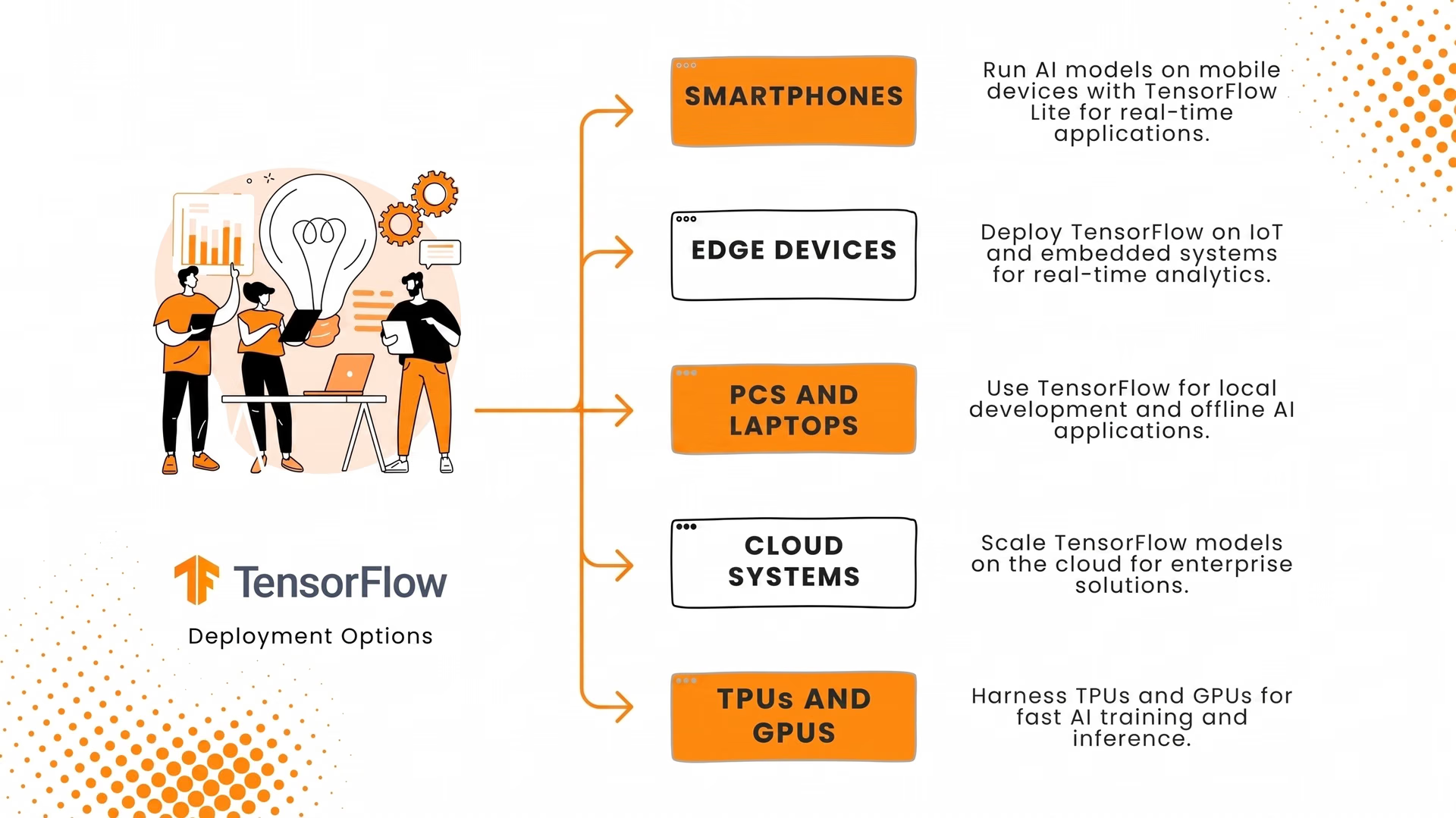
Fig 2. TensorFlow Deployment Options (Image By Author).
Key features of TensorFlow#
Here’s a quick glimpse of some of the exciting features TensorFlow provides:
- Tensor Operations: TensorFlow supports a wide range of mathematical operations, including linear algebra, matrix operations, and convolutions. These operations are optimized for efficient execution on various hardware.
- Automatic Differentiation: TensorFlow automatically calculates gradients, which are essential for optimizing model parameters during training. This process, known as backpropagation, allows the model to learn from its mistakes and improve its performance.
- Training and Optimization: TensorFlow provides optimization algorithms, such as Gradient Descent, Adam, and RMSprop, to help models reduce errors and make better predictions by fine-tuning their settings during training.
- Deployment: Once a model is trained, it can be deployed to various platforms, including web servers, mobile devices, and edge devices. TensorFlow provides tools for deploying models in different formats, such as TensorFlow Lite for mobile and embedded devices and TensorFlow Serving for web services.
TensorFlow's features enable users to build applications in areas like computer vision, natural language processing (NLP), reinforcement learning, and enterprise AI.
What is PyTorch?#
PyTorch is an open-source machine learning library originally developed by Facebook's AI Research Lab, now known as Meta AI. Built on Python and the Torch library, PyTorch is widely used for deep learning applications, simplifying the creation of neural network models.
PyTorch was introduced to the public at the 2016 Conference on Neural Information Processing Systems. In 2018, PyTorch 1.0 was released. It has since seen many updates and has gained popularity among researchers and developers due to its dynamic computational graph and ease of use.
How does PyTorch work?#
The goal behind PyTorch is similar to TensorFlow: to make building and training machine learning models easier. Consequently, they share many features. However, what makes PyTorch stand out is its dynamic computational graph.
Unlike TensorFlow's original approach, where you had to define the entire computation graph before running your model, PyTorch builds the graph as your code runs. This means you can easily use loops, conditionals, and other Python structures, making it much simpler to experiment, debug, and handle tasks with changing input sizes. While TensorFlow later introduced dynamic modes, PyTorch's flexibility set it apart.
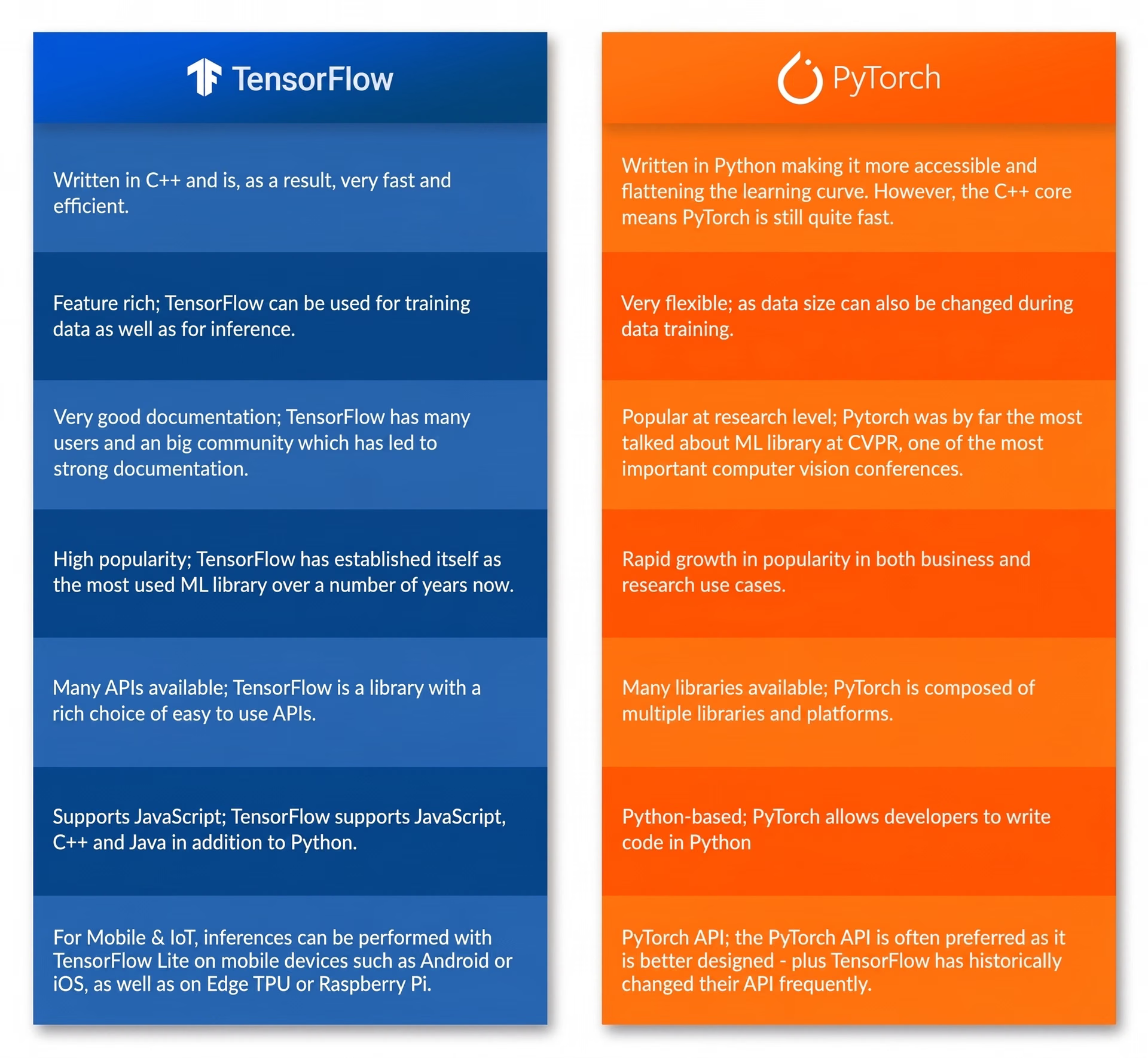
Fig 3. Comparing TensorFlow and PyTorch. source: kruschecompany.com
Key features of PyTorch#
Here are some of the other interesting features PyTorch offers:
- TorchScript for production: PyTorch supports TorchScript, which converts models into a static form that can be deployed without Python dependencies. This combines the benefits of dynamic development with efficient production deployment, bridging the gap between flexibility and performance.
- Simplified model training: PyTorch offers a user-friendly API for model training, especially with its DataLoader and Dataset classes, which make handling data and preprocessing straightforward.
- Interoperability with other libraries: PyTorch is highly compatible with popular libraries like NumPy, SciPy, and others, allowing smooth integration into broader machine learning and scientific computing workflows.
Thanks to its flexibility and user-friendly features, PyTorch is widely used for tasks like academic research, computer vision, NLP, and time series analysis. Its dynamic computational graph makes it perfect for researchers to experiment with and refine complex neural networks.
For example, libraries like TorchVision make it a popular choice for computer vision tasks such as image classification, object detection, and segmentation. Likewise, in NLP, tools like TorchText and transformer models help with tasks like sentiment analysis and language modeling. In parallel, for time series analysis, PyTorch supports models like LSTMs and GRUs, making it useful for detecting patterns in sequential data in fields like finance and healthcare.
How does OpenCV work in computer vision projects?#
OpenCV (Open Source Computer Vision Library) is an open-source computer vision software library. Initially developed by Intel, it includes over 2,500 algorithms, comprehensive documentation, and accessible source code.
While sometimes referred to as a framework, OpenCV is actually more of a library. Unlike TensorFlow or PyTorch, it does not provide a structured environment for building and training models. Instead, it focuses on offering a collection of functions and algorithms for image processing and computer vision tasks. It doesn’t enforce a specific workflow or development structure.
Key Features of OpenCV#
OpenCV is designed as a modular library with interconnected components, making it versatile for a wide range of computer vision tasks. Its features include:
- Image representation: OpenCV stores image data using matrix-based structures, with each element representing pixel intensity, ensuring efficient handling of visual data.
- Algorithms: It offers a variety of algorithms for tasks like filtering, geometric transformations, edge detection, and feature extraction.
- Real-time performance: It delivers high-speed performance through optimizations like parallel processing and GPU support, making it ideal for real-time applications.
These features make OpenCV a great tool for working alongside deep learning frameworks like TensorFlow and PyTorch. By combining their strengths, developers can build reliable computer vision models.
For example, TensorFlow or PyTorch can be used to train deep learning models for tasks like object detection, while OpenCV takes care of pre-processing images, extracting features, and displaying predictions. This integration supports a wide range of applications, including facial recognition, real-time object tracking, augmented reality, gesture control, and industrial automation.
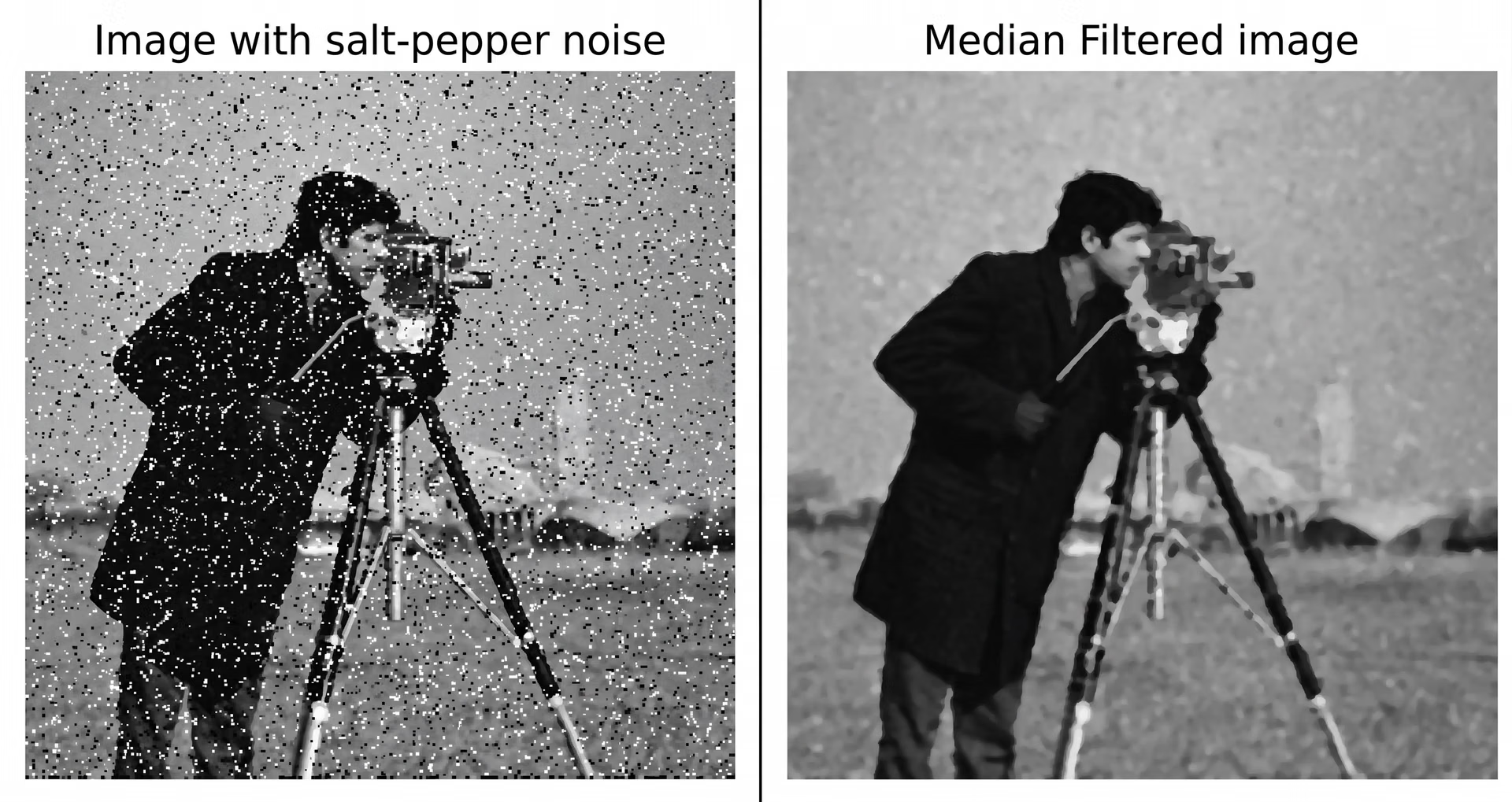
Fig 4. An example of pre-processing an image using OpenCV.
Framing the future of AI#
AI frameworks like TensorFlow, PyTorch, and OpenCV are vital for building intelligent models. They can combine deep learning and computer vision to create powerful tools for a wide range of applications. TensorFlow and PyTorch are great for developing advanced, flexible models, while OpenCV excels in real-time tasks with speed and efficiency.
Using the strengths of different frameworks allows us to tackle complex challenges and make the most of AI’s potential. Understanding what each framework offers helps us choose the right tool for the job, ensuring better results and more effective solutions.
Explore more about AI in our GitHub repository and join our active community. Read more about AI applications in agriculture and healthcare.








