Using Ultralytics YOLO models, Cali Intelligence reduced retail checkout queues by 43% and improved staffing efficiency through real-time monitoring and alerts.
During peak hours, checkout lines can build up quickly in busy retail stores. As queues grow, wait times increase, staff become overwhelmed, and shoppers may abandon their carts before completing a purchase.
Most stores already have CCTV systems in place. However, these cameras are typically used only for surveillance and don’t provide real-time operational insights. This, in turn, means that store teams can’t detect congestion early or respond before queues become a problem.
Cali Intelligence tackles these operational challenges with AI-powered retail monitoring. By upgrading existing CCTV infrastructure with computer vision technology, they transform live video feeds into real-time operational data.
For instance, using Ultralytics YOLO models, their system can detect checkout lanes, identify active queues, and measure customer buildup. This helps store teams respond quickly and prevent prolonged wait times.
Bringing real-time intelligence to retail operations#
Founded in 2020, Cali Intelligence develops AI solutions designed specifically for physical retail stores. The company was created with the goal of democratizing artificial intelligence in French retail and helping retailers improve performance and customer experience through computer vision.
A key challenge in physical retail is limited visibility into shop-floor activity. Unpredictable queues and uneven staff allocation make it difficult for store teams to respond quickly, especially during peak hours when checkout lines grow rapidly.
Retail teams are often forced into reactive decision-making rather than proactive management. Cali Intelligence addresses this gap by letting retailers better understand what is happening inside their stores in real time.
Over the past four years, Cali Intelligence has expanded its solutions across several retail sectors, including mass distribution, DIY, and ready-to-wear. Today, the company works with major French retailers such as Intermarché and Leclerc, supporting more efficient and responsive store operations.
The complexity of physical retail store operations#
Long checkout queues are one of the leading causes of shopping abandonment. A customer’s checkout experience often determines whether a sale is completed or abandoned.
Even when customers have filled their baskets, long queues can undermine purchase intent. This results in an immediate loss of sales.
In fact, the impact goes further than a single transaction. Repeated delays frustrate customers and may push them toward competitors that offer faster service. Over time, this erodes loyalty and reduces repeat visits.
Long queues also place significant pressure on store teams. At an operational level, management often struggles to respond quickly enough.
In many cases, teams react only after lines have already grown crowded, opening additional tills once the situation becomes urgent. This reactive approach forces staff into constant firefighting instead of enabling smooth, consistent service.
Staffing adds another layer of complexity. Without live queue data, it is difficult to know when and where additional support is truly needed. Often, stores end up overstaffed during quiet hours and understaffed during peak periods, leading to inefficiencies on both ends.
Optimizing retail checkouts with Ultralytics YOLO#
To improve store management and customer experience, Cali Intelligence automates checkout monitoring using computer vision through existing camera infrastructure. Their solution integrates directly with standard Video Management Systems (VMS), allowing store managers to receive instant alerts when queue thresholds are exceeded.
This enables teams to open additional tills or reposition staff before lines grow too long. At the center of this solution are Ultralytics YOLO models.
Ultralytics YOLO models support key computer vision tasks such as object detection, which identifies customers in video frames, and object tracking, which follows those customers across frames over time. These capabilities make it possible for the system to monitor checkout areas, count customers, and identify emerging queues.
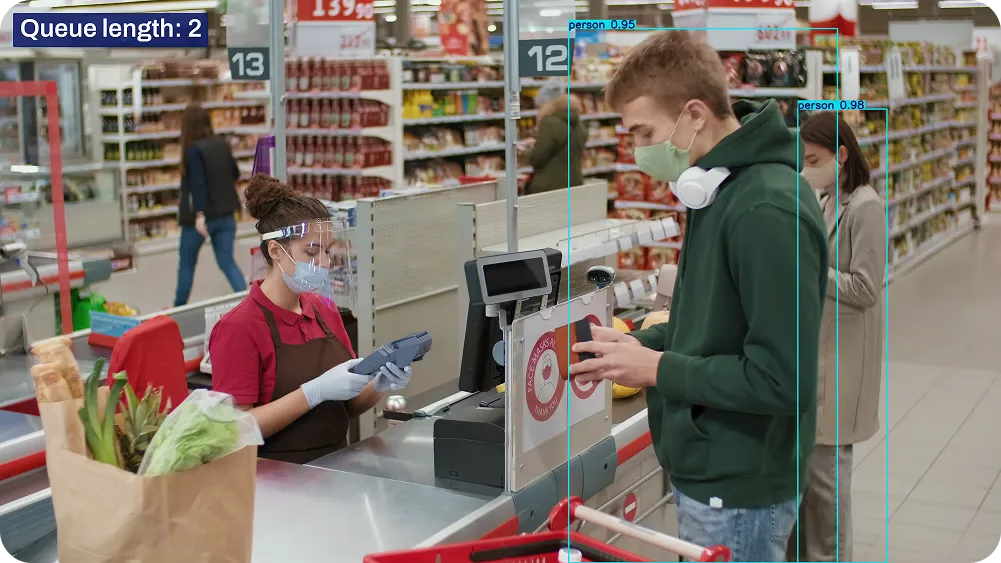
Fig 1. An example of YOLO being used to detect people in a queue. Image source: Ultralytics.
By detecting and tracking individuals in live video streams, the solution can also estimate wait times and flag developing bottlenecks. In particular, the system runs on compact, on-site servers using an edge-first architecture. This ensures round-the-clock operation while keeping customer data private.
In addition to real-time monitoring, the solution supports short-term forecasting. It can predict queue buildup as much as 15 minutes in advance, helping managers align staffing levels with expected footfall.
Why choose Ultralytics YOLO models?#
Ultralytics YOLO models provide Cali Intelligence the ability to deliver high performance without the need for expensive cloud infrastructure. The models generalize well across different camera angles and lighting conditions, which supports rapid deployment across multiple stores with minimal retraining.
The Ultralytics YOLO models also support advanced object tracking. Instead of relying only on headcounts, the system can measure how long customers spend in line. This improves queue visibility and contributes to over 90% accuracy in real-world alert triggers.
On top of this, the YOLO-driven system is optimized to process even 3 to 6 camera streams at around 3 FPS per stream. This allows it to maintain detection accuracy while significantly reducing compute load, supporting efficient and scalable retail operations.
Ultralytics YOLO and Cali Intelligence reduce queue length by 43%#
When Cali Intelligence deployed its Ultralytics YOLO powered solution across eight retail sites, the impact was both immediate and measurable. For example, at one site, the average queue length dropped from 7 to 4 customers, a 43% reduction within just two weeks.
Operational efficiency improved alongside customer satisfaction. During off-peak hours, the system reduced unnecessary checkout openings by up to 10%, enabling stores to align staffing levels more closely with actual demand and avoid wasted labor costs.
Meanwhile, detection performance remained stable across diverse store layouts and lighting conditions, maintaining a miss rate below 6%. High alert accuracy gave managers confidence to act quickly and make informed decisions on the shop floor.
The benefits also extended beyond real-time monitoring. Early testing of predictive labor optimization achieved a Mean Absolute Error (MAE) of 0.8, forecasting queue lengths within one customer of the actual count and enabling more proactive workforce planning.
Simply put, Cali Intelligence was able to leverage Ultralytics YOLO to convert in-store video into real-time operational intelligence, helping reduce wait times, optimize staffing, and enhance overall retail performance.
Advancing smarter retail operations at scale#
As Cali Intelligence continues to grow, the company plans to continue optimizing its edge performance using the Ultralytics Python package. The package provides a streamlined workflow for training, exporting, and deploying models, making it easier to implement performance improvements efficiently.
Building on this foundation, Cali Intelligence is exploring TensorRT and ONNX export formats to reduce inference time and improve hardware utilization on-site. The Cali Intelligence team is also evaluating a shift between Ultralytics YOLO model variants, moving from Medium to Small to improve efficiency while maintaining high detection accuracy.
Overall, Cali Intelligence is driving a shift in retail operations, moving stores from reactive management to proactive, data-driven performance.
Want to bring AI into operations? Visit our GitHub repository to learn more. Explore AI in logistics and computer vision in healthcare. Check out our licensing options to get started.