Ultralytics YOLO partners with DEEPX: Edge AI inference for Physical AI
Learn how the new DEEPX export integration brings Ultralytics YOLO inference to NPU-powered edge AI hardware.
At Ultralytics, we are seeing a growing shift toward running computer vision models directly on edge devices as AI becomes more deeply embedded in the physical world. From robotics and industrial machinery to smart cameras and autonomous vehicles, more and more intelligent systems are being asked to see, understand, and act in real-time, without depending on the cloud.
This new wave of intelligent systems is being called Physical AI, and it demands high-performance, ultra-energy-efficient computing that can operate autonomously in the real world. Real-world systems need vision AI that runs locally, reliably, and efficiently on hardware purpose-built for the edge.
Ultralytics YOLO models like Ultralytics YOLO26 are designed for real-time computer vision, but unlocking their full potential at the edge requires the right combination of software and hardware. To this effect, we are excited to announce our new partnership with DEEPX.
We have partnered with DEEPX to introduce a new export integration, enabling efficient, high-performance deployment of Ultralytics YOLO models on DEEPX NPU hardware. Together, we are setting a unified global standard for how Physical AI is built, deployed, and scaled.
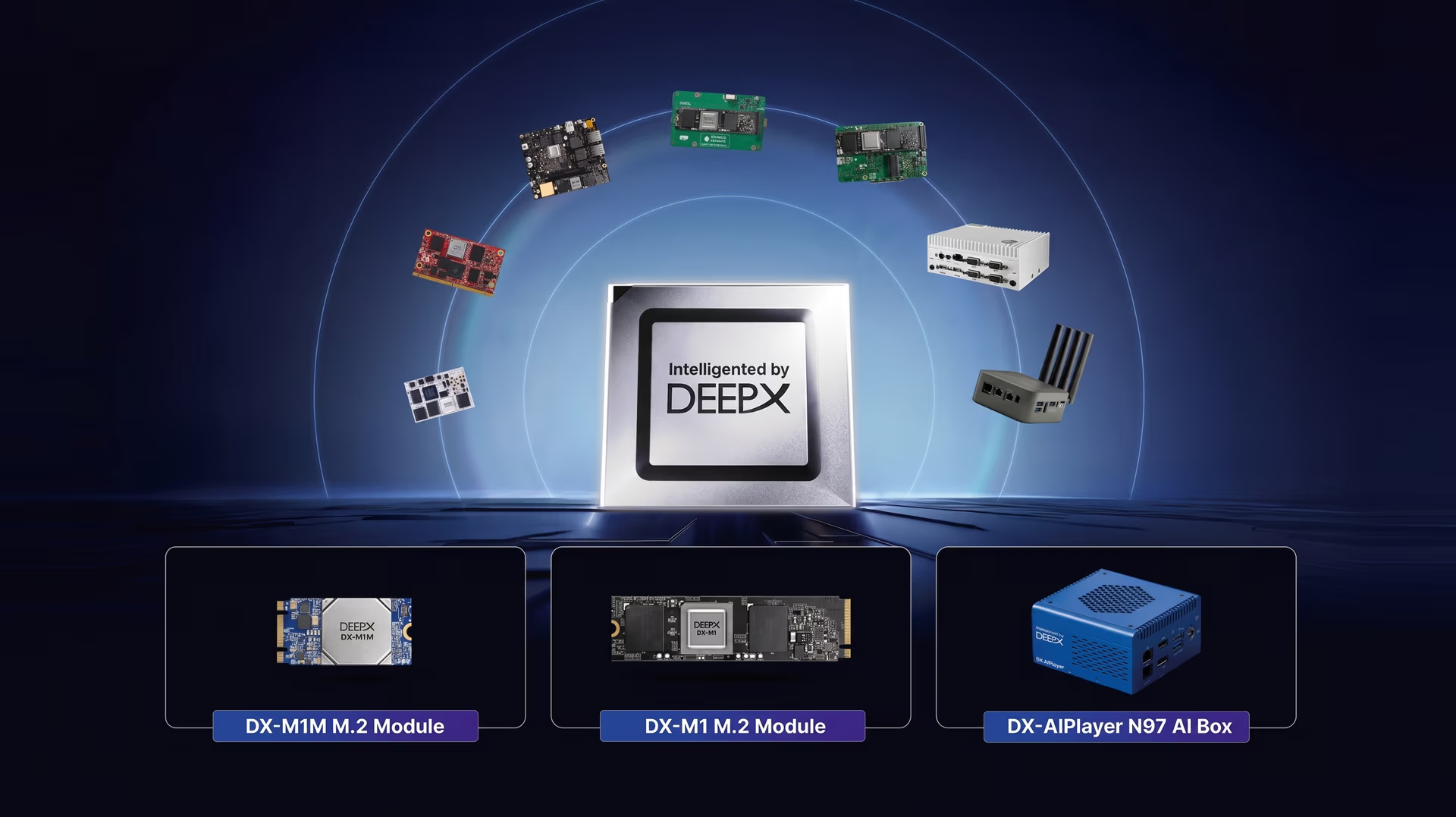 Fig 1. The DEEPX hardware ecosystem for on-device AI inference, featuring the DX-M1 M.2 module and DX-AIPlayer N97 AI Box*.*
A shared vision for the future of Physical AI#
As the most widely adopted computer vision framework in the world, Ultralytics provides the "eyes" of these systems. As one of the most efficient NPU manufacturers, DEEPX provides the "brain" to run them at scale.
At Ultralytics and DEEPX, we believe and are driven by accessibility, performance, and developer-first design. By bringing the Ultralytics and DEEPX ecosystems together, we are providing a single, trusted pathway to deploy vision AI commercially, whether they are an early-stage robotics company shipping their first product or a Fortune 500 manufacturer rolling out vision AI across thousands of facilities.
This means:
- Faster time-to-market: From annotation to deployment in days, not months.
- Lower deployment costs: GPU-class performance at a fraction of the power and silicon cost, giving you 250+ FPS with 2-4 W of power consumption.
- New revenue opportunities: Build and ship edge AI products that were previously economically unviable.
- Future-proof scaling: A dedicated CI/CD pipeline ensures every new Ultralytics release works out-of-the-box with DEEPX hardware, backed by DEEPX's multi-year supply commitments.
Exploring DEEPX's NPU technology#
DEEPX is an AI semiconductor innovator delivering efficient edge AI hardware, purpose-built for vision models like Ultralytics YOLO at class-leading frames-per-second per watt (FPS/W). Rather than optimizing for theoretical metrics, DEEPX focuses on real-world efficiency, enabling developers to achieve GPU-class results at a fraction of the power budget.
What makes this possible is a full-stack design. The DX-M1 NPU is engineered specifically to accelerate the computational patterns of computer vision models, with passive cooling and low power consumption that suit production-scale deployments where performance-per-watt and long-term reliability matter.
As Edge AI moves into mainstream adoption, what matters is sustainable performance: running advanced models reliably within tight power and thermal constraints while staying scalable for real-world deployment. This is why FPS-per-Watt has become one of the most important metrics for evaluating edge AI platforms.
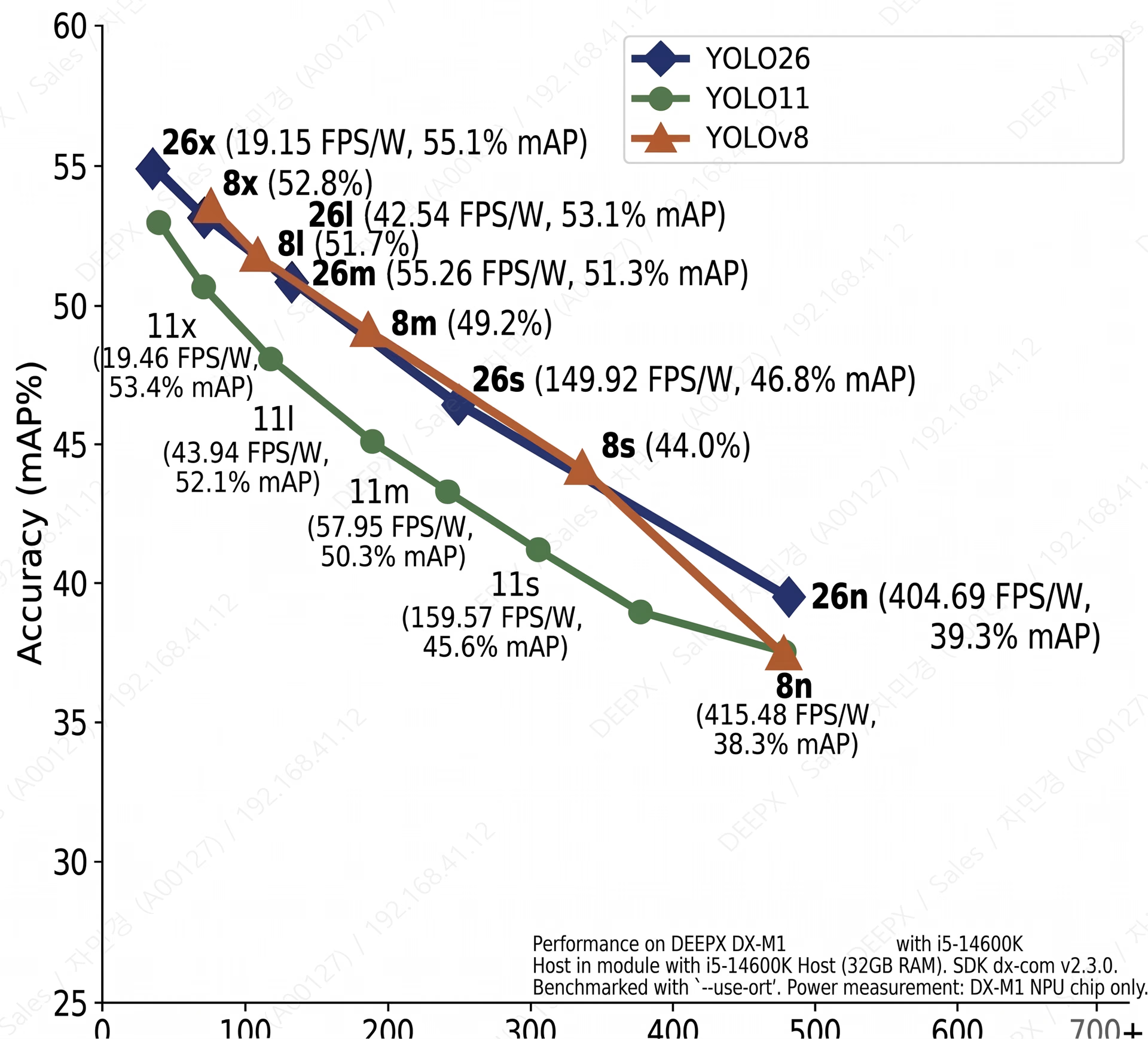 Fig 2. Pareto front benchmark of YOLO26, YOLO11, and YOLOv8 on the DX-M1 NPU. Measured on DX-M1 with an i5-14600K host (32GB RAM), SDK dx-com v2.3.0, NPU chip only.
As the market moves beyond PoCs into large-scale deployment, customers increasingly need multiple AI models running simultaneously within the same power and thermal budget. The chart above shows YOLO26 consistently delivering a stronger balance of accuracy and efficiency: YOLO26n reaches roughly 405 FPS/W on DX-M1, letting developers run more advanced AI workloads without moving to larger, more power-hungry hardware.
Getting started with exporting Ultralytics YOLO models to DEEPX#
The Ultralytics Python package and Ultralytics Platform provide a complete, unified environment for training, evaluating, and deploying YOLO models across all five computer vision tasks. Whether you prefer working in code or through a no-friction visual workflow, both pathways give you a consistent and scalable way to take a model from data to deployment.
Through this partnership, Ultralytics has introduced a new export integration with DEEPX, enabling YOLO models to be exported for deployment on DEEPX NPU hardware with a single command: format=deepx. The integration is fully supported across the Ultralytics ecosystem, meaning developers can export to DEEPX from the Python package or directly from Ultralytics Platform after annotating and training their model. During export, the model is compiled and INT8-quantized into an optimized .dxnn binary, with EMA-based calibration ensuring maximum NPU performance without sacrificing model quality.
In practice, this means commercial teams can go from labeled data to a production-ready model running on DEEPX NPUs with just three commands:
# Step 1: Install Ultralytics
pip install ultralytics

# Step 2: Export your YOLO model to DEEPX format
yolo export model=yolo26n.pt format=deepx

# Step 3: Run inference on DEEPX hardware
yolo detect predict model=yolo26n_deepx_model
For full setup details, including runtime installation and visualization with DEEPX's dxtron graph viewer, check out the DEEPX integration documentation.
Key benefits of running Ultralytics YOLO models on DEEPX NPUs#
Here are some of the key advantages of deploying Ultralytics YOLO models on DEEPX hardware using the new integration:
- Seamless integration with the Ultralytics workflow: Exporting YOLO models for DEEPX deployment fits naturally into the Ultralytics Python package, with a single format=deepx command standardizing the edge deployment process.
- Support for multiple computer vision tasks: You can deploy models for object detection, segmentation, pose estimation, oriented bounding box (OBB) detection, and classification across YOLOv8, YOLO11, and YOLO26.
- Ultra-efficient edge inference: DEEPX NPUs deliver GPU-class performance at a fraction of the power, with passive cooling and ultra-low power consumption ideal for production-scale deployments.
- Future-proof foundation: A dedicated CI/CD pipeline guarantees out-of-the-box compatibility with every new Ultralytics release, while the DX-M1 to DX-M2 roadmap extends the same software stack into the Agentic AI era.
- Scalable across Physical AI applications: From smart surveillance and industrial inspection to robotics and autonomous systems, the integration supports a wide range of real-world use cases.
Where Ultralytics YOLO and DEEPX hardware can make an impact#
So what are some common Physical AI applications where Ultralytics YOLO models can be deployed on DEEPX hardware in real-world scenarios?
Smart surveillance at the edge#
Modern surveillance systems demand real-time detection without compromising on privacy or connectivity. Ultralytics YOLO models running on DEEPX NPUs enable security cameras and monitoring systems to analyze video feeds locally, identifying people, vehicles, and unusual activity in real time, with low power consumption and no cloud dependency. As GDPR enforcement tightens in Europe and municipal procurement increasingly mandates data residency, on-device inference becomes a regulatory advantage as much as a technical one.
Industrial automation and quality control#
In factories and manufacturing facilities, vision AI is increasingly being used to automate quality control, defect detection, and process monitoring. Combining Ultralytics YOLO models with DEEPX hardware enables on-device inspection that runs reliably 24/7 in demanding industrial environments, helping reduce waste, improve product quality, and protect worker safety.
Robotics and autonomous systems#
For robotics, speed and responsiveness are critical. Whether navigating a warehouse, operating in dynamic industrial environments, or working alongside humans, robots need to interpret their surroundings instantly. Ultralytics YOLO models running on DEEPX NPUs enable robots to detect obstacles, track people, and identify objects in real-time, supporting safer movement and greater autonomy without depending on constant cloud connectivity.
Key takeaways#
Ultralytics YOLO models and DEEPX NPUs make it easier than ever to bring high-performance Physical AI to the edge. By simplifying deployment with the new format=deepx standard and optimizing models for DEEPX's energy-efficient hardware, this partnership helps bridge the gap between development and real-world commercial applications. As Physical AI continues to grow, this collaboration is a step toward making production-grade vision AI accessible, affordable, and scalable for businesses of every size.
Ready to bring your edge AI products to market faster?
- Request a license to access commercial support and Enterprise YOLO models.
- Try Ultralytics Platform to annotate, train, and deploy your first DEEPX-ready model.
- Become an Ultralytics partner to explore joint deployment opportunities.
- Read the docs for the full technical guide.
Find out how innovations like AI in robotics and AI in manufacturing are shaping the future.








