By fine-tuning Ultralytics YOLO models on edge devices, Scaleout keeps data in place, works offline, and ships new detection models in hours instead of weeks.
Training machine learning models usually assumes you can pool all your data in one place, send it to the cloud, and deploy a finished model. In many real-world settings, that assumption doesn't hold up. Across defense, industrial, and regulated environments, data is bound to its location by privacy law, security classification, or sheer bandwidth cost, and the network connecting those locations can't always be trusted.
Scaleout builds infrastructure for exactly these conditions. Its platform, Scaleout Edge, uses federated learning to bring model training to where the data lives, rather than moving data to the model. For computer vision projects, Scaleout custom-trains and fine-tunes Ultralytics YOLO models on Vision Ground Nodes, GPU-accelerated edge stations deployed at each site, so detection keeps improving in the field without sensitive imagery ever leaving the device.
Taking machine learning to where the data lives#
Founded in 2018 by researchers from Uppsala University working on large-scale distributed systems, Scaleout set out to make machine learning possible where data can’t be centralized. Its focus is on contexts where pooling data in one place is difficult or impossible, and federated learning is the core mechanism that makes it work.
Federated learning distributes training across many devices, then gathers their model updates into a central control plane that aggregates them into a new global model. Each device benefits from understanding its own local environment, while the fleet as a whole benefits from collective intelligence. Data stays where it belongs, and only what the model has learned travels.
Scaleout's work spans defense, industrial, transport, and other regulated sectors, and includes engagements such as the NATO DIANA accelerator program and a collaboration with BAE Systems. Across all of them, the pattern is the same, with data that can’t move and models that still need to improve.
The complexities of edge machine learning#
Here's a closer look at the constraints Scaleout faced in training models in the field:
-
Limited hardware: Field deployments have no data-center servers, only small, low-power devices such as the computer on a drone. Running a finished model on them is feasible, but retraining one demands far more compute.
-
Data locked to the device: The footage needed for retraining is often proprietary and can't be sent to a central server, so the model has to learn from data that never leaves the edge.
-
No specialists on site: The operators capturing data in the field are rarely machine learning engineers, so retraining can't depend on data science expertise being present.
-
Constantly shifting conditions: Field environments change quickly, so the model has to be updated continuously rather than on slow, periodic retraining cycles.
Fine-tuning Ultralytics YOLO models on the edge#
To work within these constraints, Scaleout built a training loop that runs entirely in the field, with Ultralytics YOLO models at its center.
At each site, a Vision Ground Node, a GPU-accelerated edge station with its own compute and storage, sits alongside a fleet of drones. As the drones capture footage, the node selects the most useful frames, an operator labels them, and the YOLO model is fine-tuned on that local hardware.
After a few training epochs, only the updated model is sent back to the control plane, never the raw footage. This loop is delivered through Scaleout's vision module, an extension of the Scaleout Edge platform that bundles the tools a computer vision project needs into a single package.
It brings together frame selection, annotation, training, and deployment, with Ultralytics YOLO handling detection, so teams can build on a working foundation instead of assembling these pieces themselves.
Scaleout first put this approach to work in the NATO DIANA accelerator program, using YOLOv8 to fine-tune detection on data gathered in the field. That data couldn't be moved over field networks or centralized for proprietary reasons, so the team decentralized the fine-tuning, letting the model learn from new examples locally.
The loop is also built for operators rather than data scientists. The system guides a non-specialist through reviewing and labeling the frames that matter, so the people in the field can keep the model improving on their own.
The supporting tools reflect this, with the open-source version of Label Studio for annotation, a streaming server to bring in drone feeds, and the Ultralytics Python package for fine-tuning. All of it runs on hardware that ranges from NVIDIA Jetson modules to a rugged field unit or a laptop, depending on the deployment.
Why choose Ultralytics YOLO models?#
For Scaleout, the biggest advantage of Ultralytics YOLO is how lightweight the models are, which is what makes federated training over poor connections practical. Rather than moving raw data, Scaleout moves only the model update. The model it uses most, Ultralytics YOLOv8 nano, is around 10.7 MB, so a full update is a small package to send, even when bandwidth is scarce.
The Ultralytics Python package also gives Scaleout's engineers the flexibility to train and deploy across varied hardware. The compact YOLOv8 nano model runs comfortably on constrained edge devices, while the package's export options support deployment across the different environments Scaleout works in. Since the models are straightforward to fine-tune, teams can iterate quickly as field conditions change.
Ultralytics YOLO helps Scaleout update models faster#
With Ultralytics YOLO, the heaviest part of the work stays on the device. Training runs on hundreds of gigabytes of field footage, but what actually travels is a model of around 10 MB. That adds up to roughly a tenfold reduction in the data that has to move, which is what makes federated training viable over the limited networks these deployments rely on.
The approach also changes how quickly an improved model gets back into the field. What might otherwise take weeks or months, gathering data, shipping it somewhere central, retraining, and redeploying, collapses into days and hours when the loop runs on the edge.
This shows up most clearly in Scaleout's drone work. In defense reconnaissance, a drone flies a search pattern and uses an onboard Ultralytics YOLO model to detect, identify, and geolocate objects of interest in real time, with all of the processing handled on the drone's own computer rather than sent off for analysis.
As the drones gather new footage, that data feeds a Vision Ground Node where YOLO is fine-tuned on the new frames, and an updated model is pushed back out, all without the footage ever leaving the site. Detection models have to keep up with conditions that change rapidly and with data that can't be moved, and a model retrained locally stays useful where a static, centrally trained one would fall behind.
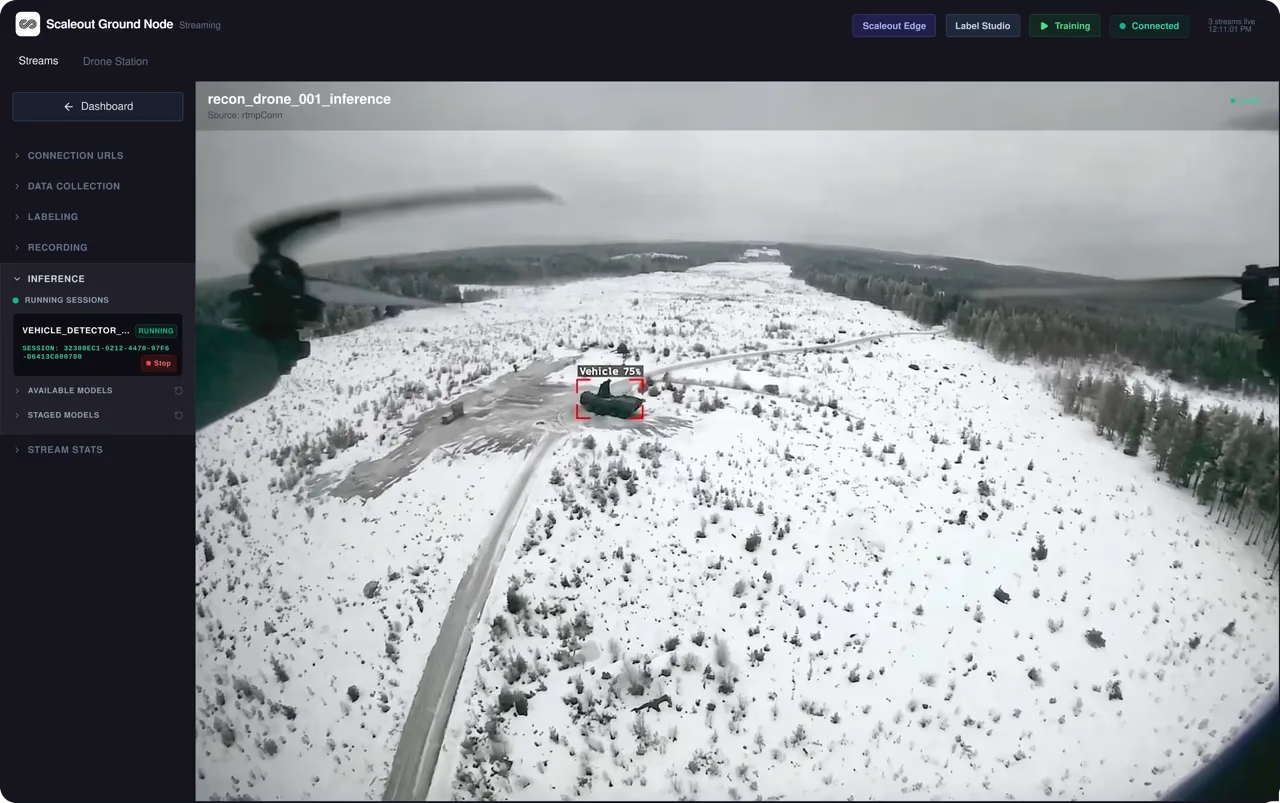
Fig 1. An example of how Scaleout and Ultralytics YOLO power AI drones (Source)
The same pattern extends well beyond drones. In industrial settings such as energy sites and remote facilities, where each location's data is sensitive, the platform improves detection models across many sites without any raw data crossing a facility boundary. Whether the data sits on a drone or a fixed installation, Scaleout keeps the footage in place and moves only what the model has learned.
Building adaptive AI for environments where data can't move#
As Scaleout grows, it continues to extend its federated, edge-based computer vision across more settings and hardware. Its pre-built modules are designed to compress months of integration into days, so customers can bring their own hardware and adopt the adaptive learning loop without rebuilding the underlying machine learning code.
With Ultralytics YOLO at the core of its detection pipeline, Scaleout is making it possible to train and improve AI in exactly the environments where conventional approaches fall short, keeping data in place, staying operational when networks fail, and turning fleets of edge devices into a system that keeps learning as a whole.
Ready to explore what Vision AI can do for you? Head to our GitHub repository to discover how YOLO models are transforming areas such as AI in manufacturing and computer vision in robotics. Check out our licensing options and begin your journey toward smarter automation.








