Exploring supervised vs unsupervised learning in computer vision
Learn the differences between supervised and unsupervised learning in computer vision and how to choose the right approach for your data and project goals.
Artificial intelligence (AI) is built on the core concept of teaching machines to learn and reason in ways that resemble human intelligence. Similar to how people learn through different methods, such as direct instruction or by observing patterns and experiences, AI and machine learning systems are designed to follow these same approaches.
Specifically, when it comes to machine learning algorithms, systems are trained to learn from data rather than being explicitly programmed for every task. Instead of relying on fixed rules, machine learning models identify patterns in data and use those patterns to make predictions or decisions.
For example, computer vision is a branch of AI and machine learning that focuses on enabling systems to interpret and understand visual information, such as images and videos. From recognizing objects to identifying hidden patterns across large datasets, these systems rely heavily on how they are trained to learn.
Various AI learning techniques are used to train these systems, depending on the type of data available and the problem being solved.
Some computer vision models learn from labeled data, where each input is paired with a correct answer, meaning every image or data point comes with a predefined label that tells the model what it represents. This allows the model to learn the relationship between the input and the expected output, improving its ability to make accurate predictions on new, unseen data.
Other vision models learn from unlabeled data, where no predefined answers are provided, and instead focus on identifying patterns and relationships within the data itself. These approaches are respectively known as supervised learning and unsupervised learning, and they form the foundation of many cutting-edge computer vision systems.
In this article, we’ll explore supervised and unsupervised learning, how they are used in computer vision, and how to choose the approach that best fits your vision AI project. Let's get started!
How AI learning approaches power computer vision#
You can think of artificial intelligence like an umbrella, covering a range of technologies that enable machines to perform tasks that typically require human intelligence. Within this umbrella, machine learning is a key area that makes it possible for systems to learn from data instead of relying only on fixed rules.
Within machine learning, different learning techniques determine how a model learns and improves over time. Approaches such as supervised learning (learning from labeled data with correct answers), unsupervised learning (identifying patterns in unlabeled data), reinforcement learning (learning through trial and error using feedback or rewards), and semi-supervised learning (combining a small amount of labeled data with a large amount of unlabeled data) define how systems process input data and generate output data.
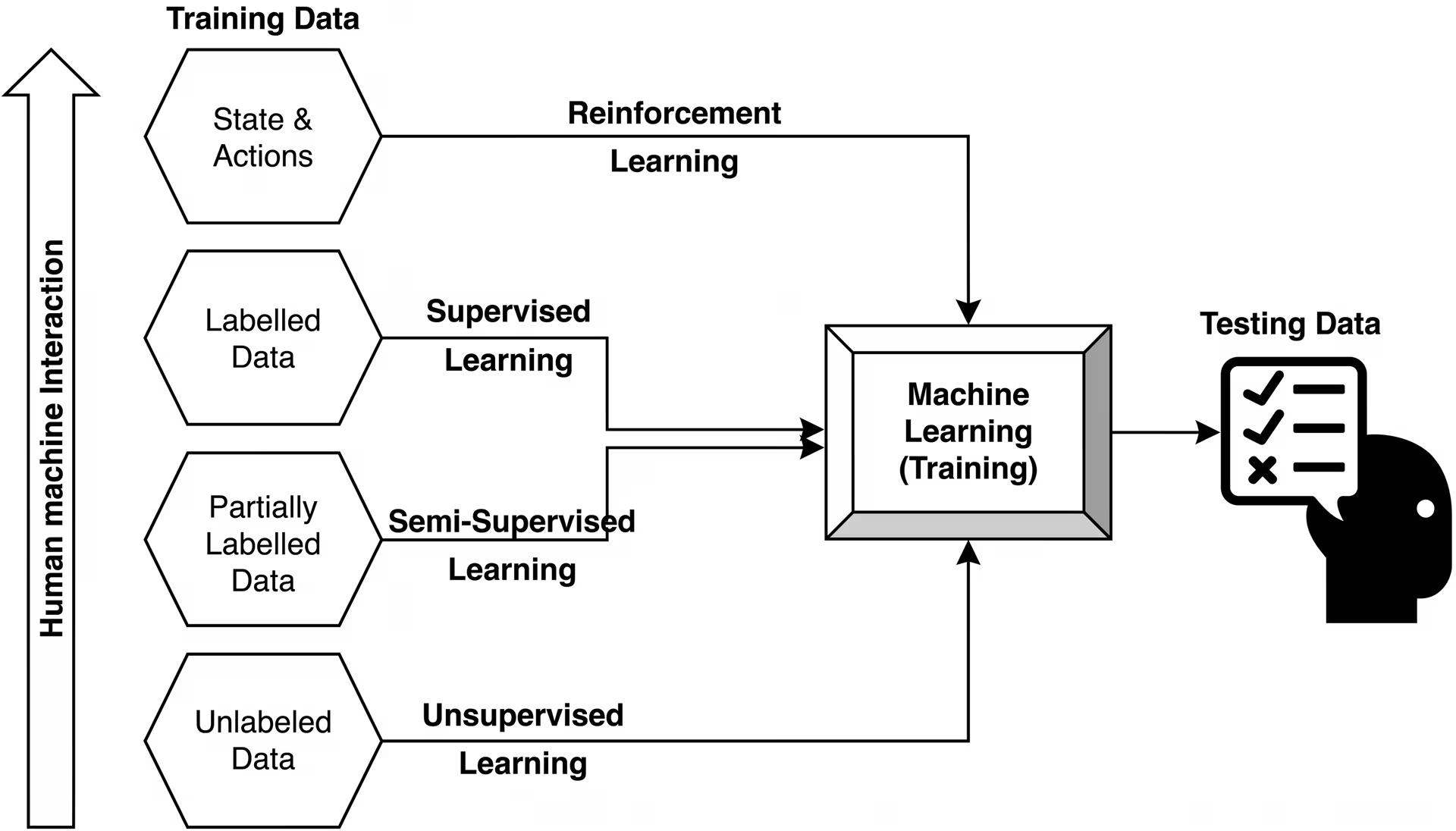
Fig 1. An overview of AI learning methods (Source)
In particular, computer vision systems are built using such learning approaches to interpret and understand visual data. Supervised learning is the most commonly used method, as it lets models learn from clearly labeled examples and produce accurate, reliable results.
For instance, a model can be trained on images labeled as “cat” and “dog,” learning features such as shape, ears, and facial structure so it can correctly classify new images using classification algorithms. Meanwhile, unsupervised and semi-supervised learning are also used in computer vision, often to explore patterns in data or to improve performance when labeled data is limited.
A look at using supervised learning models in computer vision#
You can compare supervised learning algorithms with a classroom setting, where a teacher provides examples along with the correct answers so students can learn what is right and what is wrong. In machine learning, models learn in a similar way using labeled data, where each input is paired with a known output.
Let’s say you are working on building a computer vision system that automates the analysis of baseball games. You could train a model like Ultralytics YOLO26 on images or video frames where objects like the ball, bat, and players are labeled.
Each object would be marked with its location and category, enabling the model to learn what to look for. Over time, the model can detect and locate these objects in new footage, supporting use cases such as ball tracking and player detection across frames.
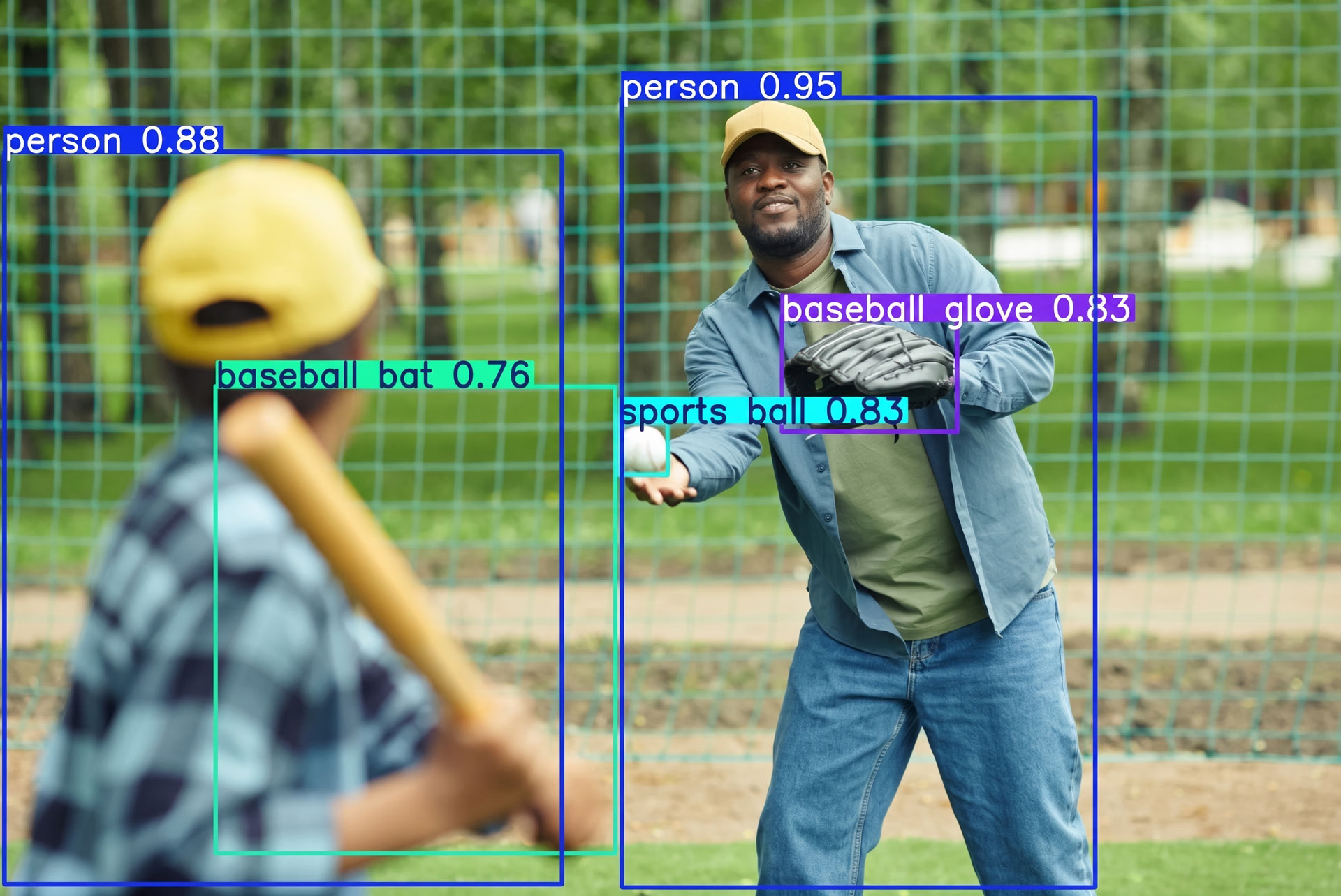
Fig 2. An example of object detection enabled by supervised learning (Source)
Beyond object detection, supervised learning is widely used across a range of computer vision tasks such as image classification, instance segmentation, and pose estimation, where accuracy and consistency are important. In each of these tasks, models learn from labeled data to identify specific patterns and make reliable predictions on new inputs.
These models are typically built using deep learning, a type of machine learning that uses neural networks to learn patterns directly from data. Neural networks are designed to process information in a way that is loosely inspired by how the human brain works, allowing models to learn complex visual features from large datasets.
Earlier computer vision approaches often relied on manually designed features combined with algorithms such as support vector machines (SVMs are models that classify data by finding the best boundary between categories) or decision trees (models that make decisions by splitting data into branches).
In contrast, computer vision models today use deep learning to automatically learn these features from data, making them more effective at handling large-scale and highly detailed visual tasks.
Understanding the need for unsupervised learning models in vision AI#
While supervised learning is the go-to approach in computer vision, there are certain vision applications where labeled data isn't available or is too expensive and time-consuming to create.
In these cases, unsupervised learning algorithms can be a useful alternative. Let's say you have a large collection of unlabeled photos from a wildlife camera.
There are no labels indicating what each image contains, but you still want to organize or understand the data. An unsupervised model can analyze these images and group similar ones together, separating animals that look alike into clusters, even without knowing their exact labels.
How unsupervised learning works in computer vision#
So, how does unsupervised machine learning work? Instead of learning from correct answers, the model learns by identifying patterns and structure within the data on its own. It looks for similarities and differences across the data without relying on labeled examples.
A common use case is anomaly detection, where the model learns what normal data looks like and then identifies anything that deviates from it. Anomaly and outlier detection is one of the most impactful industrial applications. Examples include spotting defective items on a manufacturing line, flagging unusual medical scans for radiologist review, or detecting suspicious activity in surveillance footage. Because defects and anomalies are often rare and varied, labeling every possible case is impractical, making unsupervised approaches a natural fit.
To support this, techniques such as clustering and dimensionality reduction are often used, usually on features extracted from images rather than the raw images themselves. Clustering methods, like k-means clustering, group similar images together based on shared patterns, while dimensionality reduction techniques, such as principal component analysis (PCA), simplify the data by focusing on the most important features.
This makes it easier for the model to identify meaningful patterns and structure within large and complex datasets. The main advantage of unsupervised learning is that it works well with unlabeled data and can reveal patterns that aren't immediately obvious. However, it is harder to evaluate and provides less control over the final output compared to supervised learning.
Self-supervised and semi-supervised learning in computer vision#
As you explore supervised and unsupervised learning, you might wonder if there is a middle ground between the two. Interestingly, self-supervised and semi-supervised learning bridge the gap between supervised and unsupervised learning.
These approaches make it possible for models to learn from unlabeled data more effectively. Instead of relying only on labeled examples, they either create their own learning tasks from the data or combine a small labeled dataset with a larger unlabeled one.
In self-supervised learning, the model learns by solving tasks created from the data itself. For example, it might be given an image with a missing part and learn to predict what should fill that space, or it might learn to recognize different views of the same object. This helps the model learn useful features without needing manual labels.
On the other hand, in semi-supervised learning, a small amount of labeled data is used alongside a larger set of unlabeled data to improve performance. In some cases, the model can generate labels for the unlabeled data and use them to continue learning.
The key benefit of these approaches is that they reduce the need for large labeled datasets, which are often expensive and time-consuming to create. However, they can be more complex to design and evaluate compared to fully supervised methods.
Key differences between supervised and unsupervised learning#
The difference between supervised and unsupervised learning comes down to how a model learns and what it is trying to achieve. While supervised learning relies on labeled data and clear guidance to learn specific tasks, unsupervised learning works without predefined answers and focuses on discovering patterns and structure within the data.
For example, in a traffic monitoring system, a supervised learning model can be trained on labeled images to detect vehicles, pedestrians, or traffic signals. In contrast, an unsupervised model could analyze large amounts of video footage to group similar traffic patterns or identify unusual events, such as unexpected congestion or abnormal movement, without being explicitly told what to look for.
When to use supervised learning in computer vision#
Supervised learning is a great option for computer vision tasks where the objective is clearly defined, and the model needs to map input data to accurate outputs. It works especially well when you have a reliable labeled dataset and need consistent, predictable results.
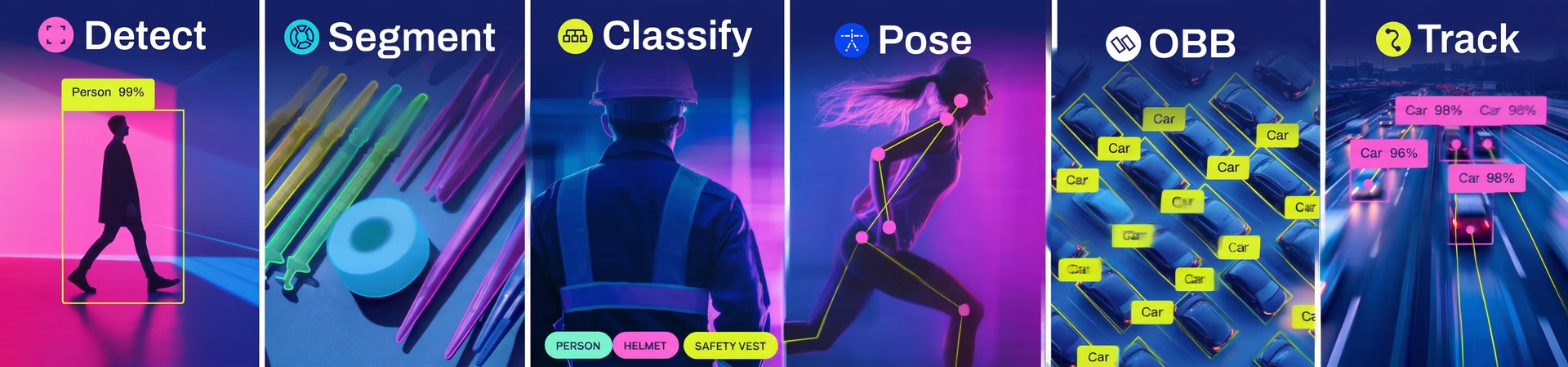
Fig 3. Computer vision tasks that are driven by supervised learning (Source)
It is commonly used for problems where the model must distinguish between known categories or predict specific outcomes. Rather than exploring patterns, the focus is on learning precise relationships from labeled data, making it easier to guide the model toward a desired result.
Another key advantage is control. With supervised learning, it is easier to measure performance using clear metrics, fine-tune the model, and ensure stable behavior during deployment. This makes it perfect for systems that require consistency and reliability over time.
However, this comes with a trade-off. The model depends heavily on the quality and scale of the labeled data, and collecting and annotating such data can be time-consuming.
Real-world examples of supervised computer vision#
Vision AI models like Ultralytics YOLO models use supervised learning to perform tasks such as object detection with high accuracy, especially in real-time applications. Here are some common real-world vision use cases where supervised learning makes a difference:
- Healthcare and medical imaging: Doctors can use computer vision systems trained on labeled scans, such as X-rays or MRIs, where classifiers are used to identify conditions like tumors or fractures, supporting faster and more accurate diagnoses.
- Industrial quality inspection: In manufacturing environments, vision systems trained on labeled data can inspect products by analyzing a number of features related to quality, such as shape, surface defects, texture, and size. By learning from examples of both acceptable and defective products, these systems can consistently identify faults and maintain production standards.
- Autonomous driving: Self-driving systems rely on models trained on labeled driving data to recognize lanes, vehicles, pedestrians, and traffic signs, helping vehicles navigate safely in real time.
- Retail and checkout systems: Stores use models trained on labeled product images to identify items on shelves or at checkout, enabling automated billing and more efficient inventory management. These systems can also support tasks like customer segmentation when combined with additional data, helping businesses better understand shopping patterns.
- Agriculture and crop monitoring: Farmers can use models trained on labeled images to detect and classify crops, such as identifying and counting healthy and damaged potatoes, improving quality control, and reducing losses.
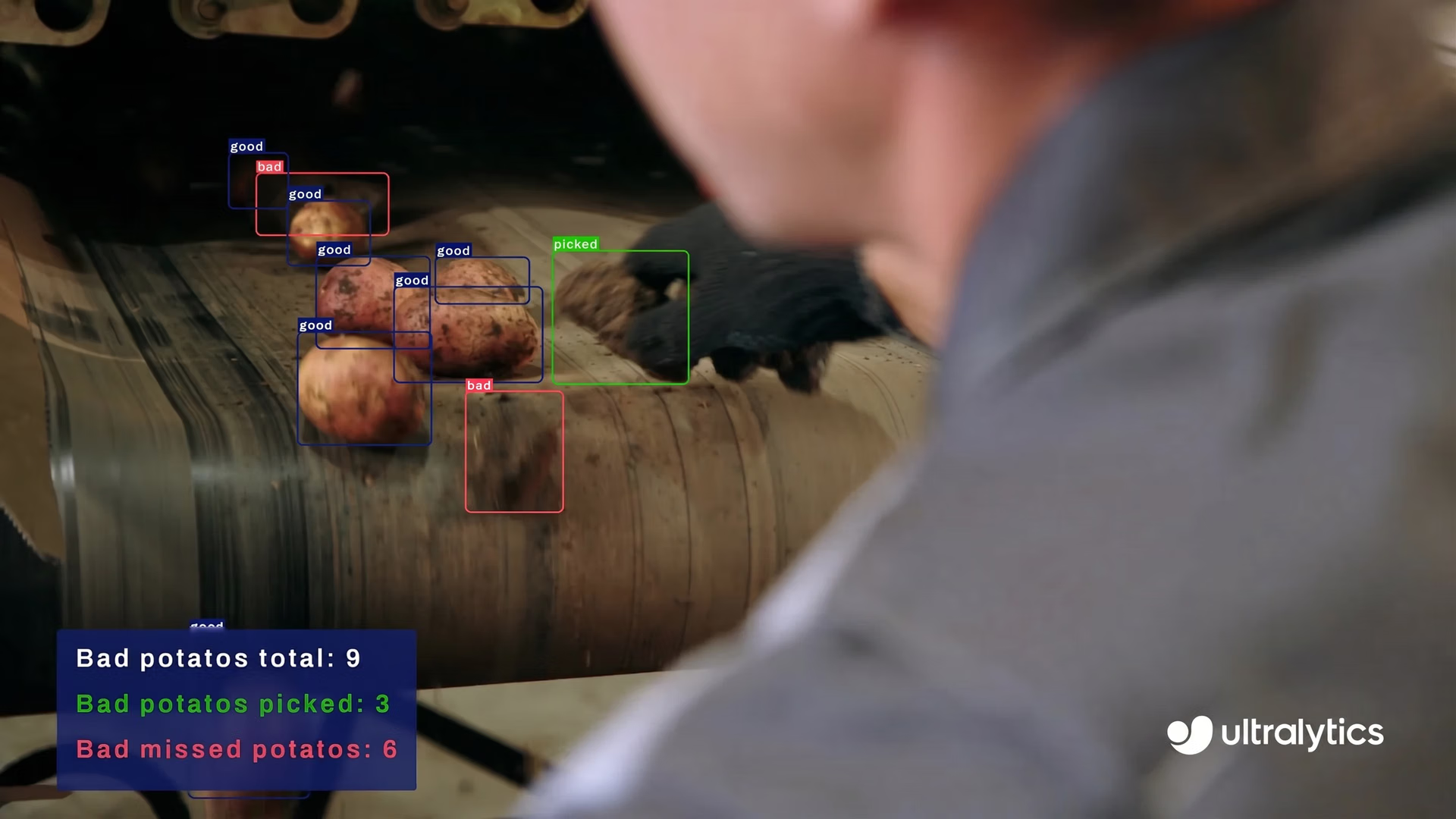
Fig 4. Using YOLO to detect and count healthy and defective potatoes
What types of problems in computer vision can unsupervised learning solve#
Unsupervised learning is useful when you don't have enough labeled data or when your data doesn't come with clear answers. In these situations, the goal isn't to make exact predictions, but to understand patterns and structure in the data.
It is often used when exploring an unlabeled dataset for the first time. Instead of telling the model what to look for, you allow it to identify similarities, group related images, or highlight unusual patterns on its own.
In a large collection of images, an unsupervised approach can help organize similar images together or flag outliers that may need further attention. This makes it a useful starting point in data science projects.
Generative models, including GANs, variational autoencoders, and diffusion models, learn the underlying distribution of images to create entirely new ones. These models power applications such as image synthesis, inpainting, super-resolution, and style transfer, and they form the backbone of today's generative AI systems.
In unsupervised segmentation, some methods group pixels or regions into coherent segments without relying on labeled masks, which is useful when annotation is too costly or when the goal is to discover structure rather than match predefined categories.
Unsupervised learning is also impactful when working with large datasets where labeling is time-consuming or not practical. In such cases, it lets you gain insights from the data without relying on labeled training data.
It is also commonly used in areas such as generative AI (models that create new data like images, text, or audio) and representation learning (models that learn useful features or patterns from raw data), where models learn general features from large amounts of data. Overall, if your problem involves exploration, pattern discovery, or working with unlabeled data, unsupervised learning is a flexible and practical approach to consider.
Real-world examples of unsupervised learning in computer vision#
Here are some examples of use cases where unsupervised learning is applied in computer vision:
- Anomaly detection in manufacturing: Models can learn what normal products look like and can flag defects or irregularities without needing labeled examples of every possible defect.
- Image organization and search: Large collections of images, such as photo libraries or e-commerce catalogs, can be automatically grouped based on visual similarity, making it easier for data scientists to organize, explore, and search through large datasets.
- Surveillance and security: Systems can analyze video footage to identify unusual patterns or behaviors, such as unexpected movement or crowd changes, without being explicitly trained on labeled events.
- Preprocessing and data exploration: Unsupervised methods are often used to explore and structure raw image data before training supervised models, helping improve data quality and reduce manual effort.
Practical limitations of supervised and unsupervised learning#
Despite the advantages of both learning approaches, there are certain limitations to consider. Here are some practical factors to keep in mind when building computer vision models:
- Overfitting in supervised models: In supervised learning, a model can learn the training data too closely instead of learning general patterns. This often happens when the dataset is small or not diverse enough. For example, a model trained to detect defects in one type of product may fail when tested on new data consisting of slightly different products or lighting conditions.
- Challenges with clustering algorithms: In unsupervised learning, a model can group similar data points together. However, this can break down when the data is noisy, inconsistent, or lacks a clear structure. For instance, in image grouping tasks, images with similar colors but different objects might be grouped together incorrectly.
- Importance of proper preprocessing: Before training, data needs to be cleaned and prepared. This is typically done using Python libraries that handle image processing and data transformation. It is especially important in computer vision, where images may vary in size, quality, or lighting. Without proper preprocessing, models may learn from noise instead of meaningful patterns, leading to poor performance.
Key takeaways#
In computer vision, both supervised and unsupervised learning play important roles. The right approach depends on the type of data you have, whether it is labeled or unlabeled, as well as the problem you are trying to solve and your deployment needs.
If your goal is high accuracy and clearly defined outputs, supervised machine learning is often the better choice. If you are exploring data or working without labels, unsupervised learning can be more suitable.
Want to know more about AI? Check out our community and GitHub repository. Explore our solution pages to learn about AI in robotics and computer vision in agriculture. Discover our licensing options and start building with computer vision today!