Managed Cloud vs Self-Hosted Computer Vision Deployment
Compare managed cloud and self-hosted computer vision deployment on cost, latency, data boundaries, scaling and exit risk, with three deployment patterns.
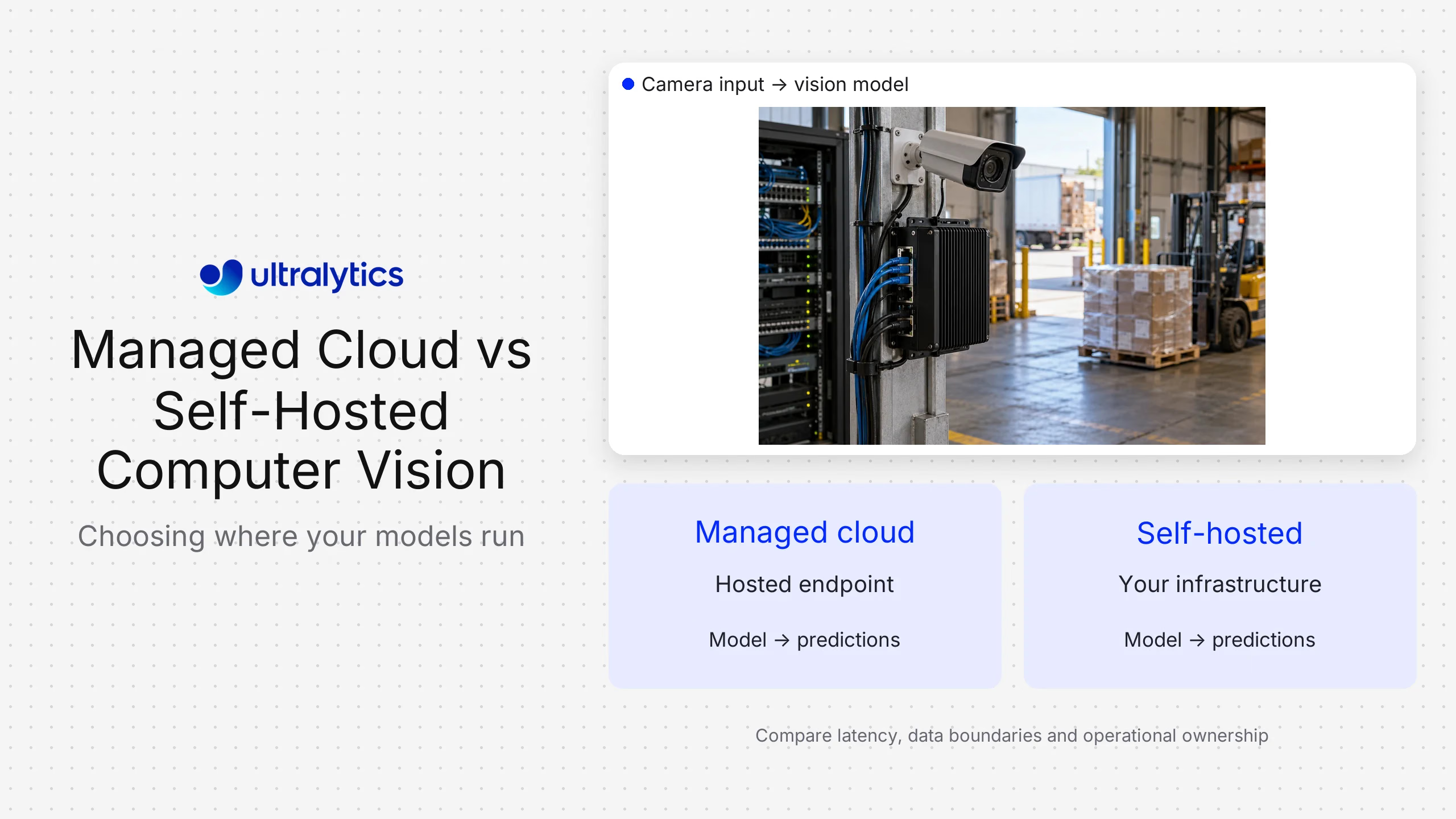
Managed cloud deployment is usually the faster way to launch a computer vision service. Self-hosting is usually the better choice when latency, data boundaries or infrastructure control are hard requirements. The difficult part is that teams often compare the two before defining which part of the system they want to control.
A vision application has at least four locations to decide: where images are stored, where models are trained, where inference runs and where the surrounding application runs. Those decisions do not have to match. A team can keep source images and training on its own infrastructure, run inference on edge devices, and still use a managed platform for experiment tracking and model management.
Ultralytics YOLO models support that kind of portable workflow. Ultralytics Platform can manage the data and training lifecycle, while export ed models can run on the infrastructure that fits the application. The correct choice is therefore not always cloud or self-hosted. It is often a hybrid with an explicit boundary for each component.
Managed cloud vs self-hosted at a glance#
| Decision area | Managed cloud | Self-hosted | Hybrid |
|---|---|---|---|
| Time to first deployment | Usually faster | Usually slower | Moderate |
| Infrastructure ownership | Provider | Your team | Shared by component |
| Scaling | Provider-managed options | You design and operate it | Managed where variable, local where fixed |
| Data control | Depends on service and region | Highest direct control | Sensitive pixels can remain local |
| Edge latency | Cloud round trip may be unsuitable | Local inference can minimize latency | Edge inference with managed control plane |
| Up-front engineering | Lower | Higher | Moderate |
| Ongoing operations | Service configuration and cost control | Hardware, orchestration, updates and monitoring | Split ownership must be documented |
| Portability | Depends on service and model format | High if the stack uses portable formats | High when exit paths are tested |
Choose managed cloud when speed, variable demand and a small infrastructure team matter most. Choose self-hosting when the workload must stay inside a controlled environment or inference must continue without a network connection. Choose hybrid when data, training and inference have different requirements.
What managed cloud means for computer vision#
In a managed deployment, a provider operates some or all of the infrastructure behind model serving. The team supplies a model or chooses a managed model, configures an endpoint, and pays for the resources or requests it consumes.
The provider may handle endpoint provisioning, health checks, autoscaling, updates to the serving layer and integration with its monitoring stack. That removes a large amount of platform work, but it does not remove application responsibility. The team still owns model quality, input validation, business logic, access policies and the decision about which images are permitted to reach the service.
Managed cloud is strongest when traffic changes significantly over time, the organization already uses that cloud, and a network round trip fits the latency budget. It is also useful during a pilot, when buying and operating a dedicated GPU fleet would front-load cost before the workload is understood.
The trade-off is dependence on a provider's endpoint model, regions, quotas and pricing structure. A service that is inexpensive at pilot volume can become the largest production cost if every camera sends every frame to the cloud.
What self-hosted means for computer vision#
Self-hosted deployment means the organization operates the serving infrastructure. That can be a server in a data center, a Kubernetes cluster, an industrial computer beside a production line, or an embedded device attached to a camera.
The organization controls where data flows and when software changes. It also owns capacity planning, GPU drivers, runtime compatibility, model rollout, observability, security updates, backups and recovery. “Runs on our hardware” is not an operating model until each of those jobs has an owner.
Self-hosting is strongest when inference must continue offline, images cannot leave a site, or a predictable high-volume workload makes dedicated compute economical. It is also the natural choice for applications where the result must return within a latency budget that a cloud round trip cannot meet.
The trade-off is operational depth. A working container on one GPU is not the same as a reliable production service across many sites.
Compare the real cost#
Do not compare a cloud endpoint's request price with the purchase price of a server. Compare the total system over the same period and workload.
For managed cloud, include:
- inference compute and any minimum provisioned capacity;
- storage and data transfer;
- monitoring, logging and retained artifacts;
- development and staging endpoints;
- idle resources that remain active between bursts; and
- engineering time for service integration and cost control.
For self-hosting, include:
- servers, edge devices, accelerators and spare capacity;
- installation, power, cooling and site access;
- orchestration, monitoring and update infrastructure;
- staff time for drivers, runtimes, security and incidents;
- replacement hardware and support; and
- the capacity held for peaks or failures.
The workload shape changes the answer. Cloud is attractive for uncertain or bursty demand because capacity can be added without purchasing hardware. Dedicated infrastructure becomes more attractive when utilization is high and predictable, provided the organization already has the people to run it.
Compare latency and bandwidth#
Computer vision workloads are unusually sensitive to data movement. Images and video are much larger than ordinary API payloads, and a camera can generate more frames than an application needs to analyze.
Start with the application's end-to-end latency budget. Include capture, encoding, network transfer, queueing, inference and the time to deliver the decision back to the machine or user. If the result controls a robot, production line or safety alert, local inference may be required even when model management remains in the cloud.
Bandwidth is a separate constraint. Sending continuous video to a remote endpoint can dominate cost and fail when connectivity is unstable. An edge system can run inference locally and send only events, metadata or selected frames upstream.
Compare privacy and data boundaries#
“On premises” and “private” are not synonyms. A self-hosted system can still be poorly secured, and a managed service can provide strong controls. The decision begins with a data map:
- where source images are captured and stored;
- whether derived images or crops leave the site;
- where labels and annotations are stored;
- which model artifacts encode information learned from the data;
- which staff and systems can access each layer; and
- how long logs, requests and outputs are retained.
Ultralytics Platform's On Premise integration illustrates why the boundary must be specific. Source and derived dataset pixels remain on the connected computer for ingest, preview and training. Classes, labels and annotations are stored as Platform metadata, training metrics stream to the Platform, and the best checkpoint uploads for later workflows. That design keeps dataset pixels local without claiming that every artifact stays local.
Review the current Ultralytics Platform On Premise documentation against the organization's requirements before treating it as a compliance control.
Compare scaling and reliability#
Managed platforms can reduce the work needed to add endpoint capacity, but autoscaling is not instant and every service has limits. Measure cold starts, queue behavior and the capacity available in the required region.
Self-hosted scaling requires deliberate engineering. The team decides how models are packaged, how requests are balanced, how GPUs are scheduled and what happens when a node fails. Kubernetes can help coordinate that infrastructure, but it does not decide the correct replica count, rollout policy or latency target.
For edge fleets, reliability includes more than endpoint uptime. Devices may lose connectivity, operate on different hardware revisions and miss updates. A production plan needs model versioning, staged rollout, rollback and a way to diagnose failures without visiting every site.
Three practical deployment patterns#
Managed training and managed inference#
Use this pattern when the team wants the shortest route from a dataset to an endpoint and cloud latency is acceptable. It minimizes infrastructure ownership and fits pilots, internal tools and services with variable demand.
The main controls are cost limits, regional data handling, endpoint access and an export path if the service must move later.
Managed training and self-hosted inference#
Use this pattern when cloud compute simplifies model development but inference must run locally. Train and evaluate in the managed environment, export a tested model, and deploy it to the edge or data center.
This pattern is common in manufacturing and robotics because model iteration benefits from managed compute while production decisions cannot depend on a network round trip.
Local data and training with managed lifecycle tools#
Use this pattern when source data must stay on controlled infrastructure but the team still wants a shared interface for annotation, metrics and model management. Ultralytics Platform On Premise is designed for this split: dataset pixels and training compute remain on the connected computer while selected metadata, metrics and the completed checkpoint connect to the Platform.
Document the boundary in operational language. State what stays local, what uploads and which cloud workflows process images submitted separately.
A decision path for common workloads#
Factory inspection. Prefer local or edge inference when the result must stop or divert a part at line speed. Managed training can still make sense.
Retail or facility analytics. Use edge preprocessing when continuous video would make bandwidth or privacy difficult. Send events or selected frames to the cloud where appropriate.
Batch image analysis. Managed cloud is often a good fit when latency is not interactive and jobs arrive in bursts.
Air-gapped or intermittently connected sites. Self-host the full runtime required for inference and operations. Do not make a cloud control plane part of the critical path.
Developer-facing vision API. Managed endpoints can reduce time to launch, especially while traffic is uncertain. Design request limits, observability and an exit path before volume grows.
Plan the exit before deployment#
Portability is not proved by downloading a model file. Test the complete path:
- Export the model into a runtime supported by the destination hardware.
- Reproduce preprocessing and postprocessing outside the original service.
- Validate output parity on a fixed test set.
- Recreate monitoring, access control and rollout procedures.
- Measure latency and resource use in the destination environment.
- Document how data, labels, model versions and audit records move.
This exercise also improves the current deployment. It exposes hidden dependencies before an outage, pricing change or new data requirement forces a rushed migration.
Frequently asked questions
Managed cloud usually reduces infrastructure work and speeds up the first launch. Self-hosting usually provides more direct control over data location, latency and runtime. The trade is provider dependence and variable cost on one side versus engineering ownership and capacity planning on the other.
It can be for a stable, highly utilized workload, but only after hardware, operations, spare capacity and staff time are included. Cloud can be cheaper for pilots, bursty workloads and teams that would otherwise build a platform from scratch.
Run inference at the edge when the application cannot tolerate a cloud round trip, connectivity is unreliable, continuous video would consume too much bandwidth, or images must remain at the site.
Yes. This hybrid pattern lets the team use managed compute and collaboration during model development, then export the model for inference on its own servers or edge devices.
Not automatically. Read the product's data boundary. In Ultralytics Platform On Premise, source dataset pixels remain local, while labels, annotations, metrics and the best checkpoint interact with the Platform as documented.
Test end-to-end latency, throughput, failure recovery, data movement, model rollout, rollback, monitoring and the total cost at expected production volume. Run the test on the intended hardware and network, not only a development laptop.