Scale AI Alternatives for Data Labeling
Alternatives to Scale AI for vision data labeling: iMerit, SuperAnnotate and Ultralytics Platform, compared on cost, control, ramp time and data handling.
If you are looking for a Scale AI alternative, the shortlist depends on one question: are you buying a labeling service or a labeling platform? Scale AI and iMerit sell managed workforces that deliver finished annotations. SuperAnnotate and Ultralytics sell tooling your own team operates, with optional services around it. Choosing the wrong side of that line is the most expensive mistake in this category, and it is not a pricing decision. It is a decision about who owns quality control.
This page compares the four options against the criteria enterprise buyers actually use: task coverage, data ownership, workforce model, integration surface, and what happens when label quality slips.
Why teams look past Scale AI#
Three reasons come up repeatedly in buyer discussions and vendor comparisons.
Enterprise pricing is quote-only. The self-serve Scale Rapid tier does publish per-unit rates with no minimum, but enterprise annotation is quoted per project and carries meaningful minimum commitments. Teams that need to model unit costs at production volume before committing find this hard to plan around.
Ownership changed the calculus. Meta took a large minority stake in Scale AI in June 2025 and founder Alexandr Wang moved to Meta. Several major AI labs subsequently reduced or ended labeling work with Scale over data-confidentiality concerns about a competitor's investor having visibility into the supply chain. Whether that applies to you depends entirely on who your competitors are (for most industrial and enterprise vision teams it does not), but it belongs in a diligence conversation, and any comparison written before mid-2025 will not mention it.
The service model assumes you are outsourcing judgment. That works when your labeling schema is stable and your acceptance criteria are easy to write down. It works badly when the schema is still moving, which is the normal state of a computer vision project in its first six months.
Iteration speed is bounded by the vendor loop. Every schema change is a conversation, a requalification, and a new batch. Teams doing weekly model iterations often want the annotation step inside their own control loop.
None of that makes Scale AI a poor choice. It makes it a specific choice, suited to large, well-specified, high-volume programs.
The four options at a glance#
Vendors are listed alphabetically, not ranked.
| Model | Best fit | You control quality? | Where is data processed? | |
|---|---|---|---|---|
| iMerit | Managed service, specialist | LiDAR, autonomous systems, safety-critical | Vendor-managed, domain experts | Vendor infrastructure |
| Scale AI | Managed service | Large, well-specified programs | Vendor-managed | Vendor infrastructure |
| SuperAnnotate | Platform + optional services | Multi-modal projects across teams | Yes, your reviewers | Your own cloud storage, via AWS, Azure or GCP integrations |
| Ultralytics Platform | Platform | Teams training and shipping vision models | Yes, your reviewers | Ultralytics cloud; residency pinnable to US, EU or AP. Dataset pixels can stay on your own machines via the On Premise integration |
Scale AI#
What it is. A managed data annotation service. You supply raw data and examples of what good looks like; Scale AI distributes the work across a remote workforce and returns cleaned, labeled data.
Best for. High-volume programs with a settled schema and a budget that tolerates quote-based pricing: autonomous driving fleets, large language model preference data, and government contracts.
Strengths. Scale operates at a size very few competitors match, and that shows in throughput on large batches. It has established processes for handling sensitive and regulated workloads, and it can staff specialist tasks that a general crowd platform cannot.
Trade-offs. Enterprise pricing is not public, which makes budget modeling difficult before you are already in a sales conversation, though the self-serve Scale Rapid tier does publish per-unit rates and carries no minimum, which is the practical way to price-test the service. The service model puts a vendor loop between you and your labels, so schema changes cost time. Small teams and academic projects are not the target customer, though limited free annotation has been available for small research projects.
Deployment and licensing. Managed service; data is processed by the vendor's workforce. Commercial terms, minimum commitments and data-handling arrangements are negotiated per contract.
SuperAnnotate#
What it is. An annotation platform covering multiple data types, sold with optional managed services on top.
Best for. Teams annotating more than one modality (images alongside video, LiDAR or audio) who want a single tool and their own reviewers in the loop.
Strengths. Breadth of data-type coverage is the differentiator: images, video, audio, text and LiDAR point clouds in one platform, which is what makes it a genuine multimodal option rather than an image tool with extras. It integrates with the major clouds so data can stay in storage you already control, and it connects to external model providers for automated pre-labeling and model evaluation. Its quality tooling is well regarded, and it is one of the highest-rated platforms in its category on public review sites.
Trade-offs. Platform breadth brings configuration overhead; teams labeling one modality may find it heavier than they need. Because you operate the tool, you also own reviewer throughput. The platform will not absorb a quality problem for you.
Deployment and licensing. Cloud platform with enterprise integrations. Licensing is seat and volume based; confirm current tiers directly.
iMerit#
What it is. A managed annotation service specializing in complex and safety-critical data, with particular depth in LiDAR and 3D.
Best for. Autonomous vehicles, robotics, and other programs where label quality needs specialist review.
Strengths. iMerit's own service range covers 3D point-cloud and LiDAR annotation across semantic, cuboid, landmark, polygon and polyline work, with multi-sensor fusion across LiDAR, radar and camera inputs: the combination autonomous-vehicle and AMR perception models need. Its team placed first in the CVPR 2026 auto-annotation challenge, which is an unusually direct piece of evidence for annotation quality in a market that mostly competes on claims. Where a general crowd workforce struggles (sensor fusion, 3D boxes, sequences needing temporal consistency) a trained specialist workforce is a genuine advantage.
Trade-offs. Specialization narrows the fit. For straightforward 2D bounding boxes at volume, you are paying for expertise the task does not require. As with any managed service, iteration runs at the speed of the vendor loop.
Deployment and licensing. Managed service with domain-expert annotators. Engagements are scoped per project.
Ultralytics Platform#
What it is. An annotation and dataset platform built for teams who will train and deploy the resulting models: annotation, dataset management and analytics in one place, connected directly to training.
Best for. Computer vision teams who own their models and want the labeling step inside their own iteration loop rather than behind a vendor.
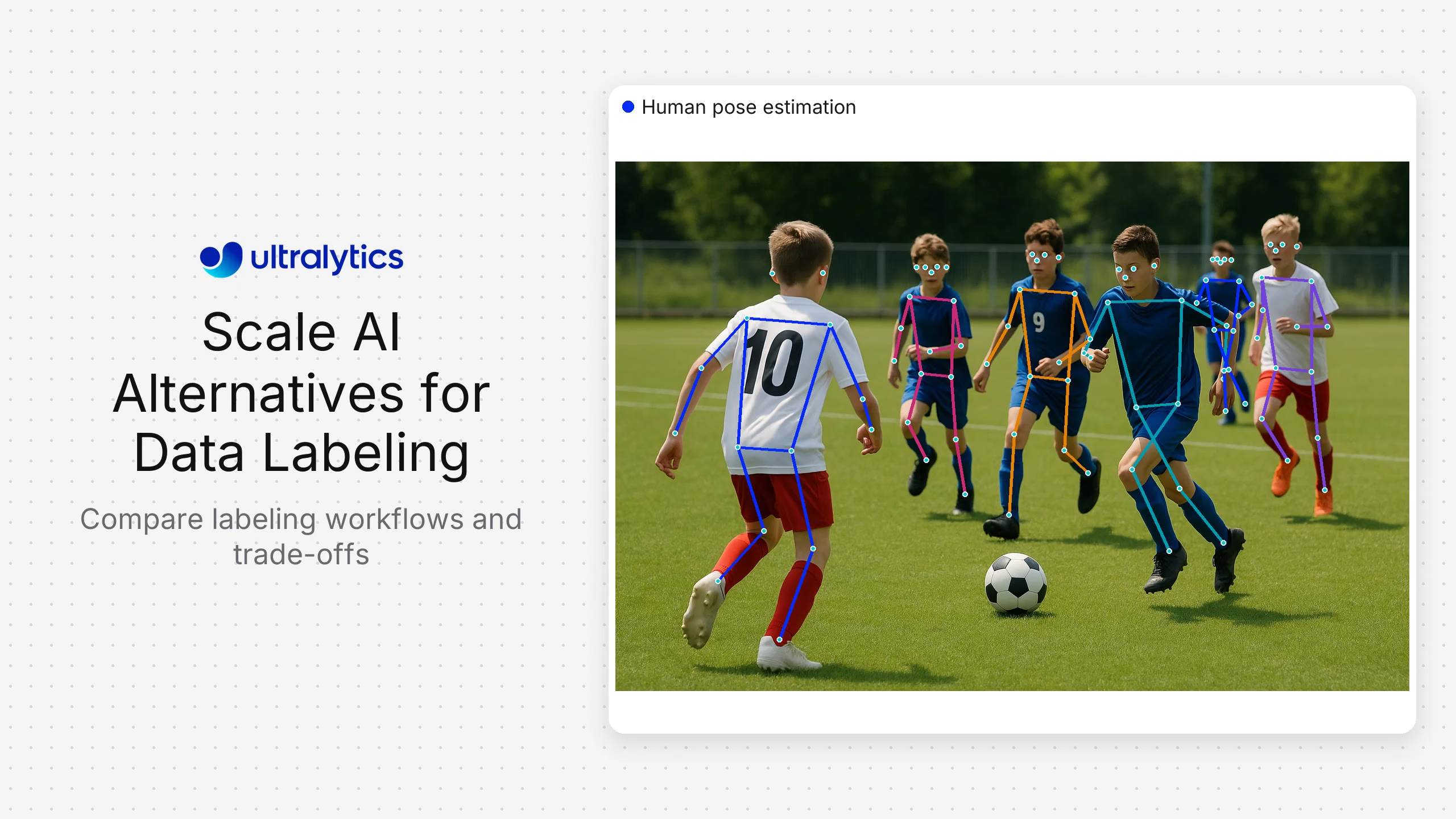
Strengths. Smart annotation is SAM-powered, producing masks and bounding boxes in a single click, and the platform covers all six vision tasks a production program needs: object detection, instance segmentation, semantic segmentation, classification, pose estimation and oriented object detection. Import and export cover YOLO, COCO and VOC, so it fits an existing pipeline rather than replacing it. Team review and dataset versioning are built in. The practical advantage is continuity: the dataset you annotate is the dataset you train on, without an export-and-hand-off step.
Trade-offs. It is a platform, not a workforce. If you have no annotators and no intention of hiring any, a managed service is the better answer. Its depth is in vision; teams needing text or audio annotation in the same tool should look at a multi-modal platform.
Deployment and licensing. Managed cloud platform with data residency selectable in the US, EU or AP, holding SOC 2 Type I and ISO 27001:2022: note that Type I attests to control design at a point in time, not operating effectiveness over a period, which is Type II. Cloud GPU rates are published per hour with pay-as-you-go billing, so the training line is calculable before any sales conversation, which is unusual in a market of quote-only vendors. Teams that need dataset pixels to remain on their own machines should evaluate the On Premise integration rather than assuming the managed platform provides that.
Ultralytics YOLO models are AGPL-3.0; commercial or proprietary use generally requires an Enterprise license. And unlike Scale AI, iMerit and SuperAnnotate, Ultralytics Platform launched in March 2026 and has no multi-year delivery history: where a decade of operating track record is part of the decision, that difference is real.
How to choose#
Choose a managed service, Scale AI or iMerit, when your schema is stable, your volume is large, and you would rather buy finished labels than run an annotation team. Pick iMerit over Scale AI when the data is 3D, sensor-fused, or safety-critical; pick Scale AI when raw throughput at scale is the constraint.
Choose a platform, SuperAnnotate or Ultralytics, when your schema is still moving, your team iterates weekly, or your data cannot leave your environment. Pick SuperAnnotate when you are annotating several modalities; pick Ultralytics Platform when the work is vision and the annotations feed models you train yourself.
A useful test: if your labeling guidelines changed in the last month, you want a platform. If they have not changed in six months and will not change again this year, a service will be cheaper.
What to ask before you sign#
Buyer guides in this category converge on a short list of questions that separate vendors quickly.
- Workforce. Who does the labeling, how are they qualified, and what is the ratio of domain experts to general crowd workers? Vague answers about a "global workforce" without verification specifics are a warning sign. - Security. Request current security and privacy documentation that matches your data, deployment region and regulatory obligations. Verify it during procurement rather than relying on a roundup. - Data handling. Where is data stored, who can access it, and how long is it retained? - Pricing transparency. Ask for per-label costs and minimum commitments in writing, not a blended project figure. - Quality mechanics. What is the measured agreement rate between annotators, and what happens, commercially, when a batch fails your acceptance criteria?
Moving off Scale AI without stalling your models#
Migration fails when it is treated as a procurement exercise rather than an engineering one.
Export in an open format first. Get your existing annotations into YOLO or COCO before you negotiate anything. Both are widely supported, and holding your labels in a portable format is what makes the next decision reversible.
Run the new vendor in parallel on a known batch. Take a slice you have already labeled, have the candidate relabel it, and measure agreement against your existing set. This is the only reliable way to compare quality, and it costs a fraction of a full migration.
Move the schema, not just the data. Labeling guidelines, edge-case rulings and class definitions carry more institutional knowledge than the annotations themselves. Write them down before they leave with the old vendor.
Keep one loop closed. Whichever option you choose, make sure a model trains on the new labels early. A dataset that has not trained a model has not been validated.
Frequently asked questions
Yes, for tooling. Open-source annotation tools such as CVAT and Label Studio are widely used and cost nothing to run, but you supply the infrastructure, the annotators and the quality process. They are a genuine option for small teams and a poor one for programs that need throughput guarantees.
Partly. The self-serve Scale Rapid tier publishes per-unit rates and carries no minimum, which is the practical way to price-test the service. Enterprise engagements are quoted, and published rates are not sufficient to model one. Ask each vendor to quote the same representative sample and separate labeling, review, rework, platform and service costs.
iMerit is the strongest specialist for LiDAR and sensor-fused data used in autonomous systems. SuperAnnotate also supports LiDAR if you want to keep the work on a platform your own team operates.
It depends on the platform. SuperAnnotate integrates with AWS, Azure and GCP so data can stay in storage you own. Ultralytics Platform is a managed cloud service. You choose a US, EU or AP residency zone, but processing happens on Ultralytics infrastructure; if dataset pixels must stay on your own machines, evaluate its On Premise integration instead. With a managed labeling service, your data is processed by the vendor's workforce, so this becomes a contractual question rather than a technical one.
Most production vision programs need more than bounding boxes. Ultralytics Platform covers six: detection, instance segmentation, semantic segmentation, classification, pose estimation and oriented object detection: smart annotation assists on the first four, with pose and classification annotated manually. Work out which tasks your models actually need and check each candidate task by task; a tool covering only bounding boxes is a constraint you will meet later.
The schedule risk is not only data movement. It is rebuilding labeling guidelines and acceptance criteria if they were never written down.