What is overfitting in computer vision and how to prevent it?
Learn what overfitting is in computer vision and how to prevent it using data augmentation, regularization, and pre-trained models.
Computer vision models are designed to recognize patterns, detect objects, and analyze images. However, their performance depends on how well they generalize to unseen data. Generalization is the model’s ability to work well on new images, not just the ones it was trained on. A common issue in training these models is overfitting, in which a model learns too much from its training data, including unnecessary noise, instead of identifying meaningful patterns.
When this happens, the model performs well on training data but struggles with new images. For example, an object detection model trained only on high-resolution, well-lit images may fail when presented with blurry or shadowed images in real-world conditions. Overfitting limits a model’s adaptability, limiting its use in real-world applications like autonomous driving, medical imaging, and security systems.
In this article, we’ll explore what overfitting is, why it happens, and how to prevent it. We'll also look at how computer vision models like Ultralytics YOLO11 help reduce overfitting and improve generalization.
What is overfitting?#
Overfitting happens when a model memorizes training data instead of learning patterns that apply broadly to new inputs. The model gets too focused on the training data, so it struggles with new images or situations it hasn’t seen before.
In computer vision, overfitting can affect different tasks. A classification model trained only on bright, clear images may struggle in low-light conditions. An object detection model that learns from perfect images might fail in crowded or messy scenes. Similarly, an instance segmentation model may work well in controlled settings but have trouble with shadows or overlapping objects.
This becomes an issue in real-world AI applications, where models must be able to generalize beyond controlled training conditions. Self-driving cars, for instance, must be able to detect pedestrians in different lighting conditions, weather, and environments. A model that overfits its training set won’t perform reliably in such unpredictable scenarios.
When and why does overfitting happen?#
Overfitting usually occurs due to imbalanced datasets, excessive model complexity, and overtraining. Here are the main causes:
- Limited training data: Small datasets make models memorize patterns rather than generalize them. A model trained on only 50 images of birds may struggle to detect bird species outside that dataset.
- Complex models with too many parameters: Deep networks with excessive layers and neurons tend to memorize fine details rather than focusing on essential features.
- Lack of data augmentation: Without transformations like cropping, flipping, or rotation, a model may only learn from its exact training images.
- Prolonged training: If a model goes through the training data too many times, known as epochs, it memorizes details instead of learning general patterns, making it less adaptable.
- Inconsistent or noisy labels: Incorrectly labeled data causes a model to learn the wrong patterns. This is common in manually labeled datasets.
A well-balanced approach to model complexity, dataset quality, and training techniques ensures better generalization.
Overfitting vs. underfitting#
Overfitting and underfitting are two completely polar issues in deep learning.
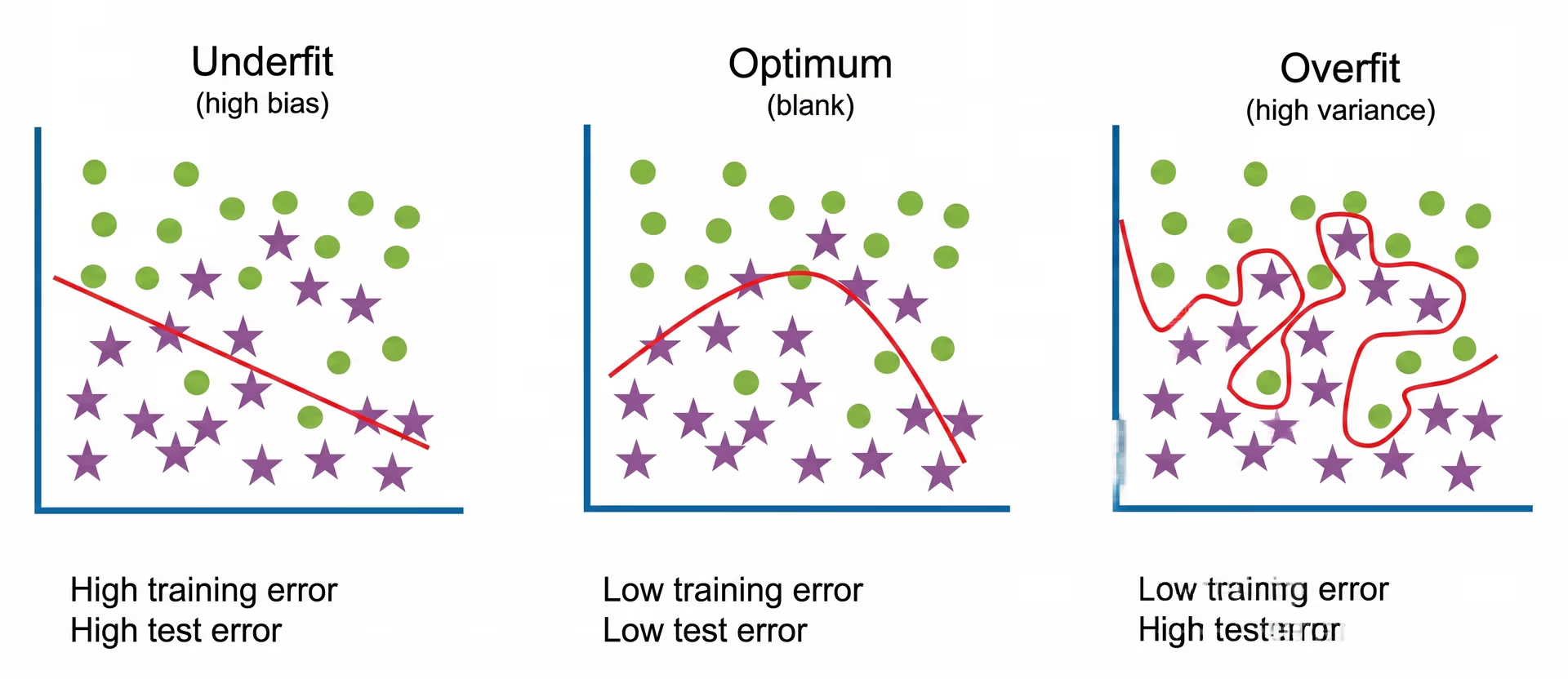
Fig 1. Comparison of underfitting, optimal learning, and overfitting in computer vision models.
Overfitting happens when a model is too complex, making it overly focused on training data. Instead of learning general patterns, it memorizes small details, even irrelevant ones like background noise. This causes the model to perform well on training data but struggle with new images, meaning it hasn’t truly learned how to recognize patterns that apply in different situations.
Underfitting happens when a model is too basic, so it misses important patterns in the data. This can occur when the model has too few layers, not enough training time, or the data is limited. As a result, it fails to recognize important patterns and makes inaccurate predictions. This leads to poor performance on both training and test data because the model hasn’t learned enough to understand the task properly.
A well-trained model finds the balance between complexity and generalization. It should be complex enough to learn relevant patterns but not so complex that it memorizes data instead of recognizing underlying relationships.
How to identify overfitting#
Here are some signs that indicate a model is overfitting:
- If training accuracy is significantly higher than validation accuracy, the model is likely overfitting.
- A widening gap between training loss and validation loss is another strong indicator.
- The model is too confident in wrong answers, showing that it memorized details instead of understanding patterns.
To ensure a model generalizes well, it needs to be tested on diverse datasets that reflect real-world conditions.
How to prevent overfitting in computer vision#
Overfitting isn’t inevitable and can be prevented. With the right techniques, computer vision models can learn general patterns instead of memorizing training data, making them more reliable in real-world applications.
Here are five key strategies to prevent overfitting in computer vision.
Increase data diversity with augmentation and synthetic data#
The best way to help a model work well on new data is by expanding the dataset using data augmentation and synthetic data. Synthetic data is computer-generated instead of collected from real-world images. It helps fill in gaps when there isn’t enough real data.
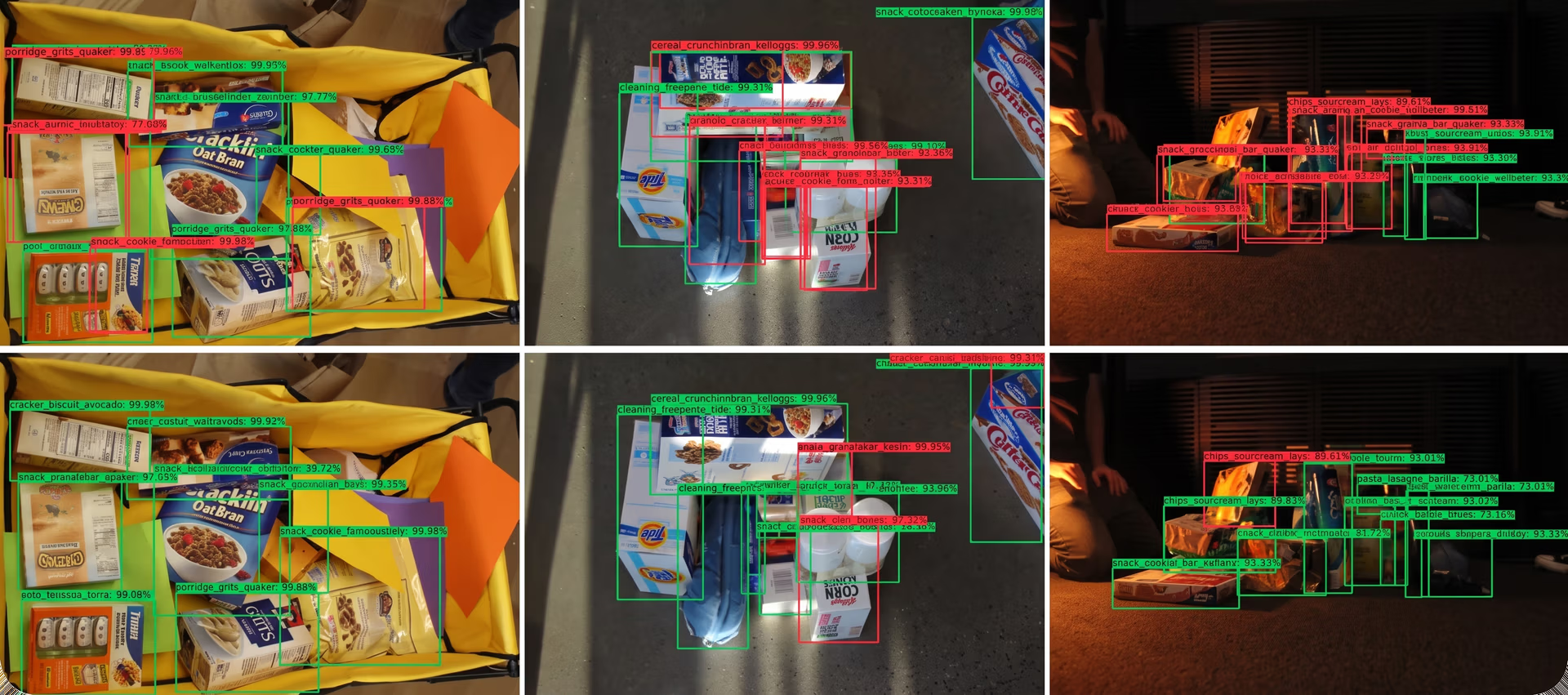
Fig 2. Combining real-world and synthetic data reduces overfitting and improves object detection accuracy.
Data augmentation slightly changes existing images by flipping, rotating, cropping, or adjusting brightness, so the model doesn’t just memorize details but learns to recognize objects in different situations.
Synthetic data is useful when real images are hard to get. For example, self-driving car models can train on computer-generated road scenes to learn how to detect objects in different weather and lighting conditions. This makes the model more flexible and reliable without needing thousands of real-world images.
Optimize model complexity and architecture#
A deep neural network, which is a type of machine learning model that has many layers that process data instead of a single layer, isn’t always better. When a model has too many layers or parameters, it memorizes training data instead of recognizing broader patterns. Reducing unnecessary complexity can help prevent overfitting.
To achieve this, one approach is pruning, which removes redundant neurons and connections, making the model leaner and more efficient.
Another is simplifying the architecture by reducing the number of layers or neurons. Pre-trained models like Ultralytics YOLO11 are designed to generalize well across tasks with fewer parameters, making them more resistant to overfitting than training a deep model from scratch.
Finding the right balance between model depth and efficiency helps it learn useful patterns without just memorizing training data.
Apply regularization techniques#
Regularization techniques prevent models from becoming too dependent on specific features in training data. Here are a few commonly used techniques:
- Dropout turns off random parts of the model during training so it learns to recognize different patterns instead of relying too much on a few features.
- Weight decay (L2 regularization) discourages extreme weight values, keeping the model’s complexity under control.
- Batch normalization helps stabilize training by ensuring the model is less sensitive to variations in the dataset.
These techniques help maintain a model’s flexibility and adaptability, reducing the risk of overfitting while preserving accuracy.
Monitor training with validation and early stopping#
To prevent overfitting, it's important to track how the model learns and ensure it generalizes well to new data. Here are a couple of techniques to help with this:
- Early stopping: Automatically ends training when the model stops improving, so it doesn’t keep learning unnecessary details.
- Cross-validation: Divides the data into parts and trains the model on each one. This helps it learn patterns instead of memorizing specific images.
These techniques help the model stay balanced so it learns enough to be accurate without becoming too focused on just the training data.
Use pre-trained models and improve dataset labeling#
Instead of training from scratch, using pre-trained models like Ultralytics YOLO11 can reduce overfitting. YOLO11 is trained on large-scale datasets, allowing it to generalize well across different conditions.
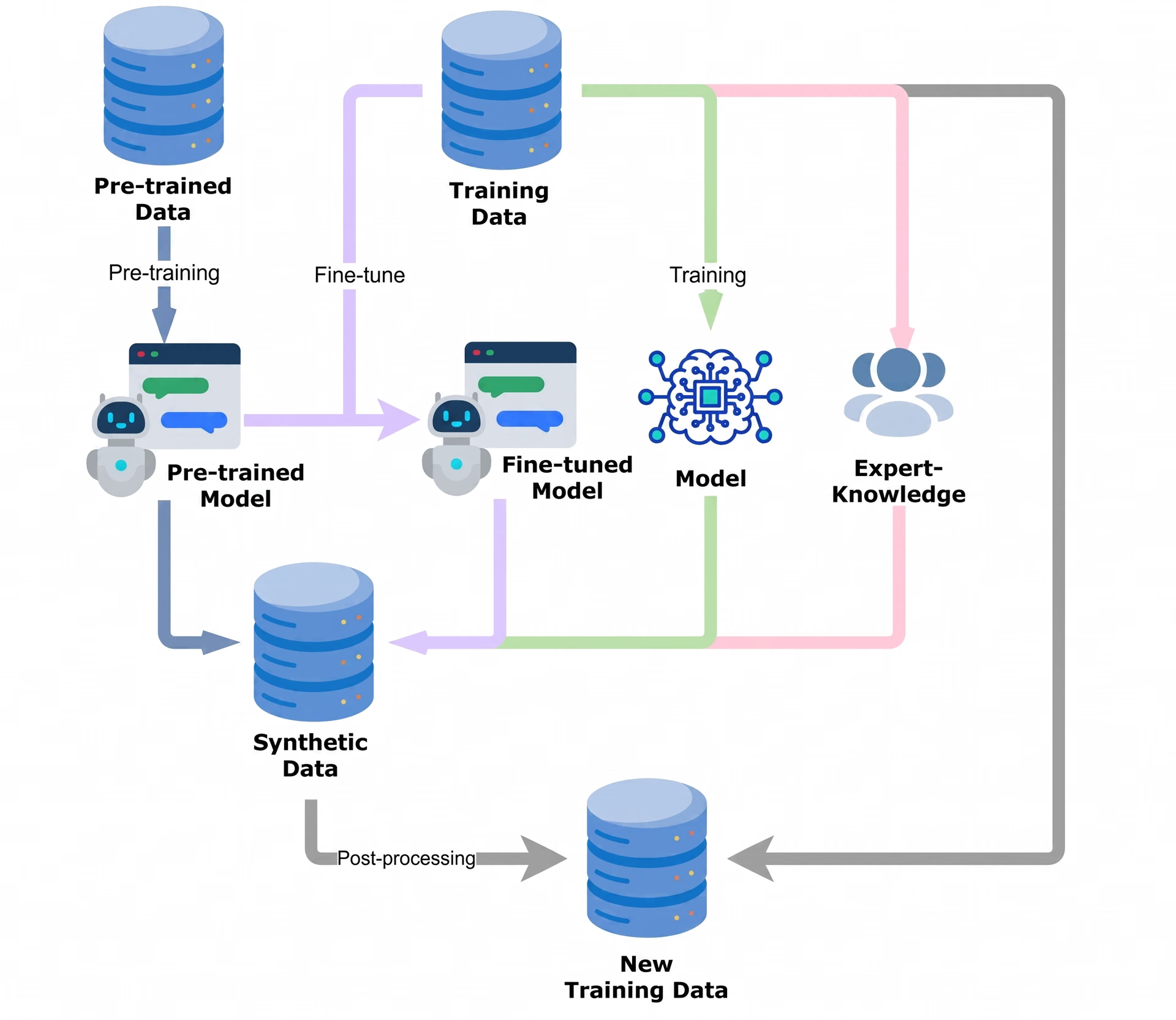
Fig 3. Pretrained computer vision models enhance accuracy and prevent overfitting.
Fine-tuning a pre-trained model helps it keep what it already knows while learning new tasks, so it doesn’t just memorize the training data.
Additionally, ensuring high-quality dataset labeling is essential. Mislabeled or imbalanced data can mislead models into learning incorrect patterns. Cleaning datasets, fixing mislabeled images, and balancing classes improve accuracy and reduce the risk of overfitting. Another effective approach is adversarial training, where the model is exposed to slightly altered or more challenging examples designed to test its limits.
Key takeaways#
Overfitting is a common problem in computer vision. A model might work well on training data but struggle with real-world images. To avoid this, techniques like data augmentation, regularization, and using pre-trained models like Ultralytics YOLO11 help improve accuracy and adaptability.
By applying these methods, AI models can stay reliable and perform well in different environments. As deep learning improves, making sure models generalize properly will be key for real-world AI success.
Join our growing community! Explore our GitHub repository to learn more about AI. Ready to start your own computer vision projects? Check out our licensing options. Discover vision AI in self-driving and AI in healthcare by visiting our solutions pages!








