OnsiteIQ built a construction intelligence platform powered by Ultralytics YOLO11, running segmentation models across 360-degree job sites to detect construction progress, safety risks, and operational issues in real time, reducing project delays by 20%.
In construction, information gaps are expensive. When a project falls behind schedule, identifying the cause, assigning responsibility, and agreeing on a resolution between owners, developers, and subcontractors can take weeks. In the meantime, delays compound, budgets erode, and revenue is lost. For a hotel delayed by two months, that gap can represent a significant portion of the original projected return on investment.
The core problem is visibility. Construction projects involve dozens of trades working simultaneously across large, complex sites. Without a reliable, continuous record of what has been completed, when, and by whom, disputes are difficult to resolve quickly, and progress is difficult to forecast accurately.
OnsiteIQ was built to close that gap. The company deploys a network of capture specialists to active construction sites, capturing 100% of each job site using 360-degree cameras on a regular weekly, biweekly, or daily cadence, depending on the project.
That footage is then transformed into geolocated imagery and run through a proprietary AI pipeline that detects construction progress, flags safety risks, and surfaces operational insights, all powered by Ultralytics YOLO11.
Bringing construction intelligence to every job site#
OnsiteIQ provides construction intelligence to owners and developers in real estate. To date, OnsiteIQ has monitored more than 3,000 projects across 200+ cities in the U.S. and Canada, covering over $34B in new development. Its platform gives project teams the ability to understand what is happening on a job site in near real time, without having to be physically present. A project team managing a one-million-square-foot development can review the entire site within a single working day, with AI-generated insights on progress by floor, by trade, and by area.
The platform is designed around a straightforward value proposition: making sure that deployed capital reaches its intended outcome, on time and on budget. Construction delays have a direct financial impact. If a hotel is delivered two months late, the lost room revenue for that period eats directly into the project's return on investment. OnsiteIQ offers project teams the visibility to catch sequencing problems early, for instance, identifying that drywall finishing is running ahead of schedule and alerting the electrical and plumbing trades to keep pace, before those issues trigger broader delays.
Beyond progress tracking, the platform also supports safety and risk monitoring. Detecting fire extinguishers, fire alarms, water ingress, and other site conditions gives project teams an additional layer of oversight that would otherwise require dedicated in-person inspection rounds.
The challenge of tracking progress across an evolving job site#
Construction sites are dynamic environments. The same space looks entirely different at every phase of a project, from excavation and superstructure through to mechanical rough-ins, drywall, and finished interiors. Tracking what has been completed and what has not requires a system that can understand the visual state of a site across all of these phases simultaneously.
Manual approaches to this problem, such as site walks, progress reports, and photo submissions, are often labour-intensive, inconsistent, and difficult to scale across large or complex projects.
For OnsiteIQ, the challenge was building a detection system capable of identifying construction-specific classes accurately across hundreds of thousands of images per project, in conditions that vary significantly by site, lighting, and phase. The system needed to be fast enough to process large volumes of imagery in the background, accurate enough to support financial and operational decision-making, and flexible enough to expand as the company's ontology of detectable classes continued to grow.
How OnsiteIQ uses Ultralytics YOLO11#
OnsiteIQ's AI pipeline is built around Ultralytics YOLO11 segmentation, running across every image captured on a job site. The system uses a proprietary ontology, a structured knowledge system of construction classes built and maintained by OnsiteIQ, as the foundation for model training and detection. As Principal Product Manager Rammohan Adabala describes it, the ontology is what makes detections decision-grade: classes are defined by state as well as by object, so the system distinguishes drywall that has been hung from drywall that has been taped or painted. That distinction is what allows image-level detections to aggregate into progress an owner can act on.
The pipeline works in two stages:
• Detection at the image level. Every 360-degree image captured on a job site is run through the YOLO11 segmentation model, which detects and classifies construction elements present in the image. The ontology covers a wide range of classes across every phase of construction, from bare concrete superstructure and MEP rough-ins through to unpainted drywall, finished surfaces, and installed appliances. Detecting a refrigerator or an oven, for example, tells the system that a residential or hospitality unit has reached the finishing stage.
• Aggregation into insights. Individual image detections are aggregated across the full dataset for a project, producing floor-level and trade-level progress metrics. These metrics feed into the platform's progress tracking, schedule analysis, risk analysis, and safety dashboards, which are surfaced directly to owners, developers, and project managers.
Using segmentation gives OnsiteIQ richer spatial information than bounding-box detection alone. As the company's ontology expands, OnsiteIQ is also developing an ensemble architecture that combines a segmentation model with a classifier, allowing the system to improve accuracy across a growing class set more efficiently than a single model would allow.
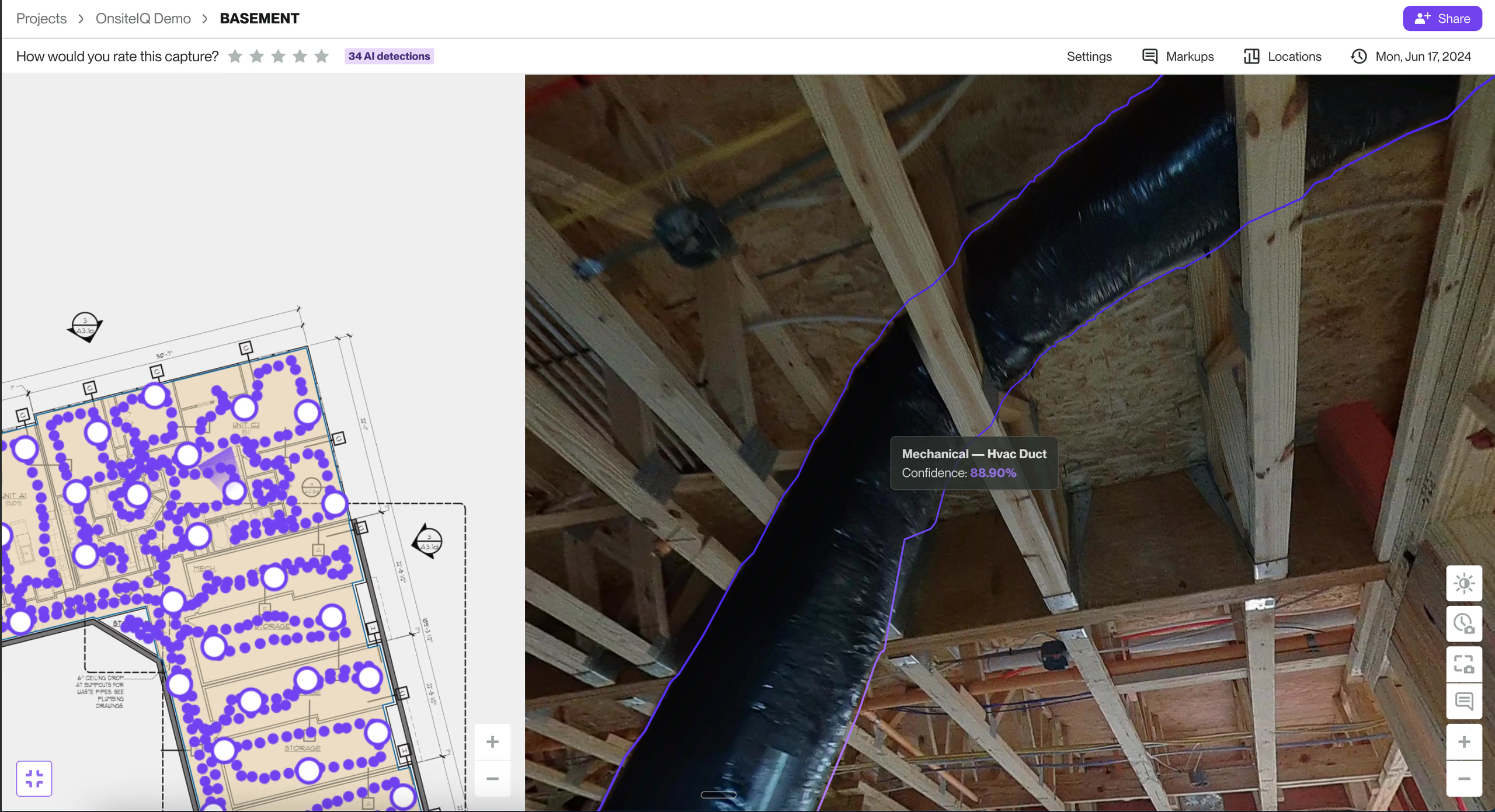 Fig 1. OnsiteIQ platform at work leveraging Ultralytics YOLO11.
Why choose Ultralytics YOLO11?#
OnsiteIQ chose Ultralytics YOLO11 for its combination of detection accuracy, training flexibility, and the ease with which the team could build and iterate on its own proprietary datasets. According to Principal Engineer Evgeny Nuger, the ability to get started quickly, building a dataset, running the trainer, and iterating on results, was meaningfully faster than building custom infrastructure from scratch, and was one of the leading reasons the team moved to Ultralytics.
Because OnsiteIQ's training data is proprietary, captured directly from active job sites and labeled according to the company's own ontology, the team manages its own infrastructure on AWS, using the Ultralytics Python package to run training and keep models up to date. This approach gives OnsiteIQ full control over its data while benefiting from the performance and reliability of the YOLO model family.
The flexibility of the YOLO architecture has also been important as OnsiteIQ's use case has evolved. Starting with a single segmentation model, the team is now building toward an ensemble approach as the ontology grows, a natural progression that the YOLO framework supports without requiring a fundamental change to the underlying pipeline.
The impact of construction intelligence at scale#
OnsiteIQ has conducted impact studies with its customers to quantify the operational improvements that follow from deploying its platform. Across these studies, several consistent metrics have emerged:
• 3x faster dispute resolution. 81% of users reported faster dispute resolution, with a 3x average decrease in time to resolution and cases up to 7x faster depending on project phase and complexity. With a continuous, geolocated visual record of every area of the site, stakeholders can quickly identify when and where an issue arose, reducing time spent in back-and-forth between trades
• $25,000 to $400,000 in cost overrun savings. Customers have reported avoiding between $25,000 and $400,000 in cost overruns per project by catching sequencing issues and risks before they escalate.
• 20% reduction in project delays. Given that the majority of construction projects finish behind schedule, a 20 percent reduction in delays represents a meaningful improvement in delivery predictability and revenue realization.
• 24% increase in delivery predictability. 78% of users reported improved project delivery predictability, with a 24% average increase, giving owners and developers a more reliable basis for financial planning and stakeholder reporting.
Overall, the platform also serves as a long-term asset record. After construction is complete, facility managers can use OnsiteIQ's imagery to understand what lies behind walls, locate pipework, or investigate building issues, without guesswork or disruptive exploratory work.
Continuous visibility across the full project lifecycle#
OnsiteIQ is solving a fundamental information problem in construction. Large projects involve significant capital, complex coordination across multiple trades, and high financial exposure to delays. By combining 360-degree capture with an AI pipeline built on Ultralytics YOLO11, OnsiteIQ gives project teams the visibility they need to keep projects on track, from the first day of excavation through to handover and beyond.
The results are measurable: disputes resolved three times faster, delays reduced by a fifth, and hundreds of thousands of dollars in cost overruns avoided per project. As OnsiteIQ's ontology continues to expand and its ensemble model architecture develops, Ultralytics YOLO remains at the core of a platform built to bring reliable, continuous intelligence to every job site.
Curious about vision AI for construction and infrastructure? Discover our licensing options to bring computer vision solutions to your projects. Visit our GitHub repository and join our community.








