By integrating Ultralytics YOLO models into the Pixelabs AI-Engine, Pixelabs was able to automate visual workflows. For instance, in retinal imaging for early Alzheimer’s detection, this improved the consistency of identifying indicators, with recall reaching up to 95%.
Many industrial, operational, and research workflows today still rely on people manually reviewing images to check processes or spot patterns. As data grows, this quickly becomes slow, inconsistent, and hard to scale.
This is especially true in research settings like retinal imaging for early Alzheimer’s detection, where identifying small indicators in images can be difficult and time-consuming.
Pixelabs helps solve this with the Pixelabs AI-Engine, a visual AI platform designed for real-time image and video analysis. Using computer vision models like Ultralytics YOLO models, the platform makes it easier to automate visual workflows, improve consistency, and scale analysis.
Applying computer vision to automate real-world workflows#
Pixelabs develops visual AI solutions that make it possible for businesses to automate and improve existing processes using computer vision. Based in Madrid, with offices in Barcelona and the UK, the company focuses on building practical AI tools that can be applied across industries.
In particular, its platform, Pixelabs AI-Engine, enables real-time image and video analysis for tasks like object detection, defect identification, surface analysis, and optical character recognition (OCR). These capabilities let users process visual data more efficiently and reduce reliance on manual review.
The platform is designed to integrate into existing systems, making it easier for organizations to adopt computer vision without disrupting operations. This flexibility allows Pixelabs to support a wide range of use cases and scale solutions as requirements grow.
The challenges of integrating and scaling computer vision#
In many industries, day-to-day operations still rely on manual workflows and limited automation. Operators, engineers, and researchers often review images by hand, validate results, and manage data across multiple tools.
This makes processes slower, harder to standardize, and more prone to inconsistencies, especially as data volumes increase. Even when organizations look to introduce computer vision, the transition isn’t always straightforward.
Integrating AI into existing systems can require changes to established workflows, new infrastructure, or additional engineering effort. That's why many solutions are difficult to scale or maintain over time.
For example, in research settings like retinal imaging for early Alzheimer’s detection, these challenges become more complex. Researchers need to detect very small features, manage large image datasets, and ensure results stay consistent across different conditions.
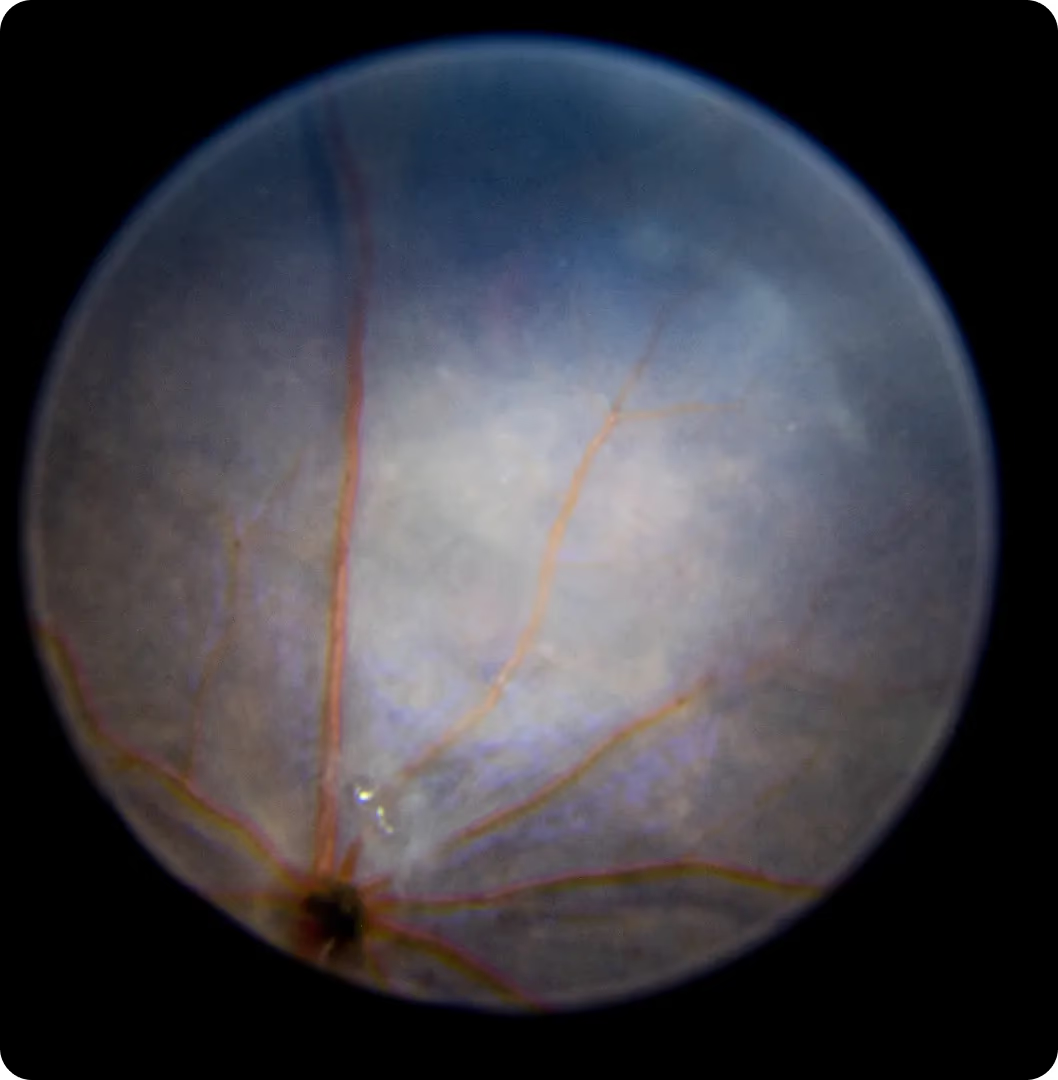
Fig 1. An example image of retinal imaging on a mouse’s eye.
Without a streamlined way to handle analysis, data management, and outputs, it becomes difficult to scale these workflows and maintain reliable results.
Automating retinal image analysis with Ultralytics YOLO models#
Pixelabs tackled these challenges by integrating Ultralytics YOLO models into the Pixelabs AI-Engine. The platform acts as the core of its visual AI solutions, making it more seamless to run real-time image and video analysis across different applications without disrupting existing workflows.
It supports a range of tasks, including object and defect detection, surface and texture analysis, color management, and OCR. Since it is hardware-agnostic and designed to integrate through APIs, it can be deployed across different environments and scaled.
This approach was applied in a recent collaboration with the CIBIR Alzheimer's research team, where Pixelabs developed a system to support early detection of Alzheimer’s in mice using retinal imaging. The goal was to identify small indicators, such as amyloid beta deposits, which can signal the early stages of the disease.
To do this, Pixelabs built a workflow that connects data storage, image processing, and a user interface. Retinal images, captured using laboratory-specific fundus imaging devices, are first transferred via Secure File Transfer Protocol (SFTP) and stored in a centralized system, making it easier to manage and access large datasets.
To ensure consistent results, preprocessing steps are then applied to handle differences in image quality and lighting. This helps the system maintain accuracy across different samples and conditions.
The images are then analyzed using vision AI models, including custom-trained Ultralytics YOLOv8 models. Medium and large variants of YOLOv8 are used to balance performance and accuracy.
Within this pipeline, Ultralytics YOLO models are used for object detection and image classification to identify and localize small areas of interest, such as amyloid beta deposits, directly within retinal images.
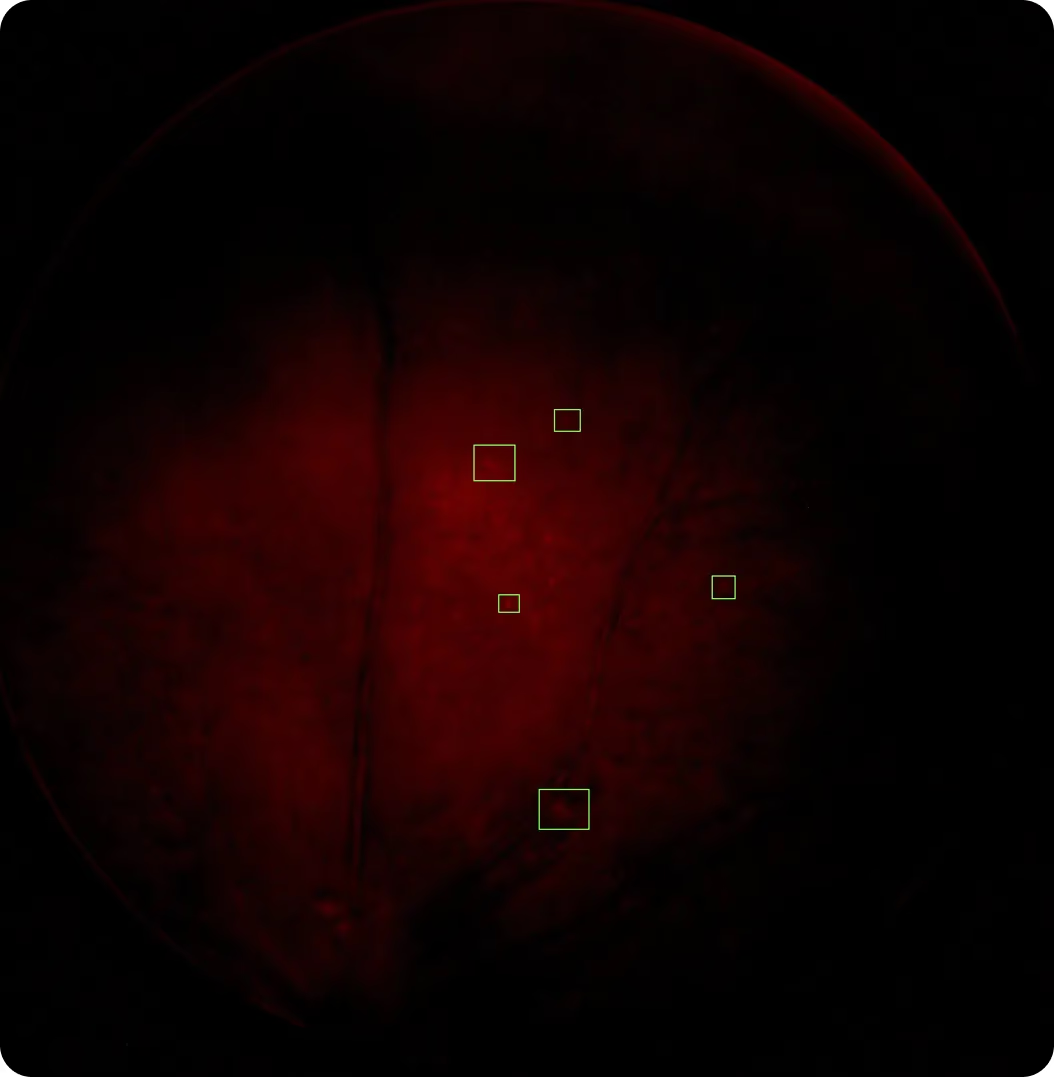
Fig 2. Computer vision models like Ultralytics YOLOv8 can help detect amyloid beta deposits.
Finally, the results are presented through a web-based platform, where users can upload images, filter data by attributes such as age, gender, or phenotype, and view detected features along with confidence scores. This makes it simpler to move from raw image data to clear, usable insights.
Why choose Ultralytics YOLO models?#
For Pixelabs, Ultralytics YOLO models were a perfect fit, providing a practical and flexible foundation for building computer vision solutions that can be adapted quickly to different use cases. They are easy to train and refine, letting the team iterate faster and respond to new requirements without needing to redesign the system.
This flexibility had a direct impact on development speed. By leveraging YOLO, Pixelabs was able to accelerate its development cycles and bring solutions to production more quickly, reducing time-to-market for new applications. At the same time, the models delivered more accurate and consistent results.
Delivering up to 95% recall while improving efficiency#
The integration of Ultralytics YOLO models into the Pixelabs AI-Engine led to clear improvements in analysis performance. In the Alzheimer’s research use case, the system achieved recall rates of around 90%, increasing to up to 95% as the disease progressed and indicators became more visible.
This allowed researchers to detect small features, such as amyloid beta deposits, more reliably across large image datasets. As a result, the analysis became more consistent, reducing variability and helping ensure that important indicators were not missed.
Beyond this use case, Pixelabs has also received consistently positive feedback from customers using its solutions across different applications. Users highlight improvements in how processes are carried out, particularly in terms of efficiency and reliability.
The impact varies depending on the specific use case, reflecting the flexibility of the platform and its ability to adapt to different operational needs. Overall, these enhancements have made it easier to manage and analyze visual data at scale, supporting more reliable outcomes and more efficient workflows.
Advancing visual AI across industries#
Pixelabs is continuing to expand the capabilities of its visual AI platform across new use cases and industries. Building on its work in research applications like Alzheimer’s detection, the team is focused on refining its models and advancing visual analysis using technologies such as Ultralytics YOLO models.
By continuously improving its technology, Pixelabs aims to help organizations automate processes more effectively and apply computer vision across a wider range of real-world workflows.
Interested in streamlining your company’s workflows? Check out our GitHub repository to learn more about Vision AI. Explore how YOLO models are driving innovations in areas like AI in healthcare and computer vision in retail. To get hands‑on with YOLO, discover how our licensing options can support your project.