REVA is a Madrid-based B2B proptech company that helps the real estate industry manage, audit, and market properties through video at scale. Brokers and field staff record standardized property walkthroughs in the REVA mobile app, which guides them room by room and stores GPS position and capture time with every clip. Loan servicers, investment funds, asset managers, legal mediators, and brokerages across Spain and Portugal then review every property in REVA's web dashboard, through its REVA VAM business platform, and receive the data their own systems need.
Since 2022, REVA has processed roughly 18,000 videos at more than 99% platform uptime, including about 12,800 for loan servicer Hipoges, whose 2026 volume is running 53% above 2025.
Making property video publishable and useful#
Property operators need a trustworthy visual record of thousands of homes, and that record has to work twice. It must be publishable on listing portals and in client systems, with no readable license plates, identifiable people, or competitor branding. It must also be useful for operations: what is in the home, what condition it is in, and what changed between a tenant's check-in and check-out.
Until recently, the industry had three options: leave footage unreviewed, pay someone to watch every video, or skip capture altogether. None of them scales to portfolios measured in tens of thousands of homes, each filmed several times before a new tenant moves in.
REVA saw an opportunity to close that gap with computer vision, but real estate video brings challenges that generic detection pipelines are not built for:
- Freeform handheld footage: Brokers film on a phone while walking and talking, producing motion blur, fast pans, portrait video, and objects entering the frame edge-first.
- A per-video standard: Clients require that a plate, face, or sign is covered in every frame where it appears. A video either leaked a plate or it did not, so per-frame accuracy alone is not enough.
- An open vocabulary: A home contains hundreds of items that matter for an inventory or deposit claim, such as coffee makers, radiators, and dish racks, most of which are not in standard training datasets.
- Privacy and data residency: The footage shows the inside of occupied homes, so processing, labeling, and training must stay on hardware REVA controls, in line with GDPR.
- Scale with a small team: Hipoges alone sends REVA around 700 videos a month.
Automating license plate redaction with Ultralytics YOLO#
REVA's vision stack is built on the Ultralytics Python package and runs entirely on REVA's own on-premises GPUs, so client footage never leaves its infrastructure. The first layer to reach production is automatic license plate redaction.
REVA started in January 2026 with the Ultralytics Solutions object blurring tool, then built its own pipeline around a custom fine-tuned Ultralytics YOLO11 extra-large (YOLO11x) single-class plate detector. After each upload, the model scans every frame of every applicable video. Each detection passes a geometric plausibility check on aspect ratio and area, plus an optional OCR check, before a Gaussian blur is applied. A nano version of the same detector is ready for lower-end hardware.
Because clients judge redaction per video, REVA designs the pipeline around coverage rather than single-frame accuracy, using object tracking and temporal dilation so a plate stays blurred across the fast pans and motion blur of handheld footage.
Reading every room with open-vocabulary detection#
The same walkthroughs are now being turned into object inventories, listing tags, and check-in and check-out audits. Each clip is sampled at 2 frames per second and passed through two Ultralytics models:
- YOLO11x with BoT-SORT tracking: Using the Ultralytics tracking mode, REVA detects 25 property-relevant object classes, such as beds, couches, refrigerators, and sinks, and aggregates each track's time on screen and mean confidence.
- Ultralytics YOLOE-26x with text prompts: Ultralytics YOLO26E lets REVA define new classes in plain text instead of labeling new datasets. A 97-term vocabulary aligned to listing data picks out features like kitchen islands, walk-in showers, hardwood floors, solar panels, and EV chargers. A tiered 74-class vocabulary of claimable items, from televisions and sofas to framed pictures and floor lamps, powers turnover audits.
REVA first used YOLO-World v2 for open-vocabulary detection and moved to YOLOE-26x as its replacement. Adding a new item type for a client is now a text prompt rather than a labeling project.
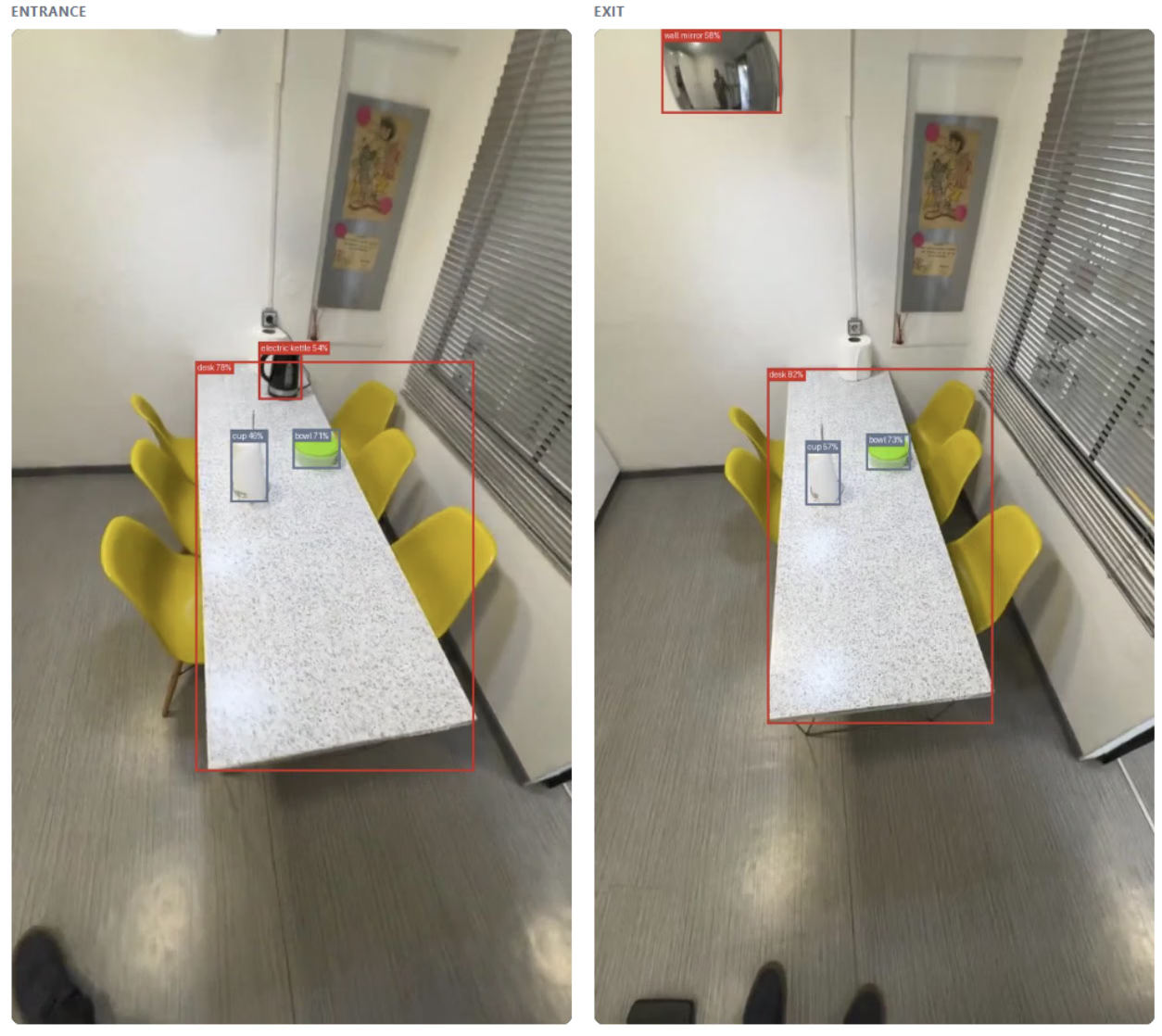
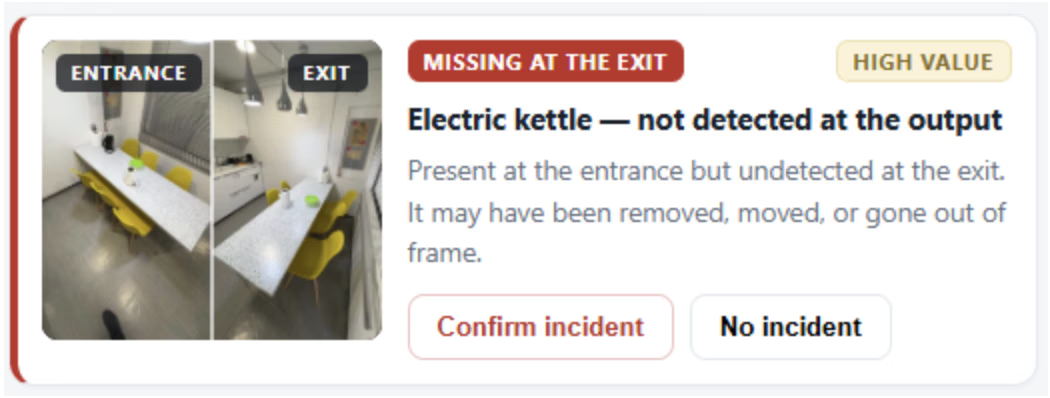 Fig 1. REVA's evidence viewer comparing check-in and check-out frames with YOLO detections. Image requested from REVA.
The audit output is an evidence viewer. For each matched room or zone, it shows check-in and check-out frames side by side, the high-confidence inventory on each side, and ranked hints such as "only at check-in" or "visibility change." CLIP embeddings match rooms between visits, while speech transcription of the broker's narration labels each room. A reviewer confirms or dismisses each flag and exports a deposit-claim summary, so people only look at exceptions.
Measuring success per video, not per frame#
REVA treats mAP as a diagnostic rather than the goal. What matters to its clients is whether a published video is fully compliant, so the team benchmarks against a per-video standard: every frame in which a plate, face, or advertising board is visible must be covered.
To hit that bar consistently for its next-generation redaction model, REVA is building an on-premises training workflow with CVAT for annotation and FiftyOne for data curation. It uses written annotation guidelines, train and test splits made at the video level so near-identical frames never leak between them, and a permanently held-out test set. That same test set will be used to benchmark small and medium YOLO model sizes against the current extra-large models for a throughput gain on production GPUs.
Compliant video at portfolio scale#
With Ultralytics YOLO running on every applicable upload, license plate redaction no longer depends on someone watching each video. That matters as volume grows: Hipoges alone sends REVA around 700 videos a month in 2026, 53% more than in 2025, and REVA's platform has held more than 99% uptime across roughly 18,000 videos.
Open-vocabulary detection with YOLOE extends the same automation to operations. Instead of a manual walkthrough review, a turnover audit now starts with a side-by-side evidence view that surfaces high-value items that appeared, disappeared, or changed. Minor items are counted but filtered out, so reviewers spend their time on the flags that could support a deposit claim.
From phone to drone: one YOLO stack for every property#
REVA's vision is a property data platform where one guided walkthrough feeds every downstream need, from compliant publication and condition records to structured listing data, floor plans, and 3D. Ultralytics YOLO is the common layer across that roadmap:
- One redaction model for GDPR and client rules: A single in-house model covering plates, faces, and advertising boards, trained on REVA's own footage to a 98% per-video standard.
- Auto-tagging label packs: Property-feature models aligned to the RESO Data Dictionary, with YOLOE handling the long tail of rarer features.
- Floor plans and 3D: YOLO segmentation of doors, windows, walls, and room boundaries from existing broker clips, as the base for plan and 3D estimation without a special camera.
- Autonomous drone capture: A sub-250 g indoor drone prototype that runs YOLO object detection on its live camera feed while scanning vacant homes for 3D reconstruction.
- Faster deployment: Exporting models to ONNX and TensorRT FP16, with INT8 to follow, and running TensorRT on Jetson-class embedded hardware for onboard drone inference.
REVA's goal is one detector family from phone to drone, where the same YOLO stack that reads broker video also reads the drone's.
Interested in building Vision AI solutions of your own? Explore Ultralytics YOLO models, learn how YOLO is driving innovation across industries, and check out our licensing options to get started.
Written by

Digital Content Manager · Ultralytics