4D Gaussian Splatting
Discover how 4D Gaussian Splatting enables real-time, photorealistic rendering of dynamic scenes. Learn to isolate moving objects with Ultralytics YOLO26.
4D Gaussian Splatting is a cutting-edge rendering technique in computer vision and deep learning that extends the principles of explicit 3D scene representation by adding a temporal (time) dimension. While traditional 3D modeling captures static environments, 4D Gaussian Splatting enables the photorealistic, real-time rendering of dynamic, moving scenes. By modeling how objects and environments deform and shift over time, this technology bridges the gap between static imagery and lifelike video synthesis, offering unprecedented visual fidelity at high frame rates.
Differentiating From Related Rendering Techniques#
To understand this concept, it is helpful to compare it to closely related novel view synthesis methods. Standard 3D Gaussian Splatting represents a scene using millions of static, ellipsoid-shaped distributions. The 4D variant introduces time-dependent attributes, allowing these ellipsoids to move, rotate, and scale across multiple frames.
Furthermore, unlike Neural Radiance Fields (NeRF), which rely on deep neural networks to implicitly calculate light and color for every pixel, 4D Gaussian Splatting explicitly calculates the position of points in space and time. This explicit rasterization drastically reduces the computational overhead normally associated with computer graphics rendering, allowing dynamic scenes to be rendered significantly faster.
How 4D Gaussian Splatting Works#
The architecture relies on continuous mathematical functions to track the state of each Gaussian at any given timestamp. During the optimization process, machine learning algorithms update the spatial coordinates (X, Y, Z) and color values alongside a temporal deformation field. Researchers often utilize foundational libraries documented in the official PyTorch documentation or TensorFlow guides to handle the complex backpropagation required to train these temporal models.
The system minimizes the difference between the rendered output and the ground-truth video sequence. Recent breakthroughs published in academic archives like arXiv and the ACM Digital Library have shown that decoupling the static background from dynamic foreground elements vastly improves training stability.
Real-World AI and ML Applications#
- Immersive Virtual Reality (VR): 4D Gaussian Splatting is heavily used to capture dynamic human performances for VR and augmented reality. Instead of relying on cumbersome motion capture suits, creators can record an actor from multiple angles and generate a fully navigable, free-viewpoint video of the performance.
- Autonomous Vehicles and Robotics: Self-driving cars require a robust understanding of their environment. By reconstructing dynamic street scenes—including moving pedestrians and traffic—engineers can create highly realistic simulations to safely test autonomous navigation models before real-world deployment.
Preparing Data for 4D Reconstruction#
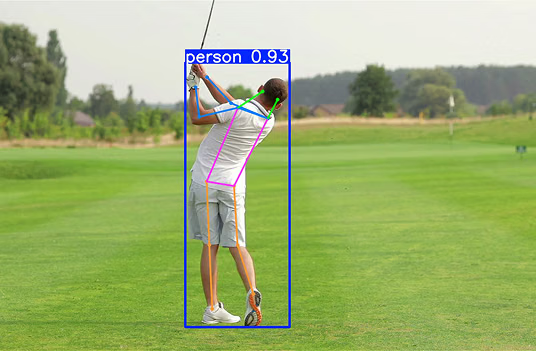
A critical step in generating high-quality 4D scenes involves isolating moving objects from the static background. Developers often use object tracking and instance segmentation to create dynamic masks before the splatting process begins.
You can easily track and isolate moving objects in a video using the Ultralytics YOLO26 model. The following code demonstrates how to execute this during a preprocessing workflow:
from ultralytics import YOLO

# Load the recommended Ultralytics YOLO26 object detection model
model = YOLO("yolo26n.pt")

# Run real-time tracking on a dynamic scene video to isolate moving subjects
results = model.track(source="dynamic_scene.mp4", show=True, save=True)
By leveraging modern generative AI workflows, teams can upload their recorded videos and annotations directly to the Ultralytics Platform to efficiently manage datasets. From there, applying model training tips ensures the resulting bounding boxes perfectly mask out dynamic elements, clearing the path for pristine 4D scene generation. Advanced research from organizations like Google DeepMind and OpenAI indicates that integrating object-aware spatial masking is becoming a standard best practice in temporal view synthesis.