Automated Defect Detection for Manufacturing: Platforms Compared
Compare automated defect-detection platforms: Cognex, Instrumental, Keyence, Landing AI, Overview and Ultralytics, plus how to match model task to defect.
The best defect-detection system is the one that can see the required flaw consistently on the production line, not the one with the longest model-feature list. Camera position, optics, lighting, part presentation and cycle time determine whether software has a usable image to analyze.
For manufacturers with an established automation team, Ultralytics YOLO models provide a flexible software-first path to custom defect detection on customer-selected cameras and compute. Integrated vendors such as Cognex and Keyence are stronger when the buyer wants industrial hardware, software and field support as one system. Landing AI, Overview and Instrumental occupy different positions between those two models.
Automated defect-detection platforms compared#
| Platform | Delivery model | Best fit | Main strength | Main trade-off |
|---|---|---|---|---|
| Cognex | Integrated industrial vision | Established production lines needing a complete vendor system | Mature industrial hardware and software ecosystem | Less open than a software-first stack |
| Instrumental | Manufacturing quality platform | Electronics and complex production analysis | Connects visual evidence with quality investigation | Broader quality workflow may exceed a simple inspection need |
| Keyence | Integrated industrial vision | Buyers prioritizing direct application support | Hardware, optics and software sold together | Customization stays within the vendor ecosystem |
| Landing AI | Vision software platform | Teams wanting a guided, low-code inspection workflow | Accessible custom-model workflow | Test deployment fit for each factory environment |
| Overview | Inspection systems | Manufacturers wanting a packaged inspection approach | Focus on production quality inspection | Confirm fit outside its target manufacturing workflows |
| Ultralytics Platform + Ultralytics YOLO | Software-first platform and models | Teams building custom inspection on their own hardware | Flexible training and deployment workflow | Buyer owns camera and line integration |
Vendors are listed alphabetically, not ranked. Ultralytics publishes this comparison and appears in it, so the ordering is deliberately neutral.
The comparison is not a universal ranking. An integrated camera system and a model platform are different purchases. Decide which operating model the plant can support before comparing features.
Integrated system or software-first platform?#
An integrated industrial-vision vendor supplies a known combination of cameras, lighting, controllers, software and support. This reduces integration ambiguity and gives the plant one vendor to call when the station fails.
A software-first platform gives the engineering team more control over models, cameras and compute. It can fit mixed hardware fleets and unusual defects, but the buyer becomes responsible for image capture, deployment, monitoring and the connection to the production process.
Choose integrated vision when the plant values standardization, vendor support and a repeatable station design. Choose software-first when defects require custom learning, existing hardware must be reused, or the organization wants to control deployment across different edge devices.
Cognex#
Best fit. Plants that want industrial vision hardware and software from an established vendor.
Strengths. Cognex offers a broad industrial-vision ecosystem covering cameras, readers and inspection software. It is a natural shortlist choice for factories that want a supported system rather than assembling components around a model.
Trade-offs. The buyer works inside a proprietary ecosystem. That may be a good trade for support and standardization, but it gives the internal ML team less control than an open software stack.
Buyer test. Ask the vendor to prove the smallest required defect under the plant's real lighting, speed and product variation. Do not accept a demo on a different material or a stationary sample.
Instrumental#
Best fit. Complex manufacturing operations that want visual evidence connected to broader quality investigation.
Strengths. Instrumental is positioned around manufacturing quality analysis, giving teams a way to investigate issues across production rather than only returning a pass or fail from one camera.
Trade-offs. A plant needing one deterministic inspection station may not need a wider quality platform. Scope the buying problem before comparing it with camera-centered systems.
Buyer test. Trace one real quality escape backward through the platform and confirm which data was required to find the cause.
Keyence#
Best fit. Manufacturers that want a complete application-oriented vision system and direct vendor support.
Strengths. Keyence combines cameras, controllers, optics, lighting and software in an integrated offering. This can shorten the path to a repeatable inspection station when the application fits the system's supported workflow.
Trade-offs. Hardware and software choices are coupled. Teams that want to mix cameras, accelerators and custom training infrastructure should compare that constraint with the support benefit.
Buyer test. Require an acceptance test on the real line and record the final optical setup. The same model with a different lens or light is not the same inspection system.
Landing AI#
Best fit. Manufacturing teams that want to create custom inspection models through a guided platform rather than build the full ML workflow themselves.
Note before shortlisting: Landing AI has repositioned around document and agentic AI, and its inspection line is maintained rather than headline. ABB Motion Ventures invested in 2025 to bring its vision AI into ABB robotics, so the capability has a route forward, but ask directly about roadmap commitments for factory inspection.
Strengths. Landing AI is strongly associated with industrial visual inspection and accessible model development. It can be useful when process experts need to participate directly in data and error review.
Trade-offs. A guided platform does not remove deployment requirements. Confirm the intended camera, edge runtime, update process and integration path before choosing it on interface usability alone.
Buyer test. Give production experts ambiguous examples and measure how quickly the workflow turns their decisions into a validated model revision.
Overview#
Best fit. Manufacturers looking for a packaged inspection approach centered on production-line quality.
Strengths. Overview builds inspection as a packaged station: camera, lighting and software delivered together and aimed at deployment on a line rather than at model development. That narrower focus reduces the translation between a trained model and the needs of a production station, and it suits plants that want a supplier to own the whole inspection cell.
Confirm the specifics against Overview's own documentation before shortlisting: the captured evidence for this vendor was thinner than for Cognex or Keyence, so treat the description above as a starting point rather than a specification.
Trade-offs. Specialized systems should be checked against the plant's product mix, geography and support requirements. A strong fit for one inspection family does not prove broad platform fit.
Buyer test. Ask for performance on multiple product variants and on defects that were not part of the initial setup.
Ultralytics Platform and Ultralytics YOLO#
Best fit. Engineering teams building custom defect-detection models and deploying them on their own selected hardware.
Strengths. Ultralytics Platform connects dataset annotation, model training, evaluation and deployment workflows. Ultralytics YOLO supports object detection, classification and segmentation, which lets the team choose whether a defect needs a class label, a location or a pixel-level region. Models can be exported for deployment across different runtimes and hardware targets.
Trade-offs. Ultralytics is not a turnkey inspection cell. The manufacturer or integrator owns the camera, lens, lighting, enclosure, trigger, edge computer and production-system connection. Cognex and Keyence have decades of industrial inspection deployment, field support networks and plant-floor credibility that a software-first entrant does not; where a plant standardizes on a long-established supplier, that is a sound reason to choose them.
Buyer test. Build a pilot with the hardest acceptable and defective samples, then run the model on the intended edge hardware at line speed. Review the Ultralytics manufacturing solution and defect-detection use case as starting points, not as substitutes for a line trial.
Match the model task to the defect#
Classification answers whether the whole image or crop is acceptable. Use it when the part is presented consistently and the defect does not need a location.
Object detection identifies and locates a defect with a bounding box. Use it when operators or downstream automation need to know where the issue appears.
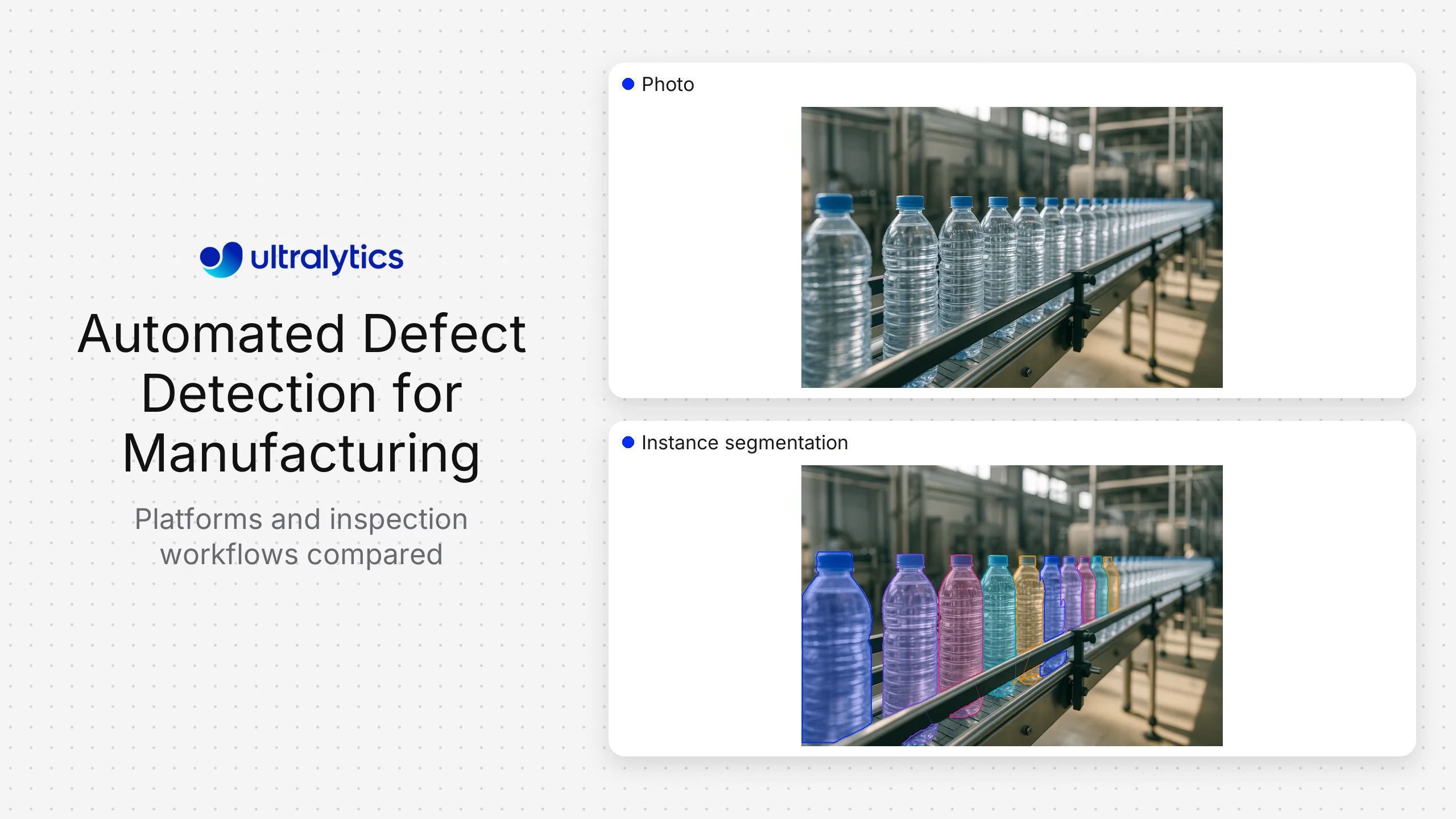
Segmentation marks the defect region at pixel level. Use it for irregular scratches, coatings, surface contamination or measurements derived from area and shape.
The more detailed task is not automatically better. Segmentation labels take more effort than image classes, and a bounding box can be sufficient for a reject decision. Choose the simplest task that supports the operational action.
Image quality comes before model quality#
A pilot should freeze the image-capture design before the team compares models. Control:
- camera distance and angle;
- field of view and smallest visible feature;
- lens and focus;
- exposure and motion blur;
- lighting direction, intensity and color;
- reflections and background;
- part position and orientation; and
- trigger timing.
If acceptable and defective parts look identical in the captured image, more training will not fix the system. Change the imaging setup or sensing method.
Build a production acceptance test#
Create an acceptance set that represents the line, not the data used in the sales demo. Include:
- every product variant in scope;
- the smallest defect that must trigger action;
- acceptable cosmetic variation;
- different shifts, lots and material finishes;
- clean and dirty fixtures;
- start-up, steady-state and high-speed operation;
- known difficult reflections and shadows; and
- examples from each intended site.
Measure missed defects, false rejects and end-to-end decision time. Report each separately. A single accuracy score can hide the error that matters most.
Run the test on the target hardware and connect it to the actual reject or review workflow. A model that passes offline but cannot keep up with the line is not a production solution.
Plan for change after launch#
Defect-detection systems need a feedback loop. Save uncertain predictions and verified errors, review them with process experts, and add the most informative examples to a versioned dataset.
Before each update:
- Validate against the fixed acceptance set.
- Compare the new model with the deployed model.
- Test latency and resource use on target hardware.
- Roll out to a limited station or shift.
- Monitor false rejects and missed defects.
- Keep a rollback path.
Changes to lighting, cameras or product geometry should trigger revalidation even when the model file does not change.
Frequently asked questions
Cognex, Instrumental, Keyence, Landing AI, Overview and Ultralytics represent different credible options. Integrated vendors suit plants wanting a complete supported system; software-first platforms suit teams that want custom models and hardware flexibility.
Automated defect detection is one type of visual inspection. A vision system can also verify presence, position, assembly, labels, counts and dimensions.
Use classification for an image-level pass or fail, object detection when the defect location is needed, and segmentation when the exact region or shape matters.
Yes, when the camera, exposure, model, edge hardware and production integration fit the required cycle time. Measure end-to-end latency on the line rather than relying on model inference alone.
Give every vendor the same difficult sample set, target hardware and acceptance criteria. Compare missed defects, false rejects, cycle time, integration ownership, support and total operating cost.
Ultralytics provides computer vision models and platform workflows, not a complete proprietary inspection cell. The manufacturer or integrator selects and connects the camera, optics, lighting, compute and production systems.