Computer Vision Platforms for Manufacturing: YOLO, Cognex and Keyence Compared
Compare computer vision platforms for manufacturing: Cognex, Edge Impulse, Keyence, Landing AI, Roboflow and Ultralytics YOLO, on inspection and MES fit.
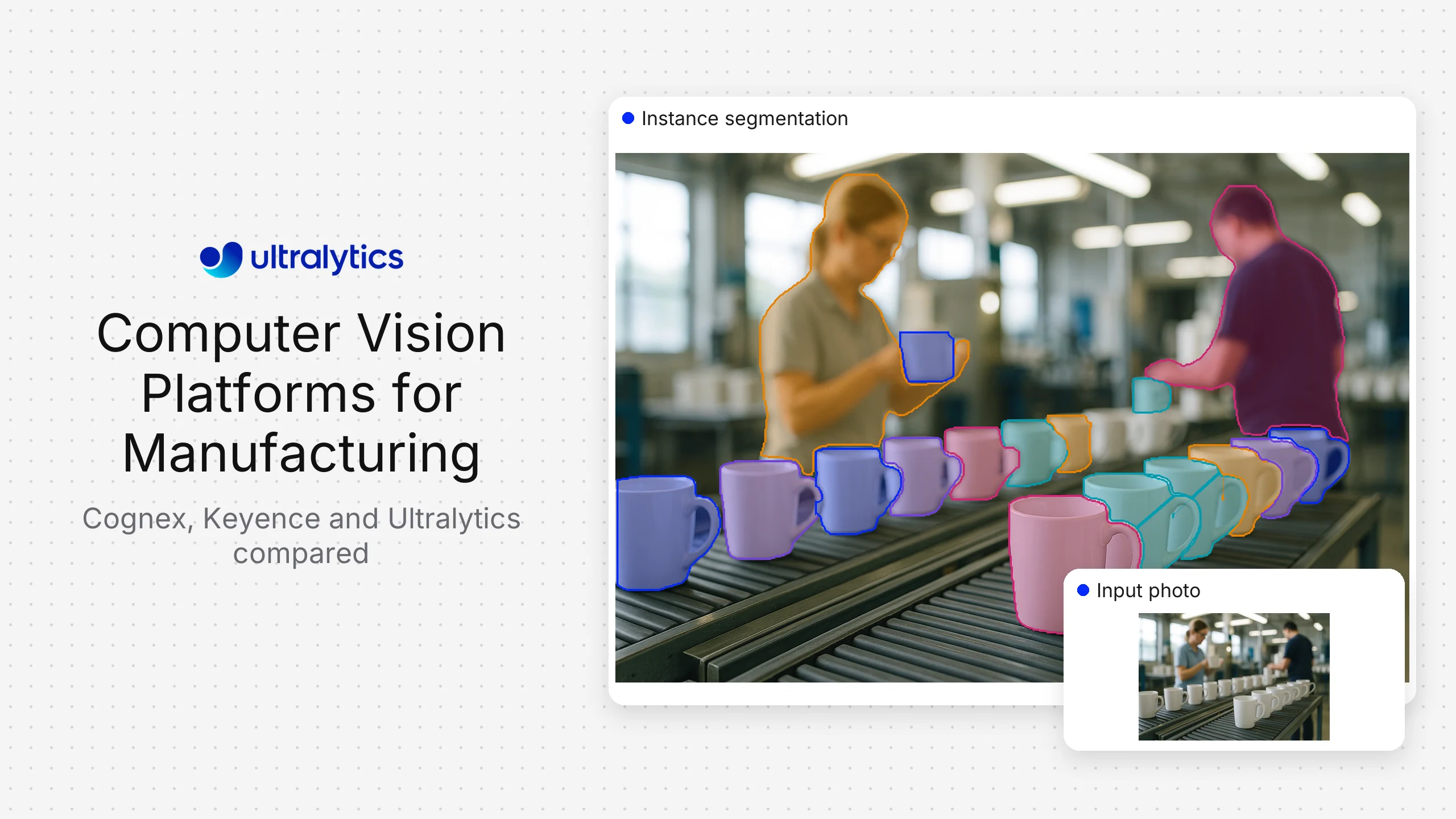
Manual inspection does not scale. On a line running thousands of units an hour, a fraction of a percent of missed defect s becomes a recall, and no human inspector holds concentration across a full shift. Computer vision closes that gap by inspecting every unit, consistently, at line speed.
Choosing a platform is harder than choosing to adopt one. The market splits into two very different camps: industrial vision vendors selling integrated hardware and software with field engineers attached, and software-first platforms where you bring your own cameras and compute. They serve different buyers, and the wrong choice is expensive in both directions.
This guide compares the platforms manufacturers actually shortlist, what each is genuinely good at, and how to decide between them.
Quick comparison#
Vendors are listed alphabetically, not ranked. Ultralytics publishes this comparison and appears in it, so the ordering is deliberately neutral and every entry carries a stated trade-off.
| Platform | Model | Best for | Trade-off |
|---|---|---|---|
| Cognex | Integrated hardware + software | Mature, high-precision industrial inspection | Premium pricing, proprietary ecosystem |
| Edge Impulse | Embedded ML | Constrained edge and embedded devices | Narrower scope than general vision platforms |
| Keyence | Integrated hardware + software | Buyers who want hands-on vendor support | Custom quotes, direct-sales model |
| Landing AI | No-code inspection software | Factory-floor experts without data science teams | Company has repositioned around document AI; confirm roadmap |
| Roboflow | End-to-end software | Developer teams managing the full dataset lifecycle | Value compounds as more of your workflow moves onto one platform |
| Ultralytics YOLO | Open models + platform | Teams wanting custom models on their own hardware | You own integration and MLOps; the same single-vendor coupling applies |
The integrated vendors#
Cognex#
Cognex is the industrial standard, and has been for a long time. Its PatMax pattern-matching technology remains a reference point for locating parts reliably regardless of angle, scale or lighting variation: a genuinely hard problem it solved early and well. The hardware is built for factory conditions, and the ecosystem is deep.
Choose it when precision and proven reliability matter more than cost or flexibility, particularly in automotive, electronics and pharmaceutical inspection where validation requirements are strict.
The trade-off is a closed ecosystem at premium prices. You are buying a system, not components, and customization happens within the boundaries the vendor defines.
Keyence#
Keyence's differentiator is commercial rather than technical: a direct-sales model with engineers who come to your site and solve the problem in person. For teams without in-house vision expertise, that support is often worth more than a feature comparison.
Choose it when you want a vendor who takes responsibility for the outcome rather than shipping a toolkit.
The trade-off is opacity and cost. Pricing is quote-based, and the relationship is with a vendor rather than a technology you control.
Omron, Basler, Matrox, Siemens and Teledyne#
Also credible in this space, generally as component or subsystem suppliers. Basler is known for camera reliability, Matrox for its mature imaging library, Siemens and Omron for industrial automation integration. If you already run their automation stack, staying inside it reduces integration risk.
The software-first platforms#
Ultralytics YOLO#
Ultralytics builds the YOLO family of open-source vision models (object detection, segmentation, pose estimation, oriented bounding boxes and classification) used widely for real-time inspection. The manufacturing case is specific: train a model on your own defect images, run it on hardware you already own, and keep the model and the data.
Oriented bounding box detection is worth flagging for this audience, since parts on a conveyor arrive at arbitrary angles and standard rectangular boxes fit them poorly.
Choose it when your defects are specific to your process, you want to avoid per-camera licensing, or you need to deploy across many lines without per-seat costs multiplying. Models run on edge hardware such as NVIDIA Jetson as well as standard industrial PCs.
The trade-off is real: you own the integration. There is no field engineer arriving to fix your lighting. Ultralytics offers an enterprise license and commercial support for production deployments, but the operating model assumes internal engineering capability. If your team has none, an integrated vendor will get you to production faster.
Roboflow#
Roboflow covers the dataset lifecycle well: annotation, augmentation, versioning, training and deployment in one place. For teams whose bottleneck is data management rather than modeling, that consolidation is the value.
Choose it when you have a development team and want managed tooling around the full pipeline.
The trade-off is subscription cost that scales with usage, and less control than running open-source models yourself.
Landing AI#
LandingLens is built explicitly for people who understand manufacturing rather than machine learning.
Note before shortlisting: Landing AI has repositioned around document and agentic AI (its headline products now target document extraction) and LandingLens is a maintained rather than headline line. ABB Motion Ventures invested in 2025 specifically to bring its vision AI into ABB robotics, so the capability has a route forward, but confirm roadmap commitments for factory inspection before selecting it. The point-and-click workflow lets a quality engineer train a defect model without writing code. A genuine advantage when domain expertise sits on the factory floor.
Choose it when your subject-matter experts should be building the models.
The trade-off is a ceiling. No-code tooling is excellent until you need something it does not do.
Edge Impulse#
Edge Impulse specializes in embedded ML for constrained devices: the right answer for microcontroller-class hardware, narrower than a general vision platform.
If you are on AWS and looking for a managed edge appliance, note that AWS Panorama reached end of support on 31 May 2026 and the purchased appliances no longer function. AWS now directs customers to partner solutions or to building on SageMaker with Jetson-class edge hardware. Any comparison article still listing Panorama as a live option was written before that date. A useful test of how current your shortlist sources are.
Automated defect detection: what actually determines success#
The platform matters less than three things people underestimate.
Lighting comes first. More vision projects fail on illumination than on model architecture. Consistent, controlled lighting turns a hard problem into a straightforward one. Budget for it before software.
Defect data is the bottleneck. You have thousands of images of good units and very few of each defect type. That is what a working production line produces. Plan how to collect and label rare defects from the start. Synthetic augmentation helps but does not replace real examples.
Drift is a process, not an incident. Suppliers change, tooling wears, materials vary. A model trained on January's output degrades by June. Whichever platform you choose, budget for periodic retraining and monitoring, and make sure you can access your own data to do it.
Real-time monitoring and MES integration#
Inspection results are only useful if they reach the systems that act on them. Most deployments need to push results into an MES or historian so defect rates appear alongside other production metrics, and need latency low enough to reject a unit before it leaves the station.
That second requirement usually decides where inference runs. Cloud round-trips are too slow for reject actuation, so inference sits at the edge on the line, with aggregated results flowing up. Confirm any platform supports local inference before shortlisting it. A cloud-only architecture is disqualifying for most in-line inspection.
How to choose#
Choose an integrated vendor (Cognex, Keyence) if you lack in-house vision engineering, need validated systems for regulatory reasons, or want one supplier accountable for the result.
Choose no-code, Landing AI, if your quality engineers should own the models and your defects are well-defined.
Choose open-source, Ultralytics YOLO, if you have engineering capability, need custom models for process-specific defects, want to deploy across many lines without per-camera licensing, or need to own your models and data outright.
Choose managed developer tooling, Roboflow, if you have a development team and want the dataset pipeline handled.
Most manufacturers running vision at scale end up with more than one. An integrated system on the critical validated inspection point, and a flexible open-source stack for everything else.
Getting started#
Pick one inspection point with a clearly defined defect and measurable current scrap rate. Fix the lighting. Collect a few hundred labeled images including real defects. Train, measure against your existing manual baseline, and only then decide whether to scale.
Ultralytics YOLO models are open source under AGPL-3.0, with an enterprise license available for commercial deployment. If you are evaluating computer vision for a production line, explore Ultralytics YOLO for manufacturing or read more on defect detection.
Frequently asked questions
Four jobs, mostly. Defect detection finds scratches, cracks, contamination and color variance. Assembly verification confirms every component is present and correctly seated. Dimensional gauging measures parts against tolerance. Optical character recognition reads serial numbers, lot codes and labels. Most deployments start with one and expand.
You show it examples. Engineers collect images of good units and defective ones, label the defects, and train a model to tell them apart. Modern object detection models like Ultralytics YOLO can reach useful accuracy on a few hundred labeled images per defect class, then improve as more edge cases are collected from the line.
Yes, and this is usually a procurement requirement rather than a nice-to-have. Vision systems signal PLCs, robotic arms and reject mechanisms directly. When the model flags a defect, the line diverts that unit without stopping.
Not necessarily. Integrated vendors like Cognex and Keyence sell cameras and software as one system. Software-first platforms run on industrial cameras you already own, provided resolution, frame rate and lighting are adequate. Lighting is more often the limiting factor than the camera.
Lighting and drift. Inconsistent illumination produces inconsistent images and unreliable inference. Drift happens when the process changes (a new supplier, a different material finish) and the model degrades because it never saw that variation. Plan for retraining, not just deployment.
A proof of concept on a single inspection point is realistically weeks. Full line integration, PLC signaling, operator training and validation is months. Anyone promising a production-grade deployment in days is describing a demo.