Is Ultralytics YOLO free for commercial use? AGPL-3.0 vs the Enterprise License
Ultralytics YOLO is free under AGPL-3.0 if you open-source your whole project. Compare licensing for internal tools, SaaS and devices.
 Kristian Sommer13 min read
Listen to this article
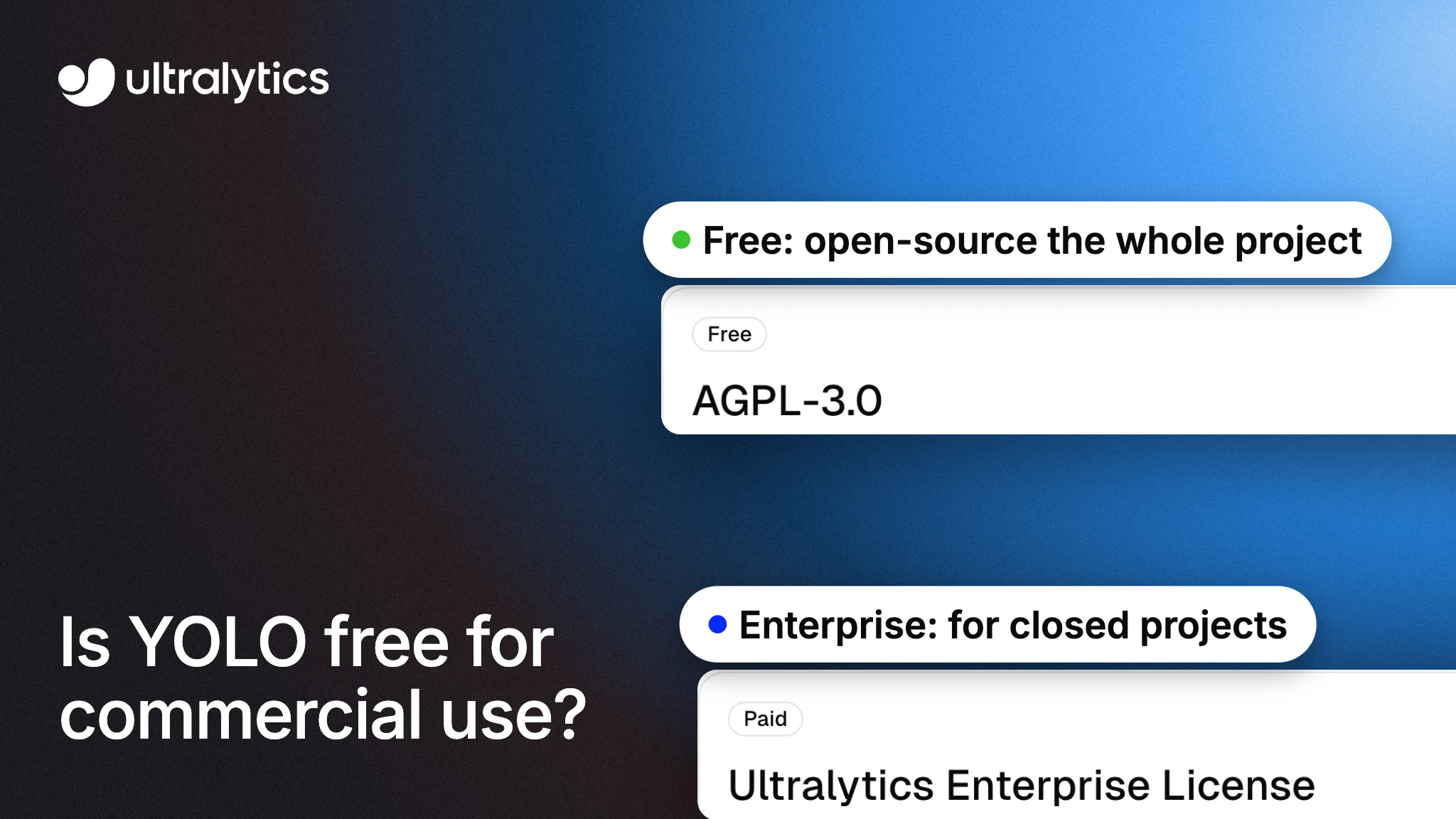
Is Ultralytics YOLO free for commercial use? Only if you open-source your entire project under AGPL-3.0. If you want to use Ultralytics YOLO without open-sourcing your project, in a commercial product, an internal tool, a SaaS service or an embedded device, you need the paid Ultralytics Enterprise License.* That holds for YOLOv5, YOLOv8, YOLO11 and YOLO26, and even for a model you trained yourself, from scratch, on your own data.
*Throughout this article, the Enterprise License requirement applies unless you hold rights to use Ultralytics YOLO under a separate agreement with Ultralytics or one of its authorized licensees.
This guide explains the Ultralytics licensing page in plain English: what each license covers, how it applies to internal tools, SaaS, embedded devices and research, what the Enterprise License gives you, and how Ultralytics Platform plans fit in. To request a license or a quote, go straight to the licensing page.
Every Ultralytics YOLO model you train is AGPL-3.0 by default#
Ultralytics YOLO, from YOLOv5 and YOLOv8 to YOLO11 and Ultralytics YOLO26, is released under the GNU Affero General Public License v3.0.
The licensing covers more than the Python package. As our licensing page puts it, if you use Ultralytics YOLO code, models, architectures, training pipelines, or trained or fine-tuned models, you must either open-source your entire project under AGPL-3.0 or obtain an Ultralytics Enterprise License.* This applies even if you:
- Train your own model from scratch
- Don't use any pretrained weights
- Use YOLO only internally or for R&D
- Deploy through a SaaS platform, API or other private system
- Embed it in hardware, edge devices or commercial products
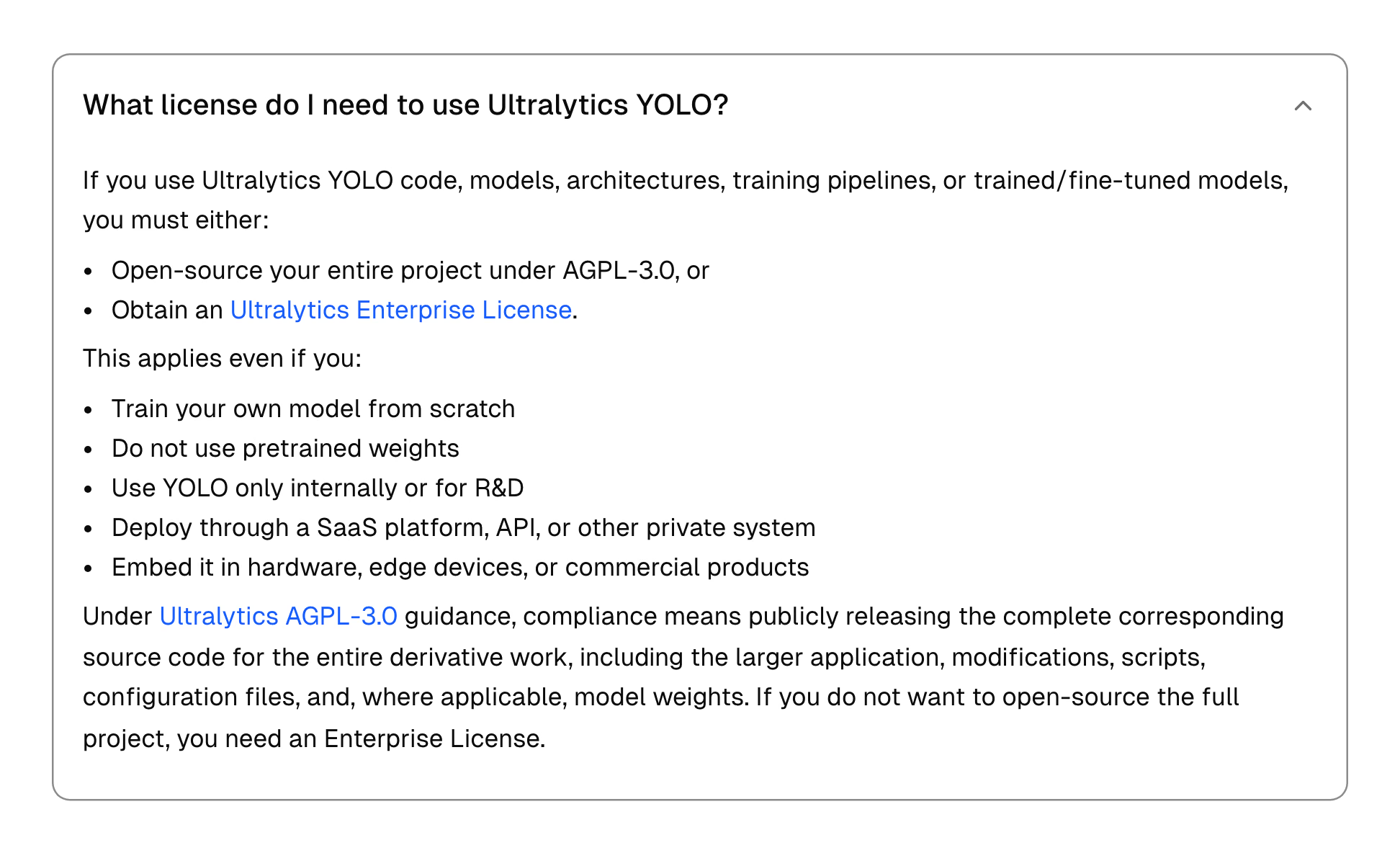
The first question in the FAQ on ultralytics.com/license, captured on November 17, 2026.
The model weights you produce are covered too: our licensing page states that the AGPL-3.0 license covers the training code and the models produced by that training code. Swapping in your own dataset doesn't change the license of the model that comes out.
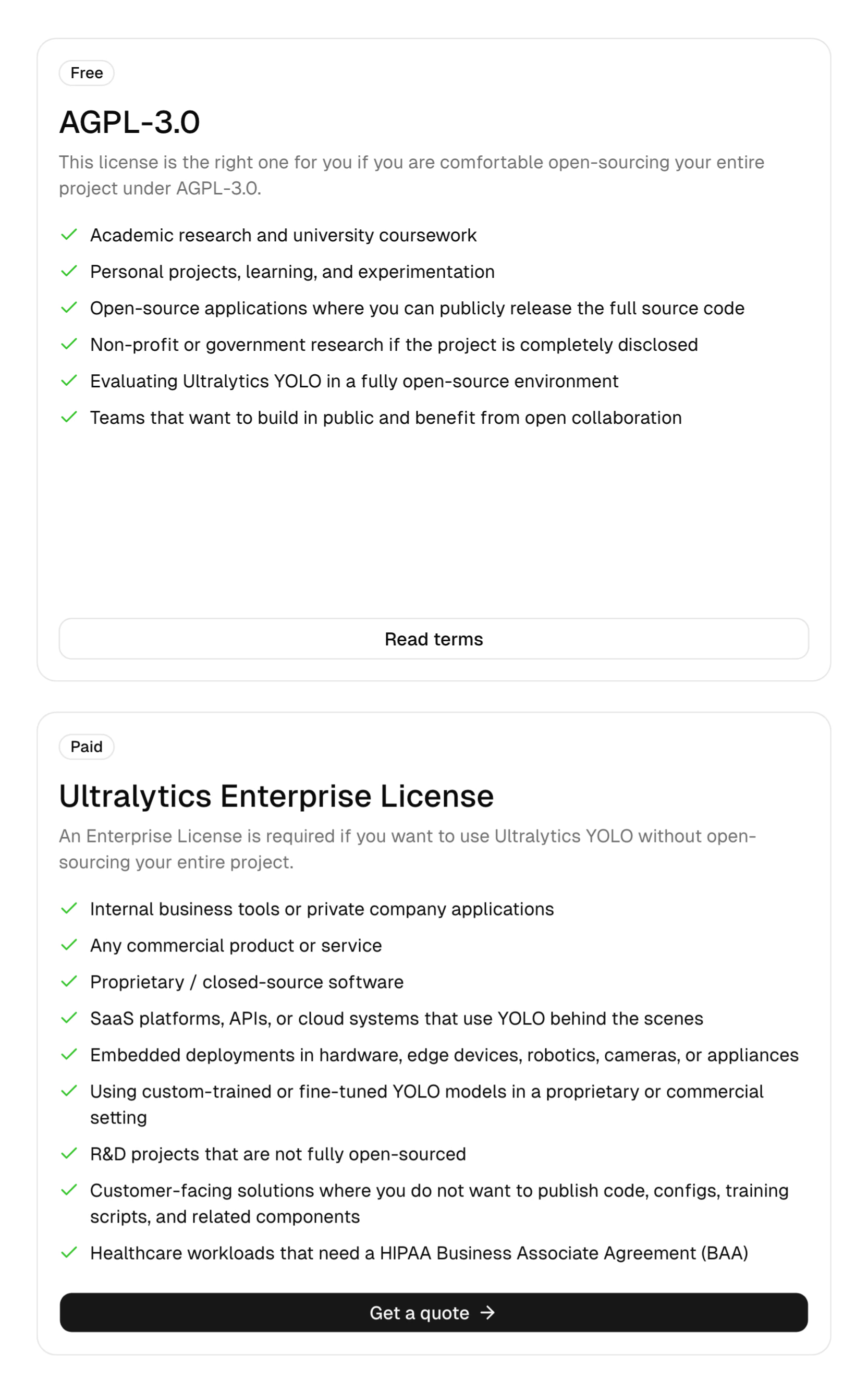
The two license cards on ultralytics.com/license, shown one above the other, captured on November 17, 2026.
What AGPL-3.0 compliance actually requires#
AGPL-3.0 is a copyleft license. Under Ultralytics AGPL-3.0 guidance, compliance means publicly releasing the complete corresponding source code for the entire derivative work, including the larger application, modifications, scripts, configuration files and, where applicable, model weights.
Our contributing guide defines compliance for a YOLO project as publicly releasing the complete source of the project under AGPL-3.0, including:
- The complete larger application or system that uses the YOLO model or code
- Any modifications to Ultralytics code
- Training, validation and inference scripts
- Model weights if modified or fine-tuned
- Configuration files and environment setup, such as
requirements.txtand Dockerfiles - Backend and frontend code if the project is a web application
- Third-party libraries you modified
- Training data, if it's needed to run or retrain the project and you're allowed to redistribute it
The same guide gives a starting structure: fork the YOLO repository or use the Ultralytics template repository, add the full AGPL-3.0 text as a LICENSE file, put a license notice at the top of each source file, and state the license and attribution in your README.
AGPL-3.0 is enough when you can publish the whole project#
Our licensing page describes AGPL-3.0 as the right license if you are comfortable open-sourcing your entire project under AGPL-3.0. The use cases in the screenshot above share that trait: academic research and coursework, personal projects, open-source applications, fully disclosed non-profit or government research, and teams that build in public.
If that's you, you don't need to purchase an Enterprise License, provided you meet the AGPL-3.0 requirements described above: pip install ultralytics, train, export and publish your whole project, following the contributing guide. You get full access to inspect, modify and enhance the source code, with community support.
Internal tools, SaaS and embedded devices need an Enterprise License unless you open-source them#
Here is how the license plays out for four common kinds of project.*
Internal tools#
A defect detector that only your quality team sees, a dashboard on the warehouse network, a model that pre-sorts documents for staff: none of these face customers, but they still count. Our licensing page lists internal business tools and private company applications as Enterprise License cases, and says the license choice applies even if you use YOLO only internally. So either the whole internal project is open-sourced under AGPL-3.0, or it runs under an Enterprise License.*
SaaS platforms and APIs#
Our licensing page lists "SaaS platforms, APIs, or cloud systems that use YOLO behind the scenes" as an Enterprise case, so a closed SaaS product needs the Enterprise License.* The AGPL-3.0 alternative is to open-source the whole service, backend and frontend code included, not just the inference script.
Embedded devices and edge hardware#
Shipping YOLO inside a smart camera, a robot, an appliance or an edge AI box is an embedded deployment. Our licensing page lists "embedded deployments in hardware, edge devices, robotics, cameras, or appliances" as an Enterprise case.* The AGPL-3.0 alternative is to open-source the entire YOLO project under AGPL-3.0, including the larger application, modifications, scripts, configuration files and, where applicable, model weights.
Research and R&D#
Academic research, university coursework, and non-profit or government research that's completely disclosed fit AGPL-3.0. R&D projects that are not fully open-sourced are on the Enterprise list, so a company running closed research or a private pilot needs the Enterprise License.*
Here is how it all fits together:
| What you're building | AGPL-3.0 works if... | Otherwise* |
|---|---|---|
| Academic research, a personal project or fully disclosed non-profit research | You open-source the full project | Enterprise License |
| Internal business tool | You open-source the full internal project | Enterprise License |
| SaaS product or API | You open-source the full project, backend and frontend included | Enterprise License |
| Embedded device or camera | You open-source the entire project, not just what ships on the device | Enterprise License |
| Corporate R&D or pilot | You open-source the full project | Enterprise License |
*This applies unless you hold rights to use Ultralytics YOLO under a separate agreement with Ultralytics or one of its authorized licensees.
What the Ultralytics Enterprise License gives you#
The paid Enterprise License lets you use Ultralytics YOLO without open-sourcing your entire project. The Compare license features table on our licensing page shows the differences feature by feature:
| Feature | What it means on the licensing page | AGPL-3.0 | Ultralytics Enterprise |
|---|---|---|---|
| Access to source code | Full access to inspect, modify, and enhance the software's source code. | Yes | Yes |
| Commercial use | Use in business or for-profit applications without open-sourcing the project under AGPL-3.0. | No | Yes |
| Private deployment | Deploy in private environments without AGPL-3.0 open-source obligations. | No | Yes |
| Access to enterprise models | Full access to pretrained, large-scale models trained on 1M-image Ultralytics Enterprise Dataset. | No | Coming soon |
| Adaptive model training for commercialization | Adjust, train, and modify models for for-profit products. | No | Yes |
| Proprietary internal use | Exclusive use inside an organization without publishing source externally. | No | Yes |
| Custom terms and support | Custom contractual terms and dedicated support channels. | No | Yes |
| HIPAA Business Associate Agreement (BAA) | Signed before any protected health information (PHI) is shared with Ultralytics. | No | For eligible customers |
| Support level | Expected support path for each license option. | Community | Advanced SLA |
| Annual fee required | Whether paid annual licensing is required. | No | Yes |
| Ownership of modifications | Who owns private modifications and derivative work. | Must be open-sourced | Licensee |
Our licensing page also links to the full Enterprise terms:
- Any purpose, including commercial use. You can make and distribute an unlimited number of commercial products and services containing the software.
- Your contractors are covered. Subcontractors, consultants and vendors can use the software to develop or deploy your products and services.
- You own what you build. You own your modifications and the models you train with the software during your license term, and Ultralytics has no rights in them.
- Every Ultralytics YOLO model. The license covers the complete source code portfolio, including YOLOv5, YOLOv8, YOLO11 and YOLO26, plus future YOLO models released during your term, with updates included.
- Scoped to how you work. Licenses can cover a specific project and everyone working on it, or your entire organization.
The license runs for one year and renews automatically unless either side gives written notice at least 45 days before the term ends. It applies to the single legal entity named as licensee, not to its subsidiaries or affiliates, and it can't be sublicensed, resold or transferred except as its assignment clause allows. The terms also include co-marketing: you provide one written testimonial and grant Ultralytics the right to use your name, logo and testimonial in its marketing. For healthcare teams, our licensing page offers a HIPAA Business Associate Agreement to eligible Enterprise customers; our guide to HIPAA compliant AI for medical imaging covers what it includes.
What happens if you don't renew#
Products and services you sold or provided during the term keep their license rights, so your end users aren't disrupted and you can keep maintaining and supporting them. Unless both sides agree otherwise in writing, distribution, offering and use of the software must stop for unsold products and unused services, and internal systems must be archived and stop using it.
Pricing is quoted for each organization's size and use case, and the request form on the licensing page gets a reply within 24 hours.
Only Ultralytics Platform's Enterprise plan includes the Enterprise License#
If you train and deploy on Ultralytics Platform, software licensing is separate from the plan you pay for, with one exception. The Free and Pro plans, Pro at $29 per seat per month, operate under the AGPL-3.0 license and include no Enterprise License. The Enterprise plan includes the Ultralytics Enterprise License, along with SSO/SAML, on-premise data and compute and the HIPAA BAA for eligible customers, according to the Platform billing docs.
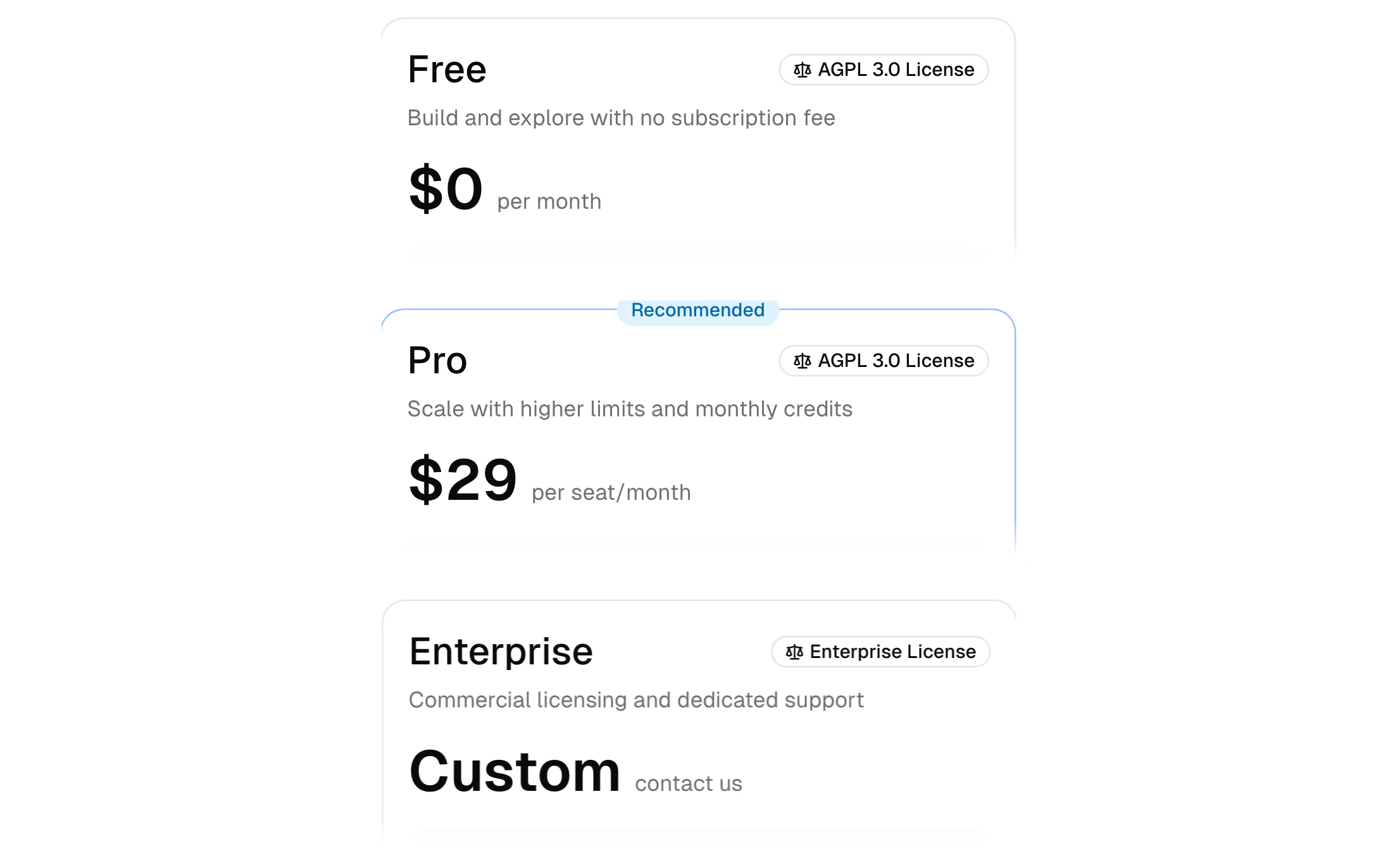
The Free, Pro and Enterprise plan headers on ultralytics.com/pricing, with the license badge each plan carries, captured on November 17, 2026.
The license you need follows the project, not the stage it's in. A team publishing its work can label, train and deploy YOLO26 on Platform on Free or Pro. A team building a closed product needs the Enterprise License,* which the Enterprise plan includes. For a wider procurement checklist, see our guide to choosing a computer vision vendor for enterprise procurement.
Find your license in four steps#
The decision comes down to one question: if you use Ultralytics YOLO code, models, architectures, training pipelines, or trained or fine-tuned models, will you open-source your entire project under AGPL-3.0?
| Your answer | License | Examples from our licensing page |
|---|---|---|
| Yes | AGPL-3.0, free | Academic research, personal projects, open-source applications |
| No | Ultralytics Enterprise License, paid* | Internal business tools, SaaS platforms and APIs, embedded devices, R&D that is not fully open-sourced |
Every AGPL-3.0 example still requires open-sourcing the entire project under AGPL-3.0. *This applies unless you hold rights to use Ultralytics YOLO under a separate agreement with Ultralytics or one of its authorized licensees.
- Find every place YOLO runs. Check training jobs, inference services, devices and notebooks. In each Python environment you use,
pip show ultralyticsshows whether the package is installed there; its metadata lists the package's default license, AGPL-3.0, not whether you hold an Enterprise License. - Ask whether you'll publish the whole project. If you will publicly release the entire project under AGPL-3.0, following the contributing guide, AGPL-3.0 fits.
- If not, request an Enterprise License.* That covers internal tools, customer-facing applications, commercial products and R&D projects that aren't fully open-sourced.
- Use the license checker. The checker on our licensing page asks a few questions about your use case and recommends a license.
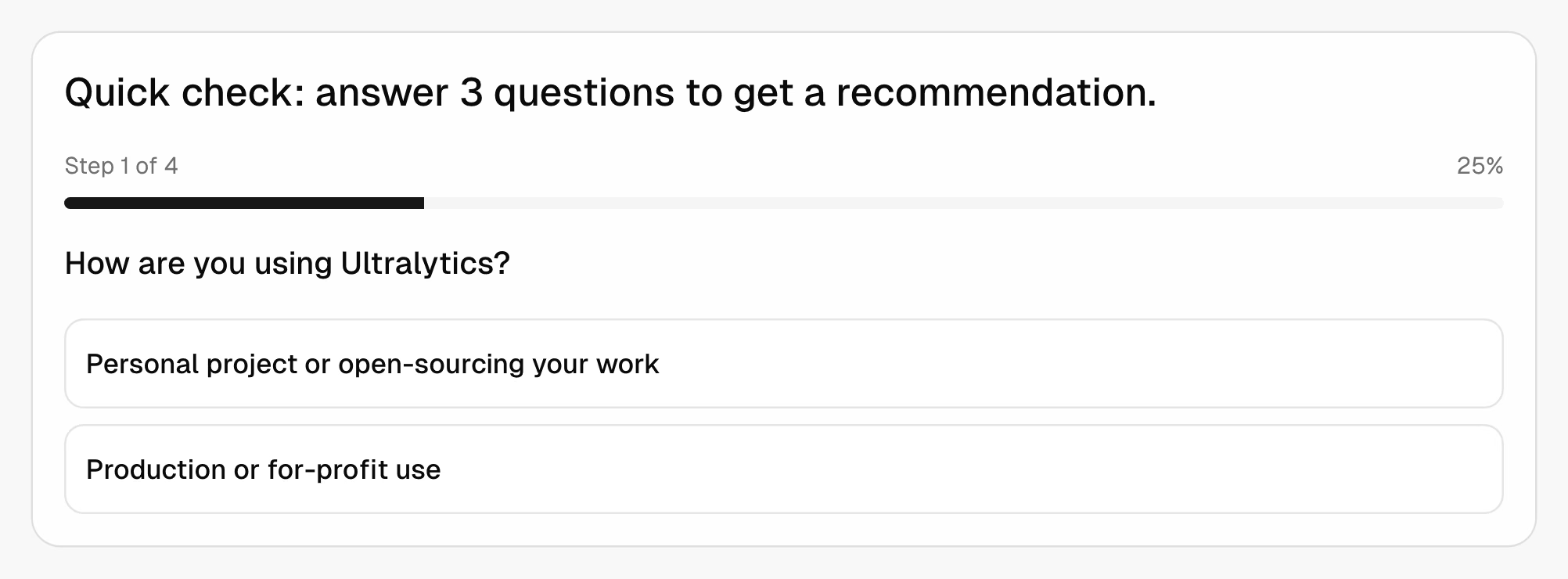
The license checker on ultralytics.com/license starts by asking whether it's a "Personal project or open-sourcing your work" or "Production or for-profit use".
Who should choose which license#
Stay on AGPL-3.0 if you're a student, researcher, hobbyist or open-source maintainer who will publish everything, including training scripts, configs and fine-tuned weights.
Choose the paid Enterprise License* if you want to use Ultralytics YOLO without open-sourcing your entire project, including internal business tools, SaaS products, APIs, embedded devices and R&D. You get commercial rights, ownership of your models, coverage for contractors, and every current Ultralytics YOLO model plus future ones released during the term. Start with the licensing page, or the Enterprise plan if your team works on Platform.
Frequently asked questions
Only if you open-source your entire project under AGPL-3.0. Using Ultralytics YOLO in a commercial product or service, an internal business tool, a SaaS service or an embedded deployment without open-sourcing it requires the paid Enterprise License, unless you hold rights to use Ultralytics YOLO under a separate agreement with Ultralytics or one of its authorized licensees. The same applies to YOLOv5, YOLOv8, YOLO11 and YOLO26.
YOLOv8 is released under AGPL-3.0, the same as YOLOv5, YOLO11 and YOLO26, and models you train with it are covered by default. During your license term, one Ultralytics Enterprise License covers the complete Ultralytics YOLO source code portfolio, including earlier versions and any future models released during that term, so you don't need a separate license for each model.
Yes. All Ultralytics YOLO trained models fall under the AGPL-3.0 License by default, including models trained from scratch without pretrained weights. Either open-source your entire project under AGPL-3.0, or obtain the paid Enterprise License, unless you hold rights to use Ultralytics YOLO under a separate agreement with Ultralytics or one of its authorized licensees.
Only if you open-source the full internal project under AGPL-3.0, or you hold rights to use Ultralytics YOLO under a separate agreement with Ultralytics or one of its authorized licensees. Our licensing page lists internal business tools and private company applications as Enterprise License cases, and the choice applies even if you use YOLO only internally.
Yes, with the right license. Under AGPL-3.0 you would open-source the whole service, backend and frontend included. To keep the service closed, you need the Ultralytics Enterprise License, unless you hold rights to use Ultralytics YOLO under a separate agreement with Ultralytics or one of its authorized licensees. Our licensing page lists SaaS platforms, APIs and cloud systems that use YOLO behind the scenes as Enterprise cases.
Products and services you sold or provided during the term keep their license rights, so your customers aren't disrupted. Unless agreed otherwise in writing, distribution, offering and use must stop for unsold products and unused services, and internal systems must be archived. Continued internal use requires renewal unless both parties agree otherwise in writing.
Written by
Security Compliance Engineer · Ultralytics
Comments
Ask a question, share your results, or help someone else.