SOHGA developed MEGURU, a mobile patrol system powered by Ultralytics YOLO26, enabling parking lot staff to scan license plates near-instantaneously while walking past parked cars. MEGURU standardizes the process while reducing patrol time.
Parking lot patrols are a routine but operationally demanding task across a range of industries in Japan. Parking lot patrols are often a requirement for certain industries like healthcare. For example, hospitals need to keep access roads clear for ambulances and wheelchair users, while other industries are required to check their parking lots for unattended occupants. For staff managing large lots across multiple patrol rounds a day, keeping track of every vehicle consistently is a real operational challenge.
SOHGA Co. built MEGURU to address this. Powered by Ultralytics YOLO26, MEGURU is a mobile license plate recognition system that helps patrol staff track every vehicle in a lot in real time, automatically distinguishing cars that have already been checked from ones that haven't, through simple audio feedback delivered via a smartphone.
Using computer vision to support parking lot patrols#
SOHGA's MEGURU system is designed around a straightforward workflow. A staff member carries an iPhone mounted on a selfie stick and walks through the parking lot at a normal pace. As they move past each vehicle, the system scans the license plate in real time and plays an audio alert: one sound for a new vehicle that hasn't been logged yet, and a different sound for one that has already been checked.
This audio-first design is intentional. Patrol staff are not just recording plates; they are also looking through car windows to check for occupants. By delivering feedback through sound rather than requiring staff to look at the screen, MEGURU keeps their attention on the vehicle rather than the device. A new plate is processed instantaneously, allowing staff to move from one vehicle to the next every 2-3 seconds. As the operators make their rounds, MEGURU is able to keep pace with the staff in real-time, delivering audio cues efficiently without breaking their visual focus.
The system is currently deployed across 112 clients in eastern Japan, operating on 147 devices, reducing patrol time by around 30% on average. In the most significant documented case, a patrol that previously took two hours was completed in 40 minutes.
Challenges of license plate recognition on a moving device#
Reliable license plate recognition in a controlled, static environment is a well-understood problem. Doing it on a handheld smartphone moving through a parking lot is considerably more complex. As the patrol officer walks, the device shakes, the viewing angle changes from car to car, lighting conditions shift, and plates appear at varying distances and orientations. These conditions create motion blur and inconsistent framing that make standard OCR approaches unreliable.
SOHGA evaluated OCR during development and found it produced frequent misreads on visually similar characters. This is a meaningful problem in a system that depends on accurate plate identification. Japanese license plates use a defined set of characters rather than an open character set, which pointed toward a more targeted approach: training a detection model on only the characters that could actually appear on a plate, rather than relying on a general text recognition system.
This approach also made the model more robust to the physical realities of the scanning environment. Because the training data reflected real-world conditions such as motion blur, tilt, and variable lighting, the model learned to handle these variations rather than being tripped up by them.
How SOHGA uses Ultralytics YOLO26#
MEGURU's vision pipeline uses two Ultralytics YOLO models working in sequence:
License plate detection. The first model locates the license plate within each camera frame. Running at 10 frames per second on the iPhone, it continuously identifies the region of the image containing the plate as the device moves past each vehicle.
Character recognition. The second model takes the cropped plate region and identifies each character. Because it is trained specifically on the character set used in Japanese license plates, it operates within a constrained detection space that improves accuracy compared to general-purpose OCR. To handle frame-by-frame variation caused by motion, the system applies a majority-vote mechanism across multiple frames before confirming a read.
YOLO's speed and trainability were central to making this work. Running inference in real time on a consumer smartphone requires a model that is both accurate and lightweight. Training on a domain-specific dataset, rather than relying on an off-the-shelf OCR model, gave SOHGA the control they needed to tune performance for their exact use case. This resulted in the number plate recognition being near-instantaneous, with a 2-3 second time window reflecting the walking cadence of the operator between vehicles, with MEGURU being able to keep pace with this speed, delivering audio cues in real-time without making the patrol officer wait.
Why choose Ultralytics YOLO models?#
Ultralytics YOLO models offer the combination of real-time performance and training flexibility that MEGURU required. Running on a standard iPhone rather than dedicated hardware, the system needed a model that could deliver accurate inference at 10 FPS across the two-stage pipeline, including the detection and character recognition, without depending on a GPU or a cloud connection. YOLO's efficient architecture made that possible.
The ability to train on a domain-specific dataset was equally important. Japanese license plates use a constrained character set, and building a model trained specifically on those characters, rather than using a general text recognition system, gave SOHGA a more reliable and accurate foundation for character detection. The same training process also allowed the model to become robust to the real-world conditions of the patrol environment: motion blur, oblique angles, and variable lighting.
SOHGA also measured an unexpected benefit to patrol quality. Using brainwave monitoring equipment in a controlled trial, they found that staff without MEGURU could sustain concentration for around 10 to 15 minutes during a patrol. With MEGURU providing continuous audio feedback and removing the need to manually log plates, staff were able to maintain focused attention for up to an hour, which was the full duration of a patrol round.
Scaling patrol operations across Japan#
MEGURU is currently deployed across 100+ clients in eastern Japan, with 140+ devices in active use. The system serves two main customer groups, each using it to address a specific operational requirement.
Hospitals: Illegally parked vehicles on hospital access roads can block ambulance routes and prevent wheelchair access. MEGURU helps hospital patrol staff identify and log offending vehicles more efficiently.
Pachinko parlors: Japanese regulations require pachinko venues to patrol their parking lots and check for unattended occupants or children left unattended in a vehicle. MEGURU gives patrol staff a consistent, structured way to log every vehicle in the lot and ensure none are missed, replacing a manual process that was difficult to verify or standardize. MEGURU’s core function is to provide an easy way to distinguish between checked and unchecked vehicles, reducing staff concentration fatigue and improving the effectiveness of vehicle interior inspections, ultimately helping to save lives.
Another practical application is addressing unauthorized parking. Vehicles repeatedly using the lot without being pachinko customers had long been a persistent problem, difficult to manage effectively. By analyzing parking patterns, these vehicles can be clearly identified, and issuing warnings has been reported to bring repeat offenses down to zero.
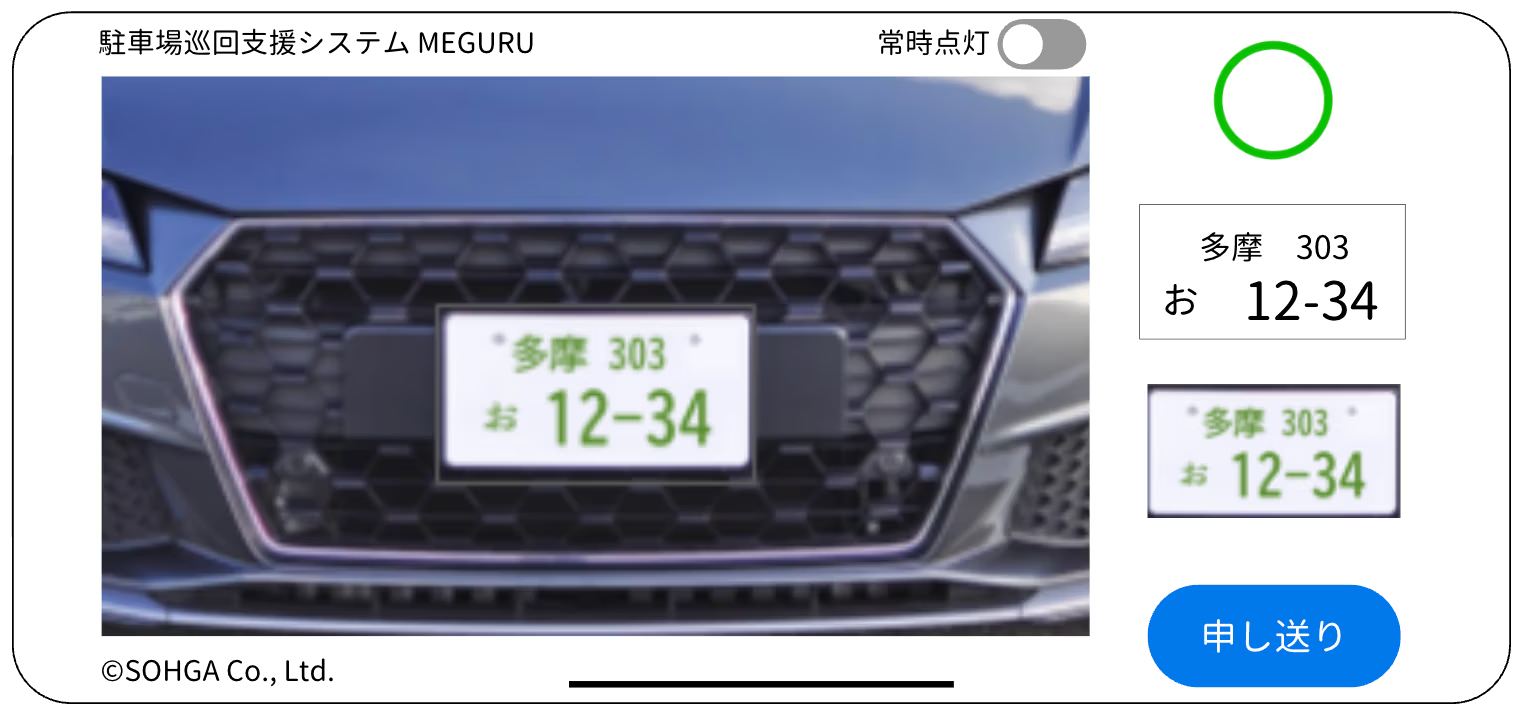 Fig 1. A license plate being analyzed by MEGURU.
Beyond the core patrol use case, SOHGA has extended MEGURU's capabilities into visitor analytics, as Japanese license plates include the vehicle's registered locality, and due to plate data not being classified as personal information under Japanese law, clients can use MEGURU's records to understand where visitors travel from, how long they stay, and how frequently they return.
Bringing structure and consistency to parking lot patrols#
MEGURU addresses a straightforward operational problem: how to make sure every vehicle in a parking lot has been checked, and solves it in a practical, scalable way. By running two Ultralytics YOLO26 models on a standard iPhone, SOHGA has built a system that works in the real-world conditions of an active parking lot.
The results are measurable. Patrol time has been reduced by an average of 30% across deployments, with staff able to maintain consistent concentration throughout a full patrol round. With 100+ clients and 140+ devices deployed across eastern Japan, MEGURU is a great example of how computer vision models are playing an active role within cities to monitor safety, as well as being a reliable tool for parking lot management.
Curious about vision AI? Discover our licensing options to bring computer vision to your projects. Visit our GitHub repository and join our community.








