Building smart products with Ultralytics YOLO26 and vision AI
Learn how building smart products with YOLO26 and vision AI enables real-time detection, intelligent automation, and scalable, responsive product experiences.
Thousands of hours of video are captured every day by cameras embedded in devices, machines, and public infrastructure. Most of that footage is stored, skimmed, or reviewed only when something goes wrong.
Often, visual data is available, but the ability to interpret it in real time is lacking. As products become more connected and data-driven, this limitation is becoming more noticeable.
Users expect systems to do more than just record events or follow fixed instructions. For instance, they expect smart products to recognize what is happening and respond immediately, without waiting for manual reviews or relying on rigid rule sets.
Recent advancements in artificial intelligence are helping close that gap. In particular, computer vision enables machines to interpret images and video, allowing systems to analyze scenes and respond in real time.
However, bringing this capability into a product requires models that are both fast and reliable. State-of-the-art computer vision models like Ultralytics YOLO26 are built for this purpose, delivering the speed and accuracy needed for real-time deployment.
Ultralytics YOLO26 supports core vision tasks such as object detection, instance segmentation, and object tracking, making it possible for products to interpret visual data and respond intelligently.
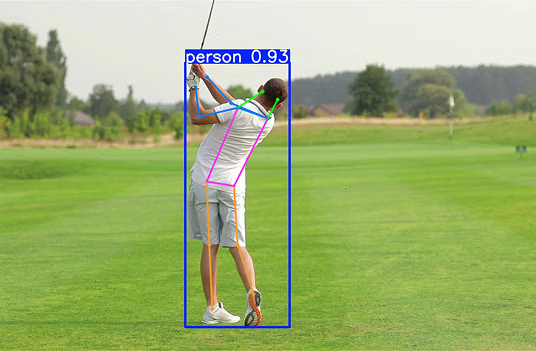
Fig 1. Detecting objects in an image using YOLO26 (Source)
In this article, we’ll explore how computer vision and Ultralytics YOLO26 can be used to build smarter products and support intelligent automation in real-world applications. Let’s get started!
The gaps in traditional product development#
Before we dive into how computer vision is helping build smarter products, let’s take a close look at the challenges teams face when relying on traditional, rule-based systems and older algorithms.
Here are some of the key challenges of traditional product development:
- Rigid rule-based systems: Hard-coded logic can work in controlled environments, but real-world settings are rarely predictable. Small shifts in lighting, camera angle, or object appearance can quickly break predefined rules and reduce accuracy.
- Poor adaptability to real-world variability: Traditional systems don’t adjust well to new or unexpected scenarios. Updates often require manual tuning and repeated optimization, which slows product improvements and increases maintenance effort.
- Scalability limitations: As the volume of image and video data grows, older image processing pipelines struggle to keep up. Processing becomes slower, making it difficult to maintain real-time performance across video streams.
- High latency in real-time scenarios: Many traditional approaches can’t process continuous visual streams quickly enough. Delayed outputs weaken automation and reduce overall responsiveness.
- Expensive compute requirements: Achieving acceptable accuracy often demands significant hardware resources, including dedicated graphics processing units (GPUs), which increases infrastructure costs.
The role of computer vision in building smarter products#
Next, let’s see how computer vision can support smarter product behavior.
Most connected products today already collect visual data as part of their normal operational processes. Cameras are built into various devices, installed in physical spaces, and linked through Internet of Things (IoT) systems.
As a result, images and video are constantly being captured in the background. The challenge isn’t collecting this data.
The tricky part is making sense of the collected data in real time. Without visual intelligence, footage is simply stored and reviewed later, often after an issue has already occurred.
Computer vision changes that. By using neural networks trained to recognize patterns, systems can analyze images and video in real time. Instead of relying on fixed rules or manual checks, products can interpret what’s happening in a scene and respond as events happen.
To bring this visual capability into products, teams can rely on efficient computer vision models such as Ultralytics YOLO26. YOLO26 supports key vision tasks and can help products interpret visual information quickly enough to enable real-time decisions.
The building blocks of vision-driven products#
Here’s a quick breakdown of how computer vision tasks can contribute to smarter products:
- Object detection: This task can identify and locate relevant objects within each frame using a bounding box and assign a confidence score, giving a clear understanding of what is present in an image.
- Object tracking: It can be used to follow specific objects across multiple frames, letting a vision system understand movement and changes over time.
- Image classification: This task assigns a label to an entire image based on its primary content. It categorizes scenes or identifies specific conditions within the frame.
- Instance segmentation: It can precisely outline objects at the pixel level, allowing products to better interpret shapes, boundaries, and spatial relationships.
- Pose estimation: This task detects key points on the human body or other articulated objects. It captures posture, motion, and physical interactions in real time.
- Oriented bounding box (OBB) detection: It can detect objects using rotated bounding boxes instead of standard horizontal ones. It improves localization accuracy when objects appear at angles or in tightly packed environments.
When these capabilities are applied to continuous visual data, products can respond faster, automate more reliably, and deliver experiences that feel aware rather than reactive. Instead of waiting for events to be reviewed later, systems can understand and act in the moment.
How real-time vision models enable intelligent product behavior#
As you learn more about vision-driven products, you might be wondering how a system moves from simply recording video to actually responding in real time.
It starts with recognizing what is in front of the camera. As video streams in, a vision model analyzes each frame and identifies the elements that matter, such as specific objects or people. Instead of reacting to every movement, the system focuses only on relevant signals.
Another key aspect is speed. Real-time systems have to process each frame quickly and consistently, ensuring that detection and decision-making happen without noticeable delay.
For example, the Ultralytics YOLO (You Only Look Once) family of models was built to process visual data in real time. Models like Ultralytics YOLO26 build on earlier versions such as Ultralytics YOLOv5, Ultralytics YOLOv8, and Ultralytics YOLO11, incorporating architectural refinements, performance optimizations, and efficiency enhancements. The result is improved speed and accuracy, even in demanding real-world conditions.
When integrated into a product, these models run continuously in the background, analyzing each frame as it arrives. The system checks predefined conditions and, once met, can instantly trigger an alert, update a workflow, or initiate an action.
This makes vision-driven systems more responsive, scalable, and practical for integration into environments ranging from robotics and autonomous vehicles to smart home and security systems. For business leaders, this translates to faster responses, fewer manual checks, and automation that feels reliable instead of reactive.
Using Ultralytics YOLO26 to power real-time visual intelligence in products#
Ultralytics YOLO models, including YOLO26, are available out of the box as pre-trained models. This means they are already trained on large, widely used datasets such as the COCO dataset.
Because of this pre-training, Ultralytics YOLO26 can immediately recognize common real-world objects. This gives product teams a practical starting point, meaning they can build visual features without training a model from scratch.
For more specific product needs, these pre-trained models can be further fine-tuned using domain-specific data with high-quality annotations.
For example, consider a restaurant equipped with ceiling cameras. A custom-trained vision AI model like Ultralytics YOLO26 can detect how many people are inside the space. It can identify which tables are occupied and which chairs are empty.
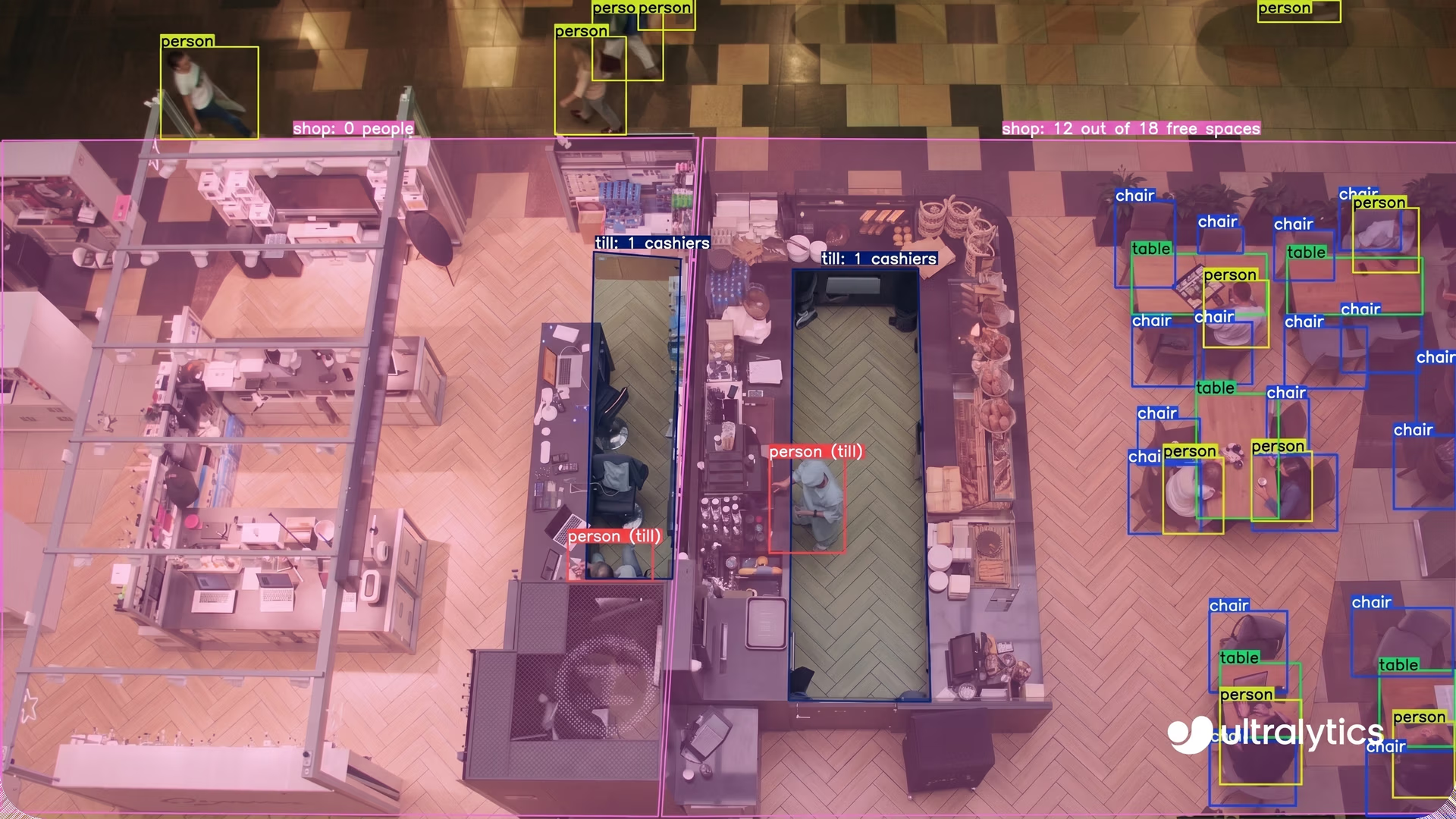
Fig 2. Ultralytics YOLO26 enables real-time detection of people, open spaces, and staffed tills in retail stores. (Source)
In this type of scenario, Ultralytics YOLO26 acts as a visual engine running continuously in the background. Teams can also deploy such models on edge devices, depending on performance needs and energy efficiency goals.
Real-world applications of YOLO models in smart products#
Now that we have a better understanding of how real-time vision models work, let’s look at how Ultralytics YOLO models can be applied within smart products for different use cases to make them more aware, responsive, and capable of acting on what they see.
Healthcare product intelligence with YOLO#
When it comes to surgical training in healthcare, hours of procedure footage are often reviewed manually to evaluate tool handling and workflow. This process can be time-consuming and heavily dependent on human observation.
With a YOLO-based vision model integrated into the system, video feeds can be analyzed automatically as procedures take place. The model can detect surgical instruments in real time and identify where and when they are used.
This enables structured logging, improved analytics, and high-quality performance insights without constant manual review. In fact, research using the Ultralytics YOLO11 model, which is a predecessor to the latest YOLO26 model, showed that real-time laparoscopic instrument detection could run effectively even on embedded systems.
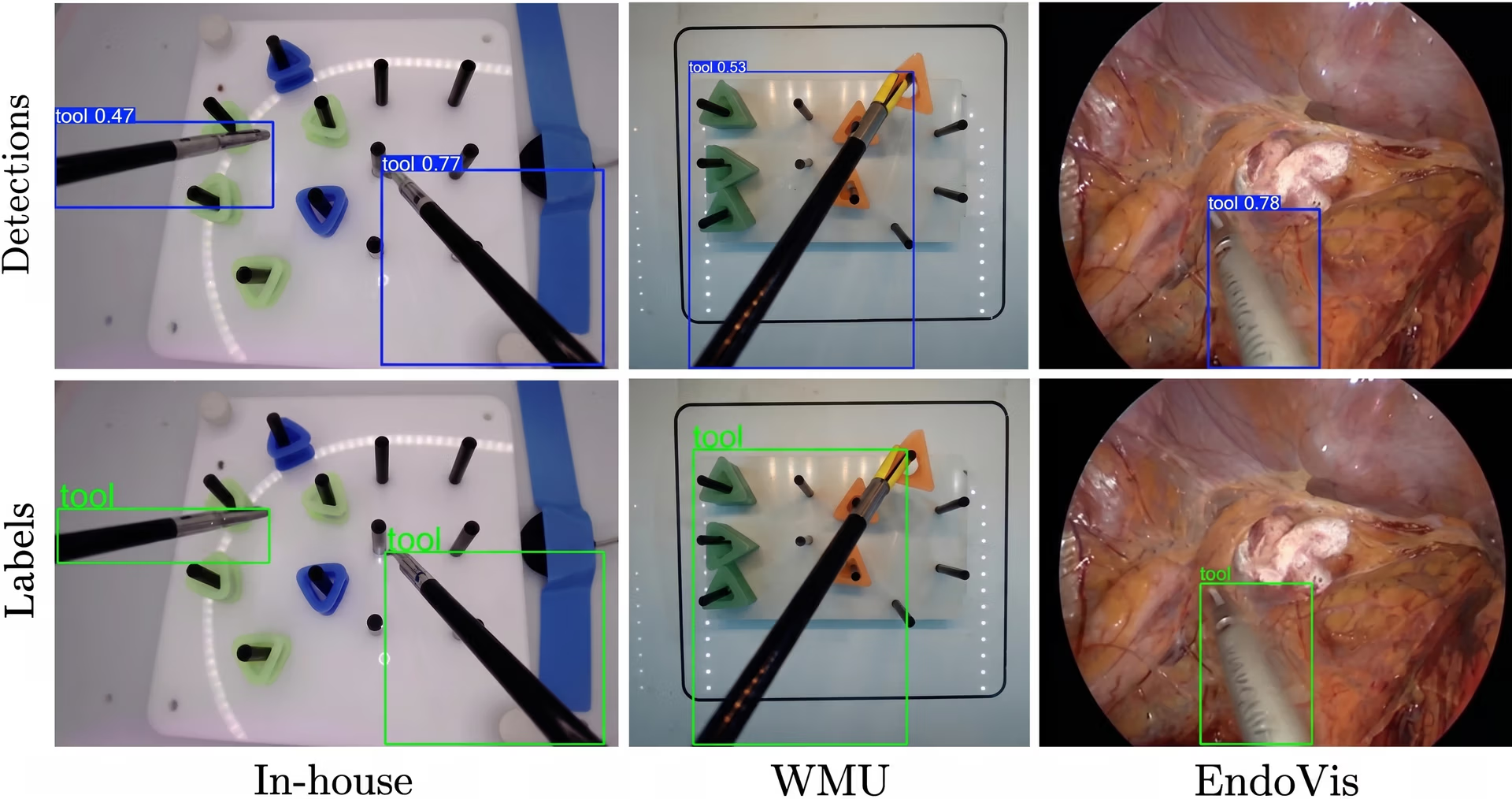
Fig 3. Real-time laparoscopic instrument detection using YOLO (Source)
The model maintained high accuracy while running fast enough for live surgical settings. This shows how deep learning can support reliable real-time visual feedback during procedures.
Creating smart YOLO-driven retail experiences#
We’ve all stood in front of a crowded supermarket shelf trying to find the right product. Many items look alike, labels are small, and products are often placed in the wrong spot.
For retailers, this makes real-time shelf visibility difficult. Vision AI and YOLO object detection models can assist store systems in understanding what is actually on the shelf through camera feeds and live video streams. This reduces reliance on barcode scans and manual checks, making shelf monitoring more accurate and responsive.
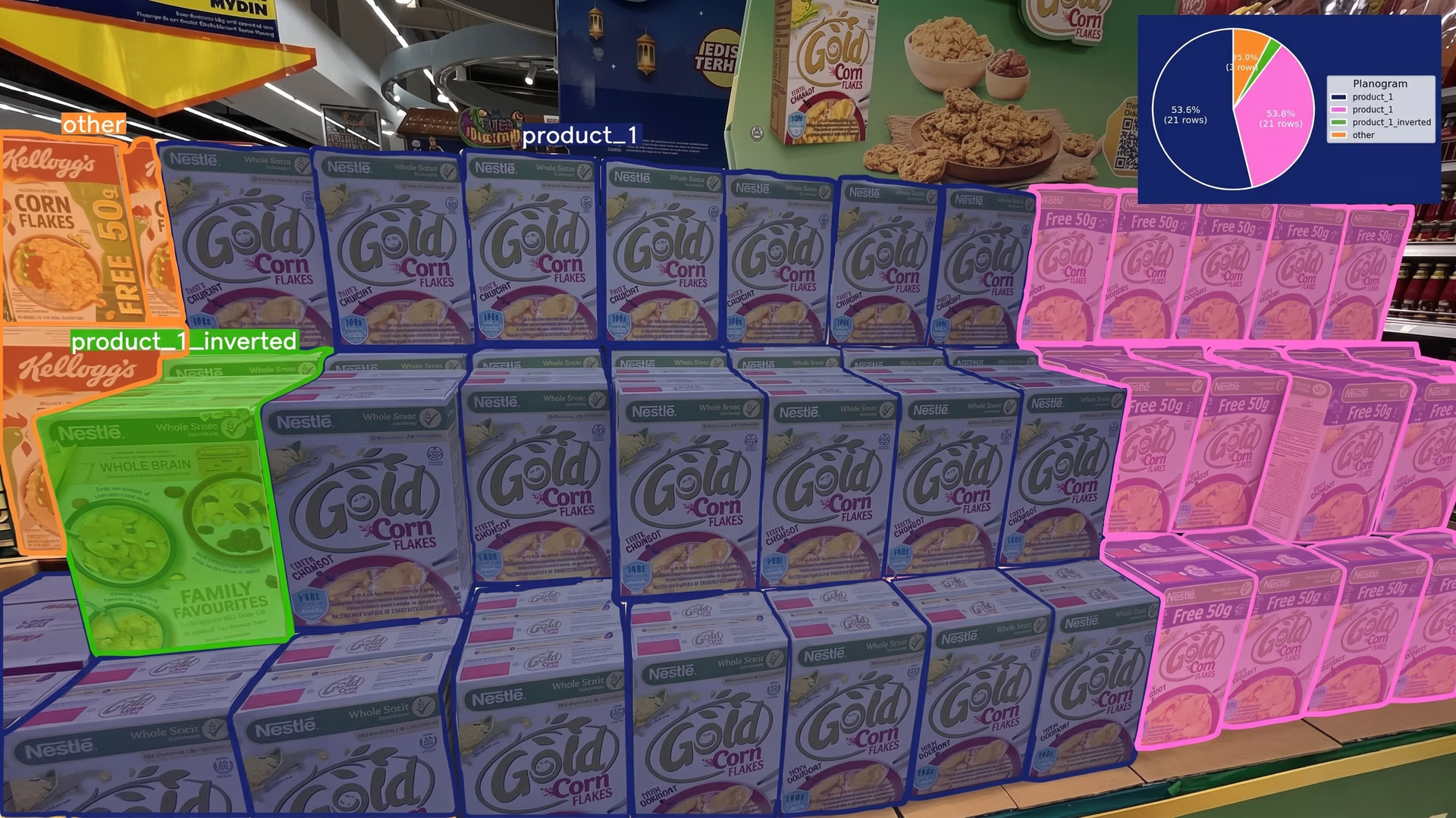
Fig 4. Detecting and segmenting products on supermarket shelves with Ultralytics YOLO26
With this kind of accuracy, retailers no longer have to rely only on periodic manual checks. Shelves can be monitored continuously through live video.
Low stock can be flagged right away, misplaced products can be spotted faster, and checkout processes can run more smoothly. This gives retailers better operational control while creating a more seamless shopping experience for customers.
Vision AI and autonomous navigation#
Autonomous systems can be highly efficient, but they often rely on fixed routes or preset coordinates. While this works in stable environments, real-world conditions rarely stay the same.
Vision AI solutions, powered by deep learning models, enable machines to understand their surroundings and adjust in real time. With computer vision combined with adaptive algorithms, systems can respond to changes as they happen instead of relying on rigid, preprogrammed instructions.
So, how does this work in real-world settings? Let’s take the example of a robot operating in a warehouse. Cameras capture its surroundings continuously, and a vision model performs real-time object detection to identify obstacles, shelves, and pathways.
These detections support localization, helping the robot determine its precise position within the facility. Based on this visual input, optimization algorithms adjust its route instantly, allowing it to navigate efficiently and maintain smooth automation even as conditions change.
Infrastructure monitoring and smarter defect detection#
Power lines and grid equipment need regular inspection to stay safe and reliable. Most of the time, these utility inspections still involve manual checks, which take time and are hard to manage across large or remote areas.
Vision AI offers a simpler way to keep an eye on infrastructure without depending only on scheduled site visits. Models like Ultralytics YOLO26 can detect defects on power line insulators, including cracks, corrosion, or visible damage, directly from images captured in real outdoor conditions.
By analyzing visual data in real time, such systems can flag potential issues that might otherwise go unnoticed. Identifying these problems early reduces the risk of equipment failure, minimizes unexpected outages, and supports more proactive maintenance operations.
Measuring the ROI of vision-based smart products#
For business leaders, vision AI isn’t just about technical performance. It is about measurable business impact.
When implemented thoughtfully, vision-driven systems can improve efficiency, reduce costs, and increase accuracy. These gains also contribute to better user experiences and stronger overall performance.
Here are a few areas where that impact becomes clear:
- Reduced manual effort: Vision systems automate repetitive inspection, monitoring, and verification tasks, lowering dependency on manual processes and freeing teams to focus on more strategic work.
- Faster decision cycles: Real-time visual analysis allows systems to detect issues or trigger actions instantly, shortening response times and keeping operations running smoothly.
- Fewer operational errors: Automated detection brings consistency. By reducing human oversight in routine tasks, organizations often see fewer mistakes and more reliable outcomes.
- Improved user engagement: Products that can see and respond intelligently feel more interactive and relevant. This leads to stronger user trust, better experiences, and higher long-term adoption.
Key takeaways#
Vision AI enables products to interpret visual information in real time, supporting smarter automation and more responsive experiences. With capabilities like detection, tracking, and segmentation, systems move beyond basic rules to context-aware decisions. Efficient models such as Ultralytics YOLO26 make it practical to build scalable, competitive vision-driven products.
Join our active community and discover innovations such as AI in manufacturing and vision AI in retail. Visit our GitHub repository and get started with computer vision today by checking out our licensing options.