Computer vision for regulated industries: an Ultralytics security review checklist
A security review checklist for computer vision in regulated industries: SOC 2 and ISO 27001 scope, on-premise and air-gapped options, privacy and SLAs.
 Kristian Sommer13 min read
Listen to this article
When a computer vision platform goes through review in a regulated industry, reviewers look at four things: independent security evidence, where images and model data flow, how access and changes are controlled, and what the contract commits to. These checks support an assessment. They don't make a vision system compliant on their own, because the rules that apply depend on your system, your data and how you use it.
This checklist is for security, compliance and procurement teams in healthcare, life sciences, manufacturing, energy, finance and the public sector who are reviewing Ultralytics YOLO, Ultralytics Platform or any other vision AI stack. Each section lists the evidence to request, the question to answer and what stays your responsibility. If you're still choosing between vendor architectures, start with our enterprise computer vision procurement guide, then come back here for the review.
Start with the requirements that apply to your use case#
Begin by deciding which requirements actually apply, before you collect any vendor documents. A shopping list of certifications slows reviews down and still misses what your regulator cares about. The frameworks below illustrate requirements to assess for your use case. Treat this as a map of questions to ask, not legal advice.
| Framework | Scope | What to establish for a vision project |
|---|---|---|
| SOC 2 | Service organizations, any sector | An auditor's report on a vendor's controls for a defined system |
| ISO/IEC 27001 | Any sector | A certified information security management system within a defined scope |
| HIPAA | US covered entities and business associates handling protected health information (PHI) | Whether the vendor acts as a business associate, and a business associate agreement (BAA) where required |
| GDPR | Personal data processed within the GDPR's territorial scope | Controller and processor roles, a lawful basis, processor terms and safeguards for international transfers |
| FDA 21 CFR Part 11 and applicable GxP requirements | Electronic records and signatures within Part 11's scope, and activities governed by good-practice rules | Which records and systems are in scope, then validation, access, audit-trail, retention and signature controls |
| IEC 62443 | Industrial automation and control systems | Zones, conduits and target security levels set through risk assessment, plus supplier requirements |
| FedRAMP | In-scope cloud services handling federal information on behalf of US federal agencies | Whether it applies to the intended use, then the specific offering's authorization status and assessed boundary |
| EU AI Act | Providers, deployers and other operators within its scope | Your role, the intended use, its risk classification and the obligations and dates that apply |
Your responsibility: vendor reports and certificates cover the vendor's own system. Part 11 validation, IEC 62443 risk assessment, GDPR role analysis and EU AI Act classification still happen in your environment, for your use case.
Check security evidence and its exact scope#
Request: the current SOC 2 report, the ISO/IEC 27001 certificate with its scope statement, and the latest external penetration test summary.
Ask: does the evidence cover the product and configuration you're buying, and does the report type meet your policy?
A SOC 2 Type I report includes an auditor's opinion on the system description and the design of controls at a specified date. A Type II report also addresses whether those controls operated effectively over a specified period, so check which report type your procurement policy requires. Read the opinion, the scope and any exceptions, not just the cover page. An ISO/IEC 27001 certificate covers an information security management system within a defined scope, and surveillance audits maintain it between recertification audits.
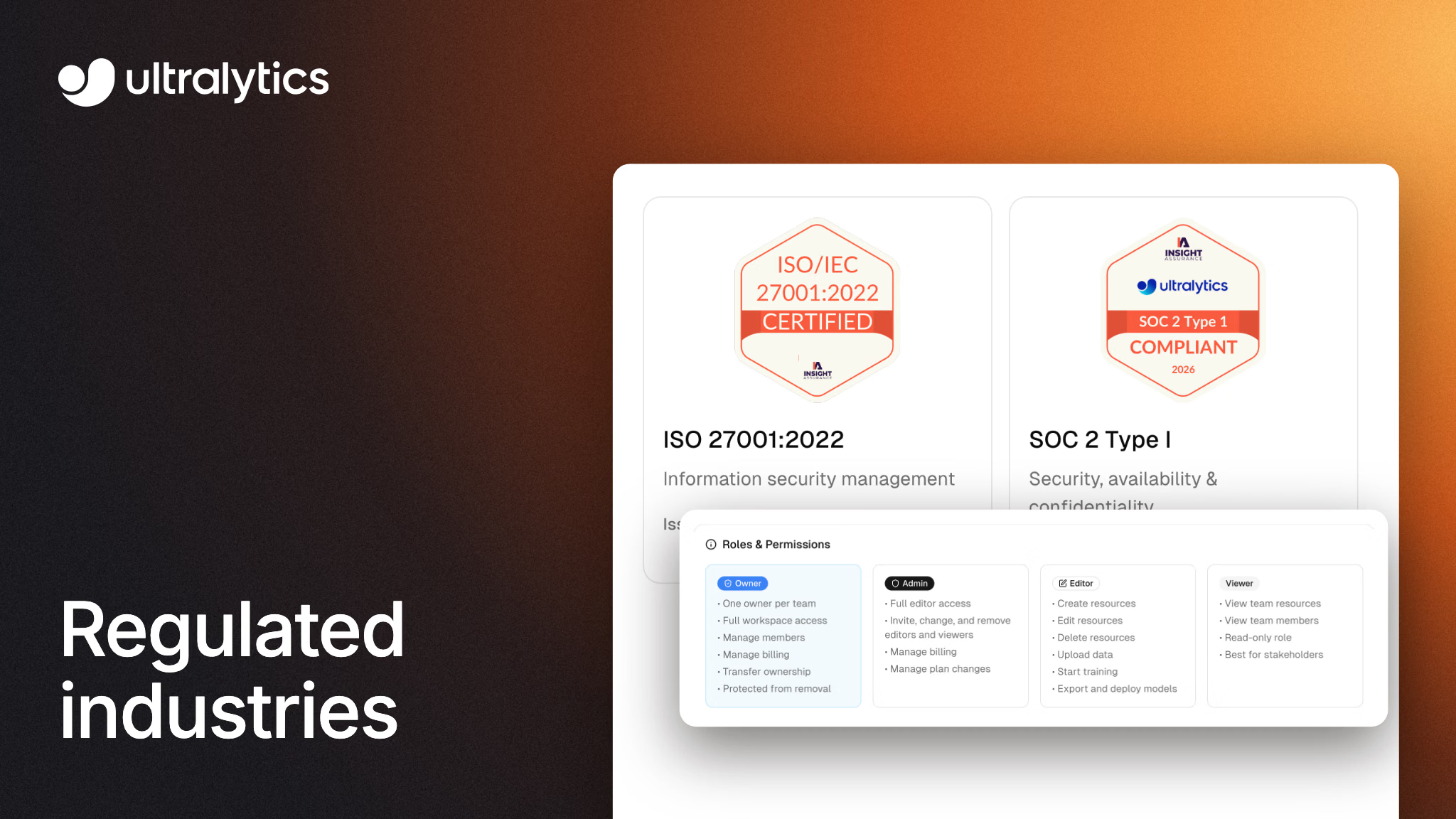
Ultralytics today: Ultralytics Platform is certified to ISO/IEC 27001:2022 and holds a SOC 2 Type I report, both issued in 2026 with the full platform in scope on every plan, according to our security page and pricing page. The reports, a penetration test attestation and the subprocessor list are available through the Trust Center. The security page lists a SOC 2 Type I report. If your policy requires Type II, confirm at the start of the review whether a suitable report is available. Our published evidence places Ultralytics YOLO and Ultralytics Platform within the ISO/IEC 27001:2022 certified management system, and the full Platform within the SOC 2 Type I scope. For the open-source YOLO packages, also review the supply-chain controls: continuous vulnerability scanning, code analysis, dependency alerts, secret scanning and a software bill of materials (SBOM) with every release.
Map where images, labels and models go#
Request: a data-flow description for your exact configuration, covering source images, labels, trained model weights, metrics and logs.
Ask: which of those leave your network, where do they go, and what still needs internet access?
Use these four deployment patterns to structure your data-flow review:
| Pattern | What leaves your environment | Who runs it |
|---|---|---|
| Cloud vision API | Every image sent for analysis | Provider |
| Managed platform with data residency | Images, labels and models, stored in a region you choose | Vendor |
| Local dataset pixels, cloud management | Labels, annotations, metrics and selected model weights; source pixels stay local | You run local ingest and training; the vendor runs the interface |
| Self-hosted, optionally air-gapped | Depends on your configuration; an air-gapped setup has no route to external services | You |
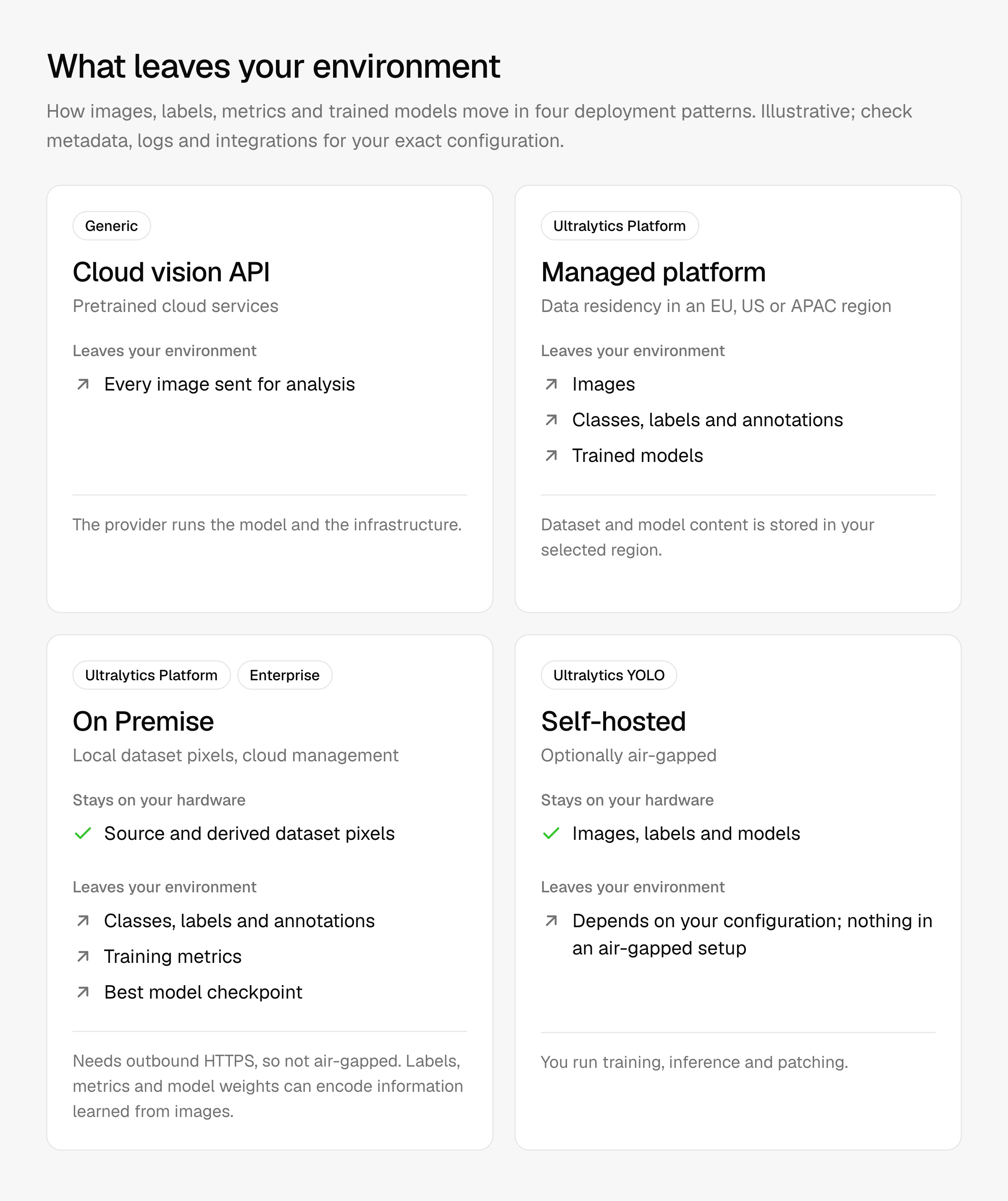
How images, labels, metrics and model weights cross your environment boundary in each pattern. Exact flows depend on your configuration.
Ultralytics today:
- Managed with residency. Ultralytics Platform stores dataset and model content in the EU, US or APAC region selected during onboarding; changing it requires a support request. Each dedicated deployment uses the region selected when the endpoint is created. The data region is a storage guarantee: account-level data such as profile and billing records is processed globally, so confirm GPU processing locations if your agreement restricts where processing happens.
- Local dataset pixels. Platform's On Premise option, part of the Enterprise plan, indexes and trains on datasets that stay on your own Linux, macOS or Windows computer. Platform never stores, logs or processes those source pixels. Labels, annotations and metrics are stored in Platform, and the best checkpoint uploads for export and deployment. Those artifacts can encode information learned from the images, so include them in your review. Setup needs outbound HTTPS to Platform, Docker registries and Python package downloads, so On Premise is not an air-gapped option.
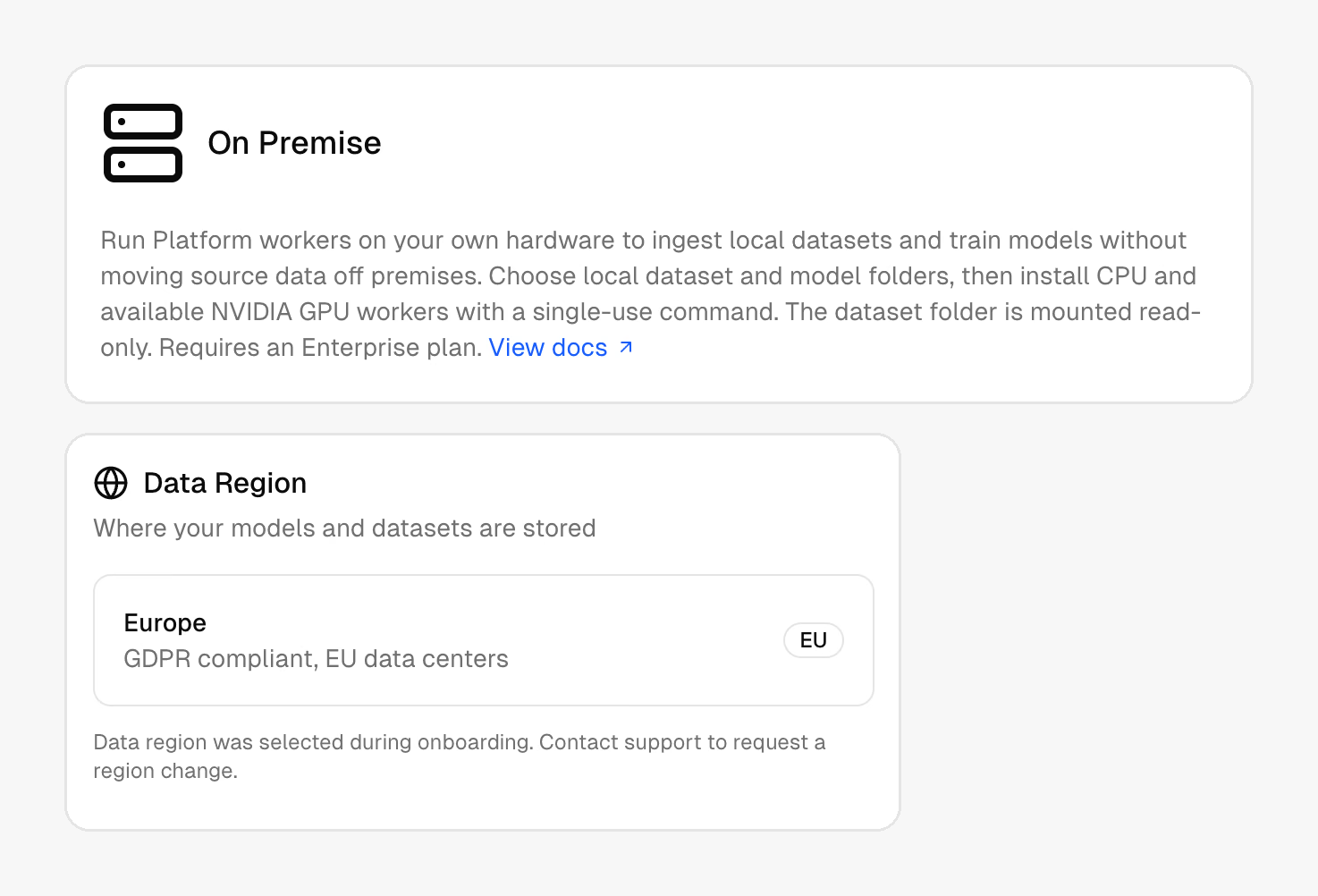
Platform's On Premise and Data Region settings. On Premise still needs internet access, and EU residency on its own doesn't establish GDPR compliance.
- Self-hosted. The Ultralytics YOLO Python package trains, validates, runs and exports models on your own servers. When YOLO runs outside Platform, Ultralytics doesn't process or store your inference data. Commercial and internal business use outside the AGPL-3.0 terms needs an Ultralytics Enterprise License.
Air-gapped deployments#
An air-gapped system has no route to the internet, so everything the software would normally download must arrive through your approved transfer process. For Ultralytics YOLO:
- Stage and test the whole workflow. Transfer the packages, model files, datasets and runtime assets your workflow needs, then test training, inference and export with the network blocked before you accept the environment.
- Turn off telemetry. The package's anonymous analytics are on by default and never include images, according to our data collection documentation. Setting
sync=Falseturns analytics and crash reports off. Disable external logging integrations too. - Export to an approved runtime. YOLO models export to ONNX, TensorRT, OpenVINO and other formats, so inference can run on a serving stack your infrastructure team already approves.
- Enforce isolation at the network. Software settings are a second line of defence, not the first.
Your responsibility: on a self-hosted or air-gapped deployment, your team runs the GPUs, labeling, versioning, monitoring and patching. Our comparison of managed cloud and self-hosted computer vision covers those costs.
Review privacy, access and data handling#
Request: the data processing agreement, retention and deletion terms, the subprocessor list and a description of access controls.
Ask: can the vendor use your images to train its own models, and who inside the vendor can reach your data?
Get the training question answered in the contract. Processing your images to deliver a feature you asked for, such as auto-annotation, is different from using them to improve the vendor's own models, and the two should be addressed separately.
Ultralytics today:
- Contract terms. The data processing agreement documents data handling, processing and retention practices, and standard contractual clauses are available. Enterprise plans add legal protections for datasets and model training; confirm the exact terms for your use in your agreement.
- Access. Our security page lists SSO/MFA and role-based access control for Ultralytics Platform, with MFA enforced, and the Enterprise plan adds SSO/SAML. Team members on Pro and Enterprise plans are assigned Owner, Admin, Editor or Viewer roles.
- Encryption. Data is encrypted in transit and at rest.
- AI features on your own storage. Datasets indexed from Amazon S3, Google Cloud Storage or Azure Blob Storage have an AI features switch, on by default. While it's on, Ultralytics GPUs and AI model providers may process those images for features such as smart annotation, auto-annotation and cloud training. Turn it off to keep the images off those services; manual annotation and local training keep working. On Premise images never leave your host, so these features aren't available for them.
- Health data. We've completed a HIPAA Security Rule self-assessment, and a BAA is available to eligible Enterprise customers. Upload PHI only after both parties have signed the BAA, and only into the services and configurations it covers. Our guide to HIPAA-compliant AI for medical imaging covers the setup.
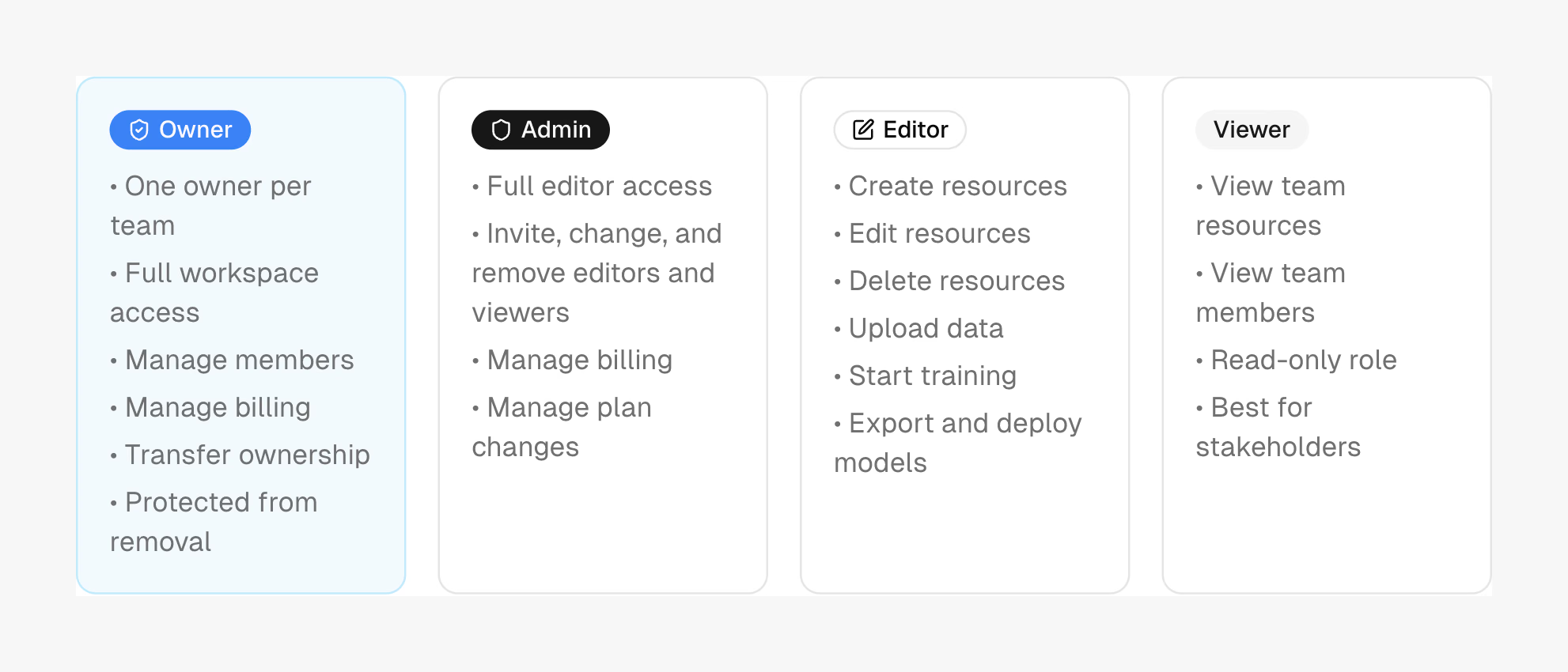
Ultralytics Platform workspace roles: Owner, Admin, Editor and Viewer, each with different permissions.
For comparison, the large cloud providers publish service-level lists for health data. AWS lists Amazon Rekognition in its HIPAA eligible services reference, and Google Cloud lists Cloud Vision among the products covered by its HIPAA BAA. Whichever vendor you use, check that the specific service is on that list.
Establish traceability and change approval#
Request: how datasets and models are versioned, which events are recorded, how long records are kept and how they can be exported.
Ask: can you show which data trained the model in production, who changed it and who approved the release?
A platform can make that evidence easier to collect. It can't validate a regulated system for you.
Ultralytics today: for uploaded datasets in the ready state, Ultralytics Platform lets you create immutable, numbered dataset versions that can be downloaded, compared and restored. Versions aren't available for datasets connected from cloud storage or On Premise, so those sources need their own versioning process. Platform's activity feed records training jobs, dataset changes, model exports and deployments, API key events and settings changes. Events can be exported as CSV or JSON, with event times, resource identifiers, user names, emails and IDs, and event metadata. The activity documentation doesn't establish Part 11 validation, so assess whether the feed and your surrounding controls meet the requirements for your intended use.
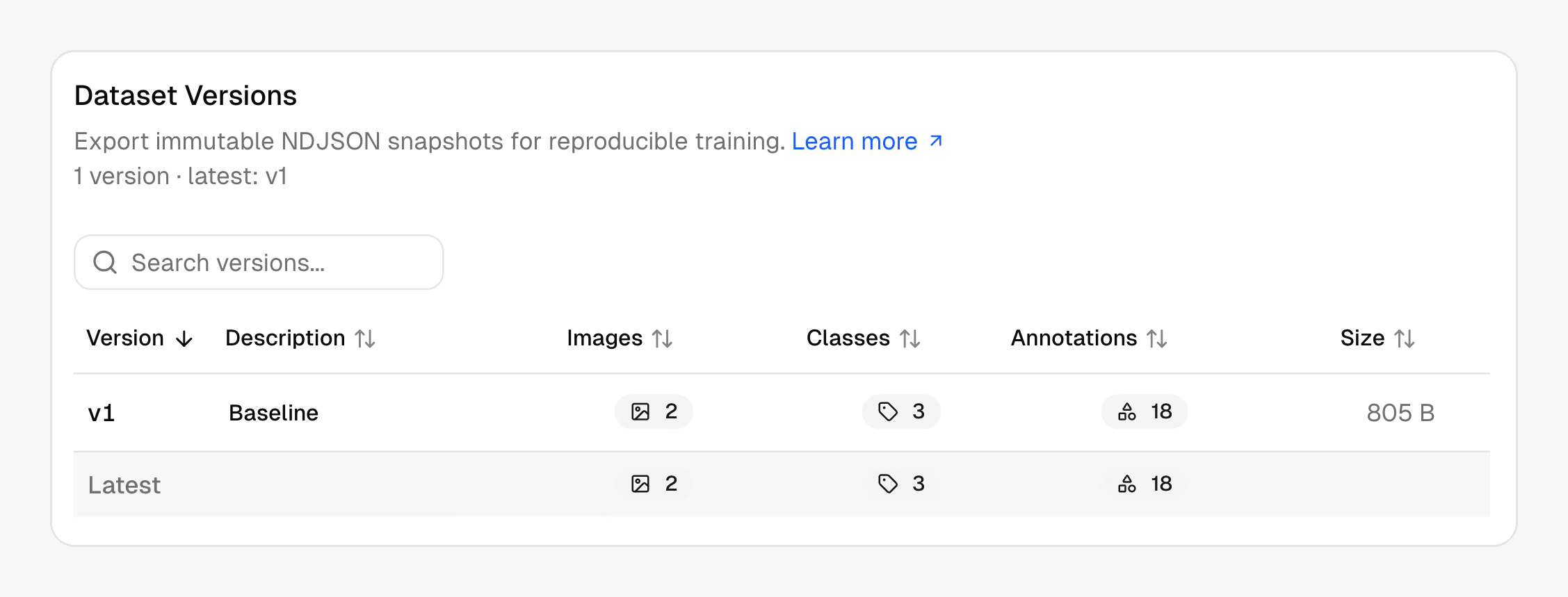
Immutable, numbered dataset versions for uploaded datasets in Ultralytics Platform, with image, class and annotation counts. Connected cloud storage and On Premise datasets need their own versioning process.
Your responsibility: record the dataset version and model checkpoint behind every release, and keep acceptance tests, approvals and change records in your own quality system.
Agree support and availability commitments#
Request: the SLA document, support response times and the incident communication process.
Ask: what exactly is covered, how is availability measured, and what happens when the target is missed?
Read three things in any SLA: what's covered (training, inference endpoints or the web app), how uptime is measured, and what remedy applies. Published cloud SLAs make good reference points. Google Cloud's Cloud Vision SLA, for example, sets a monthly uptime objective of at least 99.9%.
Ultralytics today: Enterprise plans include custom SLAs and dedicated onboarding and support. Service status and incident history are public at status.ultralytics.com.
Your responsibility: on self-hosted and air-gapped deployments, availability is yours to engineer. The vendor relationship then covers support, security advisories and updates.
Assemble the approval pack#
Close the review with a single pack your approvers can sign off, or with a written blocker. Include:
- The requirements that apply, and who confirmed them
- The SOC 2 report (with its type), the ISO/IEC 27001 certificate and scopes, and the penetration test summary
- A data-flow diagram for the exact configuration, including what needs internet access
- The data processing agreement, retention terms and subprocessor list
- An explicit contractual answer on whether your data can train the vendor's models
- The BAA, if the vendor acts as a HIPAA business associate
- Access-control settings: SSO, multi-factor authentication and roles
- Your versioning, change approval and validation records
- The SLA, support terms and licensing terms for commercial deployment
- Any open gaps, their owners and the decision taken
Frequently asked questions
Ask each vendor whether it holds a SOC 2 report, then review the report's type and scope. Ultralytics Platform holds a SOC 2 Type I report and ISO/IEC 27001:2022 certification, both covering the full platform, with audit reports available through the Ultralytics Trust Center.
Yes, with a self-hosted model. Ultralytics YOLO supports self-hosted operation. For an air-gapped deployment, stage and test every package and file your workflow needs, turn off analytics with
sync=False, disable external integrations and enforce isolation at the network level. Ultralytics Platform, including On Premise, needs internet access.Ultralytics Platform's Enterprise plan includes SSO/SAML, role-based team access and On Premise, which keeps dataset images and training on your own hardware while labels, metrics and the best model go to Platform. Sites that need full isolation can run Ultralytics YOLO self-hosted under an Enterprise License.
Ask the managed-service provider whether an SLA is available, what it covers and how uptime is measured. Ultralytics Enterprise plans include custom SLAs. On self-hosted deployments, availability depends on your own infrastructure.
No. Vendor reports and certificates provide evidence within a defined scope. Your organization still has to decide which requirements apply to its system, data and intended use, and meet them.
To see the evidence behind these answers, visit our security and compliance page, or talk to our team about an Enterprise License.
Sources, checked 16 November 2026: Ultralytics security page, pricing page and Ultralytics Platform documentation; AWS HIPAA Eligible Services Reference; Google Cloud HIPAA compliance page; Google Cloud Vision SLA.
Written by
Security Compliance Engineer · Ultralytics
Comments
Ask a question, share your results, or help someone else.