GPT-6.2 Sol vs Astra for Auto-Annotation: Similar Scores, Different Strengths
GPT-6.2 Sol and Astra score 0.551 and 0.546 mAP50 on 36 detection datasets, but Sol costs $8.10 per 1,000 images vs $31.88. Here's which to use.
 Glenn Jocher11 min read
Listen to this article
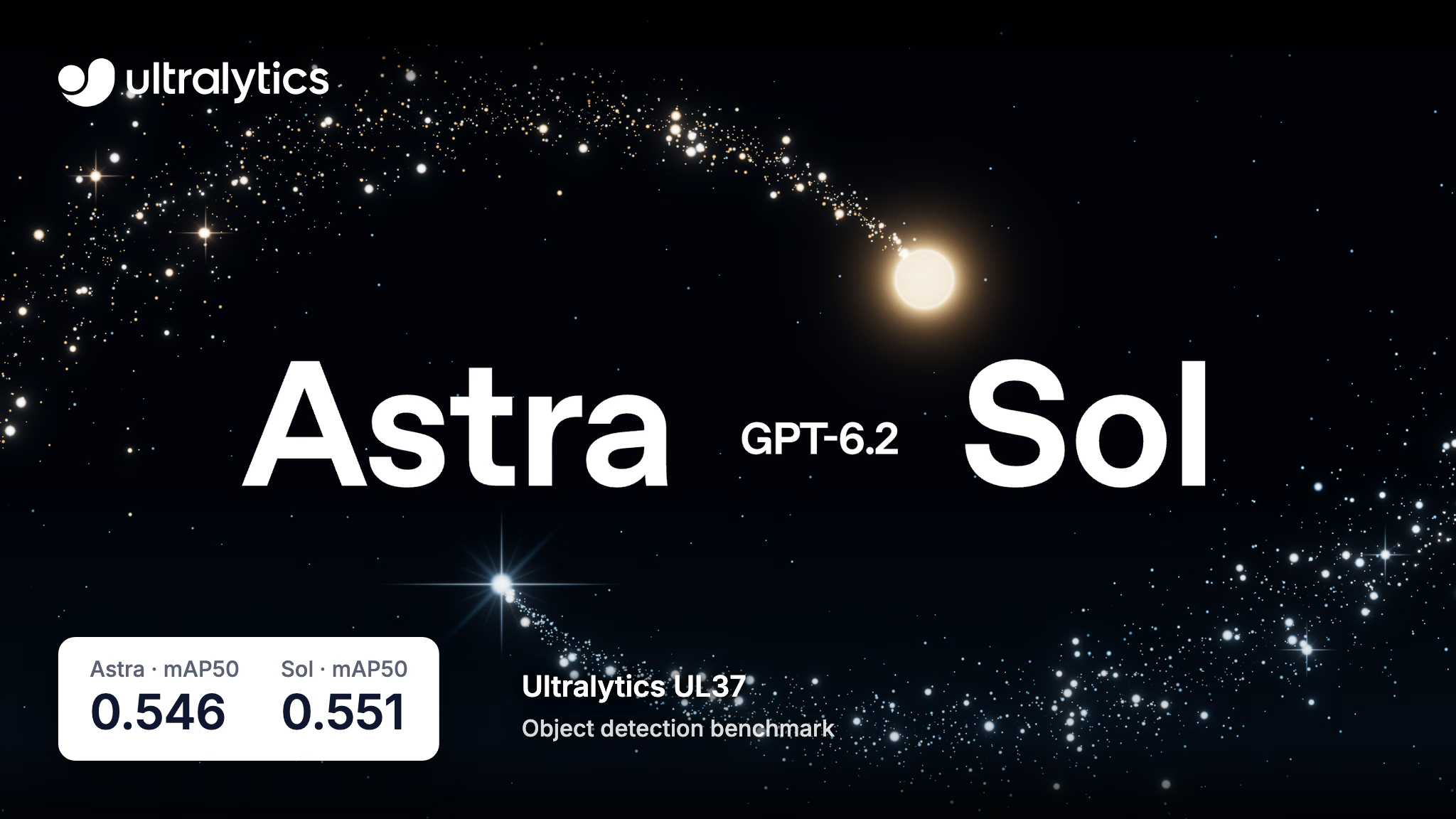
OpenAI released GPT-6.2 Astra and GPT-6.2 Sol on November 17, 2026, describing Astra as its most capable model and Sol as its go-to model for everyday work. When we asked them to draw bounding boxes, their accuracy came out close. Their prices did not.
We ran both through UL37, our 36-dataset detection benchmark, the day they launched. GPT-6.2 Sol scored 0.551 mAP50 and GPT-6.2 Astra 0.546, fourth and fifth of 50 models on our VLM Leaderboard. Sol did it for $8.10 per 1,000 images. Astra cost $31.88, almost four times as much.
Both are now the OpenAI Sol and Astra options for auto-annotation in Ultralytics Platform, replacing GPT-6.1 Sol and GPT-6 Astra. Below is how they compare, where each one leads, what a labeling batch costs, and when OpenAI's own GPT-6.1 Terra is still the better pick.
GPT-6.2 Sol and Astra score about 0.005 apart on UL37#
UL37 measures how closely a model's boxes match human labels on 360 images: 10 from each of 36 real object detection datasets, from medical scans and aerial imagery to retail shelves, sports, documents and circuit boards. Every image goes through the same production pipeline Platform users get, with the dataset's own class names and SAM 3.1 refining each box, so the scores describe that refined production pipeline rather than raw model output. The methodology is public.
UL37 results from the Ultralytics VLM Leaderboard, updated November 17, 2026.
In this run, the two are close on accuracy. Their mAP50-95 scores, which reward tight boxes, differ by 0.001, and their precision by 0.003. Sol finds slightly more of the labeled objects: its 0.643 recall is the highest of all 50 models on the leaderboard, just ahead of Gemini 4 Carbon's 0.642. It is also the fastest of the top seven models, at 3.4 seconds per image.
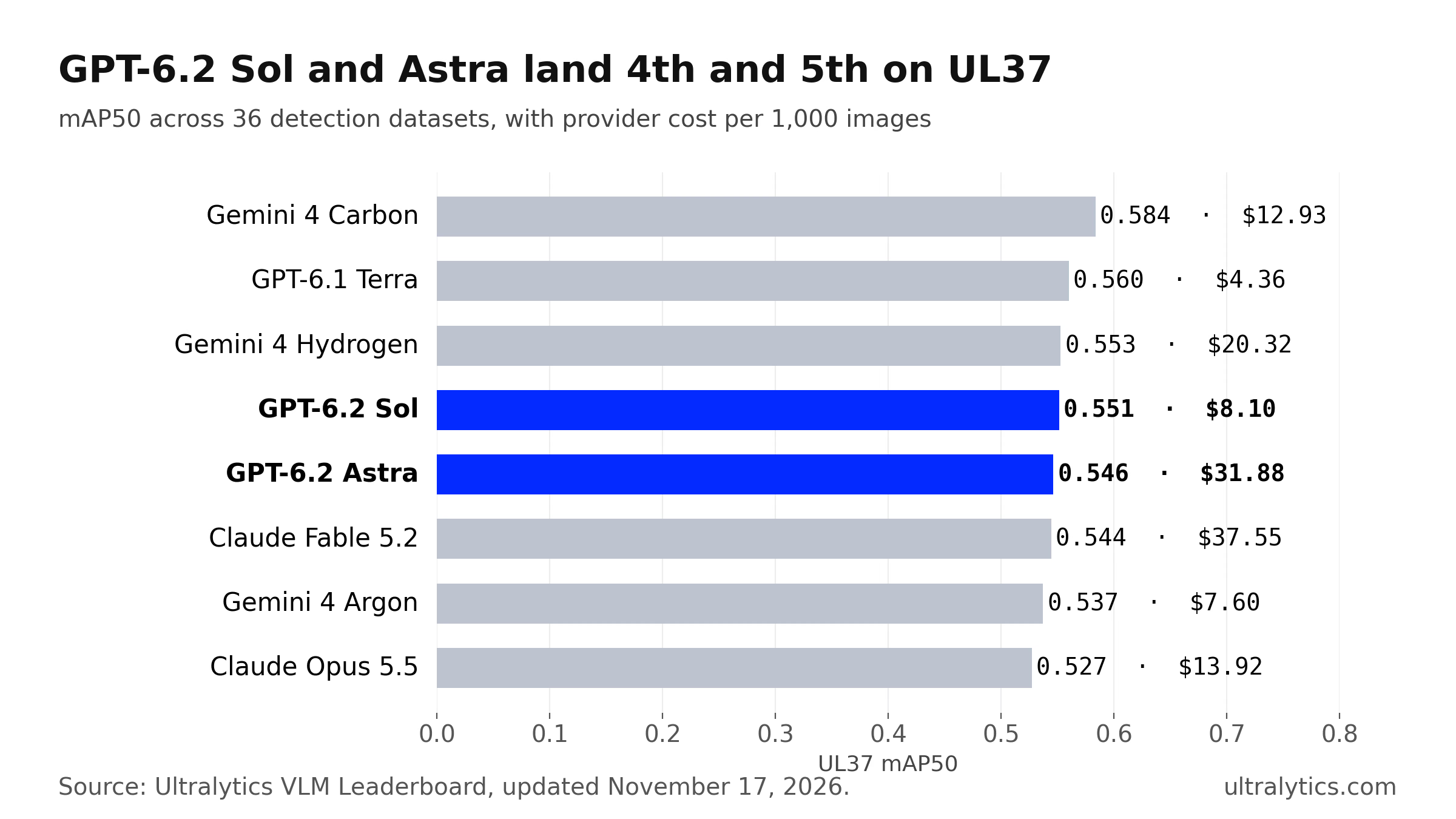
The eight highest-scoring models on UL37, with provider cost per 1,000 images.
What OpenAI built GPT-6.2 for#
OpenAI positions the two models for different work. Its changelog recommends GPT-6.2 Astra "for demanding reasoning and coding tasks" and GPT-6.2 Sol "for everyday coding and agent workflows." Both accept text and images and return text, and both are available in the Responses API and Chat Completions.
The prices follow that split. According to OpenAI's model pages, GPT-6.2 Sol costs $2 per million input tokens and $10 per million output tokens, and GPT-6.2 Astra costs $8 and $40. Astra's token price is exactly four times Sol's.
Both are general-purpose models rather than dedicated detectors, so we measured what they do on that job. Platform calls both at OpenAI's default reasoning effort, with the same box request it sends to every OpenAI model.
Astra wins more datasets, and one ultrasound set decides the average#
Sol's lead in the average does not mean it wins more often. Head to head across the 36 datasets, Astra scores higher on 17, Sol on 15, and four are ties.
One dataset explains the difference. On TN5000 thyroid ultrasound, where each box also carries a benign or malignant label, Sol scores 0.995 against Astra's 0.769. That single result lifts Sol's average by about 0.006. Leave TN5000 out and the two averages are 0.539 for Sol and 0.540 for Astra.
On this benchmark, the two are close enough on accuracy that the clearer differences are domain and cost.
Where GPT-6.2 Sol and Astra each lead#
Averaged by domain, Astra leads in seven of UL37's 12 domains and Sol in four, with security X-ray a tie.
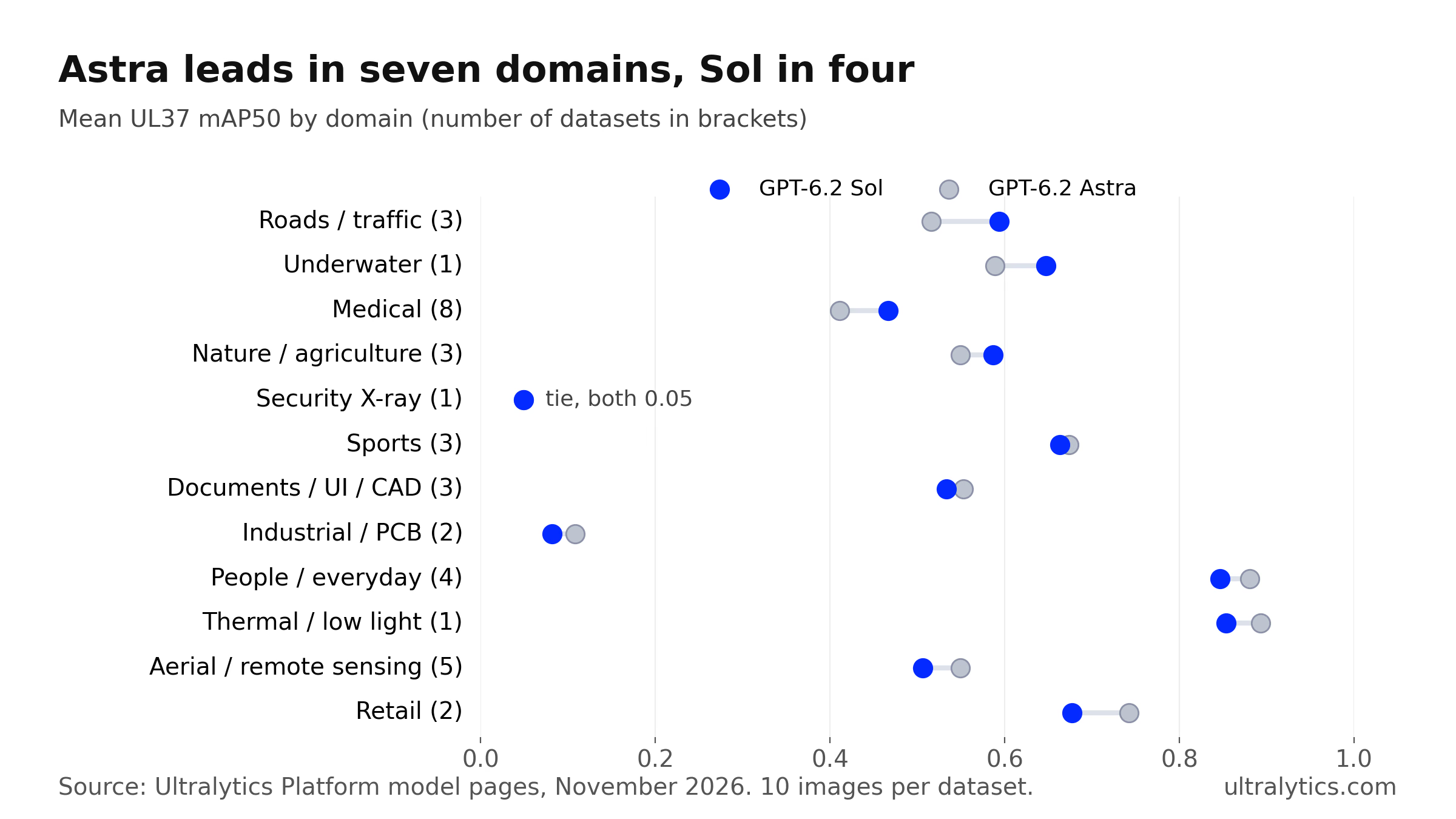
Each domain contains between one and eight datasets, with 10 images per dataset.
GPT-6.2 Sol is stronger on medical, roads and nature images. Its eight-dataset medical average is 0.466 against Astra's 0.411, led by TN5000 and by Kvasir-SEG colon polyps, 0.805 against 0.707. On wheat heads in GWHD it scores 0.684 to Astra's 0.537, and on road markings in CeyMo 0.843 to 0.705.
GPT-6.2 Astra is stronger on aerial, retail, document and people images. Its five-dataset aerial average is 0.550 against Sol's 0.506, helped by ships in SSDD radar images, 0.880 against 0.749. On products at a checkout in RPC it scores 0.978 to Sol's 0.823, and it leads on PPE, litter and basketball detection too.
| Dataset | Domain | GPT-6.2 Sol | GPT-6.2 Astra |
|---|---|---|---|
| TN5000 thyroid ultrasound | Medical | 0.995 | 0.769 |
| GWHD wheat heads | Nature / agriculture | 0.684 | 0.537 |
| CeyMo road markings | Roads / traffic | 0.843 | 0.705 |
| SoccerDB | Sports | 0.748 | 0.631 |
| RPC retail checkout | Retail | 0.823 | 0.978 |
| Basketball and hoop | Sports | 0.726 | 0.872 |
| PlantDoc plant disease | Nature / agriculture | 0.302 | 0.447 |
| SSDD SAR ships | Aerial / remote sensing | 0.749 | 0.880 |
The four largest gaps in each direction, UL37 mAP50.
Each dataset contributes 10 images, so a single score is a signal to test, not a verdict. Before labeling a large dataset, open the GPT-6.2 Sol and GPT-6.2 Astra model pages, which replay each model's recorded boxes on every benchmark dataset beside the expected labels.
A big step up from GPT-6.1 Sol and GPT-6 Astra, except on circuit boards#
Against the models they replace in Platform, both are more accurate, faster and cheaper per image.
| mAP50 | Cost per 1,000 images | Median time per image | |
|---|---|---|---|
| GPT-6.1 Sol | 0.514 | $10.30 | 10.5 s |
| GPT-6.2 Sol | 0.551 | $8.10 | 3.4 s |
| GPT-6 Astra | 0.525 | $49.31 | 11.6 s |
| GPT-6.2 Astra | 0.546 | $31.88 | 4.3 s |
GPT-6.2 Sol beats GPT-6.1 Sol on 23 datasets and loses on 12, and runs about three times faster. Its 21% lower cost per image comes at unchanged token prices. GPT-6.2 Astra beats GPT-6 Astra on 24 datasets and loses on 11, at 35% lower cost per image and lower token prices: OpenAI lists GPT-6 Astra at $10 and $50 per million tokens.
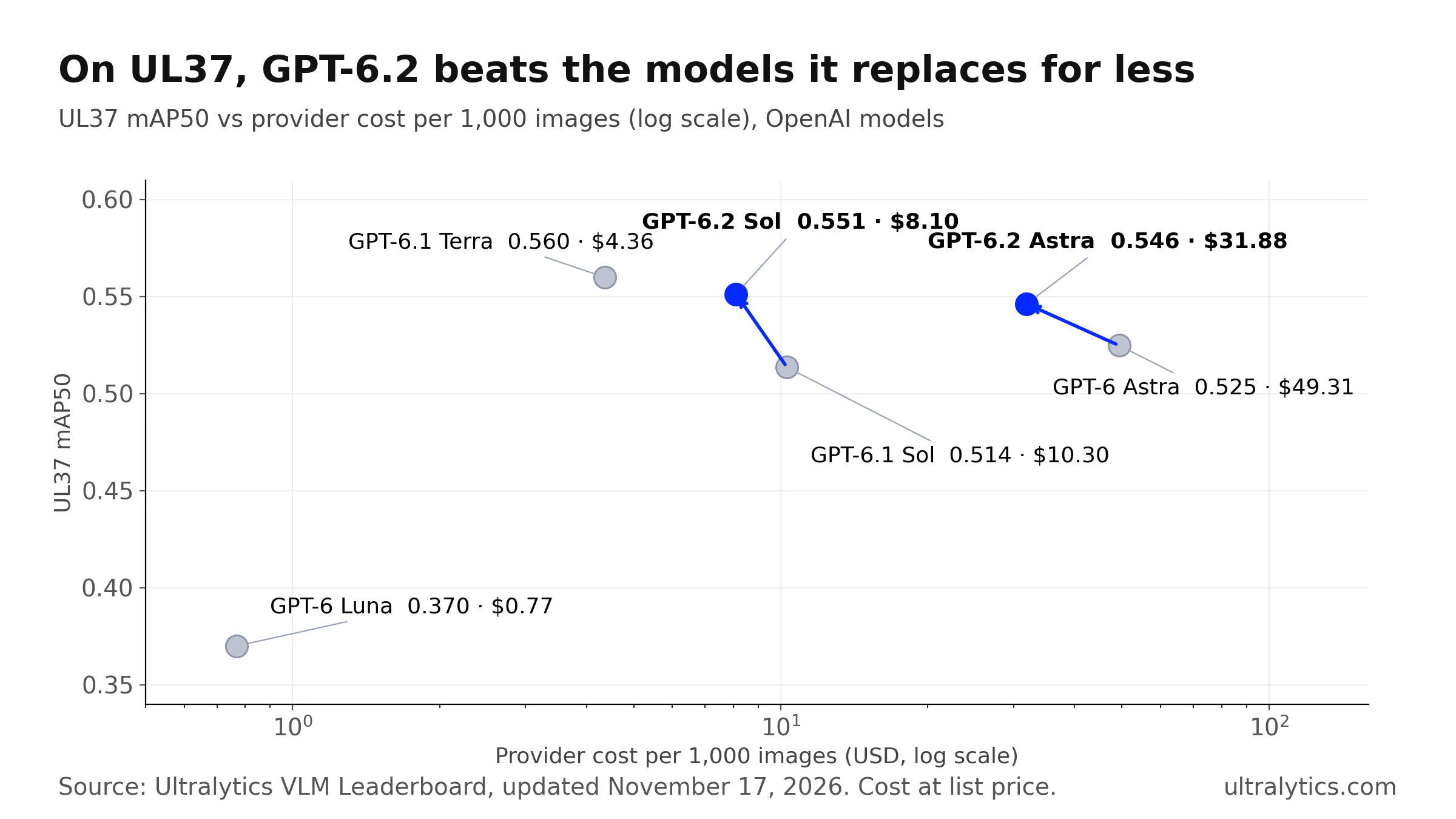
Arrows show each GPT-6.2 model against the model it replaces in Ultralytics Platform.
The exception is circuit boards. On DeepPCB bare-board defects, both GPT-6.2 models score 0.000, where GPT-6.1 Sol scored 0.393. On DsPCBSD+ surface defects, Sol drops from 0.392 to 0.164 and Astra scores 0.216. Security X-rays are weak too: both score 0.05 on IEDXray, where Gemini 4 Argon reaches 0.30. If your data is PCB inspection or security screening, test other models on a sample before committing.
GPT-6.1 Terra is still OpenAI's best annotator on UL37#
Neither new model overtakes GPT-6.1 Terra, which stays second on the leaderboard at 0.560 mAP50 for $4.36 per 1,000 images. Terra and GPT-6.2 Sol each win 17 datasets, with two ties, so the gap is narrow. Terra is more precise, at 0.646 against 0.623, and costs about half as much. Sol finds more objects and answers faster, at 3.4 seconds against 5.1.
At the top of the board, Gemini 4 Carbon still leads at 0.584 mAP50 for $12.93 per 1,000 images. Our GPT-6.1 Terra results and Gemini 4 Carbon results cover those models in detail.
What a GPT-6.2 annotation batch costs#
The provider cost is calculated from OpenAI's reported token usage at list price, and your own images may use more or fewer tokens. Batch Annotation adds a Platform processing fee of $1.00 per 1,000 images, with a minimum of $0.01 per run.
| Per 1,000 images | GPT-6.2 Sol | GPT-6.2 Astra |
|---|---|---|
| OpenAI charges | $8.10 | $31.88 |
| Ultralytics Platform processing | $1.00 | $1.00 |
| Total | $9.10 | $32.88 |
You pay OpenAI directly through your own API key, including for the test predictions you run first, and Ultralytics adds no markup to tokens. For a 10,000-image dataset, that is roughly $91 with Sol and $329 with Astra.
How to run GPT-6.2 Sol or Astra auto-annotation in Ultralytics Platform#
GPT-6.2 Sol and Astra are class-prompted models for detection datasets with 1 to 200 classes. They return bounding boxes for your dataset's own class names, and you review them before saving.
- Create a key on the OpenAI API keys page.
- Have the workspace owner add it under Settings > API Keys in the Platform workspace that holds your dataset. The provider key docs cover the details.
- In the annotation editor, switch to Smart mode and choose GPT-6.2 Sol or GPT-6.2 Astra under OpenAI in the model picker.
- Press Predict, or
P, on a few images that represent your data, and compare the two models on the same images. - When you're happy, open the dataset page and choose More actions > Batch Annotation to label every unlabeled image. Batch Annotation works on Platform-hosted datasets with up to three image channels, and Platform saves a dataset version first, so you can roll back.
- Review the boxes, save them, and train an Ultralytics YOLO26 model on the result in the same workspace.
The annotation docs explain Smart mode and Batch Annotation in full, and our guide to choosing a VLM by precision and recall helps you match a model to your review workflow.
GPT-6.2 Sol, GPT-6.2 Astra or GPT-6.1 Terra: which to use#
| If you need… | Start with |
|---|---|
| A general OpenAI annotator at the lowest cost | GPT-6.1 Terra: highest UL37 score of the three, about half Sol's price |
| Speed, or the most objects found | GPT-6.2 Sol: 3.4 s per image and the highest recall on the leaderboard |
| Medical, road or agricultural images | GPT-6.2 Sol, then check Terra on medical data |
| Aerial, retail checkout, document or PPE images | GPT-6.2 Astra, if its accuracy edge on your data justifies about four times Sol's cost |
| PCB defects or security X-rays | Test other models first; both GPT-6.2 models score poorly on UL37 here |
For most labeling work, GPT-6.2 Sol is the better buy between the two new models: a similar UL37 score to Astra at about a quarter of the cost. Choose Astra when a test on your own images shows it ahead in your domain.
Frequently asked questions
On our UL37 benchmark they score closely: GPT-6.2 Sol scores 0.551 mAP50 and GPT-6.2 Astra 0.546, and Astra wins slightly more datasets, 17 to 15. The clear difference is cost: Sol costs $8.10 per 1,000 images in OpenAI charges, against $31.88 for Astra. Sol leads on medical, road and nature images, Astra on aerial, retail, document and people images.
Yes. Both GPT-6.2 models rank in the top five of 50 models on the Ultralytics VLM Leaderboard, with no failed requests. GPT-6.2 Sol has the highest recall on the board, at 0.643. Both are weak on circuit-board defects and security X-rays.
About $8.10 with GPT-6.2 Sol and $31.88 with GPT-6.2 Astra in OpenAI charges, based on reported token usage at list price. Ultralytics Platform adds a $1.00 Batch Annotation fee per 1,000 images, for totals of about $9.10 and $32.88.
On UL37, yes, narrowly. GPT-6.1 Terra scores 0.560 mAP50 at $4.36 per 1,000 images, ahead of both GPT-6.2 models on average and on cost. GPT-6.2 Sol ties Terra on datasets won, 17 each, and is faster and finds more objects.
Yes, on average. GPT-6.2 Sol beats GPT-6.1 Sol on 23 of 36 datasets, at about three times the speed and 21% lower cost per image. GPT-6.2 Astra beats GPT-6 Astra on 24 datasets at 35% lower cost. Both older models did better on circuit-board defects.
Add your OpenAI API key under Settings > API Keys, then choose GPT-6.2 Sol or GPT-6.2 Astra in the annotation editor's Smart mode. Test a few images, then use Batch Annotation to label the full dataset, review the boxes and train an Ultralytics YOLO26 model in the same workspace.
Written by
Founder & CEO · Ultralytics
Comments
Ask a question, share your results, or help someone else.