GPT-6.1 Terra takes #1 for auto-annotation, beating OpenAI's own flagships
GPT-6.1 Terra auto-annotation tops 39 models on our VLM Leaderboard: 0.560 mAP50 for $4.36 per 1,000 images, ahead of GPT-6.1 Sol and Gemini 4 Argon.
OpenAI's launch materials say GPT-6.1 Terra nearly matches its bigger siblings at visual reasoning. When we asked it to draw bounding boxes, "nearly" turned out to be the wrong word.
We ran GPT-6.1 Terra auto-annotation through UL37, our 36-dataset detection benchmark, on October 26, 2026, the day OpenAI released it. It scored 0.560 mAP50, the best result of all 39 models on our VLM Leaderboard. OpenAI's mid-priced model finished ahead of GPT-6.1 Sol, ahead of the flagship GPT-6 Astra, and ahead of Gemini 4 Argon, which had held first place until this week.
It got there for $4.36 per 1,000 images, at 5.1 seconds per image, without a single failed request. You can use it in Ultralytics Platform today. Below is where it shines, where it stumbles, and how to decide whether it belongs in your labeling workflow.
GPT-6.1 Terra takes first place on UL37#
UL37 measures how closely a model's boxes match human labels on 360 images: 10 from each of 36 real object detection datasets covering medical scans, aerial imagery, retail shelves, sports, documents, circuit boards, and more. Each image goes through the same production pipeline Platform users get, using the dataset's own class names, with SAM 3.1 tightening every box. The methodology is public.
Here is Terra's scorecard:
- mAP50: 0.560, #1 of 39
- mAP50-95: 0.345, also #1, which means its boxes fit tightly and not just roughly
- Precision and recall: 0.646 and 0.613
- Provider cost: $4.36 per 1,000 images
- Median time per image: 5.1 s
- Failed requests: none
Six models score above 0.51 on UL37, including Claude Opus 5.5 in third place. Terra is the most accurate of the six and also the cheapest.
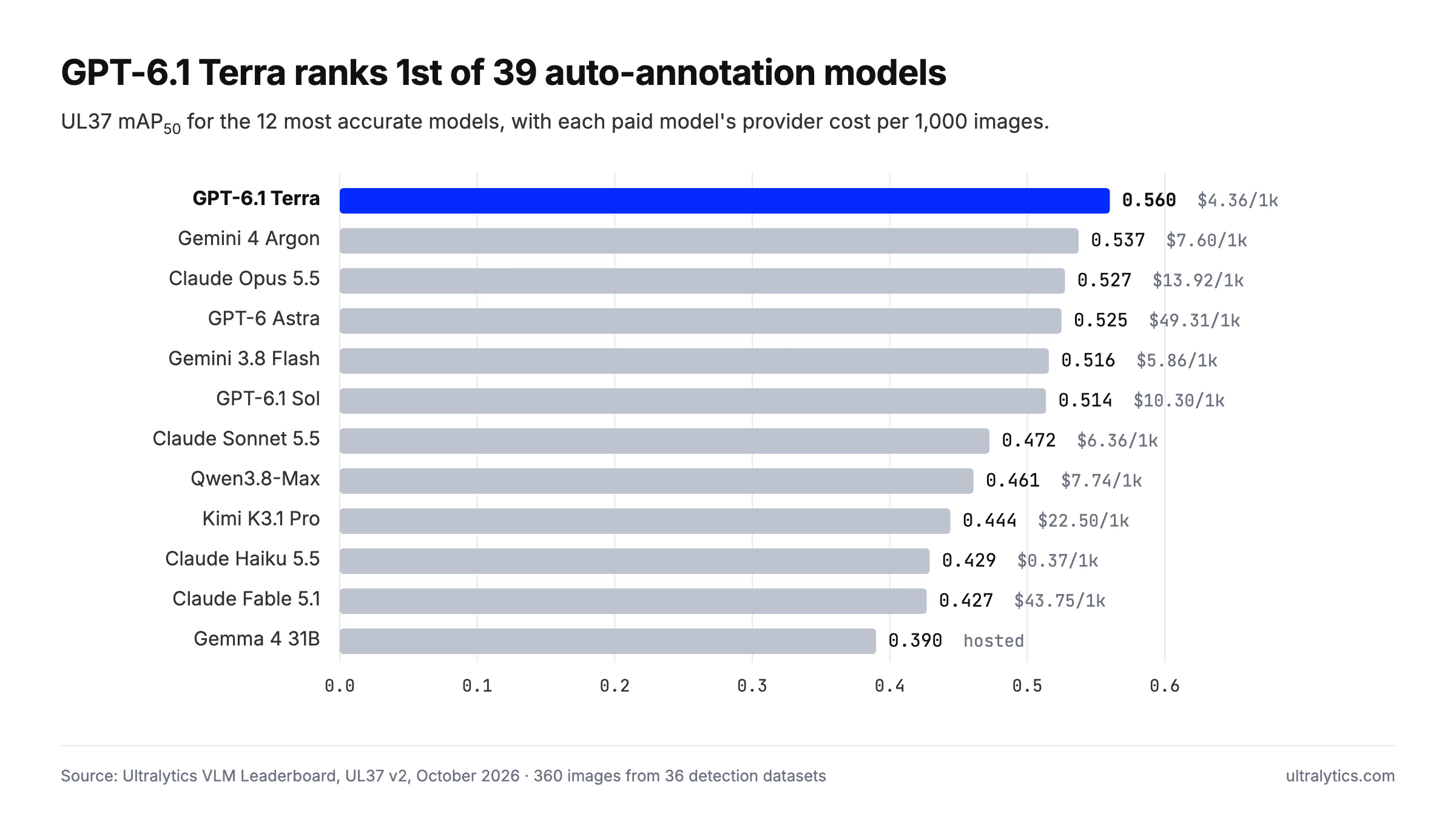
There was no tuning puzzle behind the result. Terra runs at OpenAI's default reasoning effort, which its model documentation lists as medium. It gets the same request as every other OpenAI model in Platform, with box coordinates on a 0–1000 grid. We plugged it in, and it went straight to the top.
A mid-priced model that outscores OpenAI's flagships#
OpenAI positions GPT-6.1 Terra as the fast, efficient middle of its lineup. According to launch coverage from The Decoder and BleepingComputer, it succeeds GPT-5.6 Terra and targets computer use, visual reasoning, coding, and everyday work. It is available in the API as gpt-6.1-terra, and in ChatGPT Work and Codex for Plus, Pro, Enterprise, and Edu users. OpenAI's documentation describes it as "a fast, efficient model for visual reasoning, precise computer use, and clear, natural writing," with text and image input and a 1,050,000-token context window.
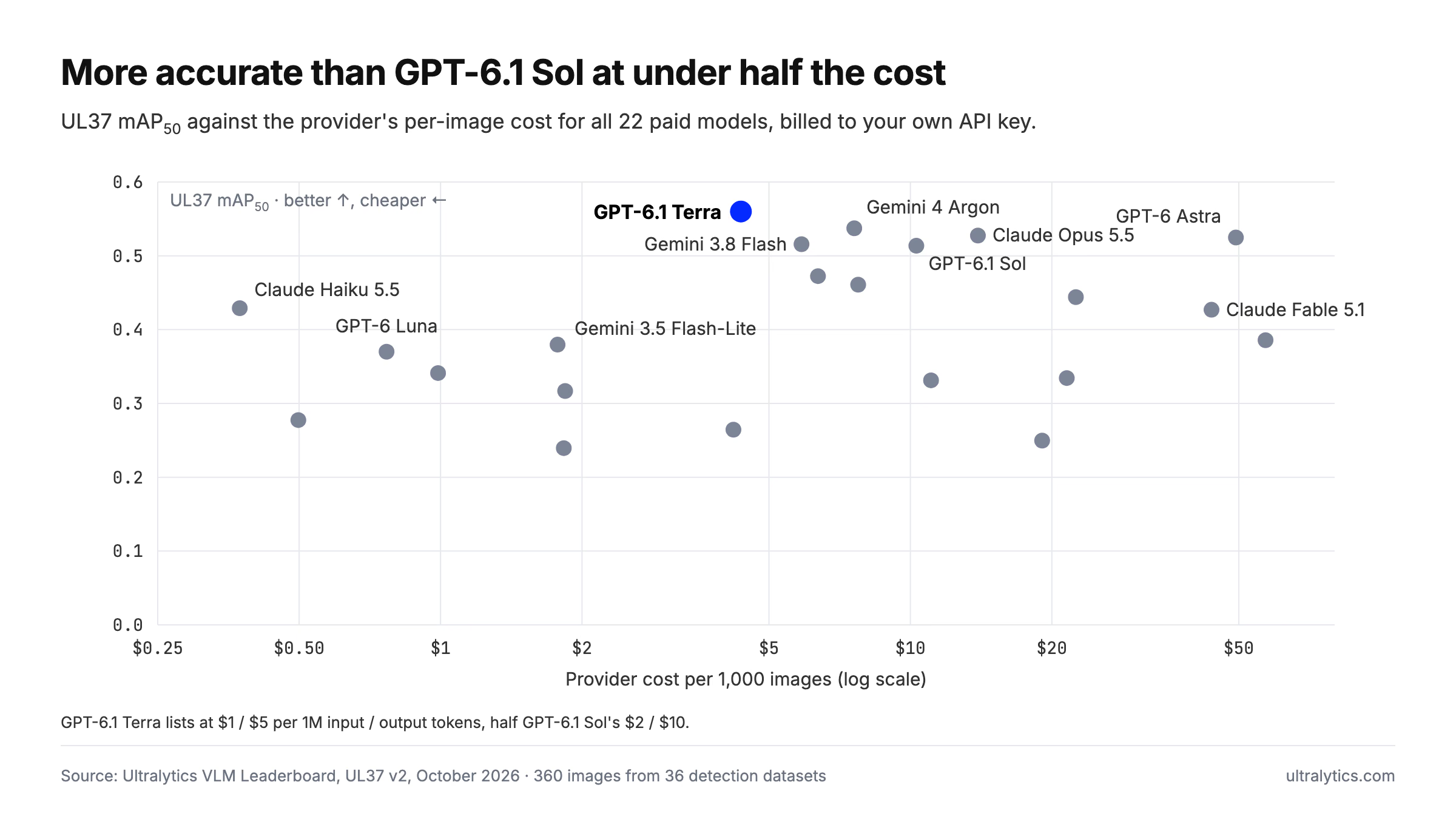
The pricing is $1 per million input tokens and $5 per million output tokens, with cached input at $0.05. That is half of GPT-6.1 Sol's $2 and $10, and a tenth of GPT-6 Astra's $10 and $50, according to OpenAI's GPT-6.1 Sol and GPT-6 Astra pages.
OpenAI's launch benchmarks pitch Terra as close to its bigger siblings, not above them. On MMMU-Pro, a visual reasoning test, OpenAI reports that Terra nearly matches Astra and Sol. On Terminal-Bench 4.0, it reports 50.3%, up from 21.5% for GPT-5.6 Terra. And it still recommends Sol or Astra for the hardest coding work.
On paper, Terra is the compromise pick. On our benchmark, it is OpenAI's best detector.
| OpenAI model | UL37 mAP50 | Cost per 1,000 images | Median time per image |
|---|---|---|---|
| GPT-6 Luna | 0.370 | $0.77 | 11.9 s |
| GPT-6.1 Terra | 0.560 | $4.36 | 5.1 s |
| GPT-6.1 Sol | 0.514 | $10.30 | 10.5 s |
| GPT-6 Astra | 0.525 | $49.31 | 11.6 s |
Terra costs less than half as much per image as GPT-6.1 Sol and less than a tenth as much as GPT-6 Astra. It also answers about twice as fast as either one. Head to head, it beats Sol on 22 of the 36 datasets.
OpenAI says Terra completes tasks more than three times faster than Sol and Astra, a claim about agent workloads. Annotation is a different job, and there we measured about 2x over Sol, which still adds up when you are labeling thousands of images.
Terra's edge over Sol is precision#
The two models find a similar share of the labeled objects. Terra's recall is 0.613 and Sol's is 0.618. The gap opens up in precision: 0.646 for Terra against 0.551 for Sol. A much larger fraction of Terra's boxes land on a real object with the right label.
SKU110K makes the difference easy to see. Its images are supermarket shelves crammed edge to edge with products, all under one class. Both models reach similar recall there, 0.73 for Terra and 0.77 for Sol. But Sol's precision on those shelves is 0.49, while Terra's is 0.79. About half of Sol's boxes are false alarms, compared with roughly one in five for Terra. Terra's 0.62 mAP50 on SKU110K is the highest any model has posted.
That matters for data labeling because errors are not equally expensive. A missed product means drawing one box. A false box means spotting it among dozens of correct ones and deleting it. Fewer false alarms give reviewers a cleaner first draft.
Medical imaging is GPT-6.1 Terra's standout strength#
The most distinctive pattern in Terra's results is medical. UL37 includes eight medical datasets, and Terra averages 0.505 mAP50 across them, #1 of 39. The next best are Gemini 3.8 Flash at 0.387 and Gemini 4 Argon at 0.379. No model on the leaderboard leads any other domain by a wider margin.
Here is how it scores on all eight, against the best of the other 38 models on each:
| Dataset | GPT-6.1 Terra | Best other model |
|---|---|---|
| Thyroid ultrasound (TN5000) | 0.94 | Gemini 3.8 Flash, 0.88 |
| Brain tumor MRI (Cheng) | 0.90 | Gemma 4 31B, 0.80 |
| Blood cell microscopy (TXL-PBC) | 0.89 | Gemini 4 Argon, 0.78 |
| Colon polyp endoscopy (Kvasir-SEG) | 0.71 | Seven models tied, including Gemini 4 Argon, 0.81 |
| Pediatric wrist X-ray (GRAZPEDWRI-DX) | 0.27 | GPT-6 Astra, 0.35 |
| Chest X-ray, TB (TBX11K) | 0.14 | GPT-6 Astra, 0.33 |
| Retinal lesions (DDR) | 0.13 | Claude Opus 5.5, 0.13 |
| Dental X-ray (DENTEX) | 0.06 | Gemini 4 Argon, 0.21 |
The top three rows carry the result, and none of them is just a matter of finding the right spot. On TN5000, each box also carries the dataset's benign or malignant nodule label, exactly the kind of call a clinician has to confirm. Gemini 4 Argon scores 0.29 there and GPT-6.1 Sol 0.53. The brain MRI classes are meningioma, glioma, and pituitary tumor, where Sol scores 0.52. The blood cell set asks Terra to sort white blood cells, red blood cells, and platelets.
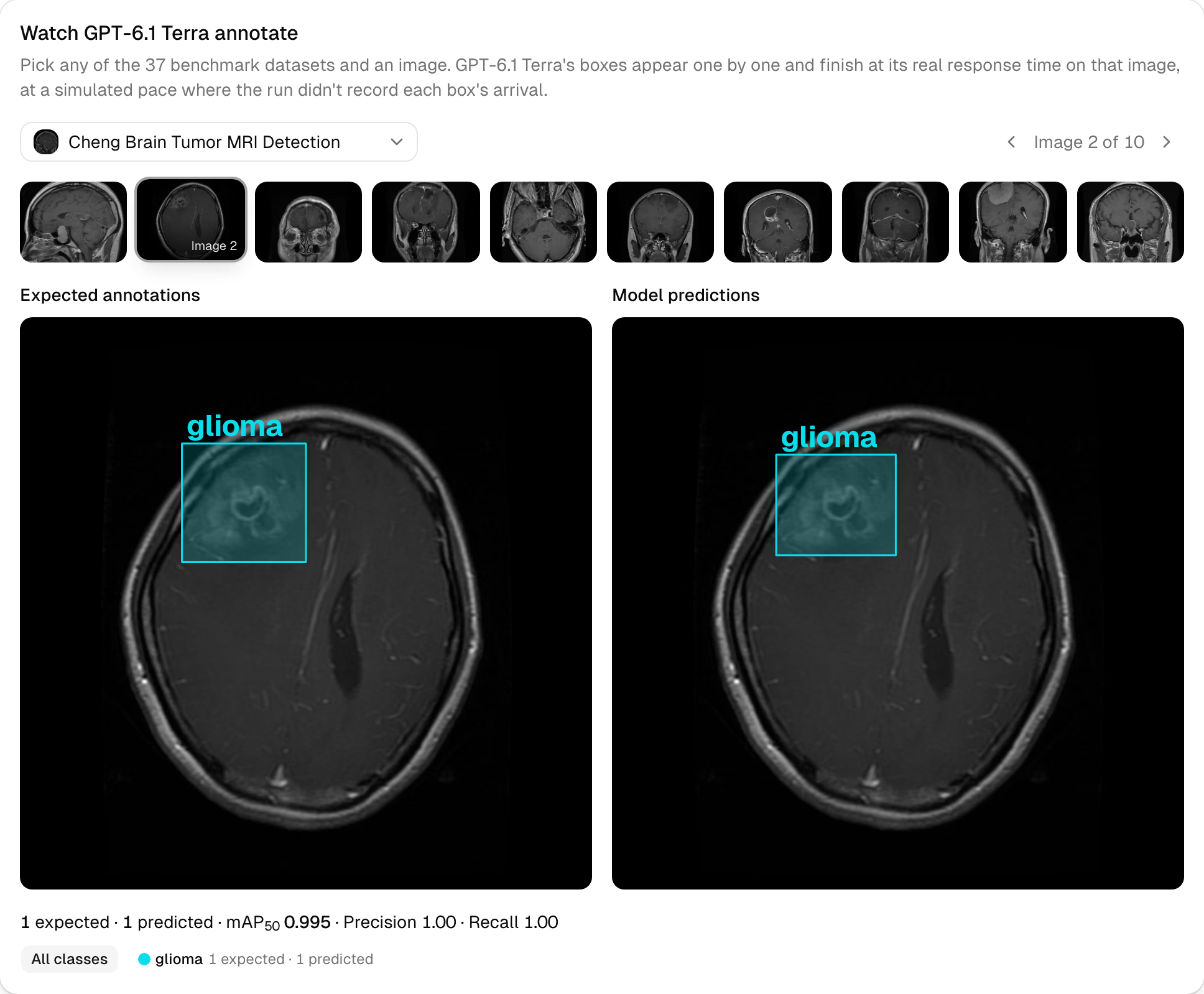
The replay above, from Terra's model page, shows a typical hit: one glioma on a brain MRI, one box from Terra, placed and labeled to match the expected annotation.
Two caveats belong next to these numbers. First, each dataset contributes 10 images, so a single dataset score is a signal to investigate, not a verdict. Second, none of this is diagnosis. For a medical image analysis team, Terra is a fast way to draft boxes on ultrasound, MRI, and microscopy images that clinical experts then check, correct, and approve. That human-in-the-loop review is the whole point of the workflow, not an optional extra.
Where GPT-6.1 Terra falls short: X-rays and circuit boards#
The bottom of that table has a clear theme. On every X-ray dataset in UL37, medical or not, another model does better. Terra trails the leader on pediatric wrist, chest, and dental X-rays, and security X-ray is worse still: 0.00 on IEDXray, where Gemini 4 Argon reaches 0.30.
IEDXray is the sharpest miss. Its scans show laptops, phones, pagers, batteries, and improvised devices, and Terra produced no correct boxes on any of them.
Circuit boards are the other blind spot. Terra averages 0.13 on our industrial PCB datasets, while GPT-6.1 Sol reaches 0.39. On DeepPCB, which covers bare-board defects such as open circuits, shorts, mouse bites, and spurs, Terra scores 0.03 to Sol's 0.39. For PCB inspection data, Sol is the better OpenAI choice.
Before you label a large dataset in any of these domains, open the GPT-6.1 Terra model page. It replays Terra's recorded boxes on all 36 benchmark datasets and COCO, beside the expected boxes, and lists its score on each one.
GPT-6.1 Terra vs Gemini 4 Argon: a closer race than the ranking suggests#
Gemini 4 Argon led the leaderboard until Terra arrived, and the two are close. Terra scores higher on 19 datasets, Argon on 16, and they tie on one.
Much of Terra's 0.023 lead comes from one dataset. On TN5000 thyroid ultrasound, Terra scores 0.94 and Argon 0.29. Leave that dataset out and the averages are 0.549 for Terra and 0.544 for Argon, practically level. Terra's first place is real, and it rests largely on medical imaging.
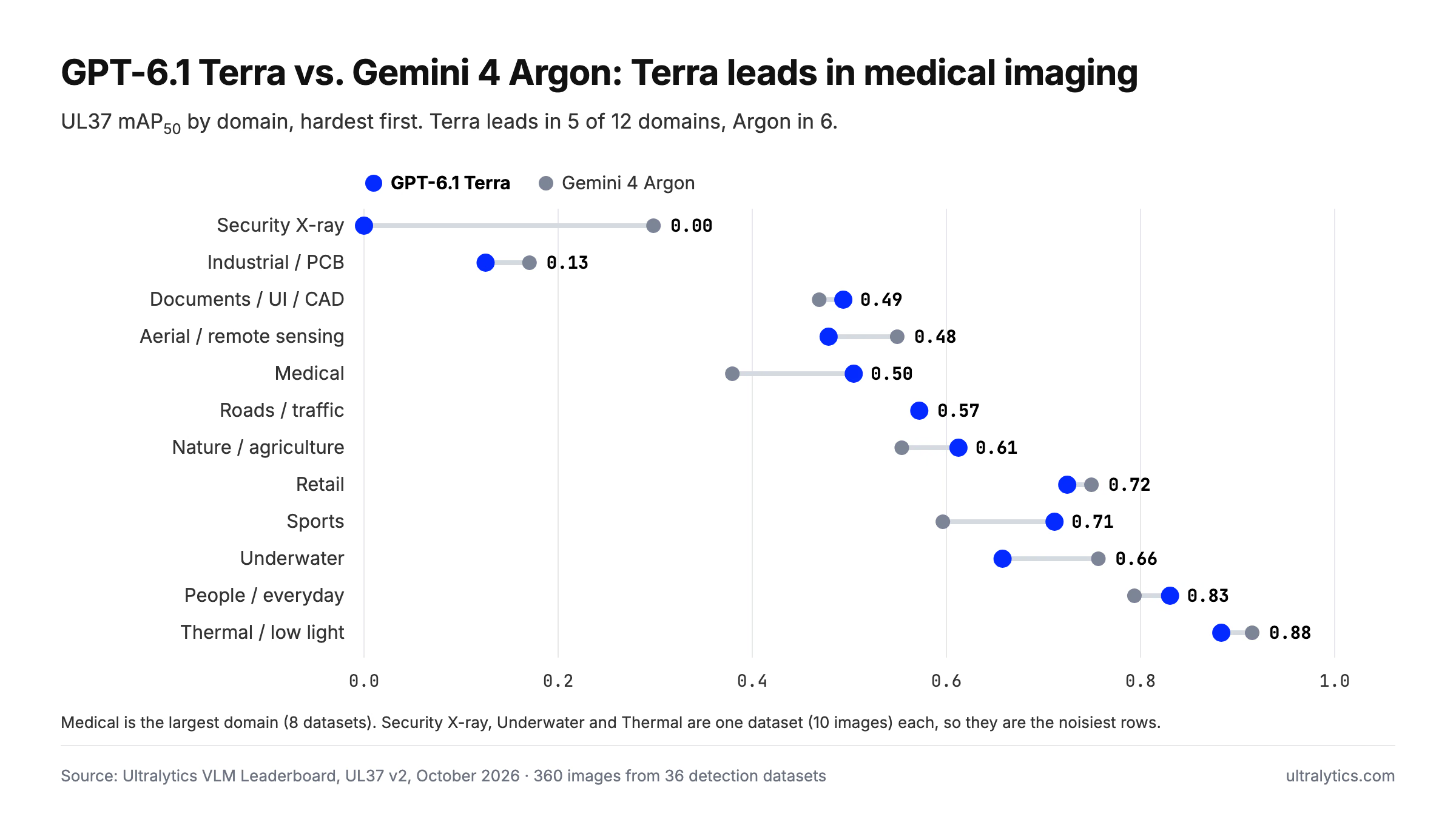
By domain, Terra leads in five, and it ranks first of all 39 models in two of them: medical, and documents, UI, and CAD. Argon leads in six, and still holds the aerial, underwater, and thermal categories. Roads and traffic is a draw.
The two also make different kinds of mistakes. Argon is slightly more precise, 0.667 against 0.646, while Terra finds more of the objects, with recall of 0.613 against 0.585. Terra costs $4.36 per 1,000 images against Argon's $7.60 at Google's launch pricing. Argon is a little quicker, at 4.6 s per image.
The practical split: reach for Terra on medical, document, and sports images. Reach for Argon on aerial, underwater, thermal, and security imagery. Our Gemini 4 Argon auto-annotation results cover its side of the story.
What a GPT-6.1 Terra batch costs#
The $4.36 per 1,000 images is the provider bill, calculated from OpenAI's reported token usage at list price. A median image used about 1,300 input tokens and 370 output tokens. Batch Annotation adds a Platform processing fee of $1.00 per 1,000 images, so a 1,000-image run comes to about $5.36 in total.
Three more details from the run:
- No failed requests. All of Terra's benchmark requests finished within Platform's 115-second limit. GPT-6.1 Sol failed on 2 images and GPT-6 Astra on 4.
- Its raw boxes are already good. Before SAM 3.1 refinement, Terra's boxes score 0.559 mAP50. Refinement lifts that to 0.560, so the model is doing nearly all the work itself.
- Nothing to configure. Default reasoning effort and the standard OpenAI request were all it needed.
If budget matters more than the last few points of accuracy, there are cheaper routes. Claude Haiku 5.5 scores 0.429 for $0.37 per 1,000 images, and Gemini 3.5 Flash-Lite scores 0.380 for $1.77. Hosted models such as Qwen3.8 27B, Gemma 4 26B, and SAM 3.1 Text need no API key at all, and neither do your own Ultralytics YOLO models.
From OpenAI key to labeled dataset#
GPT-6.1 Terra is a class-prompted model for detection datasets with 1 to 200 classes. It returns bounding boxes for your dataset's own class names, and you review them before saving. To set it up:
- Create a key on the OpenAI API keys page.
- Add it under Settings > API Keys in the Platform workspace that owns your dataset. OpenAI bills you directly, and Ultralytics adds no markup to tokens. The provider key docs cover the details.
- In the annotation editor, switch to Smart mode and choose GPT-6.1 Terra under OpenAI in the model picker.
- Press Predict, or
P, to label the current image. Try a few images that represent your data before scaling up. - When you like what you see, go to the dataset page and choose More actions > Batch Annotation to label every unlabeled image at once. Platform saves a dataset version first, so you can roll back.
- Review the boxes, save them, and train an Ultralytics YOLO26 model on the result in the same workspace. The training docs walk through it.
For a broader look at how these models fit into the editor, see how Ultralytics Platform uses AI to automate annotation, and our primer on vision language models.
Who should switch to GPT-6.1 Terra#
Make GPT-6.1 Terra your default paid model for general object detection labeling. It is the most accurate model we have benchmarked, the cheapest of the top six, and it never failed a request in our run.
It is an especially strong first-draft annotator for ultrasound, MRI, and microscopy images headed for expert review, and for dense retail shelves where false boxes pile up quickly. Look elsewhere for X-rays of any kind and for PCB defects, where Gemini 4 Argon, GPT-6 Astra, or GPT-6.1 Sol do better.
If you currently pay for Sol or Astra just to label images, switching is straightforward: Terra gives you better boxes for less than half of Sol's cost.
Frequently asked questions
Yes. On our UL37 benchmark, GPT-6.1 Terra scores 0.560 mAP50 averaged across 36 real-world detection datasets, the highest of 39 models on the Ultralytics VLM Leaderboard. It also ranks first on the stricter mAP50-95 metric, at 0.345. Its weakest areas are X-ray imagery and circuit-board defects.
On our benchmark, yes. Terra scores 0.560 mAP50 to Sol's 0.514, wins on 22 of 36 datasets, and costs $4.36 per 1,000 images against $10.30, while running about twice as fast. Sol remains the better OpenAI option for PCB defect detection.
Terra leads 0.560 to 0.537 mAP50 and costs less per image, but the race is tight: Terra wins 19 datasets, Argon 16, and one is a tie. Without the TN5000 thyroid ultrasound dataset, the two are nearly level. Choose Terra for medical and document images, and Argon for aerial, underwater, thermal, and security X-ray images.
About $4.36 in OpenAI charges, based on provider-reported token usage at list price of $1 per million input tokens and $5 per million output tokens. Batch Annotation in Ultralytics Platform adds a $1.00 processing fee per 1,000 images. You pay OpenAI directly through your own API key.
It is the strongest model on our eight medical datasets, averaging 0.505 mAP50, with top scores on thyroid ultrasound, brain tumor MRI, and blood cell microscopy. It is much weaker on X-rays and trails on colon polyp endoscopy. Use it to draft boxes for expert review, never as a diagnostic tool.
No. Platform calls it at OpenAI's default reasoning effort, medium, with the same box request it uses for every OpenAI model, and SAM 3.1 then refines each box. The median request in our benchmark took 5.1 seconds, and none failed.