Gemini 4 Carbon auto-annotation: the new leader on our VLM Leaderboard
Gemini 4 Carbon tops 45 VLMs on our 36-dataset object detection benchmark: 0.584 mAP50 and the best precision and recall. When GPT-6.1 Terra is better value.
 Glenn Jocher12 min read
Listen to this article
Gemini 4 Carbon ranks first of 45 models for auto-annotation on UL37, our 36-dataset object detection benchmark, in the November 11, 2026 Ultralytics VLM Leaderboard snapshot. It scores 0.584 mAP50 and 0.371 mAP50-95, and it now tops both the precision and the recall columns, which in our October results belonged to two different models. GPT-6.1 Terra, the previous leader, sits second at 0.560 mAP50 for about a third of Carbon's provider cost per image.
So the question for anyone labeling a dataset is not which model scores highest overall. It's when Carbon is worth three times the price. Below is where Carbon set new top scores, where Terra still wins, what each costs before and after Google's December price change, and how to run Carbon on your own data in Ultralytics Platform.
Gemini 4 Carbon is now open to every paying developer#
Google first released Carbon at the end of October to a small group of cybersecurity defenders. On November 10, 2026, it opened the model to all paying developers and enterprises, and began rolling it out to Google AI Ultra subscribers. Google's availability post says Carbon is available through the API in Google AI Studio and Gemini for business, and in the Gemini app, AI Mode and Antigravity for Ultra subscribers. Defenders keep specialized access through Google's Fairwind Program.
Google calls Carbon its strongest model, aimed at cybersecurity and long-horizon agentic work. The Gemini 4 Carbon model card says it is based on Gemini 4 Argon and uses more thinking tokens than Argon "to explore hypotheses thoroughly, reason deeply, and run extended verification loops." It reads text, images, audio and video, with a context window of up to 1M tokens, and answers in text.
Nothing in Google's launch pitches Carbon as a detector. What matters for data labeling is what that extra reasoning does to bounding boxes, and that is what UL37 measures. You can inspect every result on the Gemini 4 Carbon model page.
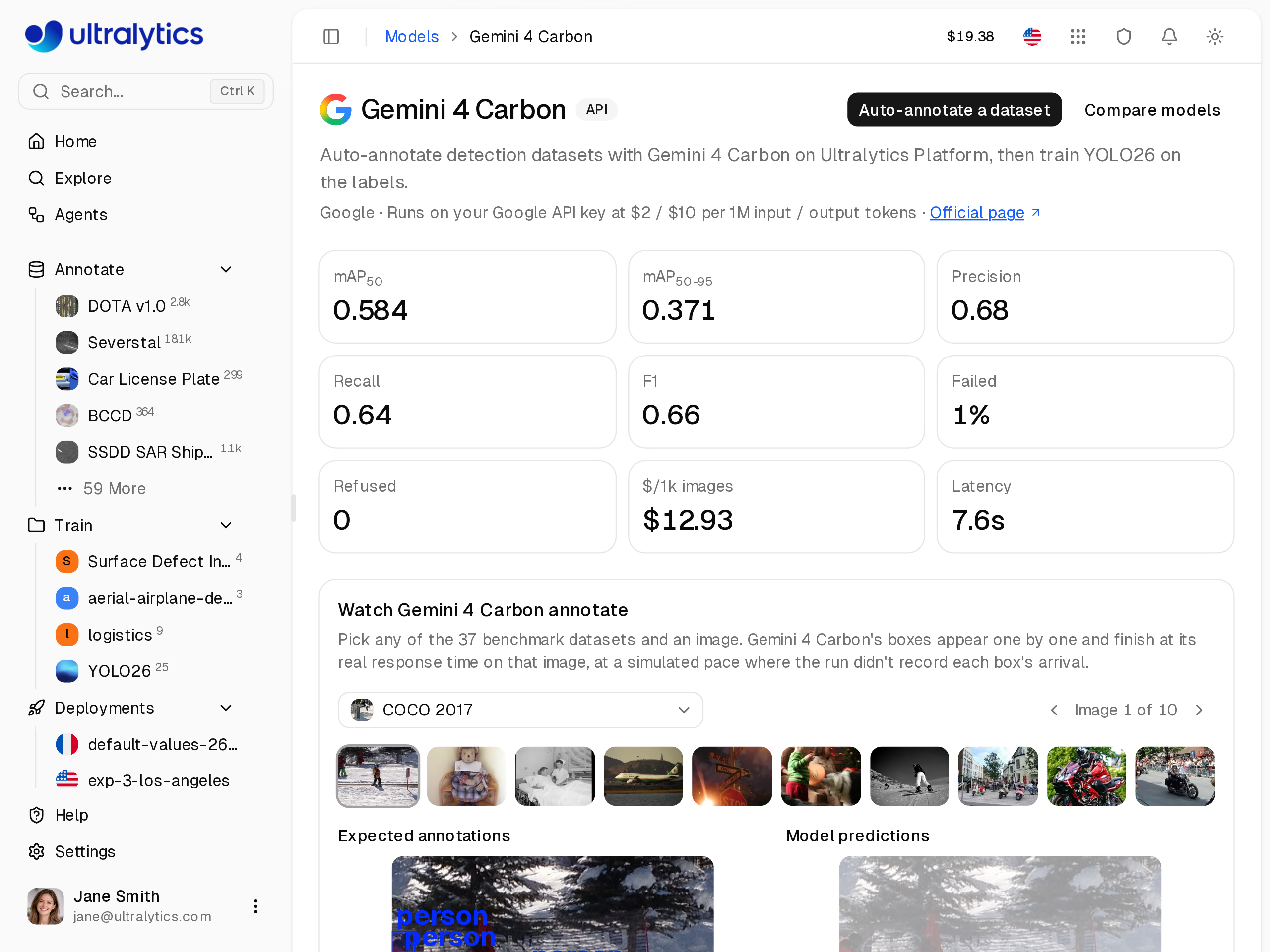
The Gemini 4 Carbon model page on Ultralytics Platform, with its UL37 scores and a link to auto-annotate a dataset.
Gemini 4 Carbon object detection: first on every accuracy metric#
UL37 scores how closely a model's boxes match each dataset's reference labels on 360 images: 10 from each of 36 real object detection datasets, covering medical scans, aerial and thermal imagery, retail shelves, sports, documents, circuit boards and more. Every image runs through the same production pipeline Platform users get, with the dataset's own class names, and SAM 3.1 tightens every model's boxes except SAM 3's, as it does for users. Each dataset counts equally; see the UL37 benchmark methodology.
Here is where Carbon lands against the next four models:
Carbon leads GPT-6.1 Terra by 0.024 on mAP50. The stricter mAP50-95, which rewards boxes that hug object edges, shows a similar gap: Carbon's 0.371 against 0.347 for Claude Fable 5.2, the previous best, and 0.345 for Terra.
Carbon also improves on the model it was built from. Gemini 4 Argon scores 0.537 mAP50 and 0.343 mAP50-95, so Carbon adds 0.047 and 0.028 on the same benchmark and annotation pipeline.
Gemini 4 Carbon has the highest precision and recall on UL37#
In our October results, the leaderboard's top models split into two camps, as our guide to choosing a VLM by precision and recall explains. Gemini 4 Argon held the highest precision, 0.667: a high share of its boxes matched, but it missed some labeled objects. GPT-6 Astra held the highest recall, 0.627: it matched more of the labeled objects, while a lower share of its boxes were right.
In the November 11, 2026 leaderboard snapshot, Carbon records precision of 0.685 and recall of 0.642, the highest averages of all 45 models, above Argon's precision and Astra's recall.
For a reviewer, that is the best combination the benchmark can show. Higher precision means a larger share of the drafted boxes are right; higher recall means a larger share of the real objects already have a box. Low precision leaves boxes to delete, and low recall leaves objects to draw, so Carbon's first drafts lean less toward either fix.
SKU110K shows why this matters on crowded images. Its supermarket shelves carry 1,666 labeled products across the 10 benchmark images, all in one class. Carbon scores 0.671 mAP50 there, the best of any model, ahead of Terra's previous top score of 0.619. On a shelf like that, every stray box is one a reviewer has to find among dozens of correct ones.
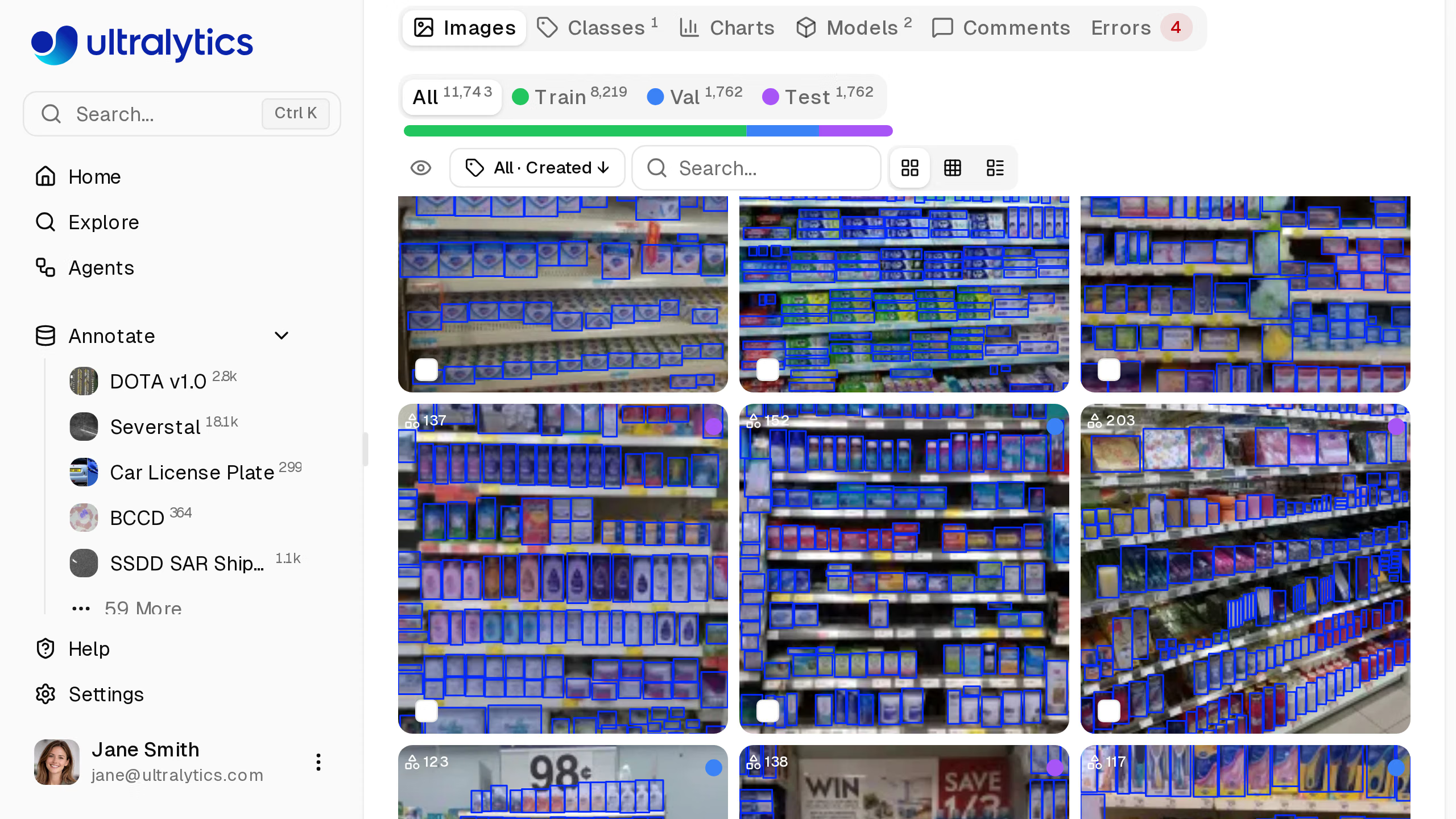
The SKU110K Dense Retail Shelf Detection 2 dataset on Ultralytics Platform, where Carbon posts the best UL37 score, 0.671 mAP50.
Gemini 4 Carbon posts top scores across nine domains#
Carbon now holds the best score of any model on a long list of UL37 datasets, according to the per-dataset results on Platform's model pages. Here they are beside the previous top score:
| Dataset | Domain | Gemini 4 Carbon mAP50 | Previous best mAP50 |
|---|---|---|---|
| LLVIP infrared | Thermal / low light | 0.955 | Gemini 4 Argon, 0.915 |
| Cheng Brain Tumor MRI | Medical | 0.942 | GPT-6.1 Terra, 0.904 |
| RPC Retail Checkout | Retail | 0.935 | GPT-6 Astra, 0.935 (tie) |
| CeyMo Road Markings | Roads / traffic | 0.905 | Gemini 4 Argon, 0.905 (tie) |
| Basketball and Hoop | Sports | 0.882 | Claude Fable 5.2, 0.849 |
| FloorPlanCAD 2 | Documents / UI / CAD | 0.821 | GPT-6 Astra, 0.726 |
| RUOD Underwater | Underwater | 0.788 | Gemini 4 Argon, 0.757 |
| HIT-UAV thermal drone | Aerial / remote sensing | 0.689 | Gemini 4 Argon, 0.582 |
| SKU110K shelves | Retail | 0.671 | GPT-6.1 Terra, 0.619 |
| PlantDoc | Nature / agriculture | 0.594 | Claude Fable 5.2, 0.521 |
| Airbus Oil Storage | Aerial / remote sensing | 0.381 | Gemini 4 Argon, 0.347 |
| DDR retinal lesions | Medical | 0.133 | Claude Opus 5.5, 0.132 |
Three patterns stand out. Carbon keeps Argon's strengths in thermal, aerial and underwater imagery and pushes each further, with the biggest jump on HIT-UAV thermal drone footage. It takes floor plans from GPT-6 Astra by almost 0.1. And on brain tumor MRI, where the classes are meningioma, glioma and pituitary tumor, it edges past Terra.
Each dataset contributes 10 images, so a single score is a signal to investigate, not a verdict. Carbon matches the existing record on RPC and CeyMo and leads by 0.001 on DDR, margins too small to separate the models.
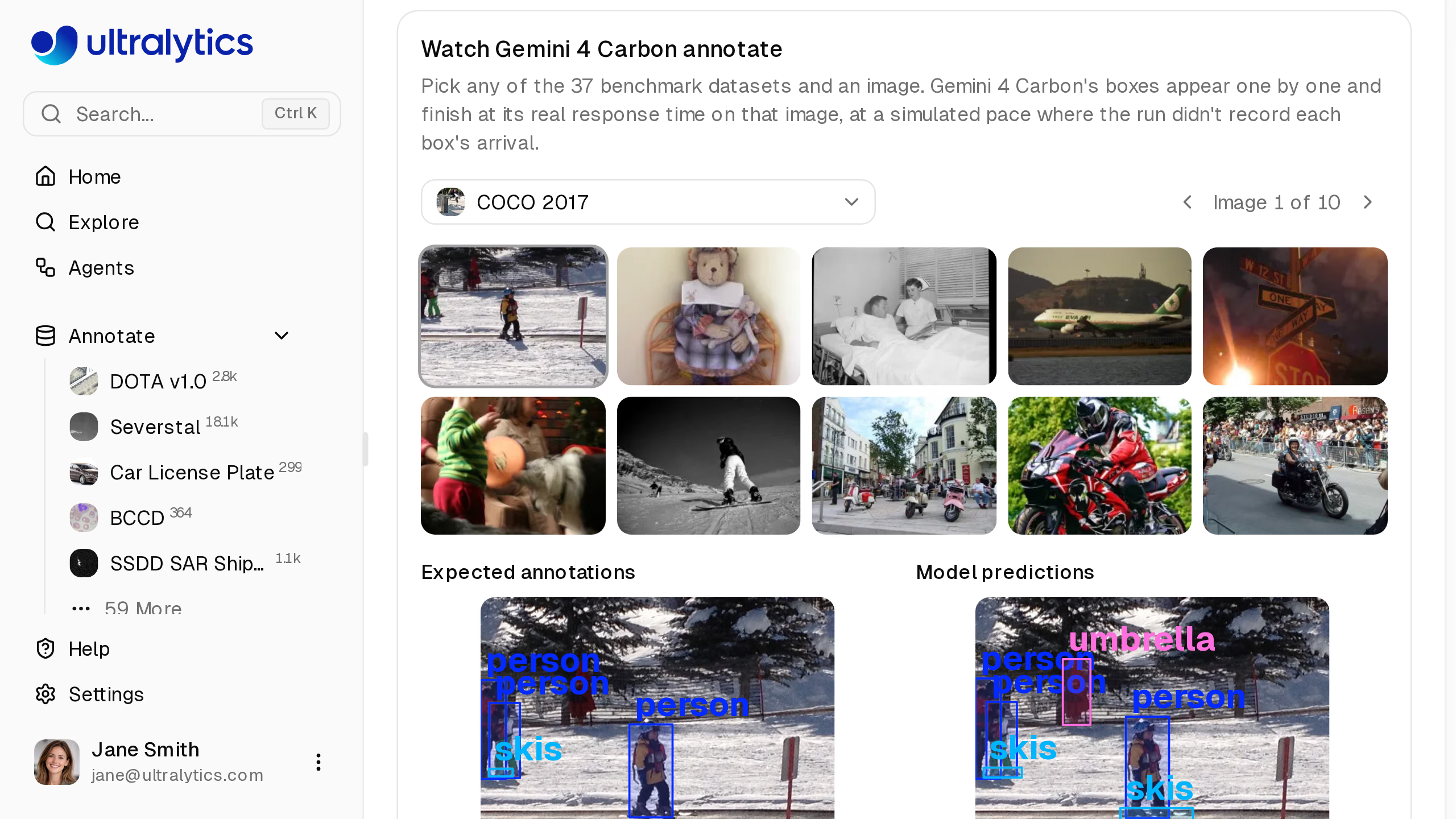
The model page replays Carbon's recorded UL37 boxes beside the expected annotations for every benchmark dataset and COCO.
Gemini 4 Carbon vs GPT-6.1 Terra: where Terra still wins#
Terra keeps two medical top scores. The leaderboard's dataset table still lists it as the best model on TN5000 thyroid ultrasound, at 0.935, and on TXL-PBC blood cell microscopy, at 0.889. If your data resembles either dataset, compare both models' rows on their model pages before you pick.
Terra's bigger advantage is price. Here is the head-to-head on UL37:
| UL37 result | Gemini 4 Carbon | GPT-6.1 Terra |
|---|---|---|
| mAP50 | 0.584 | 0.560 |
| mAP50-95 | 0.371 | 0.345 |
| Provider cost per 1,000 images | $12.93 | $4.36 |
| Median time per image | 7.6 s | 5.1 s |
| Failed requests | 1% | 0% |
Cost is estimated from provider-reported token usage per 1,000 successfully annotated benchmark images, at list prices. Terra delivers about 96% of Carbon's mAP50 for about a third of the cost, answers faster and failed no requests. Both models sit on the leaderboard's "Best value" line, which joins the models nothing beats on both cost and accuracy.
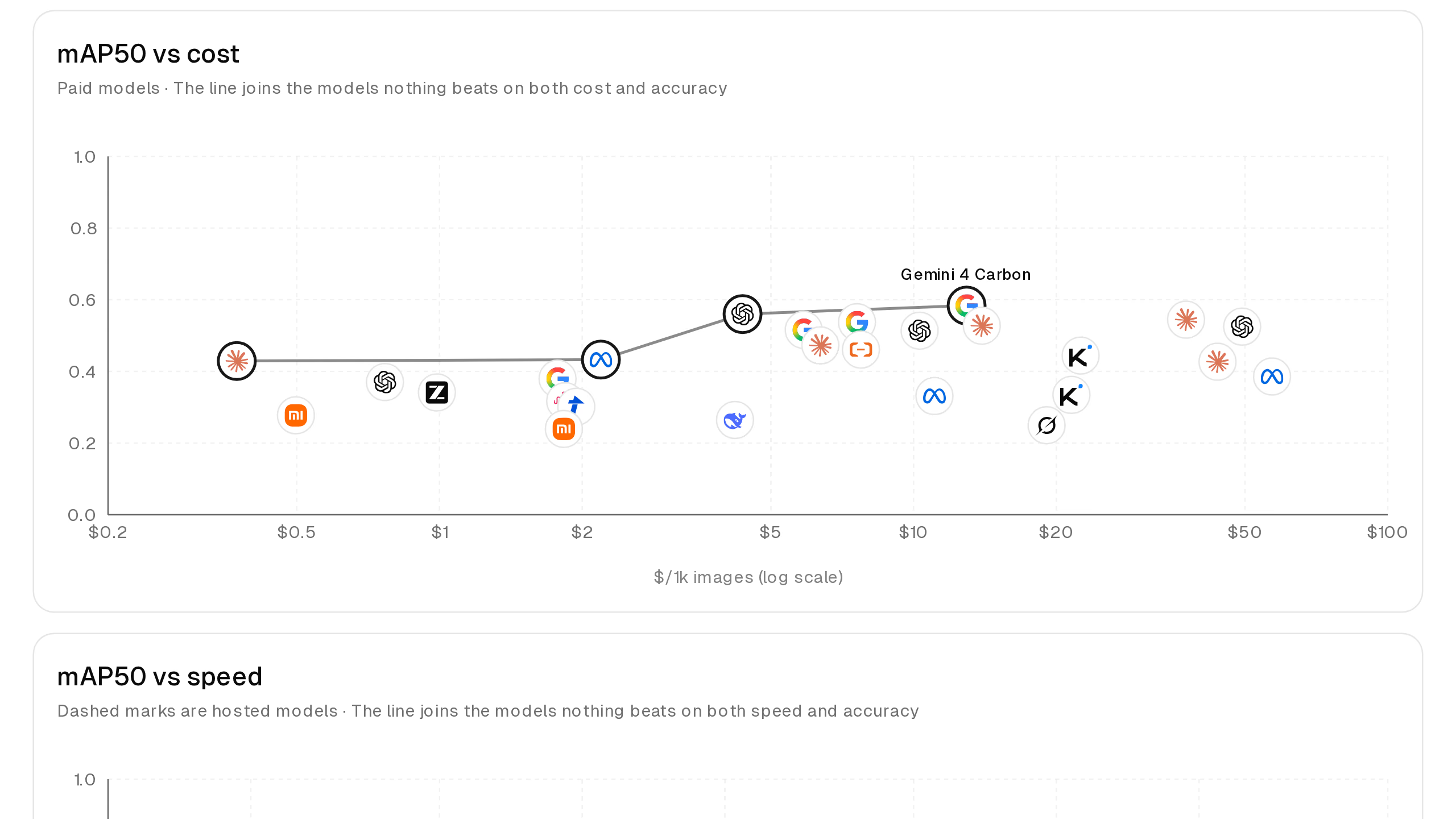
The leaderboard's mAP50 vs cost chart for paid models on UL37, at current list prices.
The price gap will grow. Google sells Carbon at an introductory $2 per million input tokens and $10 per million output tokens through November 30, 2026, then $4 and $20, according to its availability post. At the same token usage, Carbon's $12.93 per 1,000 images becomes about $26 on December 1.
Here is the practical split:
- Pay for Carbon when label quality is worth the bill: crowded scenes like retail shelves, thermal and aerial imagery, floor plans and CAD drawings, and any dataset where the model page shows Carbon well ahead.
- Choose Terra for large general-purpose batches where budget matters more than 0.024 mAP50, and for data like the TN5000 thyroid ultrasound and TXL-PBC blood cell datasets.
- Run a large Carbon job before December 1 if you plan to use it, while the introductory rate applies.
Whichever you pick, Batch Annotation adds Ultralytics Platform's processing fee of $1.00 per 1,000 images processed, with a $0.01 minimum per run, and the provider bills your own key directly. Ultralytics adds no markup to tokens. For a broader breakdown, see our image annotation software cost guide. For a cheaper paid model, Claude Haiku 5.5 scores 0.429 for $0.37 per 1,000 images, and hosted models such as Qwen3.8 27B and SAM 3.1 Text need no key at all.
How to run Gemini 4 Carbon auto-annotation on your dataset#
Carbon is a class-prompted model for detection datasets with 1 to 200 classes. It returns bounding boxes for your dataset's own class names, which Platform requests in Gemini's y-first format and refines with SAM 3.1.
- Create a Gemini API key in Google AI Studio. Carbon runs on the paid API tier, so the key needs billing enabled.
- Add it under Settings > API Keys in the Platform workspace that owns your dataset. The provider key docs cover the details.
- Open an image in the annotation editor, switch to Smart mode, and choose Gemini 4 Carbon under Google in the model picker.
- Press Predict, or
P, to label the current image. Try a handful of images that represent your data before scaling up. - On the dataset page, choose More actions > Batch Annotation to label every unlabeled image in one pass. Platform saves a dataset version first, so you can roll back.
- Review and correct the boxes, which the editor saves automatically, then train an Ultralytics YOLO26 model on the result in the same workspace.
Developers can also call Carbon from code: the Platform SDK v0.1.109 release added gemini-4-carbon as an image-prediction model. For the bigger picture, see how Ultralytics Platform uses AI to automate annotation and why human-in-the-loop review stays part of the workflow. For medical image analysis, treat any model's boxes as a draft that clinical experts check and approve, never as a diagnosis.
Who should use Gemini 4 Carbon#
Use Gemini 4 Carbon when label quality matters more than the provider bill. It is the most accurate auto-annotation model we have benchmarked, the current leader on both precision and recall, and the top scorer on thermal, aerial, underwater, retail shelf, floor plan and brain MRI datasets.
Teams already using Argon get a higher overall score and new top scores on Argon's own strongest domains, at the same introductory token price, though Carbon costs more per image at that price. Teams labeling large, general batches on a budget should keep GPT-6.1 Terra as their default and switch to Carbon dataset by dataset, where the model page shows a clear lead. For Argon's side of the story, see our Gemini 4 Argon auto-annotation results.
Frequently asked questions
On our UL37 benchmark it scores 0.584 mAP50 and 0.371 mAP50-95, first of 45 models on the Ultralytics VLM Leaderboard, and it has both the highest average precision and the highest average recall. It posts the best score of any model on thermal, aerial, underwater, retail shelf, floor plan and brain MRI datasets.
It is more accurate overall: 0.584 mAP50 against Terra's 0.560, and 0.371 mAP50-95 against 0.345. Terra costs $4.36 per 1,000 images against Carbon's $12.93, answers faster, and remains the leaderboard's best model on the TN5000 thyroid ultrasound and TXL-PBC blood cell datasets. Pay for Carbon where its lead is large, such as crowded shelves and thermal imagery.
On UL37 overall, yes. Carbon is based on Argon and scores 0.047 higher on mAP50 (0.584 against 0.537), and it beats Argon's previous top scores on LLVIP infrared, HIT-UAV thermal drone, RUOD underwater and Airbus Oil Storage images. Both carry the same introductory token price, though Carbon uses more thinking tokens per request.
Google lists an introductory price of $2 per million input tokens and $10 per million output tokens through November 30, 2026, then $4 and $20. On our benchmark, Carbon's provider cost came to $12.93 per 1,000 images at the introductory rate, about $26 at the same usage from December 1. Batch Annotation in Ultralytics Platform adds $1.00 per 1,000 images processed.
Since November 10, 2026, paying developers and enterprises can call Carbon through the Gemini API in Google AI Studio and Gemini for business, and it is rolling out to Google AI Ultra subscribers in the Gemini app. Cybersecurity defenders keep specialized access through Google's Fairwind Program. In Ultralytics Platform, you use it with your own paid Gemini API key.
Yes. Even the top model averages 0.584 mAP50 on UL37, and scores on the hardest datasets are far lower, such as 0.381 on Airbus Oil Storage across its 10 benchmark images. Review every image, and for medical data have clinical experts approve the boxes.
Written by
Founder & CEO · Ultralytics
Comments
Ask a question, share your results, or help someone else.