Golden Dataset
A golden dataset is a carefully labeled, representative set used as a trusted answer key for AI evaluation. Explains how to build and maintain one.
A golden dataset is a carefully curated, accurately labeled, and representative collection of examples used as a trusted reference for evaluating an AI system. Rather than maximizing size, it prioritizes correctness, coverage, and relevance to the intended application. Teams use it as a stable “answer key” for comparing models, checking regressions, investigating failures, and deciding whether a system is ready for deployment.
In machine learning, “golden dataset” is an informal engineering term rather than a universally standardized dataset type. Its exact contents depend on the task: images with verified bounding boxes for object detection, prompts with approved responses for a language model, or transactions with confirmed outcomes for fraud detection.
What Makes a Dataset Golden#
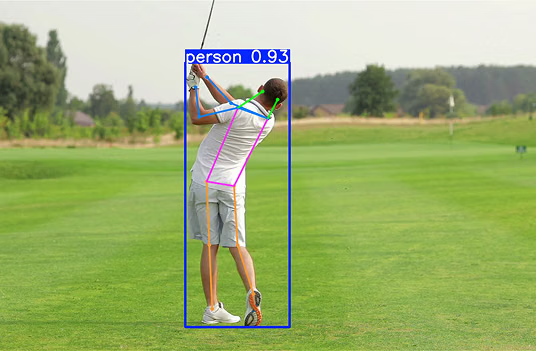
A golden dataset contains inputs plus trusted expected outputs, often called ground truth. In computer vision, these outputs may be class labels, bounding boxes, segmentation masks, or keypoints produced through rigorous data annotation.
Its main qualities are:
- Label accuracy: Domain experts or trained reviewers verify annotations using clear guidelines. Ambiguous examples are resolved consistently rather than left to individual interpretation.
- Representative coverage: The dataset reflects important production conditions, including common cases, difficult examples, rare events, and relevant user or environmental groups.
- Task alignment: Every example helps measure a defined requirement, such as detecting damaged packages under warehouse lighting.
- Independence: Examples are separated from training data to prevent data leakage, which can make reported performance misleadingly high.
- Traceability: Teams record data sources, collection conditions, annotation rules, reviewers, and changes. MLflow dataset tracking illustrates how hashes, schemas, sources, and dataset lineage can support reproducibility.
- Controlled change: Updates are versioned and reviewed. A model score is meaningful only when the exact dataset version and evaluation settings are known.
Golden does not mean flawless or permanently correct. Real-world conditions and definitions can change, so the reference set must be audited and refreshed without silently rewriting historical results.
Golden Dataset vs. Related Terms#
A golden dataset overlaps with several familiar concepts but emphasizes trust and governance:
- A ground-truth label is the accepted answer for one example; a golden dataset is a collection of reviewed examples and their accepted answers.
- A benchmark dataset is usually shared to compare systems on a common task. A golden dataset is often private and tailored to one organization, product, or deployment environment.
- Validation data guides model selection and tuning during development. Repeated decisions based on it can gradually overfit the development process.
- Test data is held back for final evaluation. A golden dataset often acts as a high-quality test or regression set, although it may also contain separate development and final-test portions.
- Training data teaches model parameters and is usually much larger. A golden dataset should remain outside training unless a versioned copy is deliberately retired from evaluation.
The Google guidance on dataset splitting recommends keeping training, validation, and testing examples distinct. When data is scarce, cross-validation techniques can improve estimation, but a protected final reference set remains valuable.
Real-World Applications#
Manufacturing defect inspection: A factory may create a golden dataset of reviewed images showing acceptable products and confirmed defects such as cracks, missing components, or incorrect assembly. It includes multiple production lines, camera positions, materials, and lighting conditions. Each candidate model is evaluated on the same set before release. If recall drops for small cracks, the team can block deployment even when the overall metric appears acceptable.
Retail shelf monitoring: A retailer may maintain verified store images containing crowded shelves, empty spaces, partially hidden products, seasonal packaging, and reflections. This dataset measures whether a vision system reliably detects products and stock gaps across store environments. Reviewing performance by scenario or product category follows the broader practice of finding high-error cohorts described in Microsoft’s responsible AI guidance.
These applications show why overall accuracy alone is insufficient. The golden dataset should support slice-based evaluation for rare classes, locations, devices, or conditions where errors carry different consequences. The NIST AI Risk Management Framework Core similarly emphasizes documented test sets, suitable metrics, and evaluation under deployment-like conditions.
Building and Maintaining a Golden Dataset#
Start by defining the model’s intended behavior and important failure modes. Collect representative examples, write precise annotation instructions, run reviewer calibration, and resolve disagreements with domain experts. Keep near-duplicates and related video frames in the same split so visually similar content cannot cross the training-evaluation boundary.
For vision projects, Ultralytics Platform supports cloud dataset management, annotation, training, and deployment. Its annotation workflow enables teams to create and refine labels, while dataset views help inspect class distributions, unannotated images, splits, duplicates, and outliers.
Version each approved release and document additions, removals, label corrections, and policy changes. The NIST guidance on AI testing, evaluation, validation, and verification provides a broader framework for meaningful evaluation. After deployment, compare incoming data with the golden reference and monitor for changing conditions; Azure model monitoring guidance explains how drift and data-quality signals can reveal when a reference set needs revision.
Evaluating a Vision Model#
Ultralytics YOLO can evaluate predictions against reviewed labels using Validation mode:
from ultralytics import YOLO

# Load a pretrained object detection model
model = YOLO("yolo26n.pt")

# Evaluate predictions against a labeled reference split
metrics = model.val(data="coco8.yaml", split="val")

# Report the primary detection metric
print(f"mAP50-95: {metrics.box.map:.3f}")
This workflow demonstrates the model-side role of a golden dataset: run a fixed model against a fixed labeled split and record a reproducible metric. In production projects, teams should also inspect per-class results, confusion matrices, difficult examples, and application-specific acceptance thresholds before approving a release.