Ground Truth
Ground truth is the reference used to train and evaluate machine learning models, from class labels and bounding boxes to measured depth maps.
In machine learning, ground truth is the reference answer for an input: a recorded label, measurement, or outcome that a model learns from or is scored against. In object detection, the image is the input, the recorded object classes and locations are the ground truth, and the model's estimates are predictions. Ground truth describes the role of the reference; its reliability depends on how it was collected and checked.
In remote sensing, NASA and the USGS use ground-based measurements as ground truth when checking observations from Landsat satellites.
How Ground Truth Is Used in Machine Learning#
In supervised learning, a loss function measures how predictions differ from training targets and supplies the signal used to update the model. During development, validation data provides a separate reference for choosing settings or checkpoints. A held-out test set supplies the reference for final scoring. In video datasets, grouping clips from the same recording session into one split and checking for near-duplicates across splits reduces the risk of inflated evaluation scores.
A label is a recorded value, such as a class ID. It serves as ground truth when the dataset uses it as the reference for that task. A pseudo-label is a prediction reused as a training target in methods such as semi-supervised learning; it can carry forward the errors of the model that produced it. A golden dataset is a curated collection of reference examples, often reserved for evaluation. Grounding connects a model's output to evidence, such as a source document or a region of an image.
What Does Ground Truth Look Like in Computer Vision?#
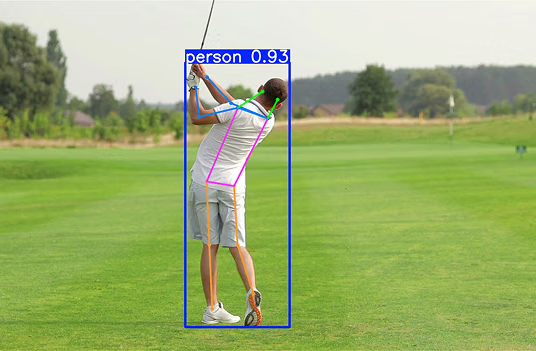
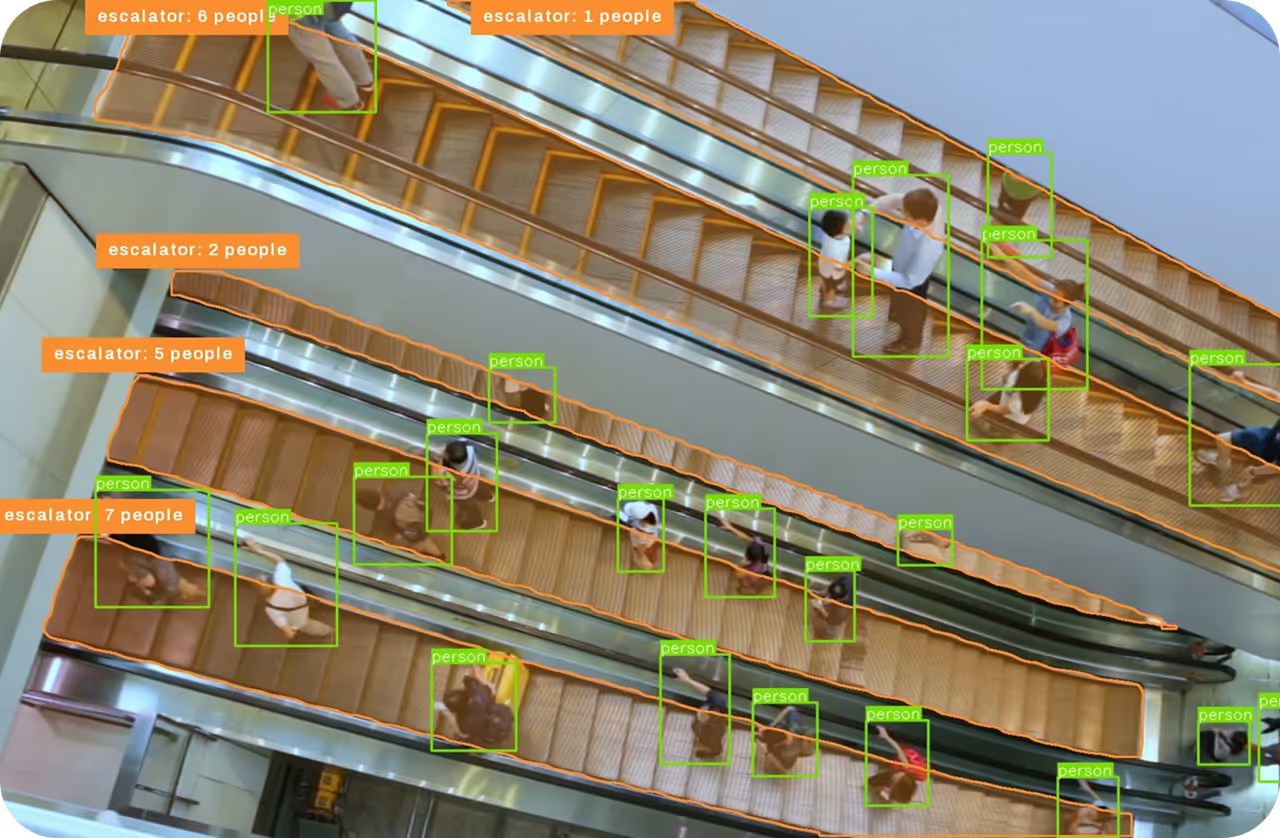
The task determines how much detail the reference needs. Image classification uses one or more labels for an entire image. Object detection uses a class label and a bounding box for each annotated instance. Instance segmentation uses a separate mask for each instance, so two overlapping objects of the same class can have distinct annotations. Pose estimation uses landmarks such as joints and can record their visibility.
COCO 2017 contains detection annotations for everyday categories such as people, bicycles, and cars. Its boxes record where those objects appear in the image. Ground truth can also come from an instrument: NYU Depth V2 pairs indoor RGB images with aligned Kinect depth maps, giving depth estimation models a distance reference at corresponding pixels.
 COCO 2017 preview 1Annotations overlay showing 9 labels
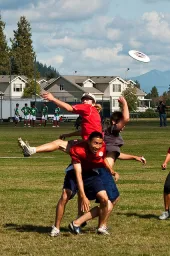 COCO 2017 preview 2Annotations overlay showing 13 labels
 COCO 2017 preview 3Annotations overlay showing 3 labels
 COCO 2017 preview 4Annotations overlay showing 12 labels
Everyday photos of common objects in natural context, Microsoft COCO's 2017 release and the standard object-detection benchmark. Images were gathered from Flickr and annotated by crowdworkers, with many small, occluded, and crowded objects per scene; test-dev labels are withheld, so only train and val are included. Source: Lin et al., "Microsoft COCO: Common Objects in Context," ECCV 2014; cocodataset.org.
What Is Ground Truthing?#
Ground truthing is the process of collecting or verifying reference data. In data annotation, teams define which objects qualify, how tightly to draw around them, and whether a box should cover only the visible part of a partially hidden object. Two annotators can label the same sample independently, and a reviewer can resolve disagreements using the written rules. With Smart Annotation on Ultralytics Platform, models propose boxes that reviewers can correct or remove. Reviewers also add boxes for objects the model missed.
A reviewed image with no target objects is a negative example. An unreviewed image with no labels has unknown status. The YOLO detection format allows images with no objects to have no label file, so an unlabeled image that contains target objects can enter training as background and teach the model to overlook them.
flowchart TD
    A["Image without labels"] --> B{"Has it been reviewed?"}
    B -->|No| C["Unknown status"]
    B -->|Yes| D{"Are target objects present?"}
    D -->|Yes| E["Missing annotations"]
    D -->|No| F["Negative example"]
How Ground Truth Affects Evaluation#
Detection evaluators typically match predictions to reference boxes of the same class using intersection over union (IoU), the overlap area divided by the combined area. The matches feed into precision, recall, and mean average precision (mAP). When an object that meets the labeling rules is missing from the reference, a correct detection can be scored as a false positive. A loose reference box can also push a well-localized prediction below the matching threshold.
Some annotations specify what the evaluator should ignore. In COCO box and mask evaluation, multiple predictions can match a single ground-truth crowd region. Predictions matched to that region count as neither true positives nor false positives.