Qwen4-Max for auto-annotation: standout datasets, uneven gains
Qwen4-Max ranks 13th of 51 in our auto-annotation benchmark, first on wrist X-rays and second on retail shelves. Accuracy, cost and how to run it.
 Miles Deans12 min read
Listen to this article
Alibaba released Qwen4-Max on November 16, 2026, calling it the most capable model in the Qwen family to date, with native vision and a one-million-token context window. We ran it through UL37, our 36-dataset detection benchmark, the same day.
Overall, Qwen4-Max ranks 13th of 51 models on our VLM Leaderboard, at 0.474 mAP50 for $5.68 per 1,000 images. That average hides a sharper result. On pediatric wrist X-rays, it posts the highest score of any model we have tested, and it is second only to Gemini 4 Carbon on underwater scenes and densely packed retail shelves.
Qwen4-Max is now the Alibaba option for auto-annotation in Ultralytics Platform, replacing Qwen3.8-Max. Below is where it stands out, where it falls short, how it compares with the models you would weigh it against, and what a labeling batch costs.
Qwen4-Max ranks 13th of 51 on UL37, and first on wrist X-rays#
UL37 measures how closely a model's boxes match human labels on 360 images: 10 from each of 36 real object detection datasets, from medical scans and aerial imagery to retail shelves, sports and circuit boards. Each dataset counts equally in the average, and every image goes through the same production pipeline Platform users get, with the dataset's own class names and SAM 3.1 refining each box, so the scores describe that refined pipeline rather than raw model output. The methodology is public.
| Qwen4-Max | Qwen3.8-Max | GPT-6.1 Terra | Gemini 3.8 Flash | Kimi K3.1 Pro | |
|---|---|---|---|---|---|
| Leaderboard rank | #13 of 51 | #15 of 51 | #3 of 51 | #11 of 51 | #16 of 51 |
| mAP50 | 0.474 | 0.461 | 0.560 | 0.516 | 0.444 |
| mAP50-95 | 0.301 | 0.295 | 0.345 | 0.321 | 0.281 |
| Precision | 0.595 | 0.572 | 0.646 | 0.656 | 0.560 |
| Recall | 0.561 | 0.524 | 0.613 | 0.555 | 0.483 |
| Provider cost per 1,000 images | $5.68 | $7.74 | $4.36 | $5.86 | $22.50 |
| Median time per image | 12.4 s | 13.1 s | 5.1 s | 7.4 s | 22.2 s |
| Failed requests | 0% | 1.7% | 0% | 0% | 6.4% |
UL37 results from the Ultralytics VLM Leaderboard, updated November 19, 2026. Qwen3.8-Max is no longer offered in Platform.
Qwen4-Max improves on Qwen3.8-Max on every headline metric, costs less per image and completed every benchmark request. It still sits well behind the leaders on average: GPT-6.1 Terra scores 0.560 for less money and in well under half the time.
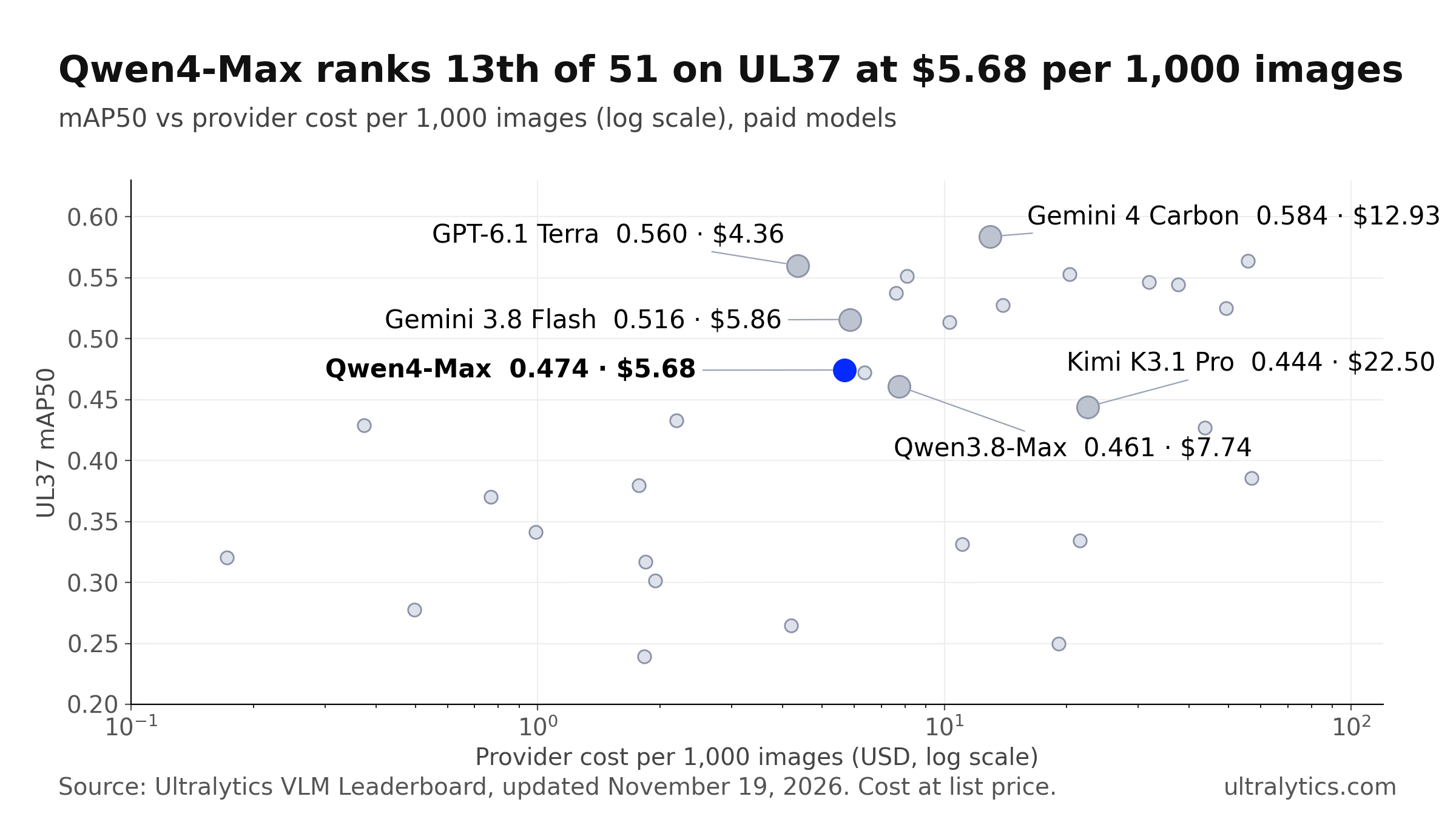
Each dot is a paid model on the Ultralytics VLM Leaderboard.
What Alibaba built Qwen4-Max for#
In its launch announcement, Alibaba describes Qwen4-Max as a sparse Mixture-of-Experts model with 2.4 trillion total parameters, of which 71 billion are active per token, and with native vision. It highlights coding, agentic tasks and visual reasoning, and reports that on its own Work360 benchmark Qwen4-Max outperforms Qwen3.8-Max while cutting average cost per task by around 60%.
Alibaba Cloud's Model Studio release notes list it as "the next-generation flagship multimodal model in the Qwen family, combining text generation, image and video understanding, and deep reasoning." Its international price is $1.50 per million input tokens and $4.50 per million output tokens, down from $2 and $6 for Qwen3.8-Max. The model is available through Alibaba's API; Alibaba says smaller open-weight Qwen4 models will follow.
Neither the announcement nor the release notes report object detection results, so that is what we measured.
Qwen4-Max vs Qwen3.8-Max: cheaper, with uneven gains#
Qwen4-Max beats its predecessor on 19 datasets, trails on 16 and ties on one. Its average gain of 0.013 mAP50 comes from large improvements on some datasets that outweigh clear drops on others.
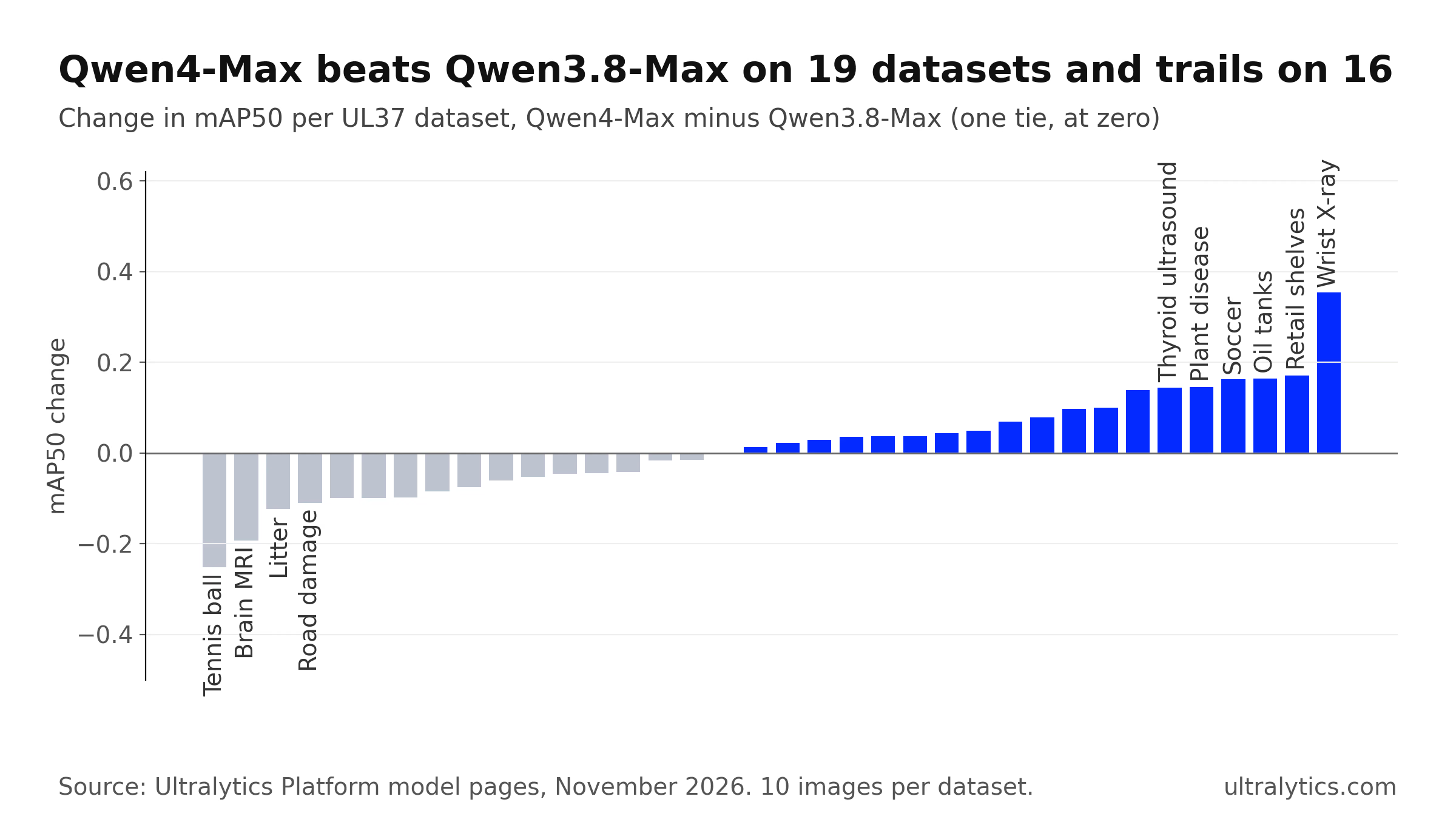
Each bar is one UL37 dataset, sorted from the largest drop to the largest gain.
| Dataset | Qwen4-Max | Qwen3.8-Max | Change |
|---|---|---|---|
| GRAZPEDWRI-DX pediatric wrist X-ray | 0.4975 | 0.1437 | +0.3538 |
| SKU110K dense retail shelves | 0.6230 | 0.4516 | +0.1714 |
| Airbus oil storage tanks | 0.3005 | 0.1363 | +0.1642 |
| SoccerDB soccer | 0.8345 | 0.6715 | +0.1630 |
| RacketVision tennis ball | 0.3775 | 0.6299 | −0.2524 |
| Cheng brain tumor MRI | 0.4421 | 0.6350 | −0.1929 |
UL37 mAP50 per dataset, 10 images each, shown to four decimals so each change matches its two scores.
The cost drop is clearer. At $5.68 per 1,000 images against $7.74, Qwen4-Max costs about 27% less per image in our run. Alibaba's own figure of around 60% comes from a different benchmark under different settings, so the two are not directly comparable.
Where Qwen4-Max stands out#
Three results put Qwen4-Max near the top of the whole leaderboard, not just the Qwen family.
| Dataset | Qwen4-Max | Rank of 51 | Leader |
|---|---|---|---|
| GRAZPEDWRI-DX pediatric wrist X-ray | 0.4975 | 1st | Qwen4-Max (next: Muse Ember 1.0, 0.378) |
| RUOD underwater objects | 0.774 | 2nd | Gemini 4 Carbon, 0.788 |
| SKU110K dense retail shelves | 0.623 | 2nd | Gemini 4 Carbon, 0.671 |
UL37 mAP50 per dataset. Rank among all 51 models on the Ultralytics VLM Leaderboard.
Wrist X-rays. On pediatric wrist trauma X-rays, Qwen4-Max scores 0.4975, ahead of every other model we have tested and more than three times Qwen3.8-Max. Each dataset contributes 10 images, so treat this as a strong signal to test, not a verdict. It is also not diagnosis or clinical validation: for research annotation in medical image analysis, Qwen4-Max can draft boxes for clinical experts to check and correct.
Retail shelves. Averaged over UL37's two retail datasets, Qwen4-Max scores 0.752, ahead of GPT-6.1 Terra's 0.724. On SKU110K, where shelves are packed edge to edge with products under one class, it is second only to Gemini 4 Carbon.
Underwater scenes. On RUOD's underwater objects, its 0.774 is second of 51, ahead of GPT-6.1 Terra's 0.658.
Where Qwen4-Max falls short#
The gaps are as clear as the wins. Qwen4-Max scores 0.000 on DeepPCB bare-board defects and 0.05 on IEDXray security scans, where the Gemini 4 models reach about 0.30. Chest X-rays for tuberculosis score 0.037, and on the brain tumor MRI dataset it trails GPT-6.1 Terra, 0.442 to 0.904.
Averaged by domain, it also trails GPT-6.1 Terra on documents, UI and CAD drawings (0.357 to 0.494), roads and traffic (0.396 to 0.572) and medical imaging overall (0.325 to 0.505). Before labeling a large dataset in any of these areas, open the Qwen4-Max model page, which replays its recorded boxes on every benchmark dataset beside the expected labels.
Qwen4-Max vs GPT-6.1 Terra, Gemini 3.8 Flash and Kimi K3.1 Pro#
| Head to head, 36 UL37 datasets | Qwen4-Max wins | Loses | Ties |
|---|---|---|---|
| vs GPT-6.1 Terra | 11 | 23 | 2 |
| vs Gemini 3.8 Flash | 17 | 18 | 1 |
| vs Kimi K3.1 Pro | 21 | 14 | 1 |
| vs Qwen3.8-Max | 19 | 16 | 1 |
GPT-6.1 Terra is the stronger general choice: it wins 23 datasets to Qwen4-Max's 11, costs less and has a median response time less than half as long. Gemini 3.8 Flash is a near-even match on datasets at a similar price, with a higher average score. Against Kimi K3.1 Pro, Qwen4-Max wins 21 datasets to 14 at about a quarter of the cost per image.
How Ultralytics Platform runs Qwen4-Max#
Two settings shape Qwen4-Max's results in Platform. First, it runs at Alibaba's "low" reasoning effort rather than its default "high". In Ultralytics testing on the 370 benchmark images (the 360 scored images plus 10 COCO reference images), the default missed Platform's 115-second request limit on 11 and "low" on 3, with the same mAP50. Second, Platform asks Qwen models for compact JSON output, because they lose about 0.02 mAP50 without it.
Neither setting needs any action from you: choose Qwen4-Max in the model picker and Platform applies both.
What a Qwen4-Max annotation batch costs#
The provider cost is Alibaba's reported token usage priced at Platform's rates for the model, per 1,000 successfully annotated images, and your own images may use more or fewer tokens. Batch Annotation adds a Platform processing fee of $1.00 per 1,000 images, with a minimum of $0.01 per run.
| Per 1,000 images | Qwen4-Max |
|---|---|
| Alibaba charges | $5.68 |
| Ultralytics Platform processing | $1.00 |
| Total | $6.68 |
You pay Alibaba directly through your own API key, including for the test predictions you run first, and Ultralytics adds no markup to tokens. If you would rather not use a paid key at all, the hosted Qwen3.8 27B runs on Platform without one, at 0.351 mAP50 on UL37.
How to run Qwen4-Max auto-annotation in Ultralytics Platform#
Qwen4-Max is a class-prompted model for detection datasets with 1 to 200 classes. It returns bounding boxes for your dataset's own class names, which you then review and correct.
- Create an API key in Alibaba Cloud Model Studio for the international (Singapore) region, which is the endpoint Platform uses.
- Have the workspace owner add it under Alibaba in Settings > API Keys of the workspace that holds your dataset. The provider key docs cover the details.
- In the annotation editor, switch to Smart mode and choose Qwen4-Max under Alibaba in the model picker.
- Press Predict, or
P, on a few images that represent your data. - When you're happy, open the dataset page and choose More actions > Batch Annotation to label every unlabeled image. Batch Annotation works on Platform-hosted datasets with up to three image channels, and Platform saves a dataset version first, so you can roll back.
- Review the boxes, save them, and train an Ultralytics YOLO26 model on the result in the same workspace.
The annotation docs explain Smart mode and Batch Annotation in full, and our guide to choosing a VLM by precision and recall helps you match a model to your review workflow.
Who should use Qwen4-Max#
| If you need… | Start with |
|---|---|
| A general paid annotator | GPT-6.1 Terra: higher UL37 score, lower cost and faster than Qwen4-Max |
| Pediatric wrist X-ray drafts for expert review | Qwen4-Max: highest UL37 score of 51 models on this dataset |
| Dense retail shelves or underwater scenes | Qwen4-Max, and compare with Gemini 4 Carbon on your images |
| An Alibaba model, or a move from Qwen3.8-Max | Qwen4-Max: higher scores, lower cost per image, no failed requests in our run |
| No paid API key | Hosted Qwen3.8 27B, Gemma 4 26B or SAM 3.1 Text in Platform |
For most labeling work, GPT-6.1 Terra remains the better default. Qwen4-Max earns its place where your data looks like its standout datasets, so test it on a sample of your own images first.
Frequently asked questions
It ranks 13th of 51 on our benchmark, with a few standout results. On our UL37 benchmark it scores 0.474 mAP50, 13th of 51 models, with no failed requests. It ranks first of 51 on pediatric wrist X-rays and second on underwater objects and dense retail shelves, but scores poorly on circuit-board defects and security X-rays.
On average, yes. Qwen4-Max scores 0.474 mAP50 against 0.461, costs $5.68 per 1,000 images against $7.74, and completed every request where Qwen3.8-Max failed 1.7%. The gains are uneven: it beats Qwen3.8-Max on 19 datasets and trails on 16, with large drops on tennis-ball and brain MRI detection.
For general labeling, GPT-6.1 Terra: it scores 0.560 mAP50, wins 23 of 36 datasets against Qwen4-Max, costs $4.36 per 1,000 images and has a median response time of 5.1 seconds. Choose Qwen4-Max when your data resembles its strongest datasets, such as wrist X-rays, dense retail shelves or underwater scenes, and confirm on your own images.
It can draft boxes for research annotation that experts review; it does not diagnose. It posts the highest UL37 score of 51 models on pediatric wrist X-rays, at 0.4975 mAP50, but averages 0.325 across our eight medical datasets, below GPT-6.1 Terra's 0.505, and scores poorly on chest X-rays.
About $5.68 in Alibaba charges: Alibaba's reported token usage priced at Platform's rates for the model, per 1,000 successfully annotated images. Alibaba's international list price is $1.50 per million input tokens and $4.50 per million output tokens. Ultralytics Platform adds a $1.00 Batch Annotation fee per 1,000 images, for a total of about $6.68.
Create an international Alibaba Cloud Model Studio API key, have your workspace owner add it under Alibaba in Settings > API Keys, then choose Qwen4-Max in the annotation editor's Smart mode. Test a few images, run Batch Annotation, review the boxes and train an Ultralytics YOLO26 model in the same workspace.
Written by
Comments
Ask a question, share your results, or help someone else.