AI Agent Orchestration
AI agent orchestration decides which agent, model, or tool handles each step of a task, what context each one sees, and how their results are merged.
AI agent orchestration is the coordination layer of a system built from several AI agents, models, and tools. It decides which component handles each part of a task, what context each one receives, in what order they run, how they hand work to each other, and how their results are combined and checked. The orchestrator can be ordinary code with fixed control flow, an LLM that plans and delegates at runtime, or a mix of both. Orchestration is what turns a set of specialists, such as a search agent, a coding agent, and a computer vision model, into one system that completes tasks no single large language model (LLM) call could.
What an Orchestration Layer Does#
- Routing: Sends each subtask to the agent or model best suited to it, often a small, fast model for easy steps and a frontier model for hard ones.
- Context management: Gives each agent only the instructions, files, and prior results it needs. Subagents that work in separate context windows can explore deeply and return a short summary instead of filling the lead agent's context.
- Structured handoffs: Passes results between agents as validated data, such as JSON with a fixed schema, so the next step can rely on their format.
- Error handling: Retries failed steps, enforces timeouts and budgets, and pauses for human approval before consequential actions.
- Observability: Records a trace of every call, tool result, and decision so failures can be found and replayed.
Common Orchestration Patterns#
Most systems combine a few recurring orchestration patterns:
- Sequential pipelines: Each agent works on the previous agent's output in a fixed order, such as draft, review, then translate.
- Concurrent fan-out: Several agents work on the same input in parallel, and an aggregator merges or votes on their results.
- Orchestrator-workers: A lead agent breaks the task into subtasks at runtime, delegates them to worker agents, and synthesizes what they return. This hierarchical pattern suits open-ended tasks whose steps cannot be listed in advance.
- Handoff: An agent transfers the whole conversation to a better-suited specialist, such as a triage agent passing a billing question to a billing agent.
- Group chat and debate: Agents take turns in a shared thread, criticizing and building on each other's contributions under a moderator.
- Evaluator-optimizer: One agent produces a result and another grades it against criteria, looping until the result passes.
Frameworks such as LangGraph, the OpenAI Agents SDK, Google's Agent Development Kit, and Microsoft Agent Framework, the successor to AutoGen and Semantic Kernel, implement these patterns as graphs of agents and tools with shared state. Two open protocols connect the pieces: the Model Context Protocol (MCP) links agents to tools and data, and the Agent2Agent (A2A) protocol lets agents built by different vendors delegate tasks to each other.
Orchestration vs. Related Terms#
- Agentic workflows: A workflow is one predefined sequence of LLM calls and tools. Orchestration is the broader coordination of many agents and workflows, and can be driven by code or by an LLM that plans at runtime.
- Mixture of Agents (MoA): One specific concurrent pattern in which several models answer the same prompt and an aggregator model writes a single improved answer. General orchestration usually assigns different subtasks to different agents.
- Compound AI systems: The umbrella term for systems that combine models, retrievers, and tools. Orchestration is the control logic inside such a system.
- Kubernetes and container orchestration: Schedule and scale containers across machines. Agent orchestration coordinates reasoning and tool steps, and agent platforms often run on container orchestrators underneath.
Orchestrating Vision Models#
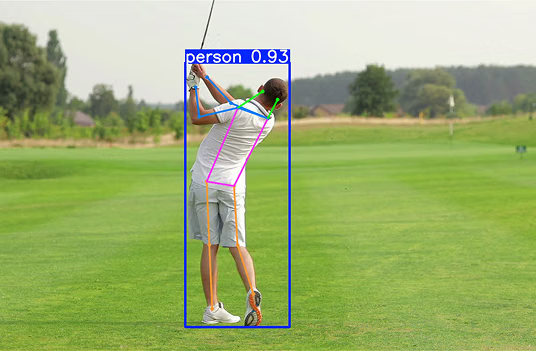
Vision systems apply the same patterns with models as workers: a fast object detector runs on every image and decides which images deserve a slower specialist. Ultralytics Platform Agents builds these workflows visually, connecting a YOLO26 block to Gate blocks that check detection counts or confidence ranges, and from there to vision-language model, dataset, Slack, and webhook blocks, so a "YOLO → VLM Monitor" workflow asks a VLM to describe a scene only when YOLO detects a person. The same routing in Python sends an image to a pose estimation worker only when the detector finds people:
from ultralytics import YOLO

# Worker models: a general detector and a pose specialist
detector = YOLO("yolo26n.pt")
pose_worker = YOLO("yolo26n-pose.pt")
image = "https://ultralytics.com/images/bus.jpg"

# Orchestrator step 1: run the detector and read its findings
detections = detector(image)[0]
people = int((detections.boxes.cls == 0).sum())

# Orchestrator step 2: route to the pose worker only when people are present
if people:
    poses = pose_worker(image)[0]
    print(f"{people} people detected, {len(poses.keypoints)} poses estimated")
else:
    print("No people detected, pose worker skipped")
The detector's result decides whether the second model runs at all, which is how gated pipelines keep expensive models off the images that do not need them.
Real-World Applications#
- Manufacturing: When a sensor raises an alert, an orchestrator sends camera frames to a defect-inspection agent and asks an LLM agent to search maintenance logs, then combines both findings into a repair ticket.
- Document processing: Scanned pages go to object detection and OCR workers that extract tables and fields, a reasoning model checks the extracted values against policy, and low-confidence pages go to a human reviewer.
- Agentic coding: A coding agent spawns subagents to search the codebase, run tests, and review the diff, keeping its own context free for the main change.
- Customer service: A triage agent identifies the request and hands off to billing, technical, or returns agents that hold the relevant tools and permissions.
Costs and Failure Modes#
Orchestration buys capability with tokens and complexity. In Anthropic's multi-agent research system, a Claude Opus 4 lead agent directing Claude Sonnet 4 subagents outperformed a single Claude Opus 4 agent by 90.2% on an internal research evaluation, while multi-agent runs used about 15 times as many tokens as chat interactions, so the pattern pays off mainly for broad tasks that split into parallel parts. Coordination also creates new ways to fail: agents can misread their instructions, withhold information from each other, or stop before the task is checked. A study of why multi-agent LLM systems fail sorted more than 1,600 annotated traces from seven frameworks into 14 failure modes grouped as system design issues, inter-agent misalignment, and task verification.