MiniMax-M3.1-Flash is now available for auto-annotation in Ultralytics Platform
MiniMax-M3.1-Flash is now in Ultralytics Platform. It scored 0.317 mAP50 on our VLM Leaderboard at $1.84 per 1,000 images, ranking 23rd of 38 models.
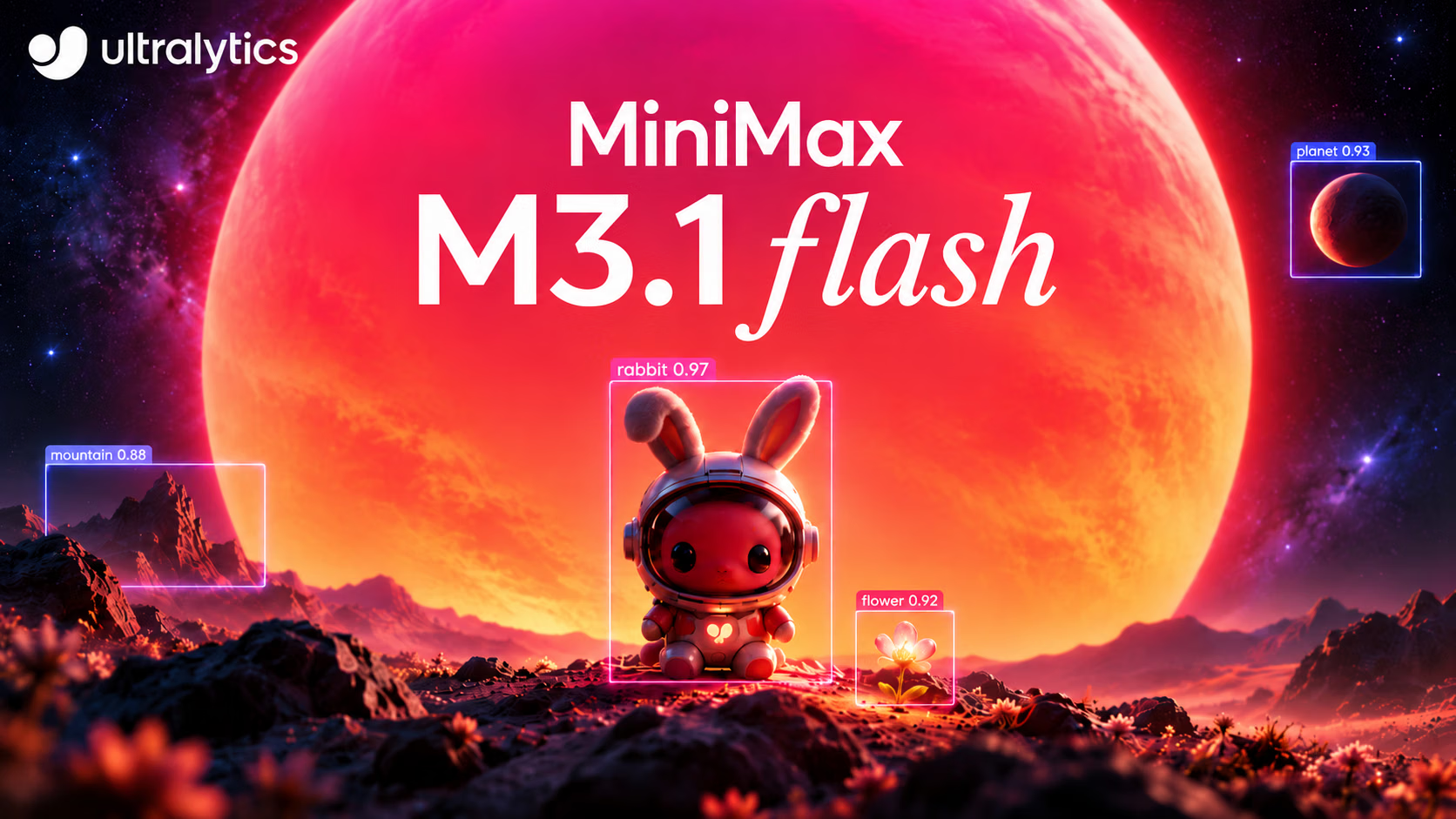
MiniMax released MiniMax-M3.1-Flash on October 19, 2026, and it's available for auto-annotation in Ultralytics Platform today. We ran it through the same test as every other model on our VLM Leaderboard: 360 images from 36 real-world detection datasets.
MiniMax-M3.1-Flash scored 0.317 mAP50 and ranks 23rd of 38 models, at about $1.84 per 1,000 images. It's the first MiniMax model in Ultralytics Platform. It finished ahead of MiMo-V2.6-Flash, DeepSeek Flash, and Grok 4.7, but behind the best budget models, led by Claude Haiku 5.5 and Gemini 3.5 Flash-Lite.
What's new in MiniMax-M3.1-Flash#
MiniMax-M3.1-Flash is the fast, low-cost model in MiniMax's M3.1 series, and MiniMax plans to release a larger Pro model later. It's a natively multimodal mixture-of-experts model with 428 billion parameters, 23 billion of them active per token, a 1-million-token context window, and image and video input. MiniMax built it for agentic work, coding, and computer use, and says it generates more than 170 tokens per second at the median. MiniMax released the weights on Hugging Face on October 23, 2026, under the MiniMax Community License. MiniMax's announcement has its agent and coding results.
It's also inexpensive. MiniMax-M3.1-Flash lists at a flat $0.15 per million input tokens and $0.60 per million output tokens.
MiniMax-M3.1-Flash for auto-annotation in Ultralytics Platform#
MiniMax-M3.1-Flash joins the class-prompted vision language models in the Ultralytics Platform annotation editor, under a new MiniMax provider. On an object detection dataset with 1–200 classes, it looks at each image and returns bounding boxes for the instances of your dataset's classes it finds, which you review and save like any other prediction.
You can use it in two ways:
- One image at a time: In the annotation editor, switch to Smart mode, select MiniMax-M3.1-Flash under MiniMax in the model picker, and click Predict (or press
P). - A whole dataset: Run Batch Annotation from More actions > Batch Annotation on the dataset page to label every unlabeled image in a single run.
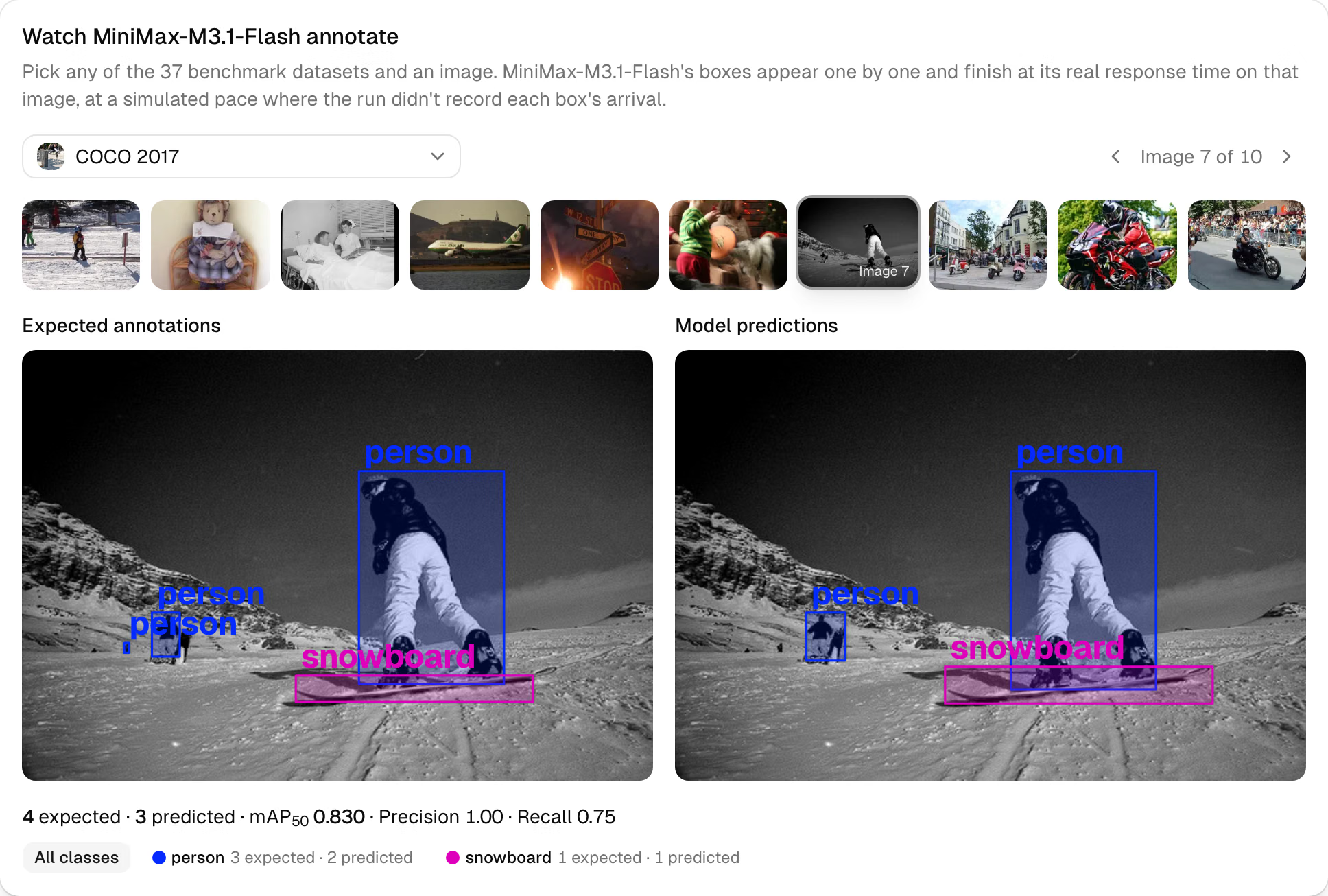
To see it work before you add a key, open the MiniMax-M3.1-Flash model page on Ultralytics Platform. It replays MiniMax-M3.1-Flash's recorded predictions on 10 COCO images next to the expected boxes, and shows its score on every benchmark dataset.
How we benchmarked MiniMax-M3.1-Flash#
A model that finds nearly every object in everyday photos can still miss most of them in a medical scan or a circuit board. So every model on the VLM Leaderboard takes the same frozen test, UL37 v2: 10 labeled images drawn at random from each of the 36 detection datasets in UL37, a set of real-world benchmark datasets Ultralytics uses for evaluation. They span medical imaging, aerial and satellite imagery, PCB inspection, security X-ray, retail shelves, traffic, sports, underwater scenes, thermal footage, and more.
Each image goes through Ultralytics Platform's production annotation pipeline with its dataset's class names, exactly as Smart mode and Batch Annotation call it, including the SAM 3.1 step that tightens each model's boxes. We score the boxes with the Ultralytics package's own detection metrics and average the 36 datasets equally. The VLM Leaderboard methodology has the details.
Before adding a new model, we test the request settings Ultralytics Platform already supports for other models and keep whichever scores best. Two choices came out of that for MiniMax-M3.1-Flash:
- Reasoning effort: MiniMax-M3.1-Flash defaults to MiniMax's maximum reasoning effort. At max, it ran past Ultralytics Platform's 115-second limit on more than half of the images we tried, and at high on 9%. Medium scored best of low, medium, and high, so Ultralytics Platform runs MiniMax-M3.1-Flash at medium reasoning effort, and its benchmark run used it.
- Box coordinates: Like Claude, Grok, and GLM, MiniMax-M3.1-Flash places boxes more accurately in pixel coordinates than on the 0–1000 grid most models use, by about 0.02 mAP50, so Ultralytics Platform asks it for pixels.
MiniMax-M3.1-Flash vs. Claude Haiku 5.5, Gemini 3.5 Flash-Lite, and GPT-6 Luna#
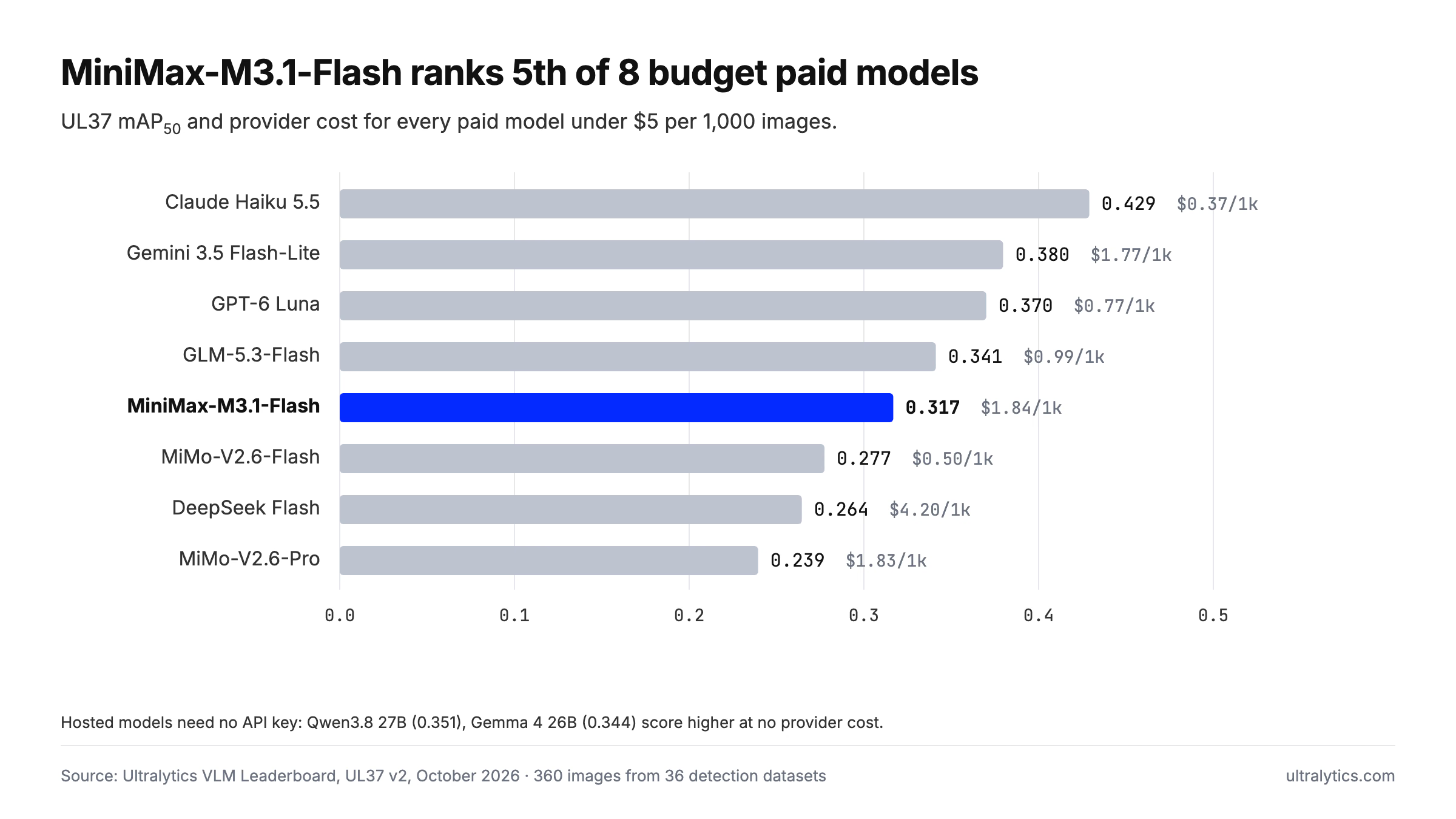
MiniMax-M3.1-Flash scored 0.317 mAP50, 5th of the 8 paid models that cost under $5 per 1,000 images. Claude Haiku 5.5 (0.429), Gemini 3.5 Flash-Lite (0.380), GPT-6 Luna (0.370), and GLM-5.3-Flash (0.341) scored higher, and it finished ahead of MiMo-V2.6-Flash (0.277), DeepSeek Flash (0.264), and MiMo-V2.6-Pro (0.239). The hosted Qwen3.8 27B (0.351) and Gemma 4 26B (0.344), which run on Ultralytics Platform's own GPUs with no provider key, also scored higher.
Its recall (0.413) was higher than its precision (0.379): it found about two of every five labeled objects, but only about 38% of its boxes matched one, fewer than for any of the models above it.
MiniMax-M3.1-Flash vs. Gemini 3.5 Flash-Lite: where each one wins#
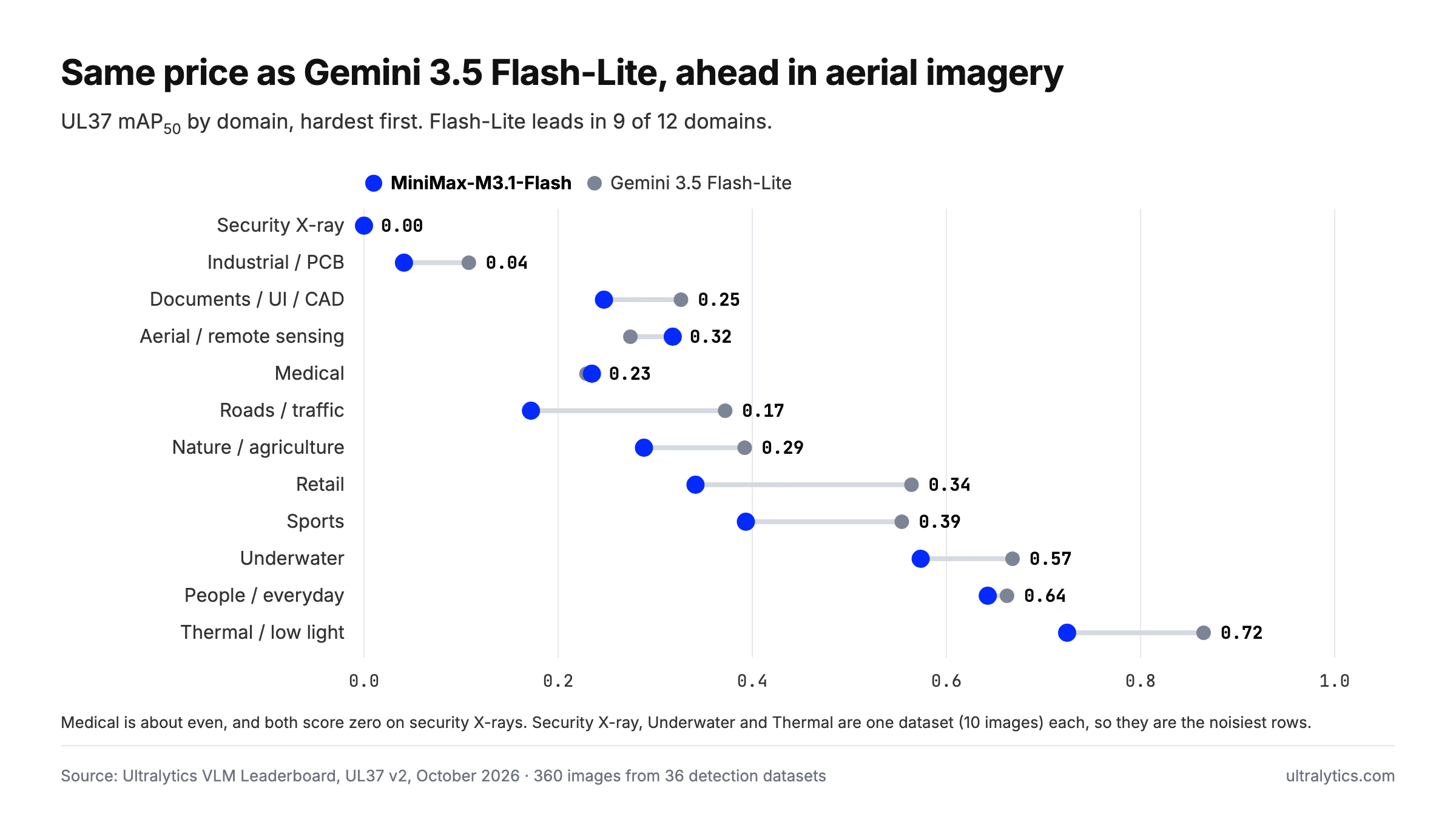
Gemini 3.5 Flash-Lite costs about the same per image ($1.77 vs. $1.84 per 1,000 images), so it's the closest comparison. MiniMax-M3.1-Flash came out ahead in aerial and remote sensing (0.32 vs. 0.27), one of the harder domains for most models. The two were about even on medical images, and both scored zero on security X-rays. Flash-Lite led in the other nine domains, by the widest margins in retail, roads and traffic, and sports.
MiniMax-M3.1-Flash's best datasets show where it fits. It ranked 6th of 32 language models on SSDD satellite radar ship detection (0.86), on EgoHands hand detection (0.90), and on GRAZPEDWRI-DX pediatric wrist X-rays (0.25). Industrial PCB defects and security X-rays stayed near zero, as they do for most models. Specialized imagery is still hard for every model, so treat MiniMax-M3.1-Flash's boxes as a first draft for human-in-the-loop review, and check a few predictions on your own images before you annotate a full dataset.
Accuracy, cost, and speed#
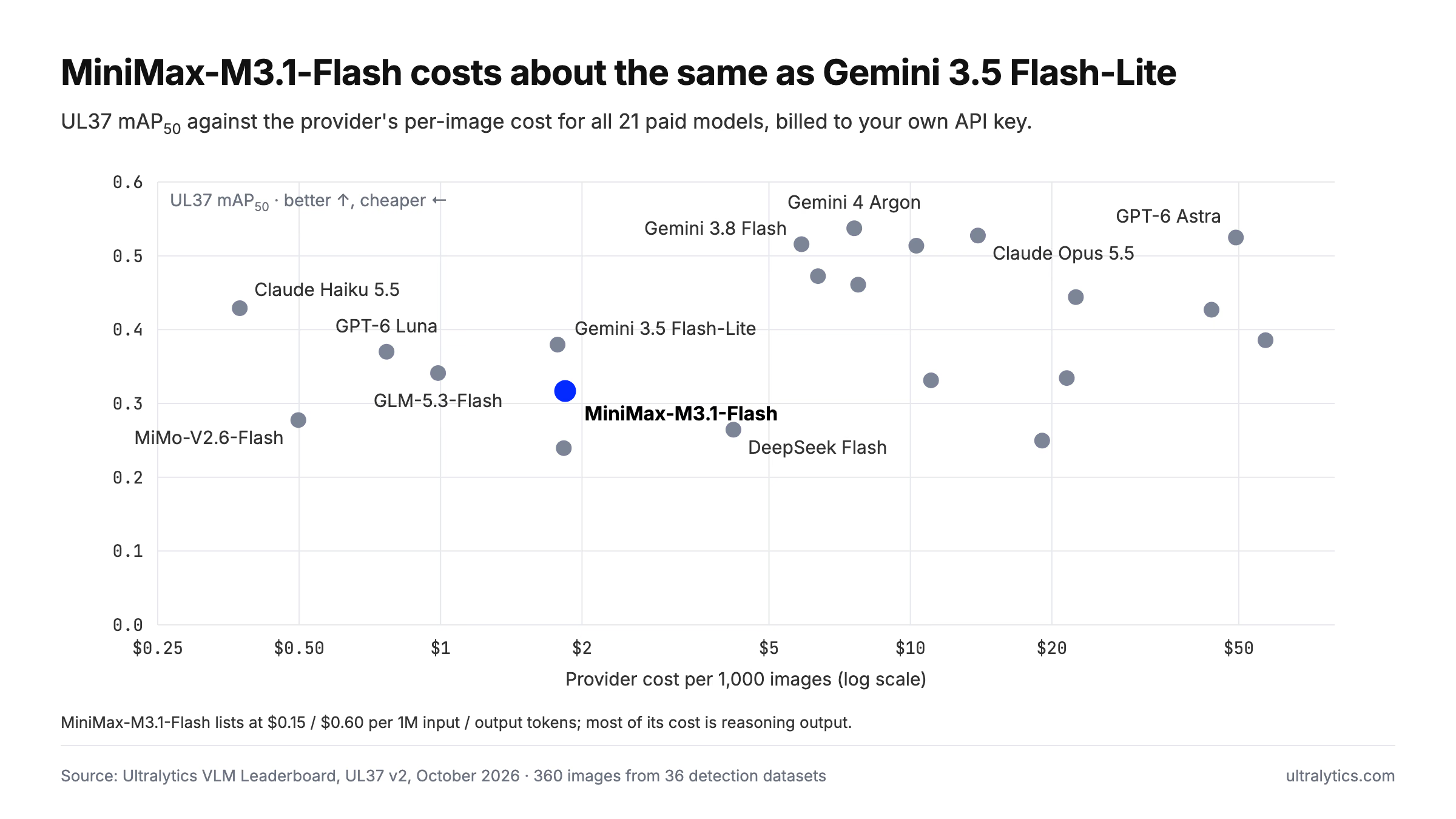
Paid models run on your own provider API key, so the provider bills each prediction directly. In our benchmark, MiniMax-M3.1-Flash cost about $1.84 per 1,000 images. Most of that is reasoning output: its token price is among the lowest of any model in Ultralytics Platform, but it thinks before it answers.
It isn't the cheapest way to that accuracy. Claude Haiku 5.5 scored about 0.11 mAP50 higher at about $0.37 per 1,000 images, and GPT-6 Luna (about $0.77) and GLM-5.3-Flash (about $0.99) also scored higher for less.
MiniMax-M3.1-Flash is also slower than its price suggests. Its median request took about 16 seconds per image, against 1.6 seconds for Gemini 3.5 Flash-Lite and 2.7 seconds for Claude Haiku 5.5, and 1.4% of its requests didn't finish within Ultralytics Platform's 115-second limit. A timed-out image comes back with no boxes, and you can predict it again.
Get started with MiniMax-M3.1-Flash in Ultralytics Platform#
- Create an API key on the MiniMax API Platform, then add it in Settings > API Keys of the workspace that owns your dataset, or ask the workspace owner to add one (see how).
- Open a detection dataset in Ultralytics Platform, switch the annotation editor to Smart mode, and select MiniMax-M3.1-Flash under MiniMax.
- Click Predict to label the current image, then review, adjust, and save the boxes.
- When the results look right, run Batch Annotation to label the rest of the dataset.
Batch Annotation adds the standard Ultralytics Platform processing fee of $1.00 per 1,000 images, separate from what MiniMax bills your API key. Each run saves a dataset version first, so you can always roll back.
Once your dataset is labeled, train an Ultralytics YOLO26 model on it in the same workspace (see the training docs). To compare MiniMax-M3.1-Flash with the most accurate models, read our Gemini 4 Argon and Kimi K3.1 Pro auto-annotation posts, or browse every model on the VLM Leaderboard and the Ultralytics Platform model pages. Then sign in to Ultralytics Platform to try MiniMax-M3.1-Flash on your own data.
Frequently asked questions
MiniMax-M3.1-Flash is the fast, low-cost model in MiniMax's M3.1 series, released on October 19, 2026. It's a natively multimodal mixture-of-experts model with 428 billion parameters (23 billion active), a 1-million-token context window, and image and video input, with open weights under the MiniMax Community License. In Ultralytics Platform, it's available as a class-prompted auto-annotation model that draws bounding boxes for your dataset's classes.
Both were more accurate and faster in our benchmark. MiniMax-M3.1-Flash scored 0.317 mAP50 against 0.380 for Gemini 3.5 Flash-Lite at about the same cost, and 0.429 for Claude Haiku 5.5 at about a fifth of the cost. MiniMax-M3.1-Flash outscored Flash-Lite in aerial and remote sensing imagery.
MiniMax bills your own API key at $0.15 per million input tokens and $0.60 per million output tokens, which came to about $1.84 per 1,000 images in our benchmark. Batch Annotation also adds the Ultralytics Platform processing fee of $1.00 per 1,000 images.
No. We benchmarked MiniMax-M3 as well. With reasoning on, it ran past Ultralytics Platform's 115-second limit on about half of the images at every reasoning effort, and with reasoning off it scored 0.268 mAP50, below the free hosted Qwen3.8 27B, Gemma 4 26B, and SAM 3.1 Text. Ultralytics Platform offers MiniMax-M3.1-Flash instead.
Yes. Hosted models such as Qwen3.8 27B, Gemma 4 26B, and SAM 3.1 Text run on Ultralytics Platform with no provider key, and you can also auto-annotate with pretrained or your own fine-tuned Ultralytics YOLO models.