Knowledge Cutoff
A knowledge cutoff is the date marking the boundary of an AI model's training data, shaping factual freshness and the need for current sources.
A knowledge cutoff is the date that marks the stated boundary of information included in an AI model's training data. It describes how current the model's learned knowledge is. For a large language model (LLM), facts learned during training become encoded in its parameters; newer information can reach an answer through documents, search, or other tools supplied during use.
How a Knowledge Cutoff Works#
During pretraining, a model learns patterns from training data, including relationships between words, concepts, and factual statements. This information becomes distributed across its model weights, the numerical parameters adjusted during learning. Once training finishes, ordinary inference uses those parameters to generate responses. Access to information published afterward comes through additional inputs or subsequent training.
A reported cutoff summarizes a training collection containing sources of different ages. A recently collected webpage can contain years-old information, and different subjects can have different levels of coverage. The effective cutoff describes the temporal boundary demonstrated for a particular topic or source. Jeffrey Cheng and colleagues formalized this distinction in 2024: effective cutoffs vary across resources, partly because web collections contain older material and deduplication changes which versions survive.
Why Knowledge Freshness Matters#
A cutoff matters most for question answering about changing facts. A model answering from learned knowledge can reproduce an outdated fact after the underlying information has changed. In a chatbot, fluent wording and high apparent confidence can make that stale answer appear authoritative. A hallucination is false or unsupported output; outdated knowledge is one source of factual errors.
Several related concepts describe different aspects of freshness:
- Context window: The amount of input a model can process in a request. Documents inside it can contain information published after training.
- Fine-tuning: Additional training that updates model weights using selected examples.
- Data provenance: The origin and history of information, including its source and collection dates. Provenance helps distinguish when material was gathered from when its contents were written.
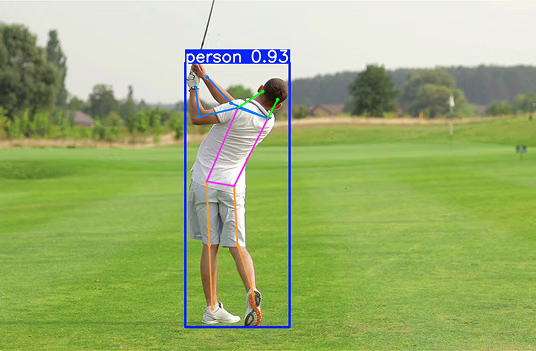
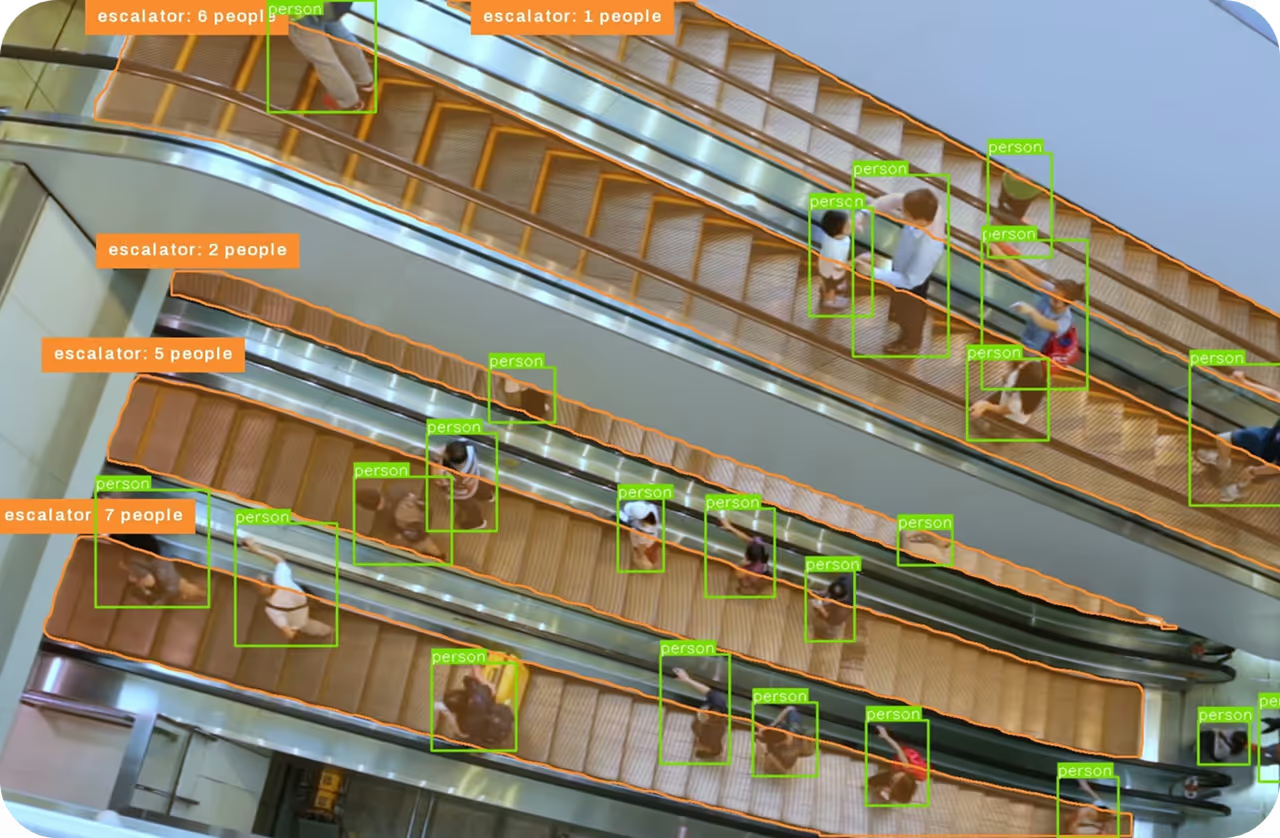
Training coverage also affects computer vision. Ultralytics YOLO supports fine-tuning YOLO26 on custom datasets, updating a pretrained detector to recognize classes represented in the new images.
How Models Use Information After Their Cutoff#
Retrieval-augmented generation (RAG) supplies relevant external information at query time. A retriever selects passages from a knowledge collection, and the generator uses those passages alongside the question. This supports grounding: connecting an answer to identifiable evidence. The answer draws on both learned parameters and supplied context, while the underlying model retains its training cutoff.
Web search serves a similar freshness role for public information. ChatGPT search retrieves web results and uses them to generate answers with source links. File retrieval provides access to uploaded or connected material, making current internal documents available for text generation. These mechanisms update the evidence available during a request.
This distinction matters in document-based assistance: the freshness of an answer depends on the retrieved document's contents and revision date as well as the model's training history. A recently updated knowledge collection gives the system access to newer facts; accurate generation also requires selecting and interpreting the relevant passages.
Knowledge Cutoff Dates in ChatGPT and Gemini#
ChatGPT and Gemini use models with documented knowledge cutoffs. The applicable date belongs to the particular underlying model or snapshot, so identifying the model is part of identifying its cutoff. A model card or official model specification provides the relevant metadata. OpenAI publishes cutoff information by model, and Google lists it alongside Gemini model properties.
For example, Gemini 2.5 Pro has a January 2025 knowledge cutoff, while its model specification lists June 2025 as its latest update. These dates describe separate properties: the boundary of learned information and the model's update history.
A snapshot identifier likewise identifies a model version separately from its knowledge boundary. The GPT-5 model specification lists the snapshot gpt-5-2025-08-07 with a September 30, 2024 knowledge cutoff.