FinOps for AI
FinOps for AI connects workload costs to business value, helping teams allocate spending, optimize compute, and measure cost per useful outcome.
FinOps for AI is the practice of managing artificial intelligence spending by connecting resource usage, costs, and business value. It brings finance, engineering, data science, and product teams together to understand what AI workloads cost, assign financial ownership, and improve the value delivered per dollar. Its scope includes model training, inference—the use of trained models to generate predictions—and the supporting data, infrastructure, and services.
How AI Changes Cloud FinOps#
AI workloads extend familiar cloud computing cost management with specialized hardware, experimentation, and model-quality requirements. Training consumes GPU time across repeated experiments, while model serving generates ongoing production costs. Hosted large language models frequently charge by input and output tokens, the text units processed by a model. Shared infrastructure and variable request sizes complicate allocation and forecasting.
The FinOps for AI framework applies allocation, forecasting, optimization, and financial accountability to these workloads. AI for FinOps means using AI to perform financial-management tasks, such as detecting spending anomalies. MLOps manages the operational model lifecycle; FinOps adds financial ownership and value measurement to decisions throughout that lifecycle.
How the FinOps Cycle Works#
FinOps uses three recurring phases: Inform, which makes usage and costs visible; Optimize, which improves resource consumption and purchasing; and Operate, which embeds ownership, budgets, and controls. Results feed back into measurement as workloads change. Finance supplies budgets and purchasing expertise, engineers implement resource changes, and product owners define the outcomes that justify spending.
FinOps tools combine billing exports with observability data: request counts, token usage, GPU utilization, and training durations. Project identifiers and resource tags connect spending to teams or products. Showback reports each team's allocated costs; chargeback assigns those costs to its budget. Shared endpoints require usage-based allocation because several applications can consume the same infrastructure.
Ultralytics Platform applies these principles through cloud training: it estimates duration and cost from the selected model, dataset, training configuration, and GPU before launch, then bills actual GPU time. This connects experiment planning with measured compute consumption.
Measuring Cost per Useful Outcome#
Unit economics expresses spending per unit of work or business output. Infrastructure measures include cost per GPU-hour and cost per thousand predictions. Business measures connect that spending to completed tasks, accepted outputs, or resolved customer requests. Using a consistent cost boundary makes comparisons meaningful: serving-only cost and full lifecycle cost include different expenses.
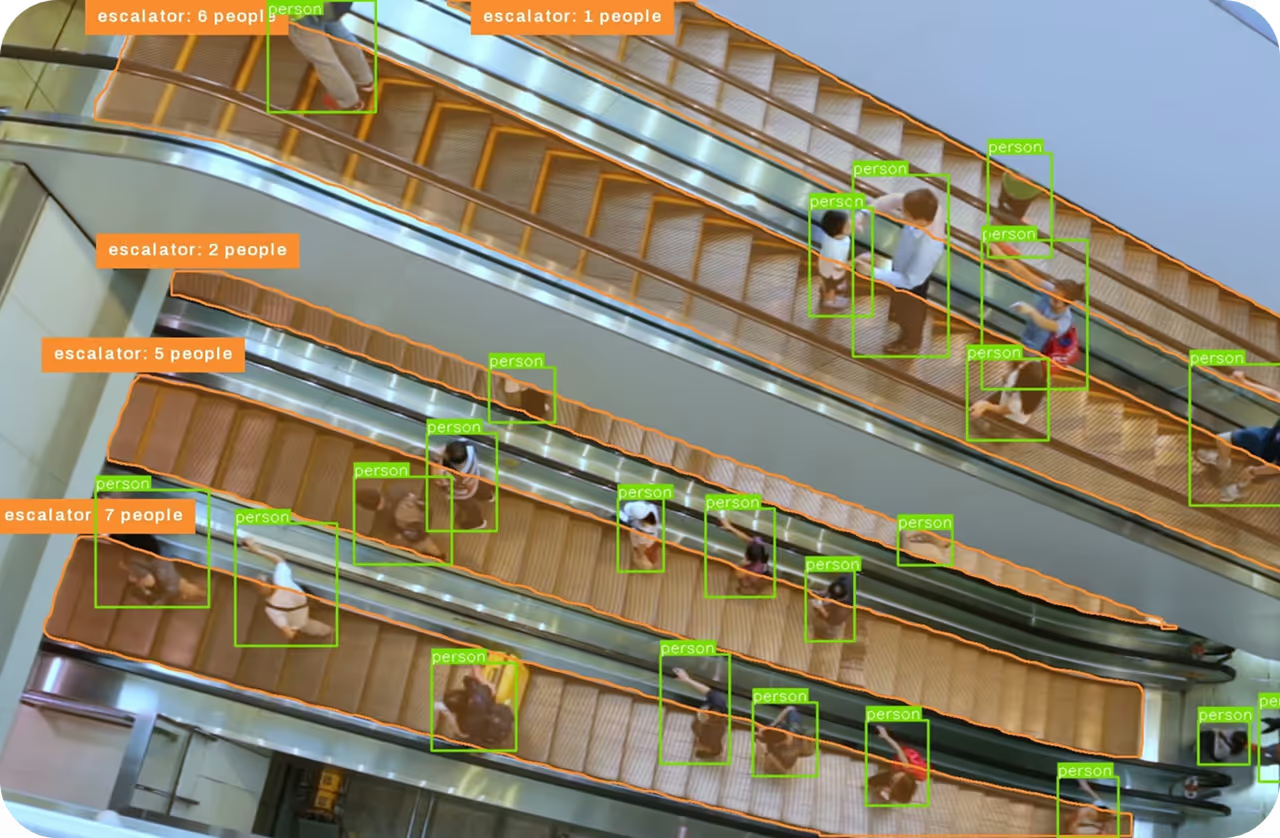
For computer vision, inference volume depends on camera count, analyzed frames per second, and operating time. Visual inspection also has a processing deadline: predictions must arrive before a part reaches the reject mechanism. Cost comparisons therefore incorporate inference latency and task quality alongside throughput.
Total cost of ownership includes data annotation, integration, hardware, storage, networking, operations, and maintenance. Cloud deployments include idle provisioned capacity; edge computing deployments include device acquisition, power, fleet management, and replacement hardware. These costs determine the economics of operating the same workload across different architectures.
Optimization Methods and Their Operational Effects#
AI and ML cost optimization combines infrastructure choices with model engineering. Rightsizing matches hardware to workload requirements, autoscaling adjusts capacity to demand, and automated pipelines reduce duplicated processing. Model quantization reduces numerical precision, while knowledge distillation transfers learned behavior into a smaller model. Quality evaluation and model monitoring track the operational effects of those changes.
Training procurement offers another lever. Amazon SageMaker AI Managed Spot Training runs training jobs on spare compute capacity at discounted rates. Capacity interruptions extend completion time, making checkpointing important for preserving completed work. SageMaker copies saved checkpoints to Amazon S3 and restores them when an interrupted training job restarts, allowing training to resume from its last checkpoint.