Gemini 4 Hydrogen auto-annotation: cheaper per token, pricier per image
Gemini 4 Hydrogen ranks third of 46 VLMs on our 36-dataset object detection benchmark at 0.553 mAP50, with top scores on plant disease, sea rescue and X-ray.
 Glenn Jocher12 min read
Listen to this article
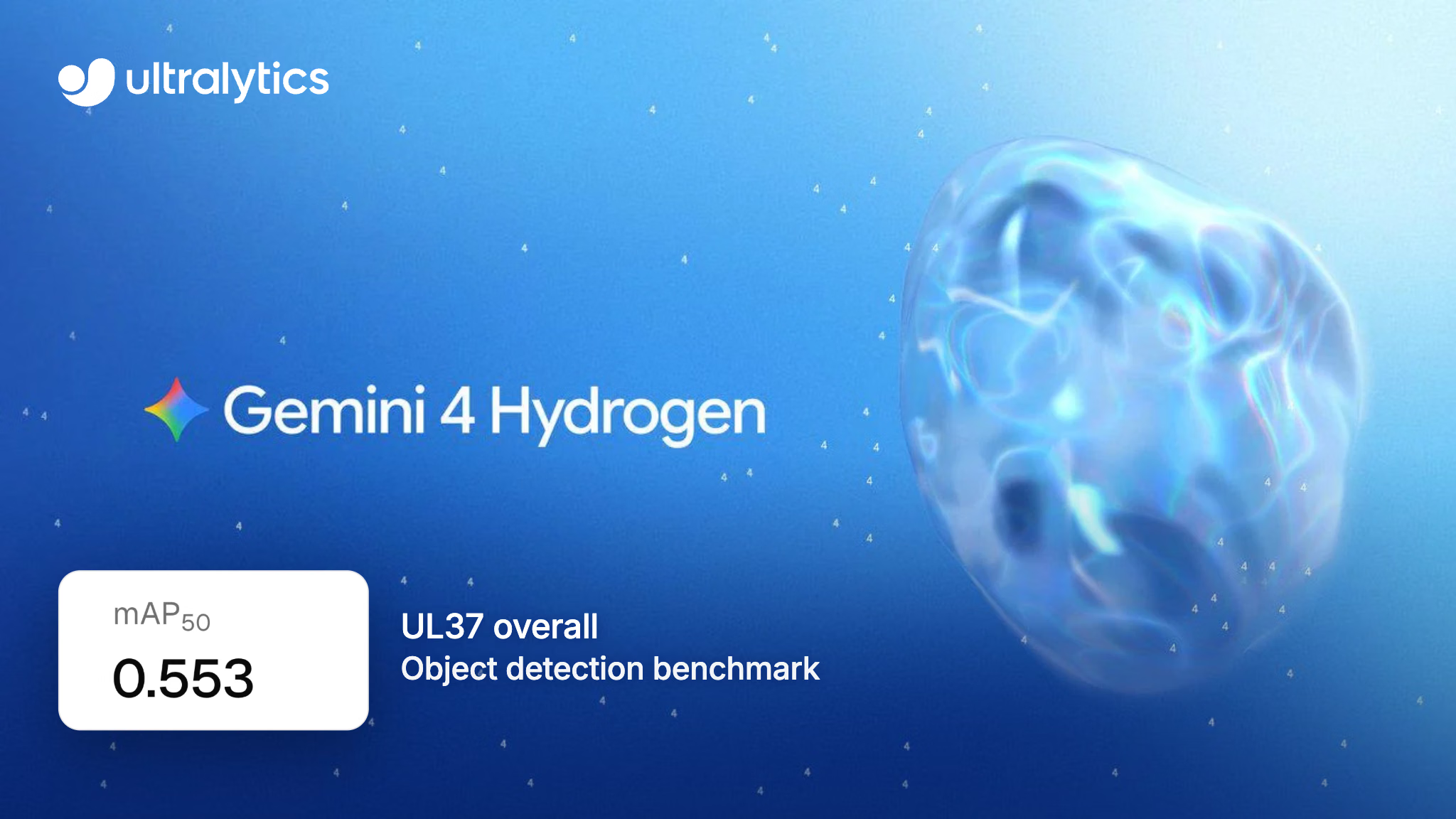
Gemini 4 Hydrogen ranks third of 46 models for auto-annotation on UL37, our 36-dataset object detection benchmark, on the Ultralytics VLM Leaderboard updated November 12, 2026. It scores 0.553 mAP50 and 0.350 mAP50-95, behind Gemini 4 Carbon (0.584) and GPT-6.1 Terra (0.560) and ahead of Claude Fable 5.2 and Gemini 4 Argon, and it has the top score on PlantDoc (plant disease), SeaDronesSee 2 (maritime search and rescue) and IEDXray (security X-ray), and ties for the top score on Kvasir-SEG and EgoHands.
Google launched Hydrogen on November 12 as its fast, cost-efficient Gemini 4 model, and it is now available for auto-annotation in Ultralytics Platform. Google pitches Hydrogen at coding and agents; UL37 measures how well it draws boxes.
Below are Hydrogen's overall and per-dataset results, how token usage shapes its cost per image, and how to run it on your own dataset in Platform.
Gemini 4 Hydrogen object detection: third on UL37#
UL37 measures how closely a model's boxes match human labels on 360 images: 10 from each of 36 real object detection datasets, from thyroid ultrasound and thermal drone footage to retail shelves, floor plans and circuit boards. Every image runs through the same pipeline Platform users get, with the dataset's own class names, and every dataset counts equally. The methodology is public.
Hydrogen's 0.553 mAP50 puts it 0.031 behind the leader and 0.007 behind Terra. Here is how it sits among Google's other models and the closest competitors:
| Model | UL37 mAP50 | Token price per 1M (input / output) | Provider cost per 1,000 images |
|---|---|---|---|
| Gemini 4 Carbon | 0.584 | $2.00 / $10.00 through Nov 30, then $4.00 / $20.00 | $12.93 (about $25.87 from Dec 1) |
| GPT-6.1 Terra | 0.560 | $1.00 / $5.00 | $4.36 |
| Gemini 4 Hydrogen | 0.553 | $1.50 / $7.50 | $20.32 |
| Claude Fable 5.2 | 0.544 | $8.00 / $40.00 | $37.55 |
| Gemini 4 Argon | 0.537 | $2.00 / $10.00 through Nov 30, then $4.00 / $20.00 | $7.60 (about $15 from Dec 1) |
| Gemini 3.8 Flash | 0.516 | $0.75 / $3.75 through Dec 31, then $1.50 / $7.50 | $5.86 (about $11.72 from Jan 1) |
Provider cost is calculated from each provider's reported token usage at the listed rates. Batch Annotation adds Platform's processing fee of $1.00 per 1,000 images for every model.
Pricing as of November 16, 2026. Google's Hydrogen launch post lists $1.50 per million input tokens and $7.50 per million output tokens. Google's Carbon availability post sets Carbon's introductory price through November 30, 2026, and $4.00 and $20.00 afterward; its Gemini API pricing page lists the same change for Gemini 4 Argon; and its Flash post sets Gemini 3.8 Flash's introductory price through December 31, 2026, and $1.50 and $7.50 from January 1, 2027. Later figures in the table apply those announced rates to the same benchmark token usage; they are estimates, not new runs.
Hydrogen's other numbers from the run: mAP50-95 of 0.350, which also rewards tightly fitting boxes and is second only to Carbon's 0.371; precision of 0.63 and recall of 0.62; no failed requests and no refusals; and a median of 7.2 seconds per image.
What Google built Hydrogen for#
Google's launch post says Hydrogen "is built for rapid execution across diverse agentic workflows," while Carbon and Argon "excel at deep, long-horizon reasoning on your hardest problems." Hydrogen has a 1 million-token context window, a price of $1.50 per million input tokens and $7.50 per million output tokens across that whole window, and four thinking levels: low, medium, high (the default) and a new xhigh.
Google reports a score of 51 on the Artificial Analysis Intelligence Index at the default high level, one point above Argon, and 54 at xhigh. It calls Hydrogen a major upgrade for teams migrating from Gemini 3.8 Flash, with 57% on Terminal-Bench 4.1 against Flash's 18.2%. None of those numbers measures bounding boxes, which is why we run UL37.
Gemini 4 Hydrogen vs Gemini 3.8 Flash on UL37#
Gemini 3.8 Flash scores 0.516 mAP50 on UL37, so Hydrogen adds 0.037 on the same images and pipeline, about four-fifths of the 0.047 gap between Argon and Carbon. On the leaderboard, Hydrogen ranks third and Flash eighth.
It also passes Claude Fable 5.2 by 0.009 at a little over half Fable's cost per image, and Gemini 4 Argon by 0.016, though Argon costs $7.60 per 1,000 images.
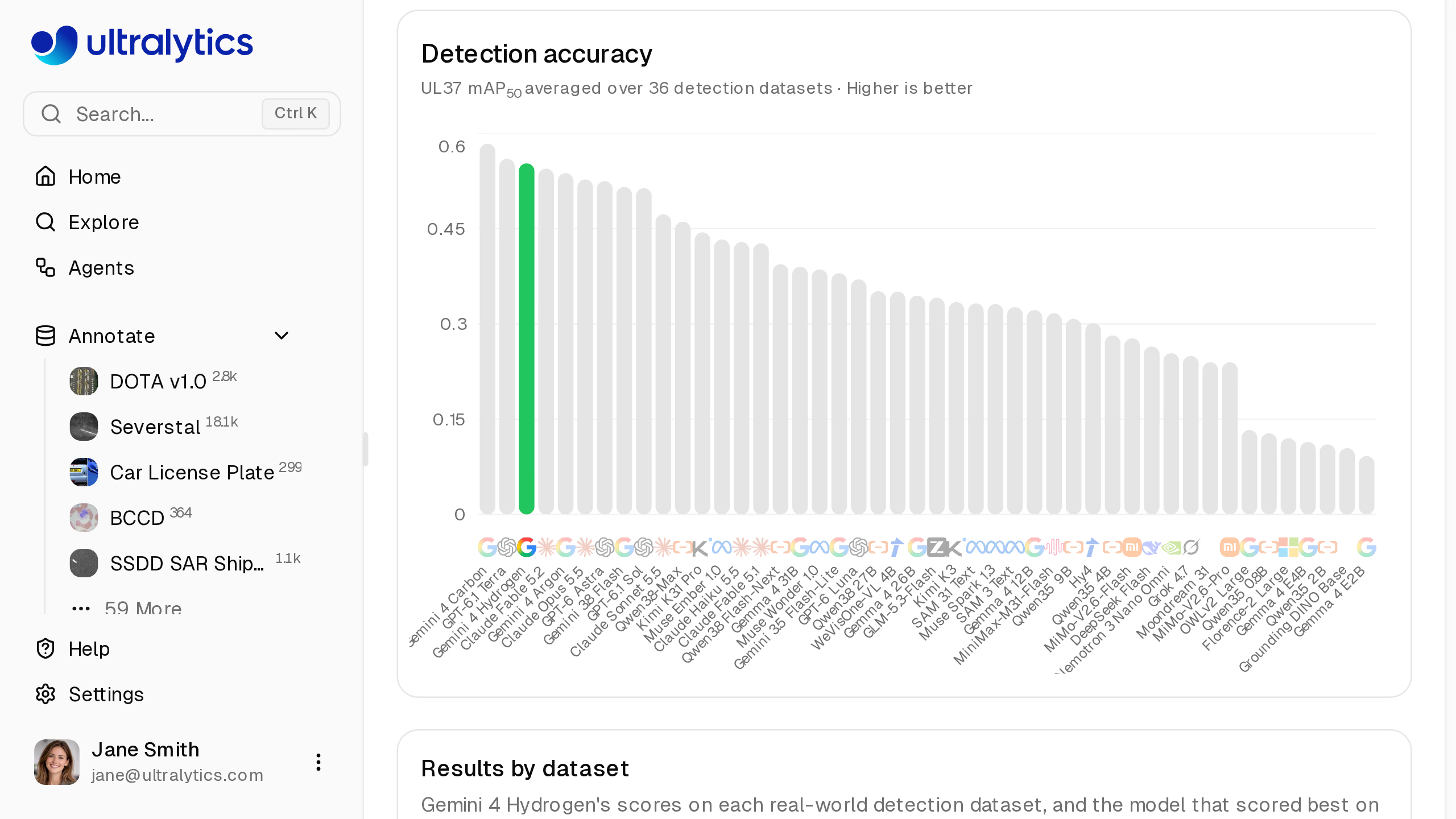
UL37 mAP50 from the Gemini 4 Hydrogen model page, with Hydrogen highlighted in third, as of November 14, 2026.
How token usage affects cost per image#
A vision language model bills for the image and prompt it reads and for every token it writes back, including any reasoning before the answer. Two models with similar token rates can have quite different costs per image if one uses more tokens.
Hydrogen's token prices are exactly 75% of Carbon's introductory prices, for both input and output. If the two models used the same tokens per image, Hydrogen would cost about $9.70 per 1,000 images. It costs $20.32, so Hydrogen's runs used roughly twice as many price-weighted tokens per image as Carbon's. Against Gemini 3.8 Flash, whose current prices are exactly half of Hydrogen's, the same math shows Hydrogen using about 1.7 times Flash's price-weighted tokens per image.
Google reports that in early partner testing on complex graph, SQL and data-heavy workflows, Hydrogen used 12% to 23% fewer tokens than 3.8 Flash. Annotation is a different job, one image and one structured answer, and on UL37 Hydrogen used more price-weighted tokens per image. Its median of 7.2 seconds per image compares with 5.1 seconds for Terra and 4.6 for Argon.
Provider cost per 1,000 UL37 images as of November 16, 2026: Terra and Hydrogen at list price, Carbon at its $2 / $10 introductory price and estimated at the announced $4 / $20 price with the same token usage.
Cost per 1,000 images combines token rates with how many tokens a model uses on a given job, so a few representative images from your own dataset give the most relevant estimate. The leaderboard and the model pages for paid models on Platform report provider cost per 1,000 images, and our image annotation software cost guide covers the rest of a labeling budget.
Where Gemini 4 Hydrogen sets top scores: plants, sea rescue and X-ray#
Averages across 36 datasets hide the ones where a model comes out ahead, and the Gemini 4 Hydrogen model page lists its score on every one of them. Hydrogen has the top score of all 46 models on three datasets and ties for the top score on two more.
Plant disease. On PlantDoc, with 29 classes of healthy and diseased crop leaves, Hydrogen scores 0.638 and is the best model on the dataset. Carbon, which set the previous top score there, scored 0.594, as covered in our Gemini 4 Carbon results.
Maritime search and rescue. On SeaDronesSee 2, drone footage of swimmers, boats and life-saving gear at sea, Hydrogen scores 0.596, ahead of Carbon's 0.564 and Terra's 0.476.
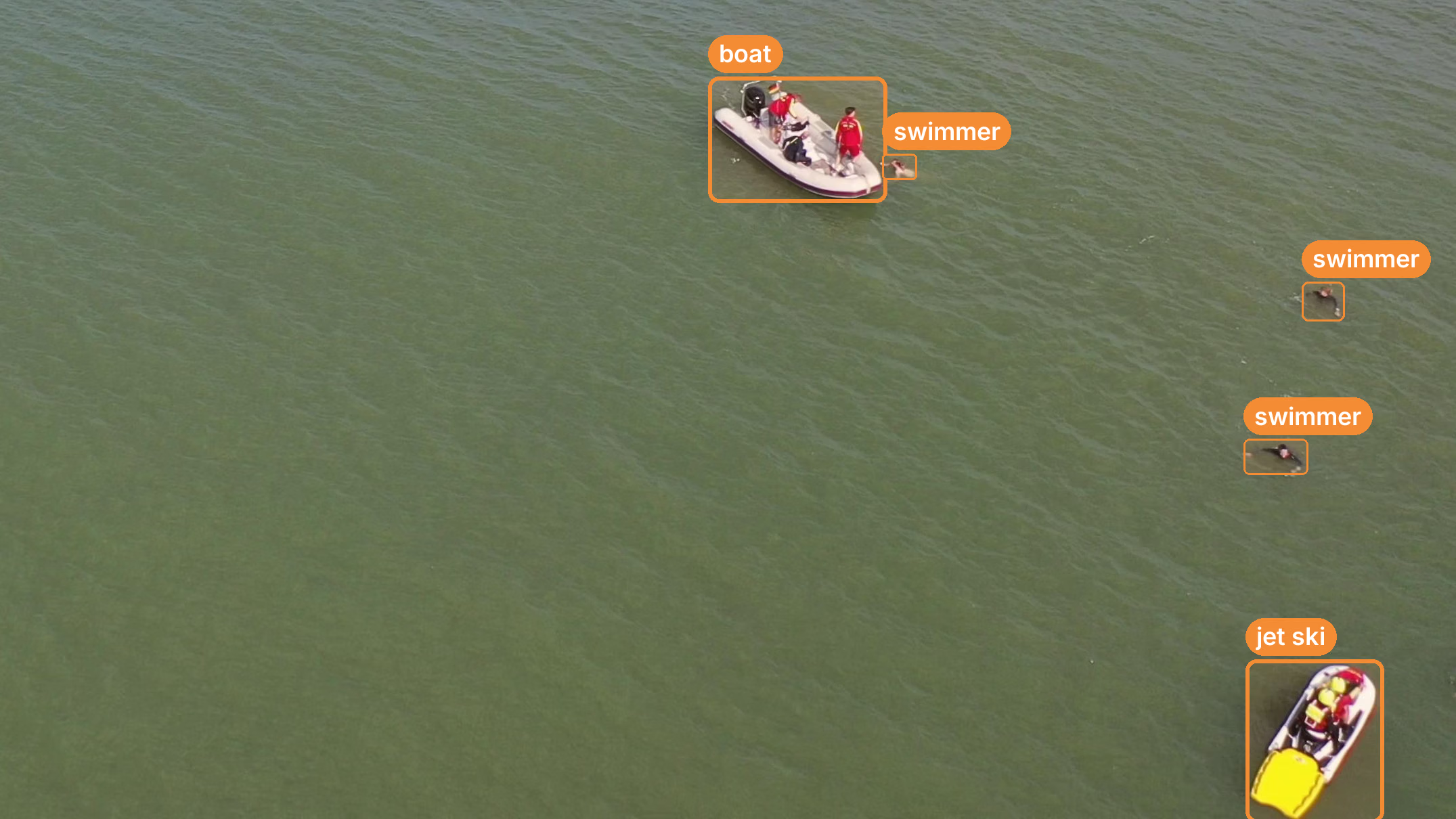
Gemini 4 Hydrogen's boxes on a SeaDronesSee 2 benchmark image, from the predictions shown on its model page.
Security X-ray. On IEDXray, concealed explosive device components in baggage X-rays, Hydrogen scores 0.315 against Carbon's 0.282. Every model scores low here, so treat this as the best of a hard dataset rather than a ready-made screener.
Polyp endoscopy. On Kvasir-SEG, Hydrogen scores 0.805 and ties the top score on the dataset. Terra scores 0.71 there and Carbon 0.65; our GPT-6.1 Terra results cover Terra's medical imaging results in more detail.
Hands. On EgoHands, first-person video of hands, Hydrogen scores 0.995 and ties GPT-6 Astra for the top score.
Thyroid ultrasound, the counterexample. On TN5000, where each nodule is labeled benign or malignant, Hydrogen scores 0.704 against Carbon's 0.537. Gemini 3.8 Flash (0.88) and Terra (0.935) both score higher on this dataset. Hydrogen also scores close to zero on bare-board PCB defects (DeepPCB, 0.000), tuberculosis X-rays (TBX11K, 0.013) and software UI elements (GroundCUA, 0.021).
For medical image analysis, treat any model's boxes as a draft that clinical experts check and approve, never as a diagnosis.
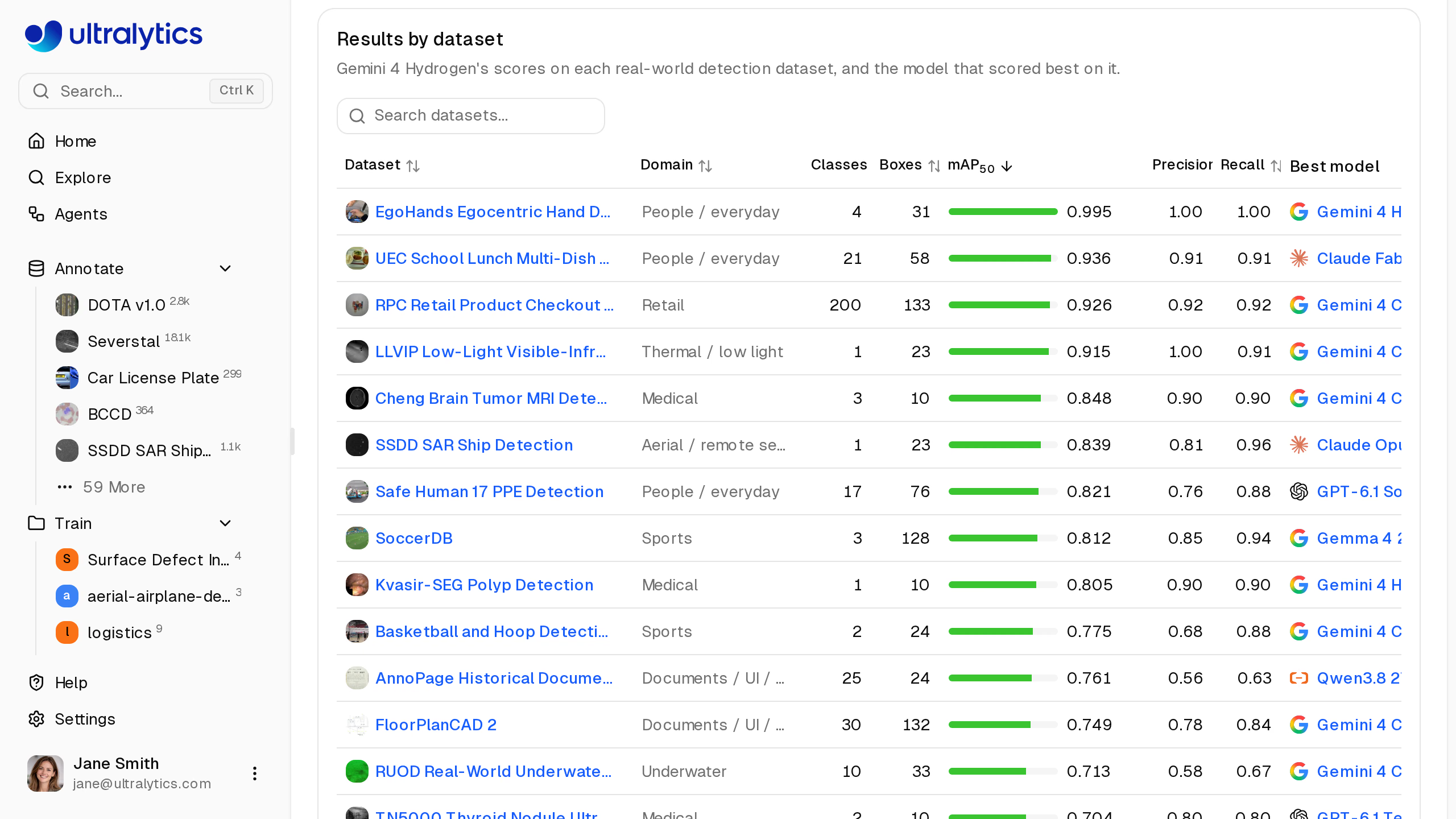
Gemini 4 Hydrogen's per-dataset UL37 results on its model page, as of November 14, 2026.
Each dataset contributes 10 images, so treat a single row as a signal to test on your own images, not a verdict. Our guide to choosing a VLM by precision and recall explains how to weigh false boxes against missed objects once you have a shortlist.
How to run Gemini 4 Hydrogen auto-annotation on your dataset#
Hydrogen is a class-prompted model for detection datasets with 1 to 200 classes. It returns boxes for your dataset's own class names, and you review them before training.
- Create a Gemini API key in Google AI Studio.
- Have the workspace owner add the key under Settings > API Keys in the Platform workspace that owns your dataset. Google bills your key directly, and the provider key docs cover the details.
- Open an image in the annotation editor, switch to Smart mode, and choose Gemini 4 Hydrogen under Google in the model picker.
- Press Predict, or
P, to label the current image. When the provider returns a cost estimate, the toast after each prediction shows it, so a handful of representative images gives you a guide to what your own data costs. - On the dataset page, choose More actions > Batch Annotation to label every unlabeled image in one pass. Review the Estimated Cost and click Start. Platform saves a dataset version first, so you can roll back, and existing labels are never changed.
- Review and correct the boxes, then train an Ultralytics YOLO26 model on the result in the same workspace with cloud training.
For more on how these models fit the editor, see how Ultralytics Platform uses AI to automate annotation and why human-in-the-loop review stays part of the workflow.
Where Gemini 4 Hydrogen fits#
For teams that label with Gemini 3.8 Flash today, Hydrogen adds 0.037 mAP50 on UL37 from Google's fast tier, and its model page shows its result on every dataset, including the top score on PlantDoc and a tie for the top score on Kvasir-SEG. Results vary by dataset, so try it on representative images and check the boxes and estimated cost before running Batch Annotation.
To weigh accuracy, cost and speed across every model, compare them on the VLM Leaderboard. Hosted models such as Qwen3.8 27B and SAM 3.1 Text need no API key at all.
Frequently asked questions
On our UL37 benchmark it scores 0.553 mAP50 across 36 real-world detection datasets, third on the Ultralytics VLM Leaderboard behind Gemini 4 Carbon (0.584) and GPT-6.1 Terra (0.560). Its mAP50-95 of 0.350 is second only to Carbon's, and it has the top score of all 46 models on PlantDoc, SeaDronesSee 2 and IEDXray.
In our benchmark, Google's token charges came to $20.32 per 1,000 images at Hydrogen's list price as of November 16, 2026 of $1.50 per million input tokens and $7.50 per million output tokens. Batch Annotation in Ultralytics Platform adds $1.00 per 1,000 images, and Google bills your own key for the tokens.
Hydrogen's per-token price is 75% of Carbon's introductory price, but on UL37 its runs used roughly twice as many price-weighted tokens per image, giving $20.32 against $12.93 per 1,000 images. At Carbon's announced price from December 1, the same Carbon usage would cost about $25.87.
On UL37, Carbon scores 0.584 mAP50 and Hydrogen 0.553, a difference of 0.031. Hydrogen scores higher than Carbon on PlantDoc, SeaDronesSee 2, IEDXray, Kvasir-SEG, EgoHands and TN5000. Performance on your own images may differ, so test both on a sample before a large batch.
On UL37, GPT-6.1 Terra scores 0.560 mAP50 and Hydrogen 0.553, while GPT-6.1 Sol scores 0.514. Hydrogen scores 0.350 mAP50-95, ahead of Terra's 0.345 and Sol's 0.318, and scores higher than Terra on PlantDoc, SeaDronesSee 2 and Kvasir-SEG; Terra scores higher on TN5000 thyroid ultrasound, 0.935 to Hydrogen's 0.704. Our GPT-6.1 Terra results cover where Terra is strongest.
On UL37, Hydrogen scores 0.553 mAP50 against Flash's 0.516. Provider cost in our runs was $20.32 per 1,000 images for Hydrogen and $5.86 for Flash at its introductory price, which Google says ends December 31. At the announced price from January 1, 2027, the same Flash usage would cost about $11.72.
Yes. The workspace owner adds a Gemini API key from Google AI Studio under Settings > API Keys in the workspace that owns your dataset, and Google bills the account linked to that key directly. To label without a provider key, use a hosted model such as Qwen3.8 27B or SAM 3.1 Text, or one of your own YOLO models.
Written by
Founder & CEO · Ultralytics
Comments
Ask a question, share your results, or help someone else.