Ultralytics YOLO27: Join the waitlist.
License YOLO
Press release

Ultralytics raises $30M to push the boundaries of computer vision

Find out about Ultralytics’ latest $30M Series A funding round and what to look forward to, from accelerated Ultralytics YOLO R&D to enterprise solutions.
3 min read
Find out about Ultralytics’ latest $30M Series A funding round and what to look forward to, from accelerated Ultralytics YOLO R&D to enterprise solutions.

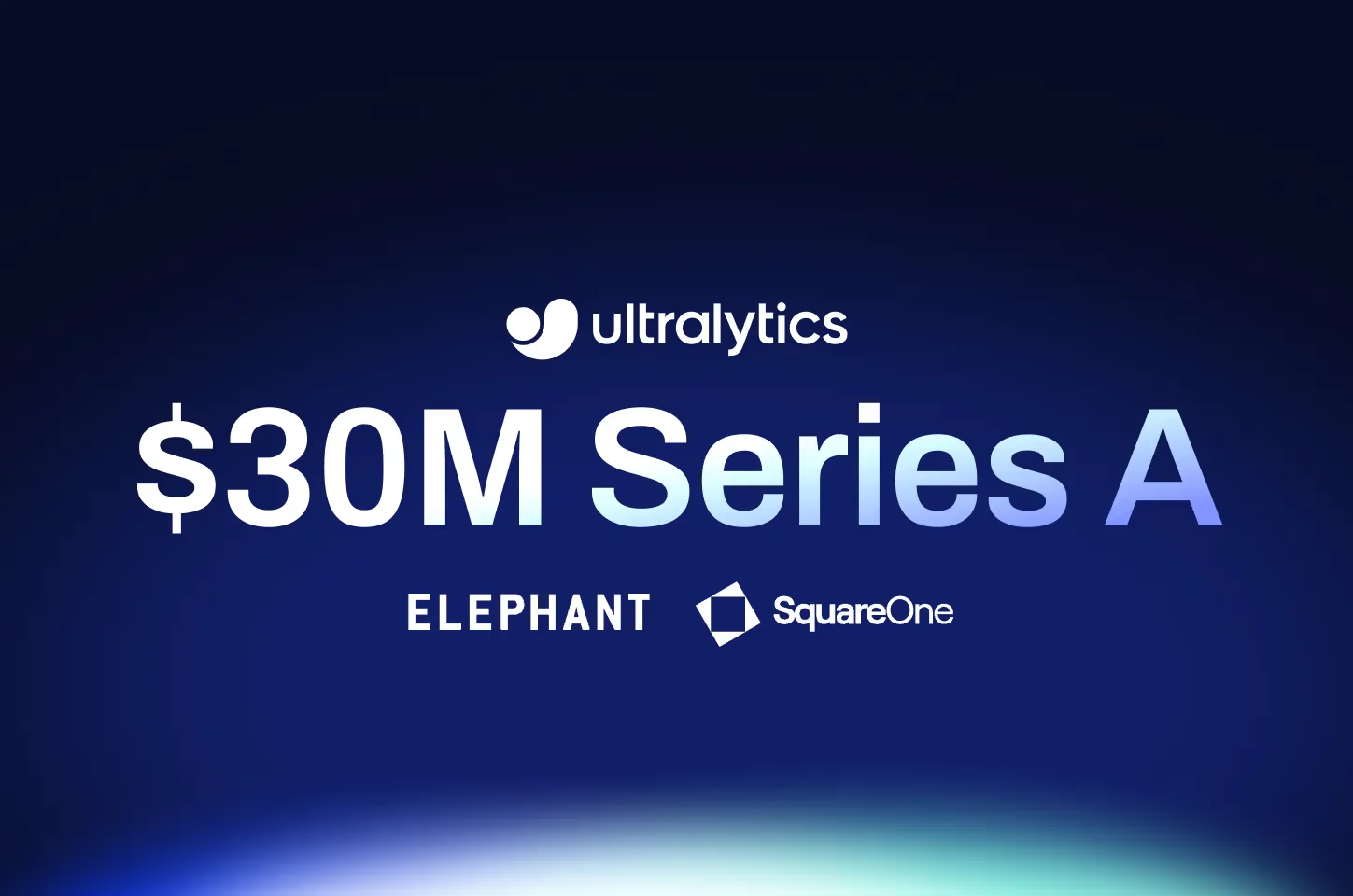
We’re excited to share that Ultralytics has raised $30 million in Series A funding. The round was led by Elephant with participation from SquareOne.

With this new round, we’re ready to take the next step in our computer vision journey together. From the very beginning, our mission at Ultralytics has been to make advanced vision AI accessible to everyone.

From an open-source Vision AI project to global adoption#

What started as an open-source project has grown into the world’s most widely adopted family of computer vision models, Ultralytics YOLO. Today, YOLO models power applications in every industry, across more than 200 countries, and run an astonishing 2 billion usages every single day.

This growth has been fueled by our incredible community. Together, we’ve reached over 115,000 GitHub stars, welcomed more than 900 contributors, and seen our Ultralytics Python library downloaded more than 115 million times.

In fact, according to GitHub’s Octoverse 2024 report, our open-source repository was ranked #5 globally among all open-source and public projects that attracted the most first-time contributors. This recognition places Ultralytics alongside some of the world’s most impactful open-source projects and highlights the trust and enthusiasm of the global developer community surrounding Ultralytics YOLO. It’s also a reminder of what we believe at our core: AI thrives when it is open, collaborative, and accessible.

Accelerating innovation at Ultralytics#

Looking ahead, this round of funding will allow us to move faster and drive innovation. We are looking forward to accelerating research and development on the next generation of YOLO models, making them lighter, faster, and more accurate. Meanwhile, we are expanding our enterprise solutions and support teams to help organizations deploy Ultralytics YOLO models with confidence.

Glenn Jocher, our Founder & CEO, emphasized that “Ultralytics is redefining what’s possible with Edge AI, delivering YOLO models that are faster, lighter, and easier to use than ever. This investment will accelerate our R&D and expand our ecosystem of application-layer solutions built on YOLO - empowering enterprises and students alike.”

Growing the AI team behind the vision#

A crucial part of this next chapter is our team. Every year, more than 50,000 people apply to join Ultralytics, and we’re excited to keep growing our team with talented folks from all over the world. By expanding our research, engineering, and go-to-market teams, we can move faster on innovation while giving enterprises the support they need to bring Ultralytics YOLO models into production.

Gearing up for Ultralytics YOLO Vision 2025#

This month, a lot is happening at Ultralytics. Along with announcing our latest funding round, we’re also getting ready for YOLO Vision 2025 (YV25) in London, our annual hybrid event.

We’ll be bringing together the AI community on September 25th at The Pelligon in London, with a global livestream on YouTube and Bilibili. YV25 is all about connection and ideas.

Developers, enterprises, and researchers from around the world will join to explore breakthroughs in computer vision, share what they’re building, and learn from each other. There will be interesting keynote sessions, live demos, and plenty of time to network.

Join us at YV25 to explore the future of Vision AI and get a front-row seat to our new product launch. Whether you’re attending in London or tuning in online, YV25 is your chance to be a part of the global conversation shaping computer vision.

Join our community and GitHub repository to explore more about AI. Check out our solution pages to read about AI in retail and computer vision in agriculture. Discover our licensing options and start building with computer vision today!
From the blog

Claude Fable 5.2 is here, and it refuses to look at security X-rays

Claude Fable 5.2 is here, and it refuses to look at security X-rays

Claude Fable 5.2 is out, and it refuses to label the IEDXray security X-ray dataset on Ultralytics Platform: all 10 scans blocked, while open models answered.
Learn more
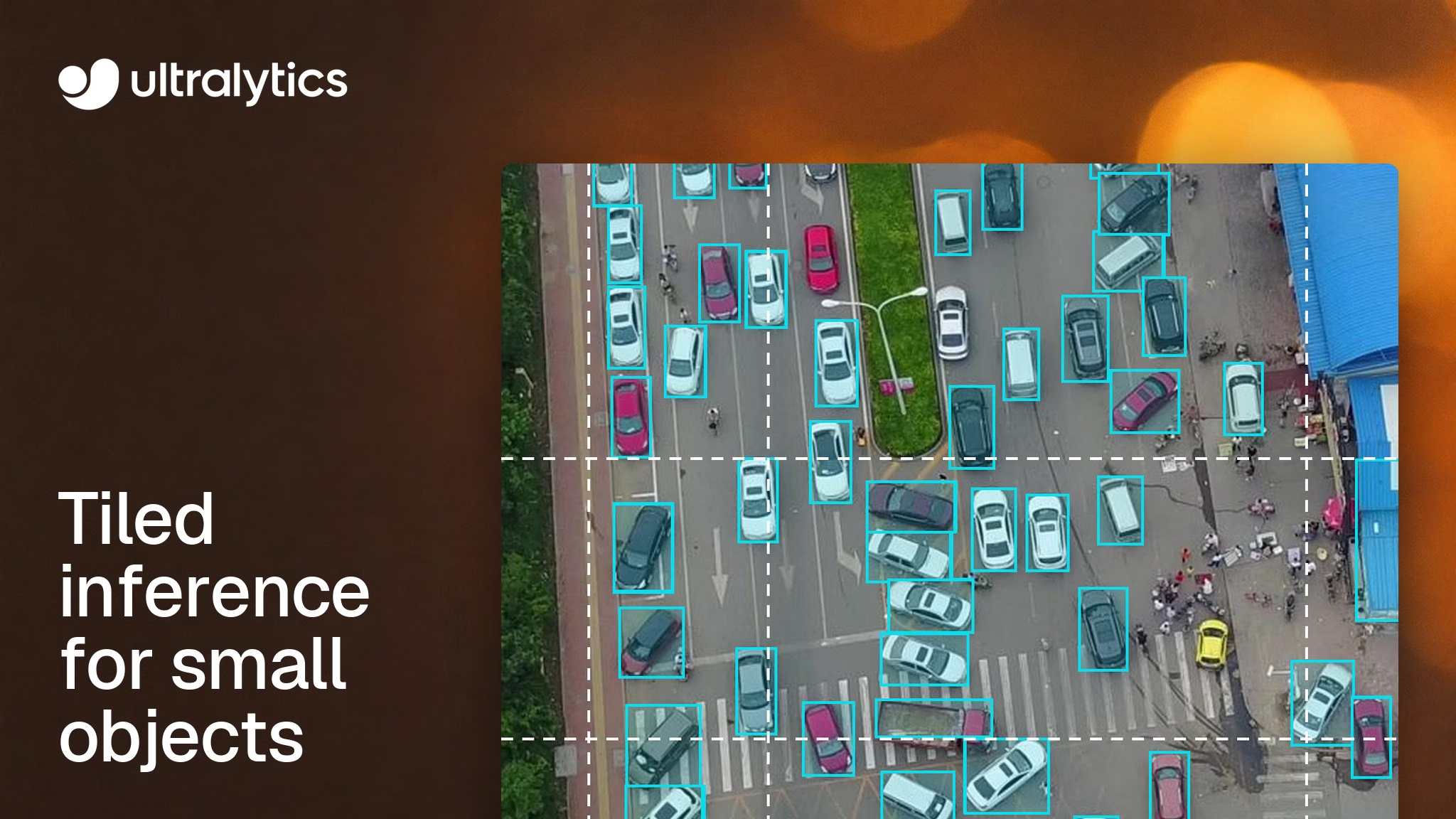
Aerial view of a busy intersection with cars boxed by Ultralytics YOLO26s using 640-pixel tiles, dashed lines marking the tile seams

Small object detection with image tiling in Ultralytics YOLO, from Python to Rust

See when image tiling helps YOLO detect small objects, compare its costs, and run built-in tiled inference in Python or Rust without SAHI.
Learn more
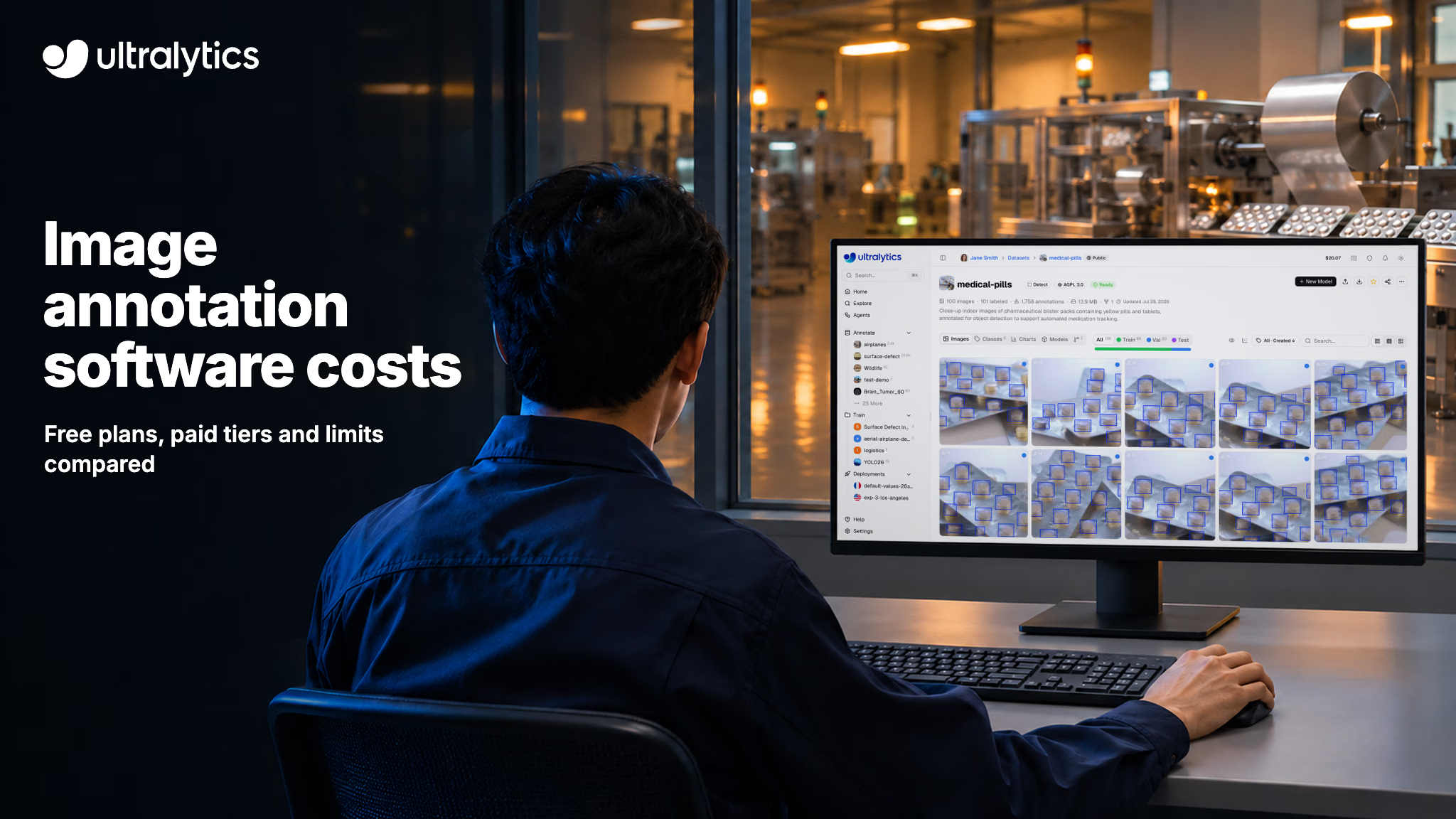
Engineer reviewing labeled blister-pack images in Ultralytics Platform at a pharmaceutical packaging plant

Budgeting for Image Annotation: Seats, AI and Exports

Compare image annotation software costs, free-plan limits and AI allowances. Estimate software and project costs with a worked three-person team example.
Learn more
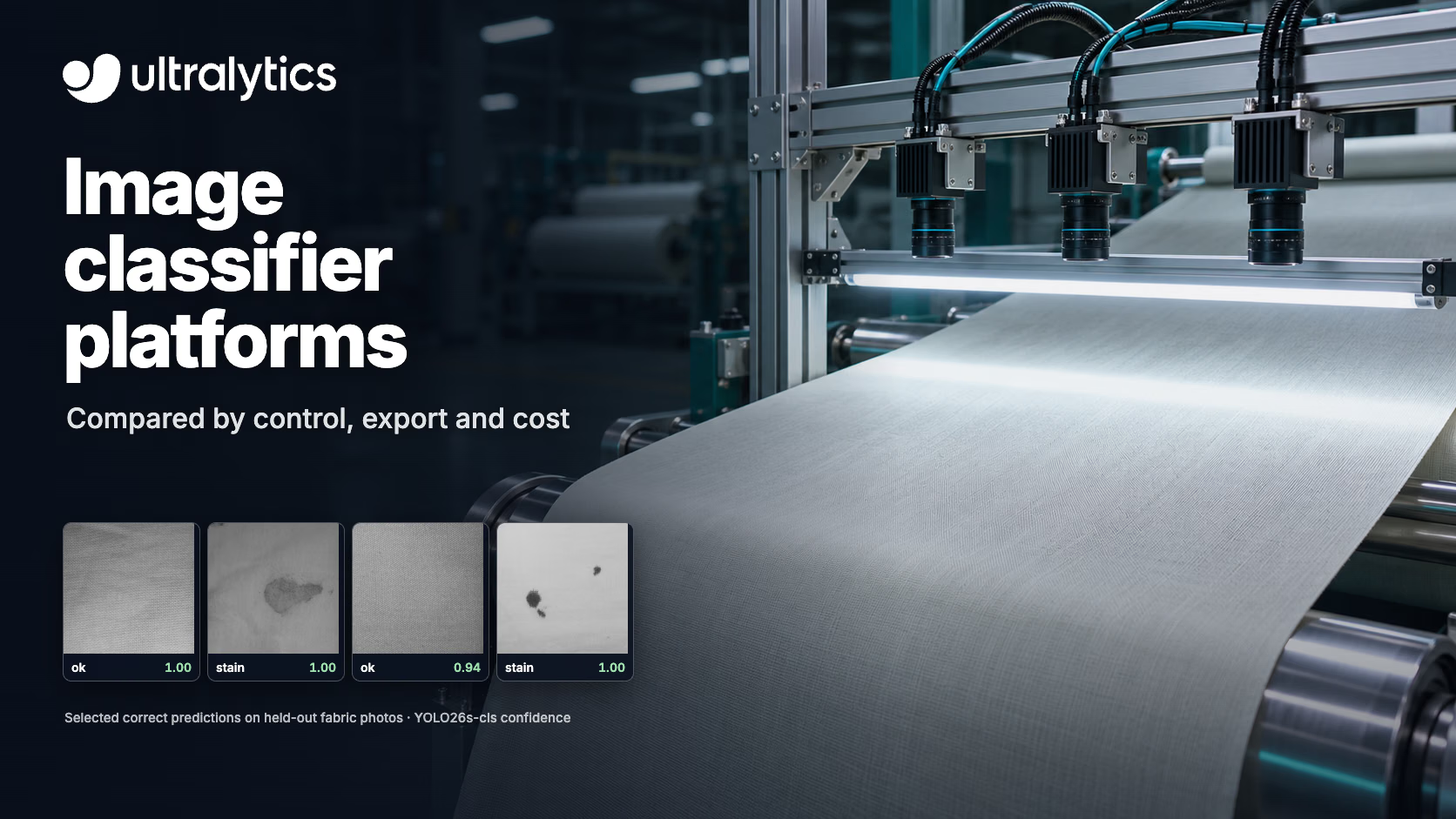
Ultralytics cover showing an AI-generated fabric inspection line with cameras above fabric rollers, plus four real fabric photo crops labeled ok or stain with model confidence scores.

Best platforms for training custom image classifiers

Image classifier training platforms compared: no-code AutoML, developer platforms and edge tools, and how to choose by control, deployment and cost.
Learn more
Two overlapping amber glass panes in warm light, like two overlapping bounding boxes

How to tune the NMS IoU threshold in Ultralytics YOLO

Tune the NMS IoU threshold in Ultralytics YOLO: why prediction now defaults to 0.5, when to change iou vs. conf, and when to skip NMS with YOLO26.
Learn more
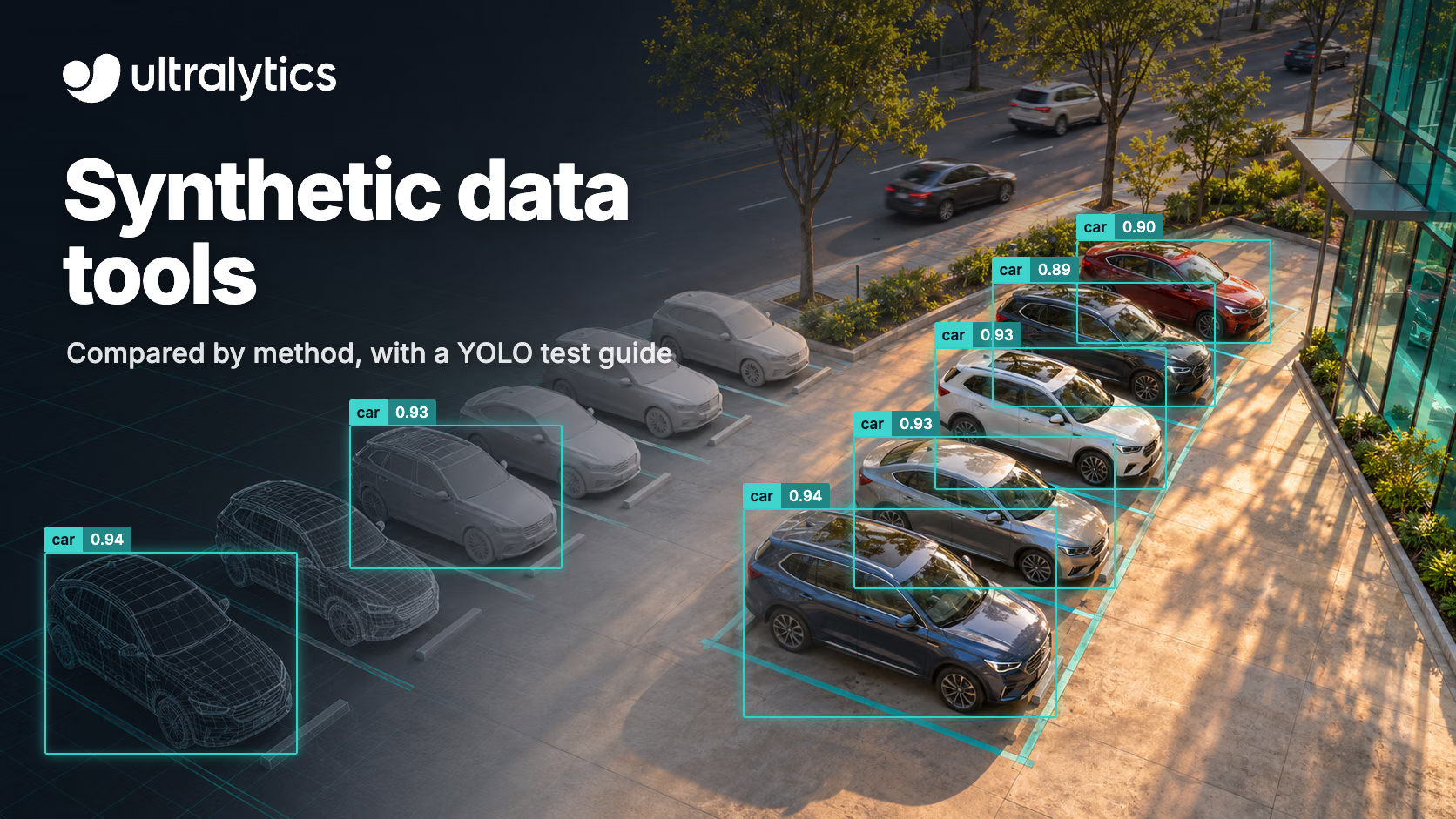
AI-generated aerial view of a car park that changes from 3D wireframe to photo, with real Ultralytics YOLO26 car detections at each stage

Best synthetic data tools for computer vision training

Synthetic data tools for computer vision compared by method: 3D simulation, generative models and augmentation, and how to test them with Ultralytics YOLO.
Learn more
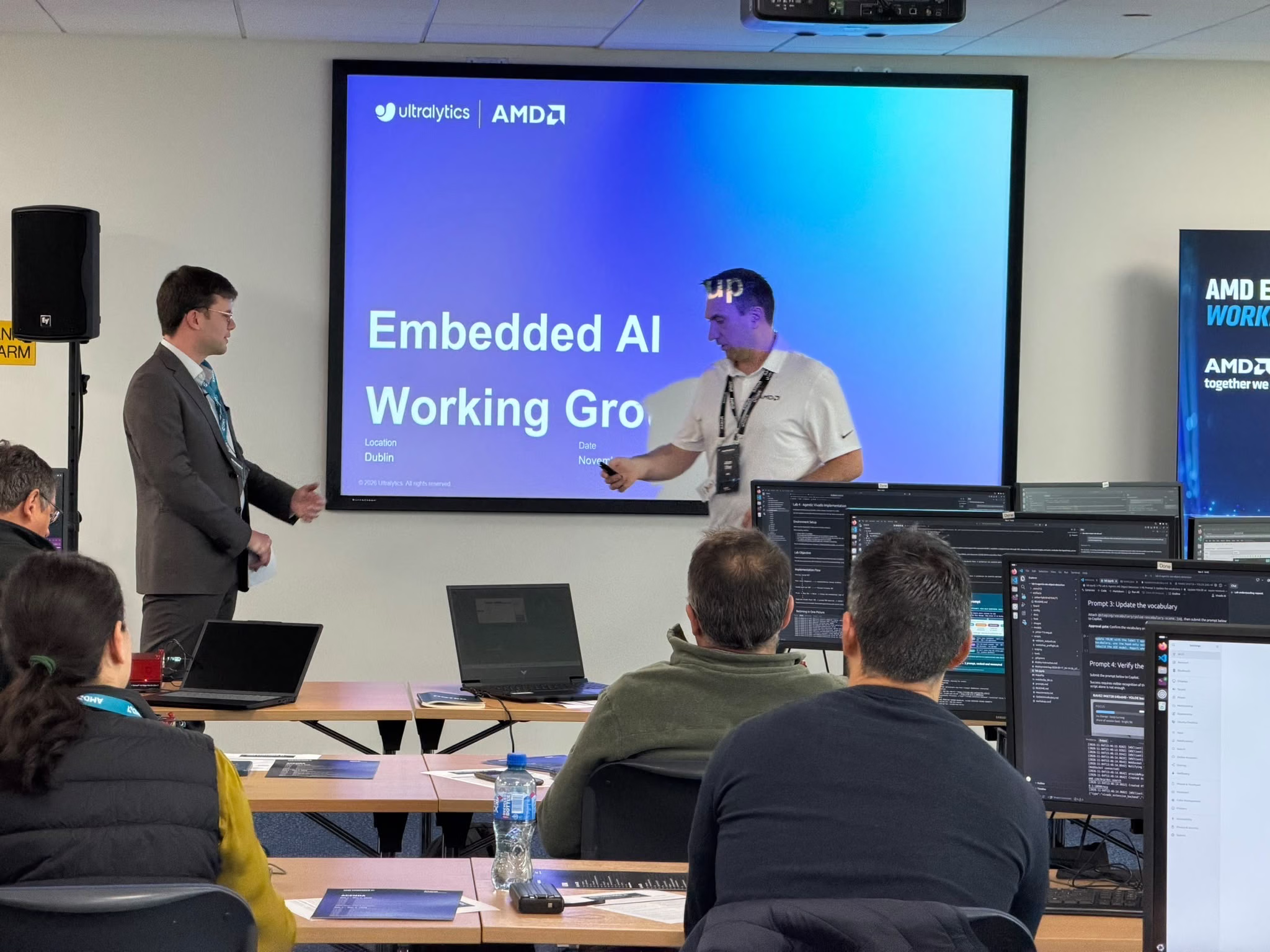
Ultralytics at AMD Embedded AI Working Group in Dublin

Ultralytics at AMD Embedded AI Working Group in Dublin

Discover how Ultralytics and AMD explored Physical AI, robotics, and computer vision deployment at AMD Embedded AI Working Group 2026 in Dublin.
Learn more
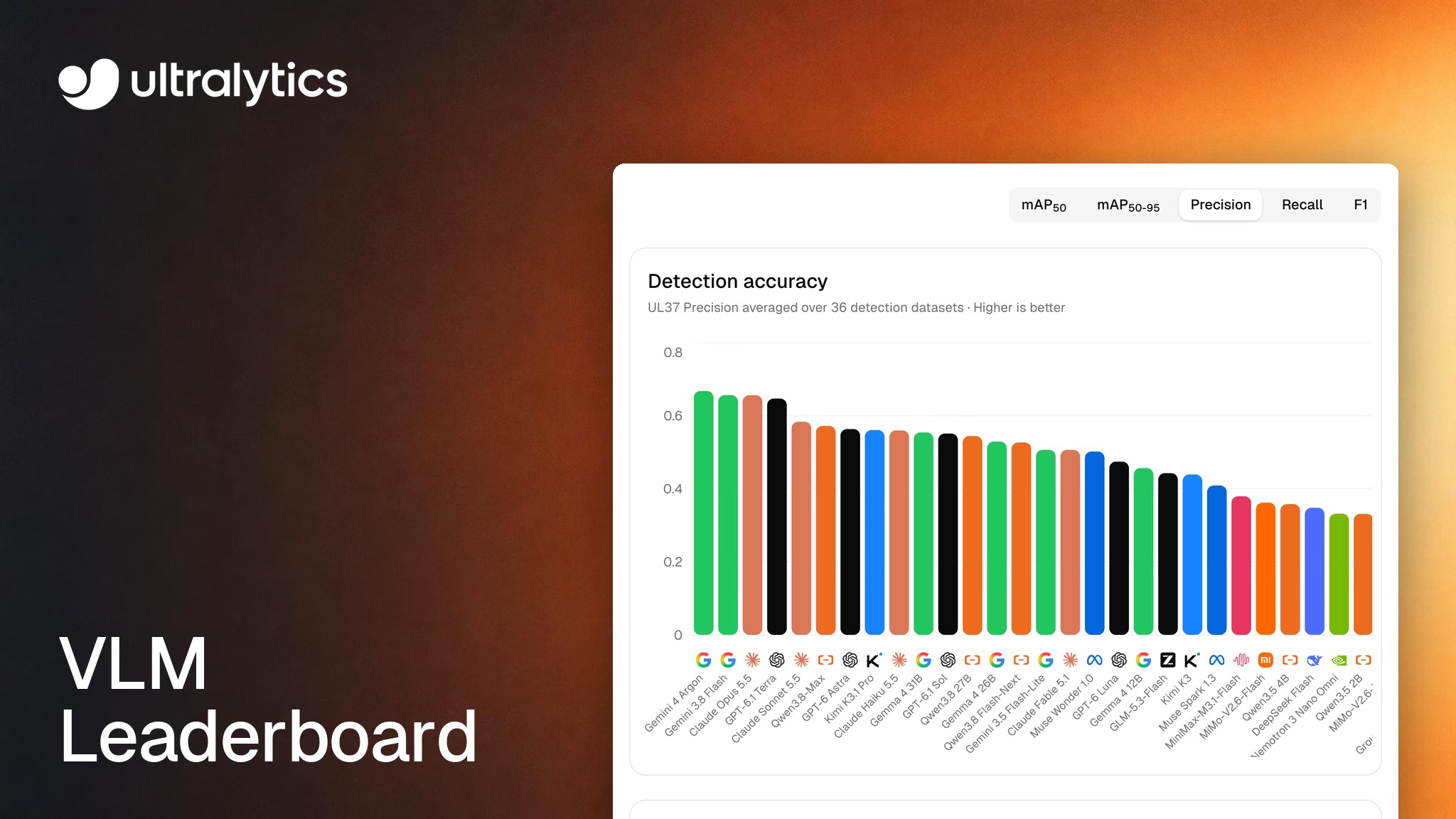
How to choose a VLM for auto-annotation using precision and recall

How to choose a VLM for auto-annotation using precision and recall

Pick a VLM for auto-annotation by precision and recall: which models leave fewer stray boxes, which miss fewer objects, and how to test on your own data.
Learn more
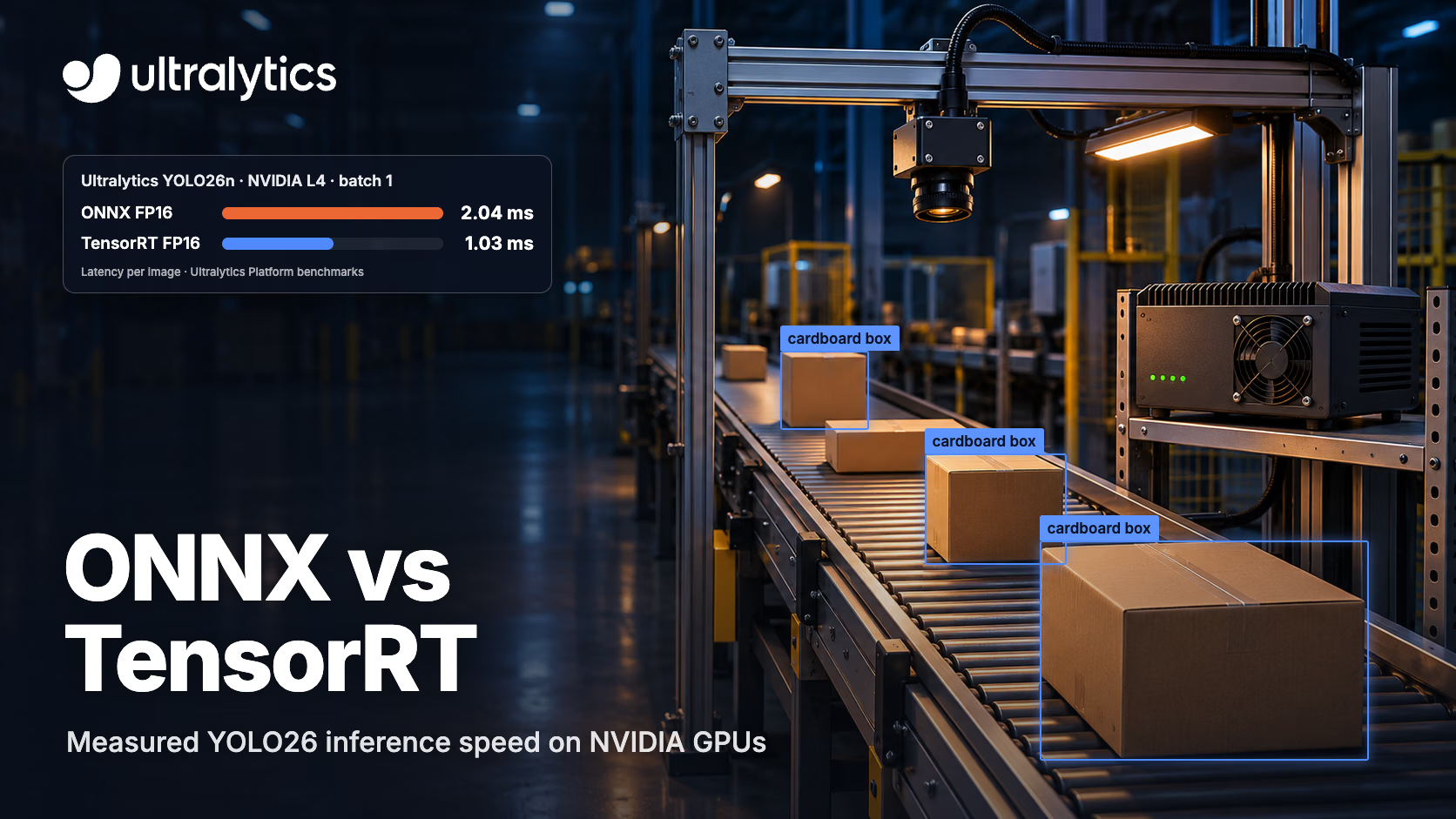
AI-generated logistics scene with illustrative detections; the inset shows Ultralytics Platform benchmark latency for YOLO26n on an NVIDIA L4.

ONNX vs TensorRT for computer vision inference: benchmarks and how to choose

ONNX Runtime vs TensorRT for computer vision inference: measured Ultralytics YOLO26 speed and accuracy on 19 NVIDIA GPUs, and how to choose.
Learn more
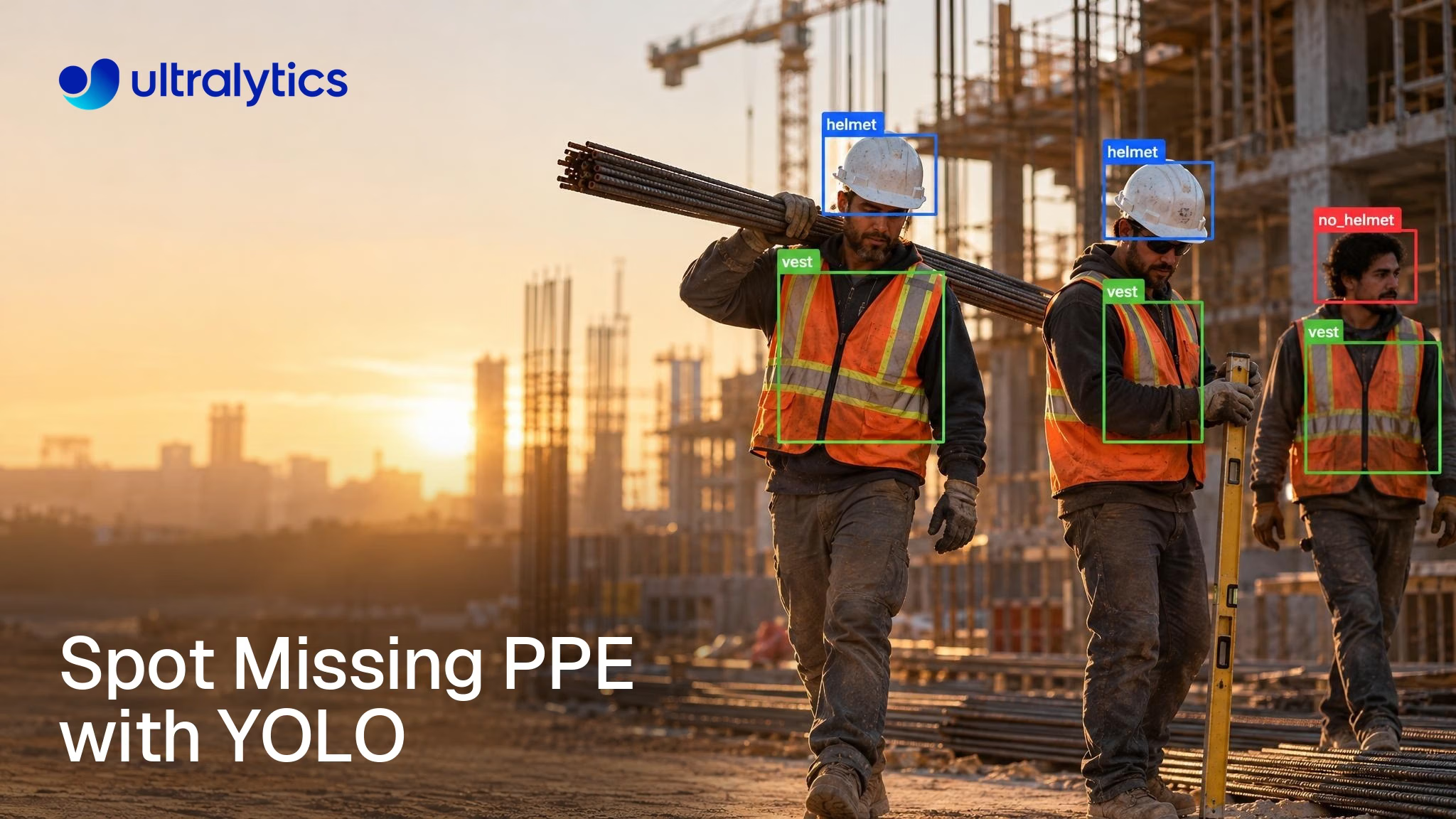
Missing PPE detection: train Ultralytics YOLO on Construction-PPE

Missing PPE detection: train Ultralytics YOLO on Construction-PPE

See how Construction-PPE labels missing helmets, vests and gloves, then train Ultralytics YOLO to detect missing PPE on your own site cameras.
Learn more
Drone detection dataset guide: train Ultralytics YOLO on tiny UAVs

Drone detection dataset guide: train Ultralytics YOLO on tiny UAVs

Compare DUT Anti-UAV, Drone-vs-Bird and thermal drone detection datasets, then train Ultralytics YOLO26 to find tiny drones and cut false alarms.
Learn more
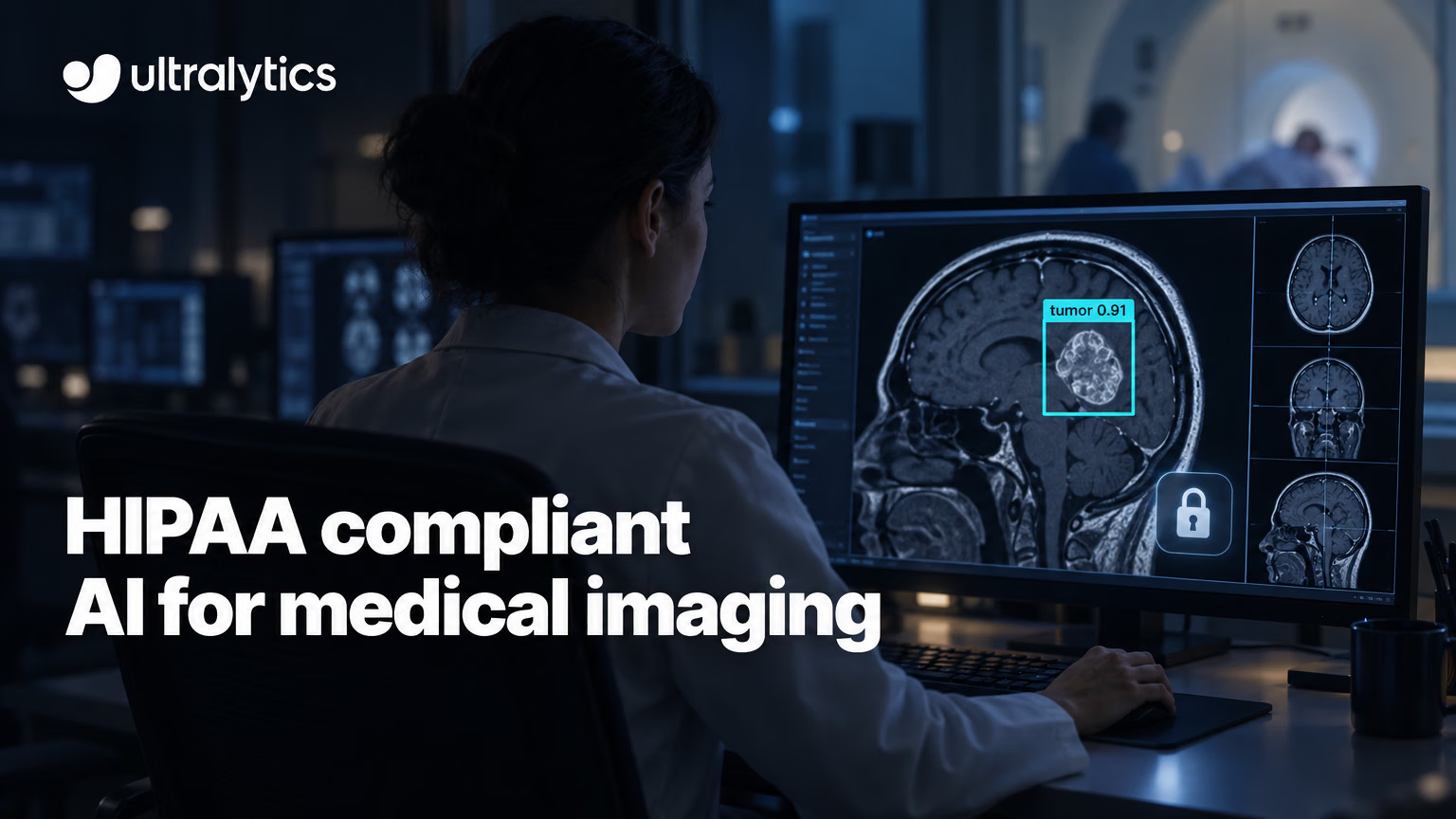
HIPAA compliant AI for medical imaging: what a BAA covers and how to train on patient data

HIPAA compliant AI for medical imaging: what a BAA covers and how to train on patient data

Learn what HIPAA compliant AI requires for medical imaging, what an Ultralytics BAA covers, and how to annotate, train and deploy with patient data.
Learn more
Best Depth Estimation Models: How to Choose

Best Depth Estimation Models: How to Choose

Compare monocular depth models such as Depth Anything, Depth Pro, Metric3D, UniDepth and Ultralytics YOLO26 for metric depth, edge devices and robotics.
Learn more
How to migrate Ultralytics YOLO models from W&B to Ultralytics Platform

How to migrate Ultralytics YOLO models from W&B to Ultralytics Platform

Import Ultralytics YOLO models from Weights & Biases (W&B) into Ultralytics Platform without retraining, then compare experiments, export, and deploy.
Learn more
GPT-6.1 Terra takes #1 for auto-annotation, beating OpenAI's own flagships

GPT-6.1 Terra takes #1 for auto-annotation, beating OpenAI's own flagships

GPT-6.1 Terra auto-annotation tops 39 models on our VLM Leaderboard: 0.560 mAP50 for $4.36 per 1,000 images, ahead of GPT-6.1 Sol and Gemini 4 Argon.
Learn more
MiniMax-M3.1-Flash auto-annotation: why less reasoning drew better boxes

MiniMax-M3.1-Flash auto-annotation: why less reasoning drew better boxes

MiniMax-M3.1-Flash auto-annotation in Ultralytics Platform: 0.317 mAP50 at $1.84 per 1,000 images after tuning, with 0.86 on SAR ship detection.
Learn more
Kimi K3.1 Pro auto-annotation: a third better than K3, at high effort

Kimi K3.1 Pro auto-annotation: a third better than K3, at high effort

Kimi K3.1 Pro auto-annotation scores 0.444 mAP50 on UL37, a third above Kimi K3. See why we run it at high effort, what it costs, and where it wins.
Learn more
Ultralytics YOLO and NVIDIA Cosmos Data Factory: Synthetic data for defect detection

Ultralytics YOLO and NVIDIA Cosmos Data Factory: Synthetic data for defect detection

NVIDIA Cosmos Data Factory synthetic data and an agentic training loop help Ultralytics YOLO26 match full-dataset defect detection accuracy with fewer labels.
Learn more
Gemini 4 Argon auto-annotation: the most precise boxes of 39 models

Gemini 4 Argon auto-annotation: the most precise boxes of 39 models

Gemini 4 Argon auto-annotation on Ultralytics Platform: #2 of 39 models, top precision (0.667), first in 6 of 12 domains, $7.60 per 1,000 images to Nov 30.
Learn more
Open Compute, Open Vision: AMD at Ultralytics YOLO Vision 2026

Open Compute, Open Vision: AMD at Ultralytics YOLO Vision 2026

See how AMD brought open compute to Ultralytics YOLO Vision 2026 with a ROCm talk, hands-on workshops, and demos running YOLO on AMD Radeon GPUs.
Learn more
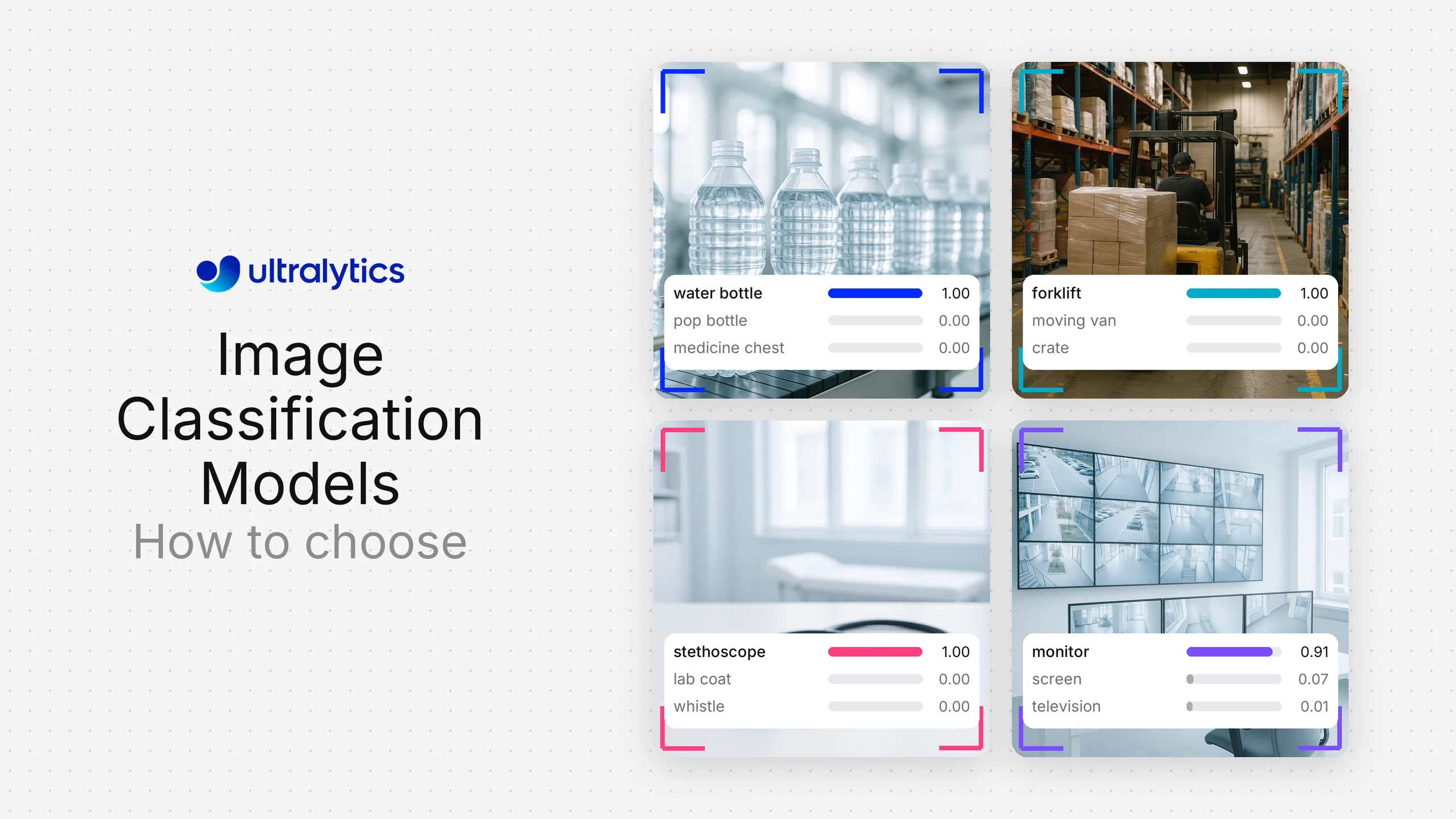
Best Image Classification Models: How to Choose

Best Image Classification Models: How to Choose

Compare the leading image classification models, from ConvNeXt V2 and DINOv3 to EfficientNetV2, ViT and Ultralytics YOLO26-cls, and learn how to choose.
Learn more
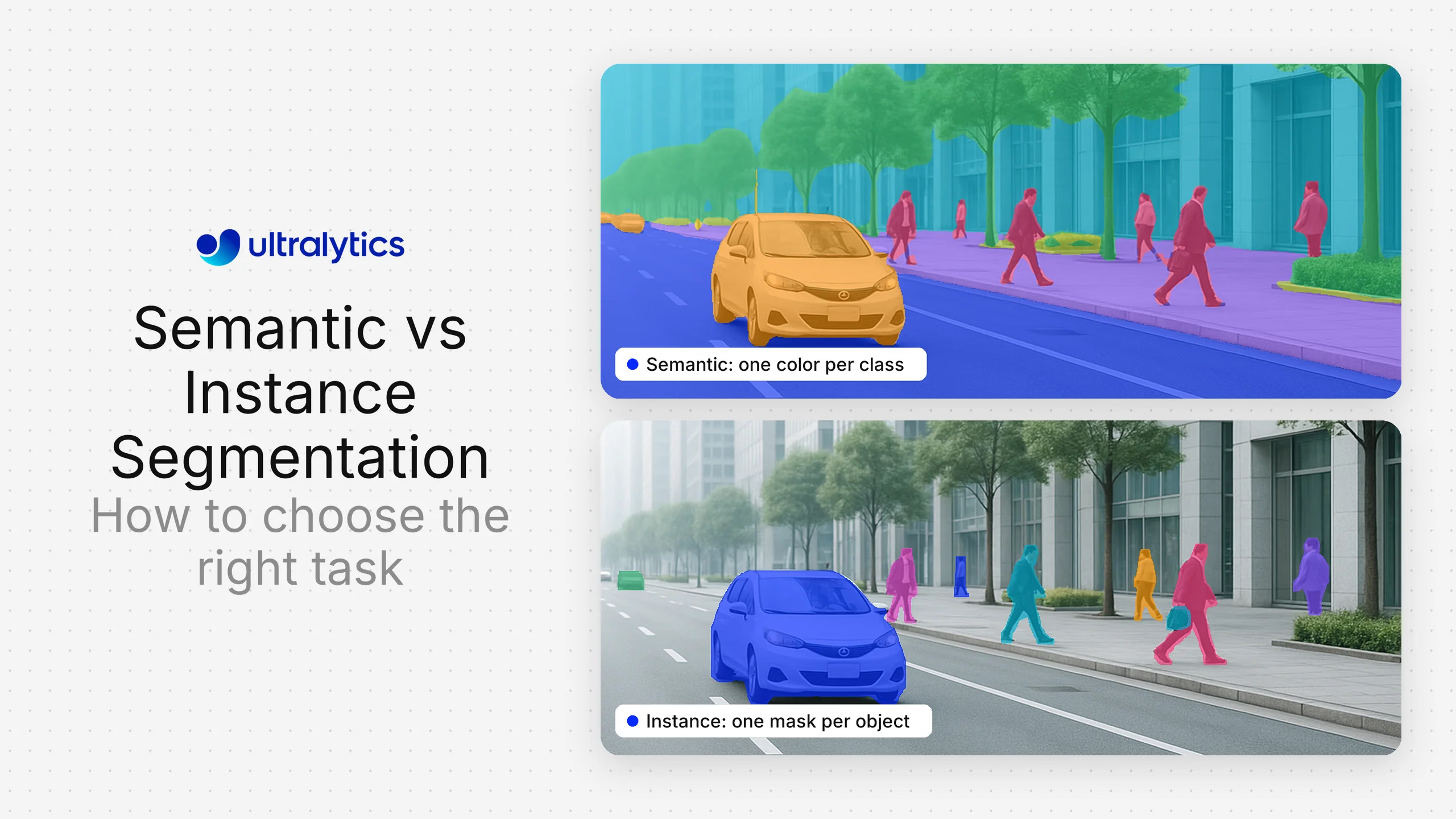
Semantic vs Instance Segmentation: How to Choose the Right Task

Semantic vs Instance Segmentation: How to Choose the Right Task

Semantic segmentation labels every pixel by class; instance segmentation separates each object. Learn which one your computer vision project needs, and why.
Learn more
Ultralytics at Arm Create 2026: Real-time Vision AI at the edge

Ultralytics at Arm Create 2026: Real-time Vision AI at the edge

Highlights from Ultralytics at Arm Create 2026 in Shenzhen: deploying Ultralytics YOLO for real-time edge AI, the model panel, and the new Arm AI Portal.
Learn more
Ultralytics Meetup: London

Ultralytics Meetup: London

Recap of the Ultralytics London meetup: A first look at YOLO27, Ultralytics Platform demos, and a vision AI panel with NVIDIA and Arm.
Learn more
Ultralytics Platform Monitoring: Keep vision AI deployments on track

Ultralytics Platform Monitoring: Keep vision AI deployments on track

Monitor deployed vision AI models with Ultralytics Platform. Track endpoint health, latency, errors, logs, and live prediction statistics.
Learn more
Introducing Ultralytics Agents: Build visual AI workflows faster

Introducing Ultralytics Agents: Build visual AI workflows faster

Build visual AI workflows with Ultralytics Agents. Connect YOLO models, vision-language models, conditions, datasets, and Slack alerts on one canvas.
Learn more
Introducing Ultralytics AutoTrain: Simplify vision AI model training

Introducing Ultralytics AutoTrain: Simplify vision AI model training

Train, compare, and improve Ultralytics YOLO models with AutoTrain in Ultralytics Platform, from initial baseline to production deployment.
Learn more
Key highlights from Ultralytics YOLO Vision 2026!

Key highlights from Ultralytics YOLO Vision 2026!

Key moments from YOLO Vision 2026, where Ultralytics unveiled Ultralytics YOLO27 and showcased AutoTrain, Agents, and Monitoring on Ultralytics Platform.
Learn more
Ultralytics YOLO26 now supports monocular depth estimation

Ultralytics YOLO26 now supports monocular depth estimation

Learn how the new depth estimation task in Ultralytics YOLO26 predicts per-pixel, metric-scale depth from a single RGB image, no stereo rig or LiDAR required.
Learn more
Best Image Annotation Platforms for Computer Vision

Best Image Annotation Platforms for Computer Vision

Compare nine image annotation platforms for computer vision: CVAT, Encord, Label Studio, Labelbox, Roboflow, Scale AI, SuperAnnotate, Ultralytics and V7.
Learn more

Let's build the future of AI together!

Begin your journey with the future of machine learning